
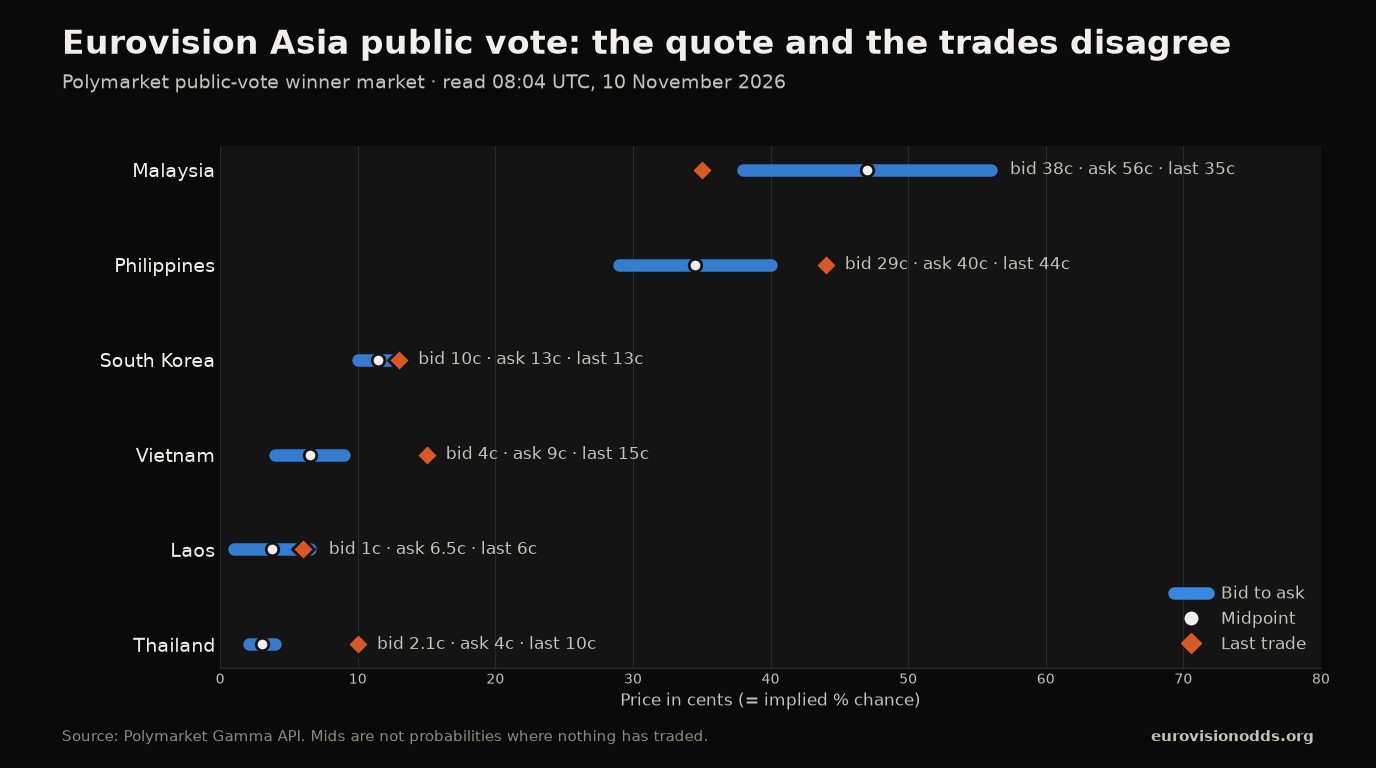
The Eurovision Asia public vote is the closest of the six markets on the contest, and on the morning of 10 November its price and its trades pointed at different winners. On Polymarket’s public-vote market, Malaysia’s Aina Abdul rose nine points overnight to a 47% midpoint, against 34.5% for the Philippines’ CARMELLE. The last trades say the opposite: the Philippines last changed hands at 44c, Malaysia at 35c. With the public half worth 52.2% of the Grand Final points, which of those two numbers you believe matters more here than in any other book.

18+ | New customers only | T&Cs apply | Please gamble responsibly
Key takeaways
- Eurovision Asia public vote odds, read at 08:04 UTC on 10 November: Malaysia 47% (38c bid, 56c offered), the Philippines 34.5% (29c / 40c), South Korea 11.5% (10c / 13c).
- Malaysia’s nine-point rise came from its quote, not from a rush of money. The whole public-vote book traded about $1,016 in the previous 24 hours.
- Both leaders’ last trades sit outside their own quotes. Malaysia’s 35c is below its bid; the Philippines’ 44c is above its ask.
- Neither favourite can be voted for at home. UN migration figures put about 256,000 Philippine-born residents inside Malaysia’s own public vote. The reverse flow is close to nil.
- South Korea’s JUNHEE is the public-vote outsider: 11.5% in this book, 0.4% in the jury book.
- The organiser can void votes after the result and correct it. For a market that settles on the official public ranking, that is a small tail risk worth knowing about.
What’s on this page
The public-vote odds · Why price and trade disagree · How it is scored and settled · Where the votes come from · South Korea, the outsider · The rule that can change a result · Kalshi · How we would read it · FAQ · Sources
Eurovision Asia public vote odds on 10 November
These are the prices on Polymarket’s Eurovision Asia 2026 Public Vote Winner market, read through its public API at 08:04 UTC on 10 November and filtered to the eleven competing countries. The same payload carries a block of unused template contracts named “Other” and “Country A” onwards; including them would inflate every total, so they are left out.
| Country | Bid | Ask | Midpoint | Last trade | Volume |
|---|---|---|---|---|---|
| Malaysia | 38c | 56c | 47.0% | 35c | $3,572 |
| Philippines | 29c | 40c | 34.5% | 44c | $1,582 |
| South Korea | 10c | 13c | 11.5% | 13c | $638 |
| Vietnam | 4c | 9c | 6.5% | 15c | $1,605 |
| Laos | 1c | 6.5c | 3.8% | 6c | $397 |
| Thailand | 2.1c | 4c | 3.0% | 10c | $558 |
| Mongolia, Bhutan, Nepal, Cambodia, Bangladesh | 0.1c or none | 0.1–0.2c | 0.1% or less | 0.2–1.5c | $371–$445 each |
The eleven midpoints add up to 106.6%, a margin of under seven points, which is respectable for an event that no fixed-odds bookmaker prices at all. Lifetime volume on the market is about $10,300. More useful is the last day: about $1,016 traded on the public vote in the 24 hours to the read, more than in the winner market ($816) or the Top 3 market ($959) over the same period. Five days before the Grand Final, the public vote is where the attention has gone.
Why the midpoint and the last trade disagree
A midpoint is halfway between the best price anyone will pay and the best price anyone will sell at. A last trade is what someone actually paid, whenever they paid it. On a busy contract the two sit close together. On this book they do not.
Start with Malaysia. The best bid is 38c and the best offer 56c, an eighteen-cent gap. Polymarket records Malaysia as up nine points in a day, and with barely a thousand dollars traded across the entire book, that rise is the order book moving rather than a stampede of buyers. Someone is now willing to pay 38c for Malaysia to win the public vote, which is more than the 35c it last traded at. That is a genuine change, but it is one bid.
The Philippines is the mirror image. Its last trade of 44c is above the 40c anyone is currently asking. Earlier buyers paid more than sellers are now asking. Both prints are stale against the live quotes, and both quotes have moved towards Malaysia since those prints. The honest summary is that the order book has shifted Malaysia’s way overnight, while the money that actually changed hands leaned to the Philippines. On a book this size, neither is strong evidence on its own.
The direction of travel over the week is clearer, and it is all one way. Dated readings, all midpoints:
| Reading | Malaysia | Philippines | Leader |
|---|---|---|---|
| 4 November | ~27% | ~38.5% | Philippines by ~11.5 |
| 9 November, morning | 38.0% (29c / 47c) | 34.0% (31c / 37c) | Malaysia by 4 |
| 9 November, 17:15 UTC | 41.5% | 36.5% | Malaysia by 5 |
| 10 November, 08:04 UTC | 47.0% (38c / 56c) | 34.5% (29c / 40c) | Malaysia by 12.5 |
In six days the public book has gone from an eleven-point Philippines lead to a twelve-and-a-half-point Malaysia lead on the midpoints. Most of that move happened as Malaysia’s jury price soared on 7 November and the market decided the favourite would carry both halves. Our 9 November report tracks how the jury book then gave some of that back. The outright winner market has followed the public book up: Malaysia was 58% (57c / 59c) at the same read, up from 55% the evening before.
How the Eurovision Asia public vote is scored, and how the market settles
The public half of the Grand Final is eleven sets of points: one from the residents of each of the ten other competing countries, and one Rest of World set for everyone living outside the eleven. Each set awards 12, 10, 8, 7, 6, 5, 4, 3, 2 and 1. As we worked through in the 252-point explainer, those eleven sets control 696 of the 1,334 points on the board, 52.2%, against 47.8% for the ten juries.
The market settles on points, not on raw votes. Polymarket’s rules say it resolves “to the country ranked first by points received from the public vote in the Grand Final”, with ties broken “by the total number of points received from the national juries” and then alphabetically by English country name. That jury tie-break is the market’s own; the organisers’ tie-break ranks the domestic public vote first, but that only decides the official placing, not this contract.
Points rather than votes changes what a winner looks like. A country that tops four sets and averages fifth place in the other seven scores 4 × 12 + 7 × 6 = 90. A country that finishes second in all eleven scores 110. Breadth beats depth. A fan base that is enormous in two countries is worth less than one that is solid in nine.
Where the public votes physically come from
The official Voting Terms let anyone vote in the Grand Final, wherever they live, with one restriction: under section 3.3 “you may not vote for the entry representing the territory in which you are resident”. Voters sign in with Google, Apple or Privy, the organiser records each voter’s country of residence, and VPNs and spoofed locations are banned. A vote is counted in the set of the country where the voter lives.
That makes migration, not nationality, the map of the public vote. In the United Nations’ International Migrant Stock estimates for mid-2024, 255,520 people from the Philippines live in Malaysia. They vote in Malaysia’s public set, and they can vote for CARMELLE. There are 37,555 more in South Korea and 23,402 in Thailand. The UN records almost no Malaysian-born residents in the other competing countries: 193 in Cambodia, and an estimate for Bangladesh that we explain, and set aside, in our analysis of Eurovision Asia bloc voting.
Malaysia’s own public set is the most crowded in the contest. Besides the Filipinos it contains 502,596 people from Nepal and 282,437 from Bangladesh, the two largest single migrant groups anywhere among the eleven. Aina Abdul can get nothing from that set. The Philippines can, but it is competing for Malaysia’s twelve with two countries that have larger communities there.
The Rest of World set points the same way. Counting only first-generation migrants, the UN puts about 6.67 million Filipinos outside the eleven competing countries, against about 2.16 million Malaysians, 1.55 million of them in Singapore. Our CARMELLE deep dive covers the overseas Filipino vote in more detail.
The caveat is a big one. A migrant population is not a voting population. Voting needs someone aged 18 or over to know the contest exists, find the voting page while the window is open, and sign in. Nobody has published turnout for any of the national selections, so there is no way to say how many of those quarter of a million will vote. What the figures do show is that the structure of the vote leans one way. It gives the Philippines a route into its main rival’s home set, and gives Malaysia no equivalent anywhere.

CARMELLE performing “Sobra-Sobra” at Philippine Selection Night: a still from the official performance video. Photo: Eurovision Song Contest Asia (eurovisionasia.com).
View this post on Instagram (@eurovisionasia)
South Korea: the public-vote outsider the jury book ignores
The most striking line in the public book is the third one. South Korea’s JUNHEE, singing “DEEP DIVE” ninth in the running order, is 11.5% to win the public vote on a 10c / 13c quote, with a last trade at 13c. In the jury book the same act is 0.4%. In the outright he is 1.3%.
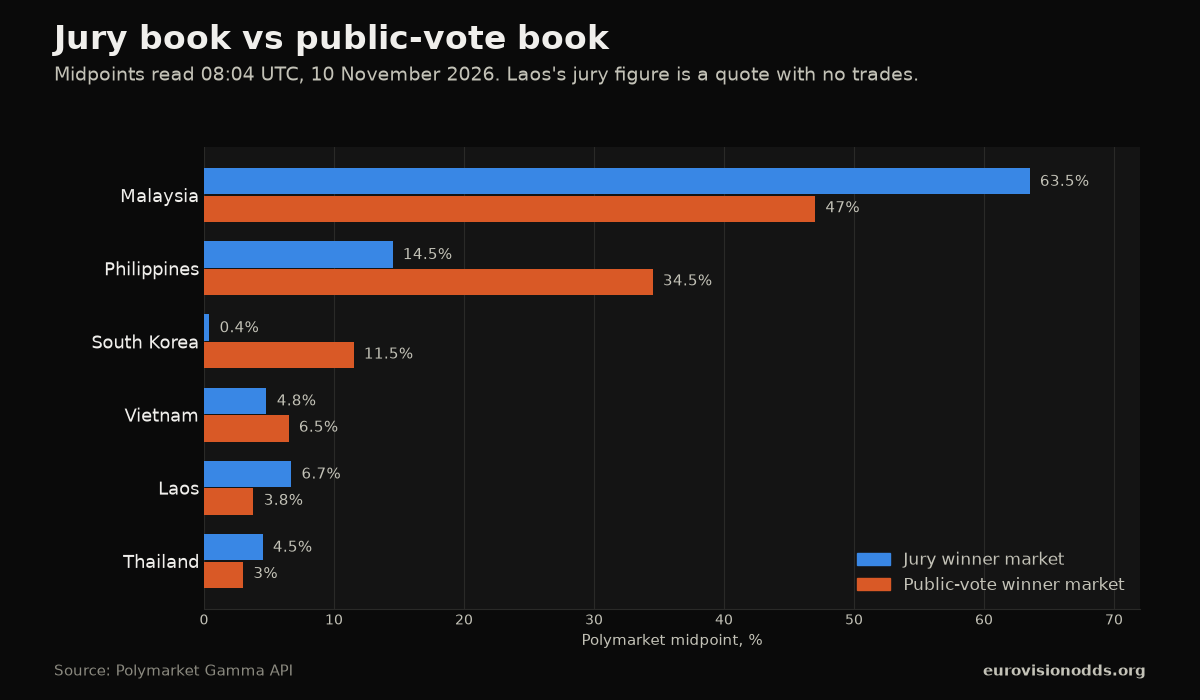
No other act has a gap like that. The Philippines is 14.5% with the juries and 34.5% with the public, so the market sees CARMELLE as a public-vote act too, but South Korea’s public price is almost thirty times its jury price. The quote is also one of the tightest in the book, three cents wide against Malaysia’s eighteen. And the Top 3 market agrees that something is moving: South Korea was up 5.5 points there in a day to a 26% midpoint, on $1,775 of volume.
The market is pricing a K-pop act whose entire route runs through the public. Like everyone else, residents of South Korea cannot vote for him, so his public points have to come from the other ten countries and the Rest of World. K-pop has large audiences in several of those countries, including the Philippines, Vietnam and Thailand, whose residents are barred from voting for their own entries and must put their votes somewhere. That is a mechanism, not a measurement: nobody has published how K-pop fans voted in any of the national selections. But it explains why the jury and public books disagree so sharply about the same three minutes. Our JUNHEE deep dive has the act, the song and the full set of books.
The rule that can change a result after the show
Section 7.1 of the Voting Terms bans bots, multiple accounts, VPNs, “buying, selling, exchanging or organising votes” and “coordinated activity designed to distort the result”. Section 7.2 then says that where the organiser believes votes break those rules it may “void the votes concerned, before or after the result is announced” and “exclude them from the count and correct the result accordingly”. The result is final once announced and verified, subject to that clause.
Two things follow for anyone trading the public vote. The first is that the line between an enthusiastic fan campaign and “organising votes” is the organiser’s to draw. Online fan mobilisation is exactly the kind of strength the public-vote market is pricing for the Philippines and South Korea. The second is resolution. The market settles on official information, including the live broadcast. If a public ranking shown on the night were later corrected, the market’s resolution process would have to pick between the two. Nothing suggests that will happen. It is a tail risk, not a forecast, and it is written into the rules.
The vote caps shape the public half in a quieter way. Every voter gets eight free votes per show and can buy up to ten more, to a maximum of 18. No more than 16 can go to one entry, and every ballot must be spread across at least three countries’ entries: “votes that do not meet this requirement will not be counted”. So every counted ballot backs at least three countries. Second and third preferences decide points as well as first choices, and a single-country campaign that ignores the spread rule loses its votes entirely.
No public-vote market on Kalshi
Kalshi, the US-regulated exchange, lists only the outright winner of Eurovision Asia, so Polymarket is the only place the public vote is priced on its own. Read at the same time, Kalshi’s winner board had Malaysia’s last trade at 60c on a 47c / 68c quote and the Philippines at 31c on 23c / 30c, broadly in line with Polymarket’s 58% and 25.5%. Vietnam’s last trade still reads 79c against an ask of 40c and no bid, a stale print this site has flagged before. The whole board has about 5,900 contracts of lifetime volume.
How we would read the Eurovision Asia public vote
This is a two-horse race priced as one, with an outsider that needs almost everything to go its way.
- The case for Malaysia: Aina Abdul closes the show from slot 11 of 11, is favourite in every other book, and the order book has moved her way three readings running.
- The case for the Philippines: the last trade, a community of about a quarter of a million inside Malaysia’s own public set, and the second-largest diaspora in the Rest of World pool. CARMELLE sings sixth.
- The case for South Korea: a pure public-vote profile and the tightest quote of the three. It needs to top a lot of sets in countries where nobody can vote for their own act.
Our view is that the overnight move to 47% was made on very little money. On the structure of the vote and the trades that have actually happened, Malaysia and the Philippines are closer than the midpoints say. That is a reading, not advice. Our full predictions have Malaysia winning overall, which can happen without a public-vote win if the juries back her as strongly as their market expects. The Eurovision Asia hub carries every book, and Saturday settles it.
FAQ
Who is favourite to win the Eurovision Asia public vote?
Malaysia’s Aina Abdul on the midpoint, at 47% on Polymarket at 08:04 UTC on 10 November, ahead of the Philippines’ CARMELLE at 34.5% and South Korea’s JUNHEE at 11.5%. On the last trade the Philippines leads, 44c to 35c.
Can people in the Philippines vote for CARMELLE?
Not if they live in the Philippines. Residents of a competing country cannot vote for that country’s entry in the Grand Final. Filipinos living anywhere else, including Malaysia, South Korea and Thailand, can.
How many votes do you get at Eurovision Asia?
Eight free votes per show, plus up to ten paid votes, to a maximum of 18. No more than 16 can go to one entry, and votes must be spread across at least three countries or they are not counted.
How does the Polymarket public-vote market settle?
On the country with the most public-vote points in the Grand Final. Ties are broken on jury points, then alphabetically by English country name.
Is the public vote worth more than the jury at Eurovision Asia?
Slightly. The eleven public sets, including the Rest of World, control 696 of the 1,334 points available (52.2%); the ten juries control 638 (47.8%).
Sources
- Prices, quotes, last trades, volumes and resolution rules: Polymarket Gamma API, read 08:04 UTC on 10 November 2026, eleven competing countries only.
- Kalshi prices: Kalshi trade API, series KXEUROVISIONASIA, read the same morning.
- Voting rules, caps and the voiding clause: Eurovision Asia Voting Terms and Conditions, last updated 28 August 2026, sections 3, 6, 7 and 8.
- Migration figures: UN DESA, International Migrant Stock 2024, destination by origin, mid-2024 (CC BY 3.0 IGO).
- Earlier readings: this site’s dated reports of 4 and 9 November.
Every price here is dated to the moment it was read, and prices move. A midpoint on a contract with no trades is not a probability. 18+; prediction markets are not available in every country.