
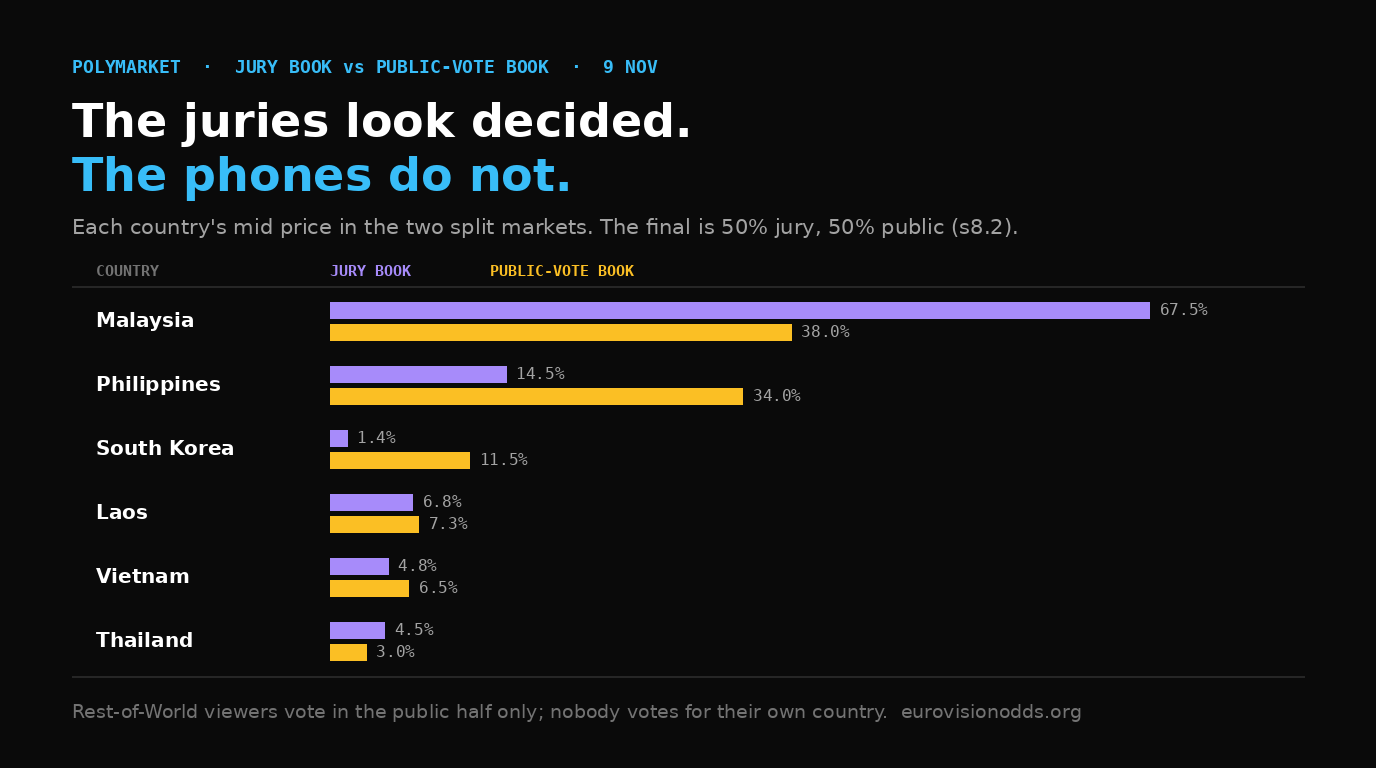
The Eurovision Asia 2026 jury vote looks decided and the public vote does not. On Polymarket, read about 01:47 UTC on 9 November, Malaysia’s Aina Abdul is 67.5% to top the juries, on a one-cent spread. On the public vote she is 38% against the Philippines’ CARMELLE on 34%, and South Korea’s JUNHEE is on 11.5%. The Grand Final in Bangkok on Saturday weighs the two halves equally. This piece sets out how the vote works under the official rules, what the two split markets say, and the three ways Saturday can go.

18+ | New customers only | T&Cs apply | Please gamble responsibly
Key takeaways
- The result is 50% jury, 50% public, combined for each competing country. Viewers outside the eleven form a Rest of World public vote with no jury half.
- Nobody may vote for their own country. Thailand’s home audience, the biggest in the hall, cannot vote for MANG x DAOU.
- Jury market: Malaysia 67.5%, Philippines 14.5%, then a long tail of untraded quotes.
- Public-vote market: Malaysia 38% (bid 29c, offer 47c), Philippines 34% (31c–37c), South Korea 11.5%. On real orders, it is close to level between Malaysia and the Philippines.
- The outright (Malaysia 54.5%, Philippines 25%) is roughly what you get if the jury favourite usually keeps a respectable public score.
- Vienna in May is the reminder: Romania came second on the televote and finished third overall, because its jury score was weak.
What’s on this page
How the vote works · The two markets side by side · Three ways Saturday can go · Who the rules help · What the prices imply · How we would read it
How the Eurovision Asia jury and public vote works
Section 8.2 of the official voting terms, last updated on 28 August, sets the Grand Final rule. In full: “The result of the Grand Final is determined by two components, weighted equally at 50/50: the public vote and professional jury scores. For each participating territory, the public vote and jury vote are combined on that same 50/50 basis. Viewers from non-participating territories take part in the public vote only, aggregated as an additional Rest of World vote. No jury component applies to the Rest of World vote.”
| Component | Who | Weight | Key rule |
|---|---|---|---|
| Jury | A professional jury in each of the 11 competing countries | 50% of each country’s vote | Scores, not a public poll |
| Public vote, domestic | Viewers resident in the 11 competing countries | 50% of each country’s vote | No votes for your own country |
| Public vote, Rest of World | Viewers anywhere else | One extra public vote, no jury half | Counted together as one bloc |
The voter rules matter as much as the weights:
- Each voter gets eight free votes and can buy up to ten more, to a maximum of 18 per person and 16 for any one entry. Paid votes count the same as free ones.
- Votes must be spread across at least three countries, or none of them count. A fan who puts 16 on one act has to place two more elsewhere.
- Voting is web-only, at eurovisionasia.com/vote, for over-18s signing in with Google, Apple or Privy, with an automated check that each voter is a real, distinct person.
- Ties are broken on the public vote from the competing countries first.
One thing the terms do not publish is the points scale: how each country’s ranking becomes points on the scoreboard. Without it, nobody outside the production can turn a market price into a points forecast. Everything below is about rankings and probabilities, not points.
Eurovision Asia jury odds and public-vote odds side by side
Polymarket runs a Jury Winner market and a Public Vote Winner market. They resolve on the country with the most jury points and the most public-vote points in the Grand Final. Both prices below are the midpoint of the best bid and best offer, read about 01:47 UTC on 9 November, with the quote and the money traded so far.
| Country | Jury mid | Jury bid / offer | Jury traded | Public mid | Public bid / offer | Public traded |
|---|---|---|---|---|---|---|
| Malaysia | 67.5% | 67 / 68 | $10.1K | 38.0% | 29 / 47 | $3.3K |
| Philippines | 14.5% | 13 / 16 | $2.7K | 34.0% | 31 / 37 | $0.9K |
| South Korea | 1.4% | 1.0 / 1.8 | $0.7K | 11.5% | 10 / 13 | $0.6K |
| Laos | 6.8% | 0.6 / 12.9 | <$0.1K | 7.3% | 2.8 / 11.7 | $0.4K |
| Vietnam | 4.8% | 0.5 / 9.0 | $0.5K | 6.5% | 4 / 9 | $1.6K |
| Thailand | 4.5% | 1 / 8 | $0.4K | 3.0% | 2.1 / 4.0 | $0.6K |
| Bhutan | 7.8% | 3 / 12.7 | <$0.1K | 0.1% | — | $0.4K |
| Mongolia | 7.0% | 0.9 / 13.1 | <$0.1K | 0.1% | — | $0.4K |
| Nepal | 5.0% | 0.3 / 9.7 | <$0.1K | 0.1% | — | $0.4K |
| Cambodia | 1.4% | 1.0 / 1.7 | $0.3K | 0.1% | — | $0.4K |
| Bangladesh | 0.5% | — | $0.3K | 0.1% | — | $0.4K |
Read the two columns of money as well as the prices. The jury market’s Malaysia line has taken $10.1K on a one-cent spread. It is the most confident price in the whole event. Below the top two, the jury book is mostly untraded quotes: Bhutan, Mongolia, Laos and Nepal sit between 5% and 7.8% with almost nothing traded on any of them. The public-vote book is the reverse. It is the most balanced market in the event, its mids summing to about 101%, with real money on the Philippines, Vietnam and South Korea.
View this post on Instagram (@eurovisionasia)
Three ways Saturday can go
1. Malaysia wins both halves. This is the market’s main case. With the jury book at 67.5% and the public book at 38%, the outright’s 54.5% says traders expect the two to go together more often than not. A jury favourite with a strong public score is hard to catch under a 50/50 rule, which is how DARA won Vienna in May: first with the juries (204 points) and first with the public (312).
2. The split. Malaysia tops the juries and the Philippines tops the public vote. The winner is then whoever does better in the other half. The 25% outright on the Philippines is a bet that CARMELLE’s public lead is big and her jury score respectable. Vienna has the warning. Romania came second on the televote with 232 points but took only 64 from the juries, and finished third. Australia was joint second with the juries (165) and fourth overall. Leading one half is not enough. The other half has to be competitive too.
3. A third country splits the phones. South Korea at 11.5% on the public vote, with a 1.4% jury price, is the profile of a fan-vote act. If JUNHEE takes a large slice of the public vote, it comes off the top two. Most likely it comes off whichever of them relies on the phones more, and on these prices that is the Philippines. That would help Malaysia.
Who the voting rules help
These are the rules’ mechanical effects. Which way the votes go is our reading, not data.
- The own-country ban hurts the host most. Thailand has the biggest audience in the hall and on Channel 3, and none of those viewers can vote for MANG x DAOU. That is consistent with Thailand being priced at 44% to make the podium but only 3% to win the public vote. The Thai public’s eight votes each still have to go somewhere, to at least three other countries.
- The Rest of World bloc rewards a following outside the eleven. Anyone voting from a non-competing country, in Europe, North America, Australia or elsewhere in Asia, lands in one public bloc with no jury attached. An act with a large overseas audience gets that support in full.
- The three-country rule dilutes pure fan voting. Even the most committed fan must give at least two votes to two other entries. Those spare votes are spread across the field, and they favour acts that casual viewers already know.
- Paid votes are capped. Ten paid votes per person, and ten per payment method, limit how far any one fanbase can buy its way up the public half.
The jury half is the one no fanbase can touch. That is why the market treats Malaysia’s 67.5% there as the anchor of her whole price.
What the prices imply
A rough consistency check. If the two halves were independent, the chance that Malaysia tops both would be about 0.675 × 0.38, or 26%. Malaysia would then also need to win some of the split cases. The outright at 54.5% is roughly double that 26%. So traders either expect the two halves to be strongly linked, which is normal because good songs tend to do well with both, or they expect Malaysia to win most splits on the strength of the jury half. Both readings put Malaysia’s jury score at the centre of her price.
The Philippines’ numbers work the other way. At 14.5% with the juries and 34% on the public vote, a 25% outright needs CARMELLE to win most of the cases where she tops the phones. That is a reasonable bet if her public lead is large. It is a poor one if the public vote is as close as the quotes suggest.
All the Asia markets, including the winner market and the Top 3 market, are in our full odds report.
How we would read the Eurovision Asia jury and public vote
The jury price is the strongest number on the board, and also the least tested. Juries have heard only the released songs and seen national-final performances. Malaysia and the Philippines rehearse in Bangkok today. If the organisers follow European practice, juries will mark a dress rehearsal before the final. They have not said so.
The public-vote book is the one to watch through the week. It is the most balanced market in the event and the one most sensitive to rehearsal clips, social reach and the size of each fanbase. Its 18-cent spread on Malaysia means the true price could be anywhere from 29% to 47%.
Do not forget the scoreboard reveal. If the jury and public results are revealed separately, as they are in Europe, a big jury lead can look decisive until the public points arrive. That makes in-play swings possible on the night. The six markets close on 15 November.
For viewing times, see our guide to watching the Grand Final. For voting, see the step-by-step voting guide. Every country is profiled on the Eurovision Asia hub.
Sources
- Eurovision Asia voting terms, sections 3, 4, 6, 6.1 and 8.2, last updated 28 August 2026.
- Polymarket Gamma API, about 01:47 UTC on 9 November 2026: Eurovision Asia 2026 Jury Winner and Public Vote Winner markets. Mids are the midpoint of best bid and offer; placeholder contracts excluded.
- Vienna 2026 jury and televote totals: this site’s Eurovision 2026 results.
18+. Prediction markets carry risk, and prices on thin books can move without trades. Check the live board before acting.