
The EBU published the Eurovision Song Contest Asia 2026 voting rules on 9 November, five days before the Bangkok Grand Final, and they settle the one piece of the format this site has been unable to report: the points scale. Juries and the public will both use the 1–8, 10 and 12 scale that the European contest has used since 1975. A song can score a maximum of 252 points and a minimum of 21. Those two numbers do more than fill a gap — they reveal exactly how the Grand Final scoreboard is built, and they show that the public half of a contest billed as 50/50 is, in points, the larger half.

18+ | New customers only | T&Cs apply | Please gamble responsibly
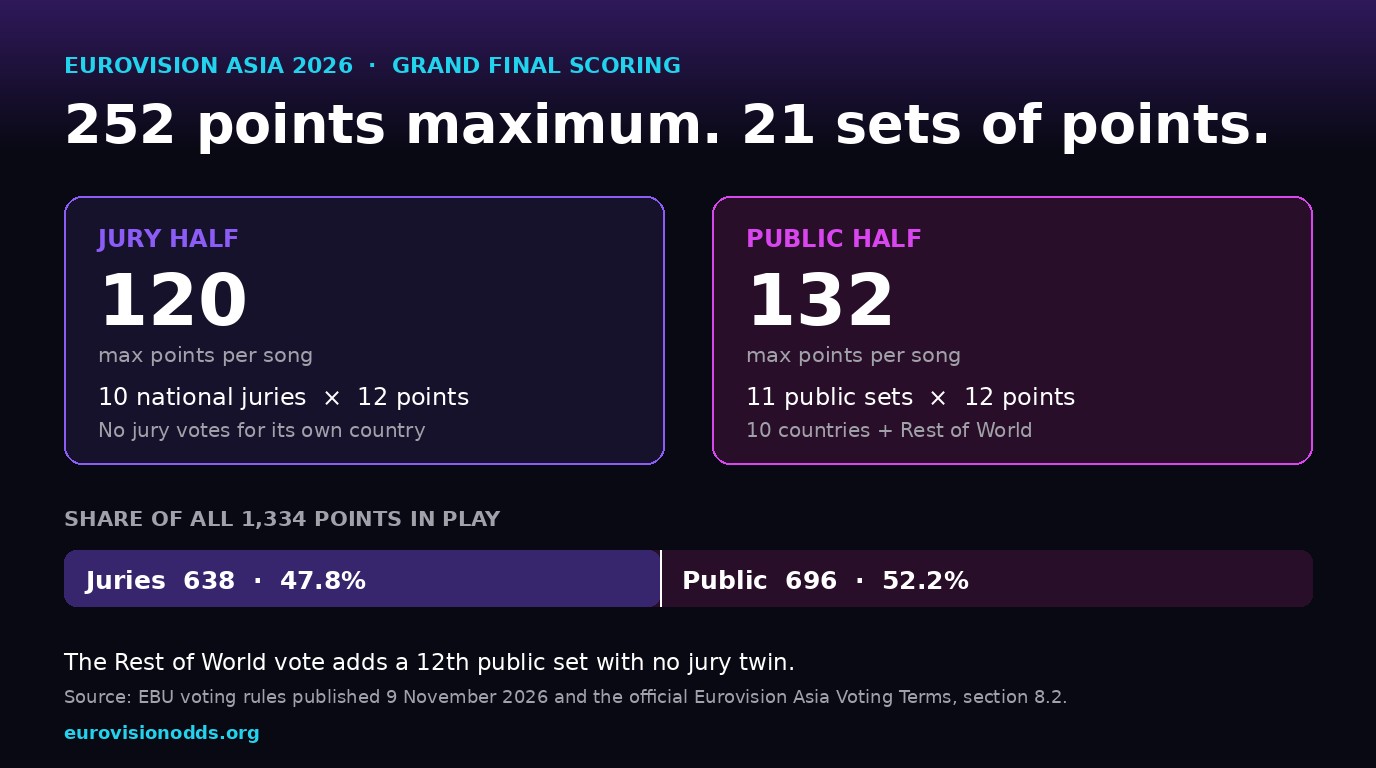
How the 252-point maximum breaks down. Chart: eurovisionodds.org, from the EBU’s published rules and the official Voting Terms.
Key takeaways
- The scale is the classic one: 12, 10, 8, 7, 6, 5, 4, 3, 2, 1 to a set’s top ten, from juries and from the public alike.
- Maximum 252 points, minimum 21. Those figures only reconcile if each song is scored by 21 separate sets of points: ten juries and eleven public votes.
- The public half can award more points than the jury half — 132 against 120 for any one song — because the Rest of World vote is an extra public set with no jury counterpart.
- Across the whole scoreboard the juries control 638 of the 1,334 points in play (47.8%) and the public 696 (52.2%).
- Ties go to the public. Under the official Voting Terms the domestic public vote is ranked first in every tie-break.
- Still unpublished: the order in which the results are revealed, and the voting window times. The organisers’ own vote page still said “more details … soon” when we checked it on 9 November.
What the EBU announced about Eurovision Asia voting
The announcement, reported by Eurovoix on 9 November, confirms the shape of the result and adds the detail that was missing. Juries in the eleven competing countries determine 50% of the result. The other 50% comes from viewers in those eleven countries plus a Rest of World vote open to everyone else.
Within each voting set, the ranking converts to points on the familiar scale: first place 12 points, second 10, third 8, fourth 7, then 6, 5, 4, 3, 2 and 1 down to tenth. The act that tops a national jury’s list, or collects the most votes in a country, takes that set’s 12 points. Nobody votes for their own country, which is the same restriction the European contest applies.
None of that is a surprise. The surprise is in the two totals the EBU attached to it.
Why the maximum is 252 — and what it tells you
A maximum of 252 and a minimum of 21 are not arbitrary. Divide 252 by the top score of 12 and you get 21. Divide the minimum of 21 by the bottom score of 1 and you get 21 again. Both figures point to the same structure: each song is scored by twenty-one separate sets of points.
There is only one arrangement of eleven countries that produces twenty-one sets:
- Ten jury sets. Eleven countries have juries, but no jury scores its own country’s entry, so any given song is ranked by the other ten.
- Eleven public sets. Ten from the competing countries that are allowed to vote for it, plus one aggregated Rest of World vote.
Ten plus eleven is twenty-one. At 12 points each that is 252; at 1 point each it is 21. The arithmetic closes exactly, and it rules out the alternative reading of the rules — that each country would combine its jury and public vote into a single set of points before awarding them. Had the organisers done that, there would be twelve sets, a maximum of 144 and a minimum of 12. The published figures say otherwise. Eurovision Asia will reveal jury points and public points separately, as the European contest has done since 2016.
That matters for anyone watching the scoreboard on Saturday, and it matters more for anyone holding a position on it.
The public half is bigger than the jury half
Count the points each side can award to a single song and the two halves are not equal:
| Half | Sets of points | Maximum to one song |
|---|---|---|
| Juries | 10 national juries | 120 points |
| Public | 10 countries + Rest of World | 132 points |
| Total | 21 | 252 points |
Across the entire scoreboard the gap is the same shape. Every set hands out 58 points in total (12 + 10 + 8 + 7 + 6 + 5 + 4 + 3 + 2 + 1). Eleven juries therefore distribute 638 points. Eleven national publics distribute another 638, and the Rest of World vote adds 58 more, for 696. The whole contest is decided by 1,334 points, of which the juries control 47.8% and the public 52.2%.
This is not a contradiction in the rules, and it is not a mistake by the organisers. It follows directly from how section 8.2 of the official Voting Terms is worded. The two components are “weighted equally at 50/50” and, in the terms’ own phrasing, “for each participating territory, the public vote and jury vote are combined on that same 50/50 basis”. The 50/50 is exact inside each of the eleven competing countries. The Rest of World vote then arrives as, again quoting the terms, “an additional Rest of World vote”, and “no jury component applies” to it.
An additional public set with no jury twin is precisely what tilts the totals. The headline figure of 50/50 is accurate as a description of how each participating country is treated; it is not quite a description of the scoreboard as a whole.
One caveat, stated plainly because this is a betting site. The 638/696 split follows from the EBU’s published maximum of 252 and from the structure that maximum implies. If the organisers normalise the Rest of World set differently — scaling it, for instance, so that the two halves finish exactly level — then the 252 figure would not hold, and nor would this arithmetic. The 252 is the evidence. We will know for certain when the scoreboard is read out on Saturday.
The tie-breaks lean the same way
The Voting Terms also set out what happens if two entries finish level, and the order is worth knowing:
- The domestic vote — the public vote from the competing countries — is ranked first.
- If two entries tie on domestic vote points, the jury ranking decides which is higher within that domestic ranking.
- If two entries tie on total combined points, the one with the higher domestic vote points wins.
- If two entries tie within the Rest of World ranking, the domestic vote ranking decides the order.
In other words, in a close finish the public vote from the eleven competing countries is the senior document, with the juries used to break ties inside it. A contest that is marginally public-weighted on points is also public-weighted on tie-breaks.
The vote caps that shape the public half
How that public half is cast is already on the record, and it is unusual. From sections 3 and 6 of the Voting Terms:
- Voters must be 18 or over and sign in with Google, Apple or Privy.
- Everyone gets eight free votes per show.
- Booster packs add up to ten paid votes, sold by Voxovation and processed by Stripe. Paid votes carry exactly the same weight as free ones.
- The caps are 18 votes per person per show, 16 for any one entry, and 10 paid votes per person and per payment method.
- Votes must be spread across at least three different countries’ entries, or they are not counted at all.
- Residents of a competing country cannot vote for that country.
Two of those rules pull in opposite directions. The paid booster mechanic rewards organised, motivated fanbases, which historically favours acts with large and mobilised followings. The three-country minimum works the other way: every voter is obliged to spend points on at least two acts beyond their favourite, which should lift the mid-table and make a total shut-out less likely. The minimum score of 21 says the same thing — in an eleven-song field where each set scores ten entries, almost nobody finishes on nothing.
What it means for the jury and public-vote markets
Polymarket runs separate books on the jury winner and the public vote winner, alongside the outright. Both resolve on halves of the result that, as of today, we can finally describe precisely.
Read at about 17:15 UTC on 9 November, across the eleven real contracts in each book:
| Country | Jury winner | Public vote winner | Outright |
|---|---|---|---|
| Malaysia | 59.0% | 41.5% | 55.0% |
| Philippines | 14.5% | 36.5% | 24.0% |
| South Korea | 0.9% | 11.5% | 1.2% |
| Vietnam | 4.8% | 7.0% | 7.3% |
| Laos | 6.7% | 5.7% | 5.5% |
| Thailand | 4.5% | 3.0% | 4.5% |
The structural point from this article has a direct consequence for those two books. If the public side really does control 52.2% of the points, then the public-vote market is pricing the slightly more decisive half of the contest — and it is also the book where the field is closest. Malaysia leads the jury book by more than forty points of probability; it leads the public book by five. Our jury versus public vote analysis set out those two books in full on 9 November, and the gap between them has been the most informative thing in this event for a fortnight.
What is still missing
Two things have not been published. The first is the order of the results reveal — whether jury points are read country by country in the European style, with the public totals added afterwards, or presented some other way. That ordering is what makes the European scoreboard watchable, and it also determines how a market behaves in the final twenty minutes of the show.
The second is the voting window. The terms say it opens and closes at times announced on air and on the voting page. The organisers’ how-to-vote page still read “More details about Eurovision Song Contest Asia voting, including where you can do it and how it works, will be made available here soon” when we checked it on 9 November, so the fullest public statement of the rules is for now the EBU’s announcement rather than the official voting page.
FAQ
How many points can a song win at Eurovision Asia 2026?
A maximum of 252 and a minimum of 21, as published by the EBU on 9 November 2026. The maximum is twenty-one sets of 12 points: ten national juries plus eleven public votes.
What is the Eurovision Asia points scale?
12, 10, 8, 7, 6, 5, 4, 3, 2 and 1 points to the top ten of each set, used by the juries and by the public vote alike. It is the same scale the Eurovision Song Contest has used since 1975.
Is Eurovision Asia really 50/50 jury and public?
Within each of the eleven competing countries, yes — the Voting Terms weight the two components equally. Across the whole scoreboard the public side is slightly larger, because the Rest of World vote adds an eleventh public set with no jury equivalent. On the published maximum of 252 points, the juries account for 47.8% of all points in play and the public for 52.2%.
Can I vote in Eurovision Asia from outside Asia?
Yes. Viewers in non-participating territories vote as a single aggregated Rest of World set, which carries the same 58 points as any competing country’s public vote. You must be 18 or over.
How many times can I vote?
Eight free votes, plus up to ten paid booster votes, to a maximum of 18 per person and 16 for any single entry. Your votes must cover at least three different countries or they will not count.
Sources
- Points scale, maximum and minimum: EBU announcement of 9 November 2026, as reported by Eurovoix.
- Result structure, tie-breaks and vote caps: Eurovision Asia Voting Terms and Conditions, sections 3, 6 and 8.2, last updated 28 August 2026, read 9 November 2026.
- Voting page status: eurovisionasia.com how to vote, read 9 November 2026.
- Prices: Polymarket Gamma API, read about 17:15 UTC on 9 November 2026, counting only the eleven competing countries.
Full contest background, broadcasters and start times are on our Eurovision Asia hub and in our how to watch guide. The European contest’s own 50/50 scoreboard, for comparison, is in our Eurovision 2026 results, and the next European edition is tracked on our Eurovision 2027 page.
Prediction-market prices move. Every figure above is dated and was read at the stated time. 18+; prediction markets are not available in every territory.