
All eleven Eurovision Asia acts have now had their first rehearsal on the One Bangkok Forum stage, and the prediction market has spent the two days of rehearsals quietly rearranging itself. Malaysia’s Aina Abdul is still the favourite at 55% to win, exactly where she was on 7 November. Underneath that unchanged headline, her price in the jury market has fallen nearly ten points while her price in the public vote market has risen five. The market has not changed its mind about whether Malaysia wins. It has changed its mind about how.

18+ | New customers only | T&Cs apply | Please gamble responsibly
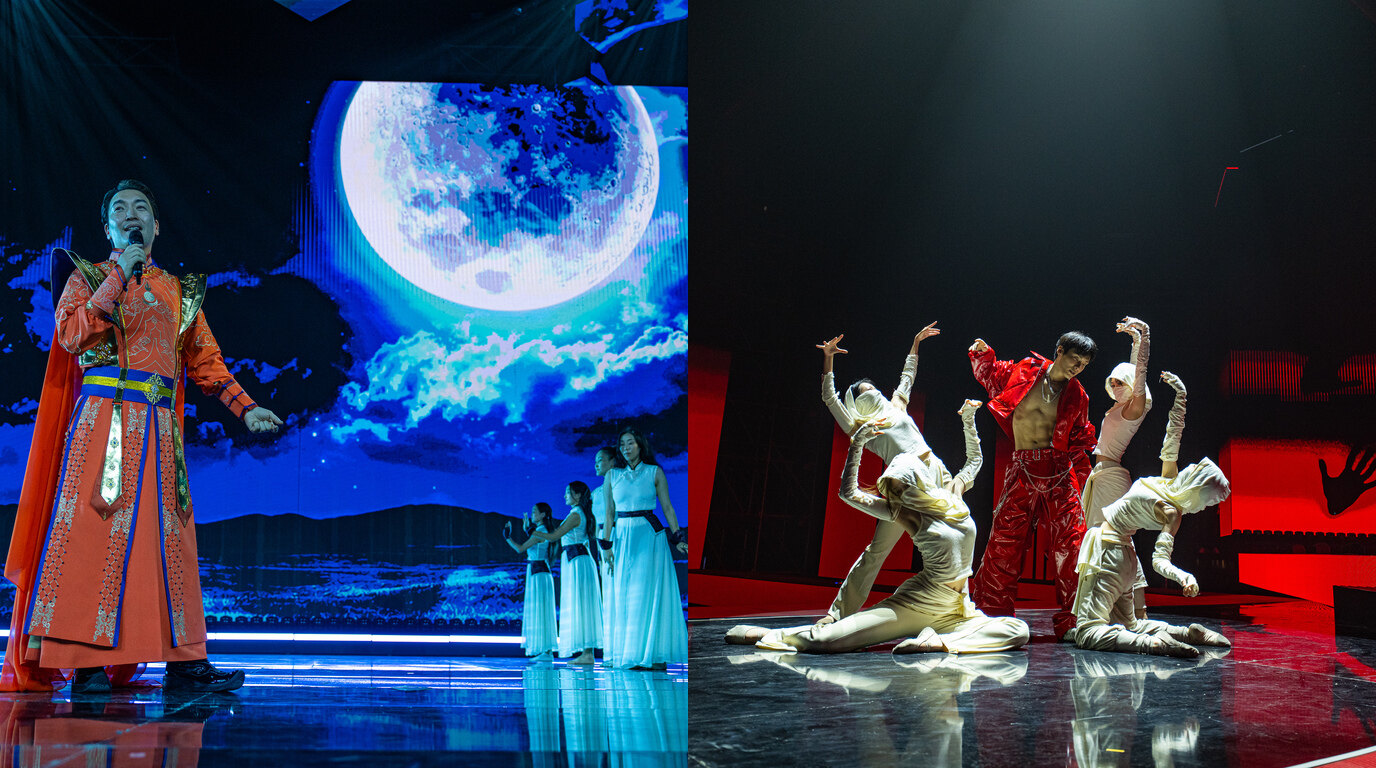
Beck (Mongolia) and JUNHEE (South Korea) in first rehearsals at the One Bangkok Forum, 9 November. Photos: Eurovision Song Contest Asia (eurovisionasia.com).
Key takeaways
- Rehearsals are complete. Four countries took the stage on 8 November, the remaining seven on 9 November.
- Malaysia’s jury price fell from about 68.5% to 59% between 7 and 9 November, while its public-vote price rose from about 36.5% to 41.5%.
- The outright did not move at all — 55% on both readings.
- The Philippines firmed in the public book to 36.5%, five points behind Malaysia, and strengthened sharply for a podium finish.
- Beware the third-place book. Laos shows a large one-day rise that comes entirely from a quote on a very wide spread, not from a trade.
- Turnover across the six Asia books is about $81,400, up from roughly $58,600 on 7 November.
Every act has now rehearsed in Bangkok
First rehearsals ran over two days. On 8 November, Eurovoix reported, four acts took the stage for the first time: Bangladesh’s Beatmosphere with “Tumi Ele”, Bhutan’s Nyendra with “Lhayi Semo”, Cambodia’s Monetrey with “I Let You Go” and Laos’s Thinla with “BAE”.
The remaining seven followed on 9 November: Malaysia’s Aina Abdul, Mongolia’s Beck, Nepal’s Pratik Himal Rai, the Philippines’ CARMELLE, South Korea’s JUNHEE, Thailand’s MANG x DAOU and Vietnam’s Tóc Tiên. The organisers released first-look photographs of Beck and JUNHEE on the stage, both of which appear above.
The two staging glimpses that are public tell you something about the production budget this contest has been reported to be working with. Beck performs “Chamguigeer (Without You)” in traditional Mongolian dress against a full-width LED moon, with four backing vocalists in pale blue. JUNHEE’s “DEEP DIVE” is the opposite register entirely: a red-and-black set, four dancers in cream bodysuits, and choreography built around floor work. Neither is a budget staging.
Rehearsal footage is the one input a prediction market gets before a show that nobody has seen. It is also the least reliable: a first rehearsal is a technical run, not a performance, and acts routinely change staging between the first rehearsal and the final. Treat what follows as the market’s reaction rather than as a verdict on the staging.
The two halves have started to converge again
This event’s most interesting feature has been the disagreement between the jury market and the public-vote market. On 4 November they pointed at different countries: Malaysia led the jury book near 46%, the Philippines led the public vote near 38.5%. On 7 November that disagreement vanished — Malaysia led both, and its jury price had jumped twenty-two points in a single day to about 68.5%.
Two days later the gap has partly reopened, from the other direction:
| Malaysia | 4 November | 7 November | 9 November |
|---|---|---|---|
| Jury winner | ~46% | ~68.5% | 59.0% |
| Public vote winner | ~27% | ~36.5% | 41.5% |
| Outright winner | ~38.5% | ~55% | 55.0% |
Between 7 and 9 November Malaysia gave back about nine and a half points in the jury book and gained five in the public book, and the outright finished precisely where it started. The gap between Malaysia’s two halves has narrowed from roughly thirty-two points to seventeen and a half.
That is a coherent thing for a market to do. Under the rules the EBU published on 9 November, the two halves carry almost identical weight — the juries control 47.8% of the points in play and the public 52.2%. A favourite who is enormous with juries and merely ahead with the public, and a favourite who is strong with both, can price identically in the outright while looking very different in the component books. The outright standing still is not the same as nothing happening.
The six books, read on 9 November
Read at about 17:15 UTC on 9 November, counting only the eleven competing countries. Polymarket’s payload also returns twenty-two unfilled template contracts named “Other” and “Country A” to “Country T”; including them inflates every total and they are excluded throughout.
| Country | Winner | Jury | Public | Top 3 |
|---|---|---|---|---|
| Malaysia | 55.0% | 59.0% | 41.5% | 80.0% |
| Philippines | 24.0% | 14.5% | 36.5% | 71.5% |
| Vietnam | 7.3% | 4.8% | 7.0% | 38.5% |
| Nepal | 6.0% | 5.0% | 0.1% | 6.0% |
| Laos | 5.5% | 6.7% | 5.7% | 27.5% |
| Thailand | 4.5% | 4.5% | 3.0% | 46.0% |
| South Korea | 1.2% | 0.9% | 11.5% | 21.0% |
| Mongolia | 0.2% | 7.0% | 0.1% | 11.0% |
| Bhutan | 0.1% | 7.8% | 0.1% | 7.0% |
| Bangladesh | 0.1% | 0.5% | 0.1% | 3.0% |
| Cambodia | 0.1% | 0.7% | 0.1% | 12.5% |
Two readings in that table should be treated with suspicion rather than interest. Mongolia at 7.0% and Bhutan at 7.8% in the jury book are not evidence that anyone fancies them with the juries: both contracts are quoted across enormous spreads — Mongolia 0.9c bid against 13.1c offered, Bhutan 2.9c against 12.7c — on total volumes of five dollars and eighty dollars respectively. A midpoint between two prices nobody has traded is not a probability. The same contracts sit at 0.2% and 0.1% in the outright, which is the honest number.
The Laos move is a quote, not a trade
The third-place book shows Laos as the largest one-day riser in the entire event, with its midpoint up about eighteen and a half points to 24.1%. It would be easy, and wrong, to write that up as a Laos surge.
Laos is bid at 2.0c and offered at 46.1c in that market, and its contract has recorded no trade at all. The midpoint of a forty-four-cent spread moves whenever either side adjusts, and Polymarket’s one-day change field moves with the quote, not with the money. The same pattern appears in the Top 3 book, where Laos is up about eleven points to 27.5% while its last actual trade was at 12c.
Thailand’s +12 in the Top 3 book deserves the same caution, though less of it: Thailand is quoted 32c against 60c, which is wide, but it has traded, most recently at 41c. The reliable prices in this event remain the ones with money behind them: the Malaysia outright contract has about $18,600 of volume, the Malaysia jury contract about $10,400, and Thailand’s third-place contract about $3,800. Those move for reasons. The rest are quotes.
This distinction has already cost readers of other sites money this autumn. Our five-days-out odds report sets out the same test applied across both venues.
The podium books are where the money went
The Top 3 market, which opened only on 7 November, has taken about $12,700 in under three days, and it is the one place where the field disagrees usefully with the outright. Thailand is 46% for a podium while being 4.5% to win; the Philippines is 71.5% for a podium against 24% outright.
The host’s shape is the most interesting of those. MANG x DAOU cannot collect a single point from the largest audience in the hall, because Thai residents are barred from voting for Thailand, and the jury book has them at 4.5%. A podium price of 46% against a win price of 4.5% is the market saying: capable of finishing third, structurally blocked from finishing first. Our deep dive on the host entry works through that in detail.
Across all six books turnover is now about $81,400, up from roughly $58,600 on 7 November and about $19,500 on 4 November. The books have also tightened: counting only the real contracts, the sum of the winner book’s midpoints is 104.2%, against about 114% on 7 November, and the public-vote book is at 105.7%. For an event with no fixed-odds bookmaker anywhere, those are respectable margins.
Kalshi: the stale Malaysia price has finally cleared
Polymarket is not the only venue. Kalshi, regulated by the US CFTC, opened the first real-money Eurovision Asia market on 14 September, and its board has carried two long-standing distortions that made its displayed prices misleading.
One of them has now gone. Malaysia’s last trade on Kalshi had been stuck at 6c since before anyone was willing to bid on it, a print left over from a time when the market had barely opened, even as its live quote climbed above 50c. Read at 17:06 UTC on 9 November, Malaysia’s last trade is 60c, quoted 47c against 58c. A gap of more than fifty cents between a displayed price and its own order book has closed, and Kalshi’s Malaysia number is now broadly consistent with Polymarket’s 55%.
The second distortion survives. Vietnam’s last trade of 79c still sits above its own ask of 40c, with no bid underneath it — a price at which you could not sell and above which you could buy. Vietnam is 7.3% on Polymarket. Anyone reading Kalshi’s Vietnam line at face value is reading a number that no longer describes anything.
The rest of the board remains thin. Of eleven contracts, seven show no bid at all, and Laos alone accounts for about half of the 5,912 contracts of lifetime volume — a concentration that has been a feature of this market since October. The Philippines, which did most of the trading on 7 November when it fell from 95c to 39c, has drifted further to 31c, moving in the same direction as its Polymarket outright.
Both venues now agree on the shape of the contest. That is new, and it is worth noting on a contest where for six weeks the only quoted prices anywhere disagreed with each other by fifty cents.
What happens next
- 10–12 November: second rehearsals and dress rehearsals, where staging changes become visible.
- Friday 13 November, 20:30 ICT: the Preview Show at the One Bangkok Forum, for ticket holders. This is the last meaningful information event before the final.
- Saturday 14 November, 20:30 ICT / 14:30 CET / 13:30 UTC: the Grand Final. Note that some reports, including Eurovoix’s, still give 19:30 ICT; the organisers’ ticketing page, broadcaster schedule and running-order announcement all give 20:30 ICT now that Europe has moved to winter time.
- 15 November: all six Polymarket Asia books close. The Kalshi market on the same contest does not close until 2 January 2027.
Our how to watch guide has the start time in every competing country, and the Eurovision Asia hub carries the live market table. For the European contest, the Eurovision 2027 page tracks the 36 broadcasters confirmed so far.
FAQ
Who is the favourite to win Eurovision Asia 2026?
Malaysia’s Aina Abdul with “Bluest Sky”, at 55% on Polymarket read on 9 November. The Philippines’ CARMELLE is second at 24%.
Have all the Eurovision Asia acts rehearsed?
Yes. Four rehearsed on 8 November (Bangladesh, Bhutan, Cambodia and Laos) and the other seven on 9 November (Malaysia, Mongolia, Nepal, the Philippines, South Korea, Thailand and Vietnam).
Why did Malaysia’s odds fall if it is still the favourite?
They did not fall in the outright, which was unchanged at 55%. Malaysia’s price fell in the jury market, from about 68.5% to 59%, and rose in the public vote market, from about 36.5% to 41.5%.
Is there a bookmaker on Eurovision Asia?
No. No fixed-odds bookmaker lists the contest. The only prices are on two prediction markets, Polymarket and Kalshi.
Sources
- Rehearsal schedule and running order: Eurovoix, 9 November 2026.
- Rehearsal photographs: official media library, Eurovision Song Contest Asia, published 9 November 2026.
- Prices, spreads, volumes and one-day changes: Polymarket Gamma API, read about 17:15 UTC on 9 November 2026, filtered to the eleven competing countries.
- Earlier readings of 4 and 7 November: this site’s own dated reports.
Prices move, and every figure here is dated to the moment it was read. A midpoint on a contract with no trades is not a probability. 18+; prediction markets are not available in every territory.