
Eurovision Asia counts the public vote by where people live, not where they are from, so the region’s migration map is one of the best guides to where the public points will go on Saturday. A resident of Malaysia cannot vote for Malaysia. A Nepali worker living in Malaysia can vote for Nepal, and that vote counts in Malaysia’s public set. United Nations figures put more than half a million people from Nepal in Malaysia, more than 660,000 Cambodians and Lao in Thailand, and more than a quarter of a million Vietnamese in South Korea. That is what Eurovision Asia bloc voting is likely to look like: less about neighbours, more about who works where.

18+ | New customers only | T&Cs apply | Please gamble responsibly
Key takeaways
- Votes are counted by country of residence. Residents cannot vote for their own country, and each country’s public awards one set of 12 to 1 however many people vote in it.
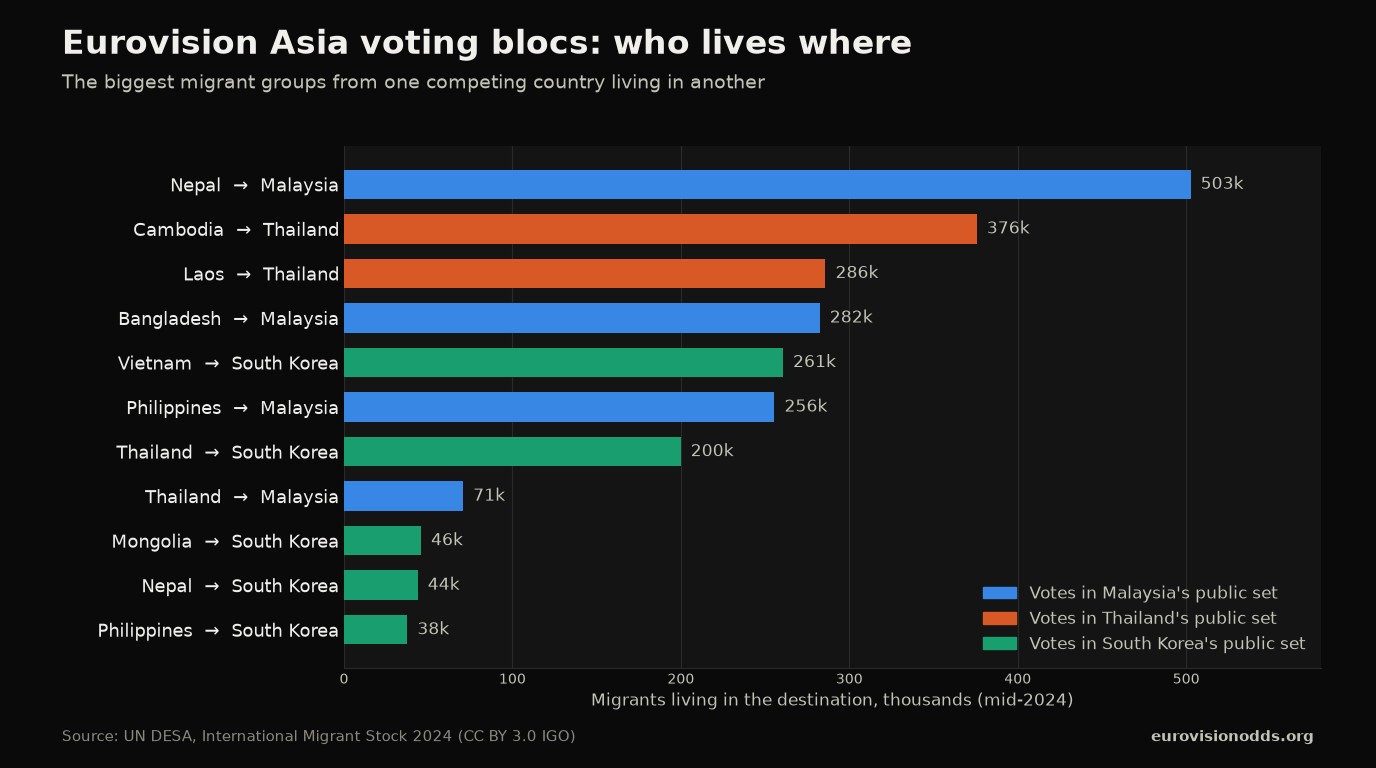
- The seven biggest corridors between the eleven (UN, mid-2024): Nepal to Malaysia 502,596; Cambodia to Thailand 375,635; Laos to Thailand 285,819; Bangladesh to Malaysia 282,437; Vietnam to South Korea 260,609; the Philippines to Malaysia 255,520; Thailand to South Korea 199,861.
- Three public sets hold almost all of that migration: Malaysia, Thailand and South Korea.
- The host’s largest community abroad among the eleven is in South Korea. Thai residents cannot vote for Thailand, but about 200,000 Thais in Korea can.
- In the Rest of World pool, Bangladesh and the Philippines have by far the largest diasporas outside the eleven.
- Migrants are not voters. This is a structural reading of the vote, not a forecast.
What’s on this page
How residence decides the vote · The migration map · Country by country · The host’s hidden vote · The Rest of World pool · What it means for the odds · The limits · FAQ · Sources
How residence decides Eurovision Asia bloc voting
The official Voting Terms set three rules that, together, decide who can give points to whom. First, voting in the Grand Final “is open to anyone; the only country-based restriction is that if you are resident in a Participating Territory, you may not vote for the entry representing that territory”. Second, each competing country’s public vote is a separate set of points, and “viewers from non-participating territories” are pooled into “an additional Rest of World vote”. Third, the organiser records each voter’s country of residence and bans VPNs and spoofed locations.
The consequence is easy to miss. Population does not buy points. Bhutan’s public set, from a country of under a million people, is worth exactly as much as Bangladesh’s. Each awards 12, 10, 8, 7, 6, 5, 4, 3, 2 and 1 to ten of the other countries. Size only matters inside a set, where whoever turns out decides the order, and in the Rest of World pool, where everybody outside the eleven is counted together.
That makes motivated minorities matter. If turnout among a country’s own citizens is low, a migrant community that cares about its home entry can decide where that country’s twelve goes. Each voter’s eight free votes must be spread across at least three countries, so every counted ballot also hands out second and third preferences. Eurovision watchers in Europe will recognise the pattern: diaspora voting has long been visible in the European televote. The difference in Asia is that the biggest communities are recent labour migrants rather than settled, long-established diasporas.
One warning before the numbers. The terms forbid “organising votes” and “coordinated activity designed to distort the result”, and let the organiser void votes after the result. Communities voting for their home country is not the same thing as an organised campaign, but where the line sits is for the organiser to decide.
The migration map: who lives where
The figures come from the UN Department of Economic and Social Affairs’ International Migrant Stock 2024, which estimates, for mid-2024, how many people from each country live in each other country. For Thailand, Vietnam, the Philippines, Laos and Mongolia the UN works from foreign citizens; for the others, from people born abroad; most figures include refugees. These are the largest flows between the eleven competing countries:
| From | Living in (votes in that set) | People, mid-2024 |
|---|---|---|
| Nepal | Malaysia | 502,596 |
| Cambodia | Thailand | 375,635 |
| Laos | Thailand | 285,819 |
| Bangladesh | Malaysia | 282,437 |
| Vietnam | South Korea | 260,609 |
| Philippines | Malaysia | 255,520 |
| Thailand | South Korea | 199,861 |
| Thailand | Malaysia | 70,718 |
| South Korea | Vietnam | 48,707 |
| Mongolia | South Korea | 45,698 |
| Nepal | South Korea | 43,743 |
| Vietnam | Cambodia | 41,357 |
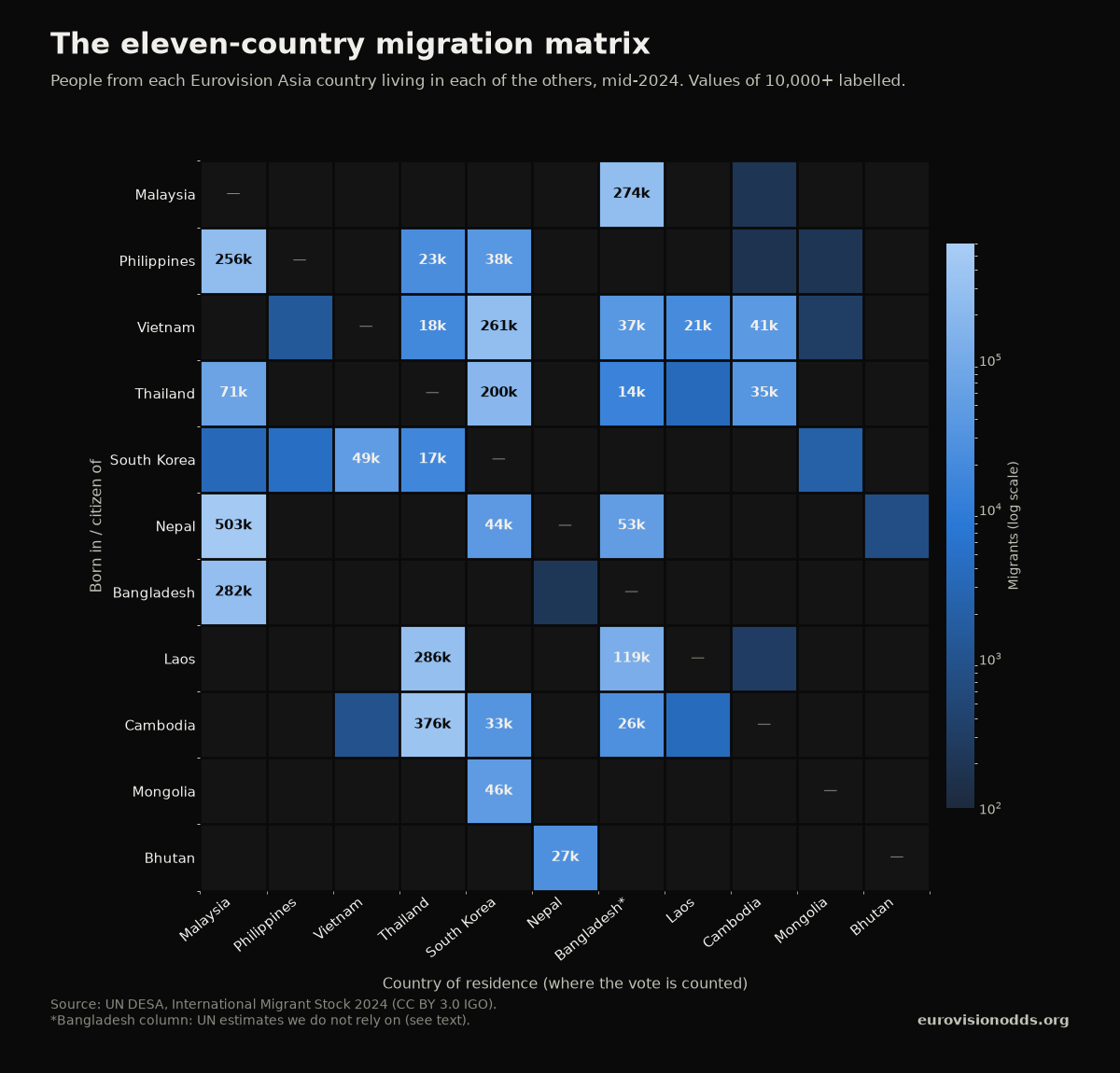
The matrix makes the shape obvious. Almost all the weight sits in three columns: Malaysia, Thailand and South Korea, the region’s big employers of migrant labour. The other eight competing countries receive little from the rest of the field, apart from the Bangladesh estimates explained below.
One column we do not use. The UN’s estimates for Bangladesh as a destination include 274,253 people born in Malaysia and 118,769 born in Laos. Those do not match any labour corridor we know of, and may reflect how the source data classifies people born abroad to Bangladeshi families. We cannot check them, so we do not read Bangladesh’s public set from them.
Country by country: where each public set could lean
Combining the UN figures with language and cultural ties gives a working hypothesis for each of the ten domestic sets. It is a reading, not a forecast: it says which countries are positioned to collect points, not who will.
| Public set (residents of) | Largest communities from other competing countries | Positioned to benefit |
|---|---|---|
| Malaysia | Nepal 502,596 · Bangladesh 282,437 · Philippines 255,520 · Thailand 70,718 | Nepal, Bangladesh, the Philippines |
| Thailand | Cambodia 375,635 · Laos 285,819 · Philippines 23,402 · Vietnam 17,986 · South Korea 16,518 | Cambodia, Laos |
| South Korea | Vietnam 260,609 · Thailand 199,861 · Mongolia 45,698 · Nepal 43,743 · Philippines 37,555 · Cambodia 33,452 | Vietnam, Thailand |
| Vietnam | South Korea 48,707 | South Korea |
| Cambodia | Vietnam 41,357 · Thailand 34,957 | Vietnam, Thailand |
| Laos | Vietnam 21,400 · Cambodia 3,871 · Thailand 3,718 | Thailand (language), Vietnam |
| Nepal | Bhutan 26,552 | Unclear (see below) |
| Philippines | South Korea 4,520 · Vietnam 1,391 | No migrant signal; taste decides |
| Mongolia | South Korea 2,103 | No migrant signal |
| Bhutan | Nepal 780 | No migrant signal |
| Bangladesh | UN estimates not relied on | — |
Malaysia’s set is the most contested in the contest. Three communities of more than a quarter of a million each, from Nepal, Bangladesh and the Philippines, can all vote in it. None of them is Malaysian, and none of them can be outvoted by Malaysians voting for Aina Abdul, because Malaysians cannot vote for her. If those communities turn out, Malaysia’s twelve, ten and eight are likely to go to some order of those three.
South Korea’s set is the most varied. Six of the other ten countries have communities of more than 30,000 there, led by Vietnam. Korea is also the one set where a strong Vietnamese turnout could help Tóc Tiên directly.
Vietnam’s set runs the other way. The 48,707 Koreans living in Vietnam are small next to Vietnam’s own electorate, but K-pop’s popularity there points the same direction as the migration figure. South Korea’s JUNHEE is a natural candidate for Vietnamese points. The same is true, on taste rather than migration, in the Philippines, where the UN records very few migrants from the other ten countries.
Nepal’s set is the hardest to read. The 26,552 people from Bhutan in Nepal are counted with refugees; Nepal hosted camps for people who left Bhutan in the 1990s, many of them ethnically Nepali. Whether that community would vote for Bhutan’s Nyendra, singing “Lhayi Semo”, is not something the numbers can tell you.
The host’s hidden vote is in South Korea
Thailand is the host, and its own residents, the biggest audience in the hall, cannot vote for MANG x DAOU. Our deep dive on the host entry covers what that does to Thailand’s chances of winning. The migration data adds a twist. Thailand’s largest community among the other ten competing countries is not next door. It is in South Korea, at 199,861, with another 70,718 in Malaysia. Those Thais vote in the Korean and Malaysian sets, and they can vote for “Aroma”.
Language helps Thailand in one more set. Lao and Thai are closely related and largely mutually intelligible, and Thai television and pop music reach a wide audience in Laos. If any domestic set leans to the host on taste rather than migration, Laos’s is the likeliest. The flows into Thailand, 375,635 Cambodians and 285,819 Lao, are the largest in the region but cannot help Thailand: they vote in Thailand’s set, and are positioned to send its top marks to Cambodia’s Monetrey and Laos’s Thinla.
The Rest of World pool
The eleventh public set is the Rest of World: everybody voting from outside the eleven competing countries, pooled into one set of 12 to 1 with no jury. Here population finally matters, because the more people from a country who live elsewhere, the bigger its potential vote.
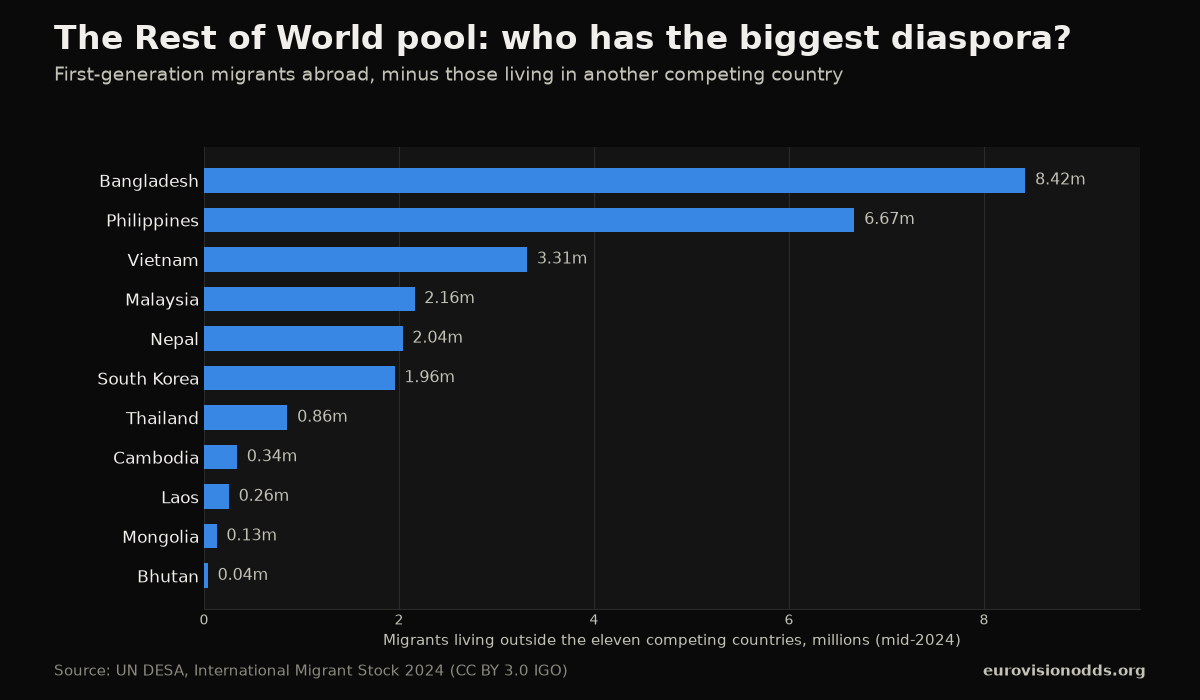
Counting first-generation migrants only, Bangladesh has about 8.42 million people living outside the eleven, mostly in the Gulf states and India. The Philippines has about 6.67 million, with 2.26 million in the United States alone. Vietnam follows with 3.31 million, then Malaysia (2.16 million, 1.55 million of them in Singapore), Nepal (2.04 million) and South Korea (1.96 million). Thailand, Cambodia, Laos, Mongolia and Bhutan trail well behind.
Two corrections to read alongside that chart. It counts only people who moved, not their children. Korean, Vietnamese and Filipino communities in the United States are much larger once you include the generations born there. And the Rest of World pool also contains Eurovision fans in Europe and Australia with no tie to any of the eleven, who will vote on the songs. The organisers have even enlisted Australia’s Delta Goodrem to sing all eleven songs in their original languages. The pool is diaspora plus taste, and nobody knows the mix.
What Eurovision Asia bloc voting means for the odds
The public-vote winner market only pays on first place, and one or two strong sets will not take an outsider there. Where the migration map matters most is the total score, and so the podium books. Prices are Polymarket midpoints read at 08:04 UTC on 10 November.
- Nepal is 7% to win (6c / 8c), but the public-vote book prices it at effectively nothing, with no bid at all. Half a million Nepalis in Malaysia and 43,743 in South Korea suggest Pratik Himal Rai will collect real public points, even if not enough to win the public vote. Nepal is 7% for the Top 3 (5c / 9c).
- Cambodia has no bid in the public book but is 15% for the Top 3 (14c / 16c, last 14c, about $1,600 traded). It is the main beneficiary of the largest corridor into the host’s set.
- Laos is 27% for the Top 3 on a wide 13c / 41c quote with a last trade of 12c. The 285,819 Lao in Thailand are its best route to public points.
- Vietnam is 41% for the Top 3 on one of the tightest quotes in the event (40c / 42c, about $2,600 traded), and has the largest community in South Korea’s set.
- The Philippines has 255,520 people inside Malaysia’s set and the second-largest Rest of World diaspora. That case is set out in our public-vote odds report.
- Malaysia has no meaningful migrant vote in any other competing country. Aina Abdul’s public points have to come from taste, which the market clearly believes in: she leads the public-vote book.
The limits of this analysis
- A migrant population is not a voting population. Voting requires being 18 or over, knowing about the contest, signing in with Google, Apple or Privy, and voting in the window. Many of the largest corridors are of labour migrants working long hours.
- The figures are estimates for mid-2024, and the UN uses different definitions for different countries: citizenship in some, birthplace in others.
- Residence is assigned by the organiser from device and network signals, not declared by the voter.
- Taste may simply dominate. A song that lands can win a set with no diaspora behind it.
- There is nothing to test this against yet. None of the eleven national selections published its Rest of World or diaspora breakdown. If the organisers publish each country’s public set after Saturday, we will score this piece against it.
For the jury half, which works on different logic, see jury versus public. For the scoring arithmetic behind all of this, see the 252-point explainer. The Eurovision Asia hub carries every live book.
FAQ
Can you vote for your own country at Eurovision Asia?
No. In the Grand Final, residents of a competing country cannot vote for that country’s entry. People from that country living anywhere else can.
Does a bigger population mean more points?
Not in the domestic sets. Each competing country’s public awards one set of 12 to 1, whatever its size. Population matters only in who turns out within a set, and in the Rest of World pool.
Which country has the most migrants living in another competing country?
Nepal: about 502,596 people from Nepal live in Malaysia, according to the UN’s mid-2024 estimates. Cambodia (375,635 in Thailand) and Laos (285,819 in Thailand) follow.
What is the Rest of World vote at Eurovision Asia?
One set of public points, from everyone voting outside the eleven competing countries, with no jury component. It is the eleventh public set, which is why the public half carries slightly more weight than the jury half.
Is diaspora voting allowed?
Yes. Anyone living outside a country can vote for it. What the rules forbid is buying, selling, exchanging or organising votes, multiple accounts and VPNs.
Sources
- Migration figures: UN DESA, International Migrant Stock 2024, Table 1, destination by origin, both sexes, mid-2024 (CC BY 3.0 IGO).
- Voting rules: Eurovision Asia Voting Terms and Conditions, last updated 28 August 2026, sections 3, 6, 7, 8 and 11.
- Delta Goodrem’s recordings: Eurovision Song Contest Asia.
- Prices: Polymarket Gamma API, read 08:04 UTC on 10 November 2026.
This is a structural reading of the vote, not a forecast. Prices move and are dated to the moment they were read. 18+; prediction markets are not available in every country.