
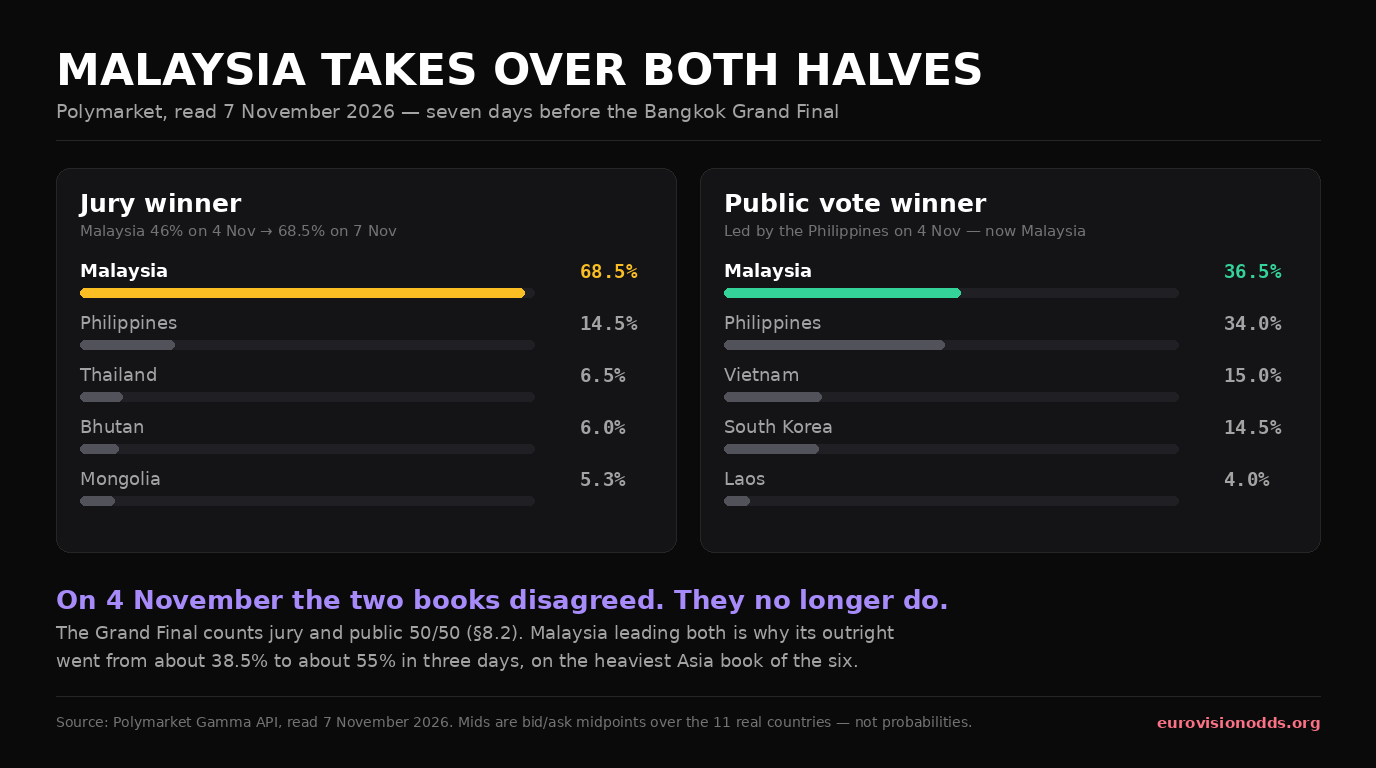
Malaysia now leads every one of the six Eurovision Asia books on Polymarket. Read on 7 November 2026, seven days before the Grand Final in Bangkok, Aina Abdul is the outright favourite at about 55%, the jury favourite at about 68.5% and — this is the change — the public-vote favourite too, at about 36.5%, a place the Philippines held three days ago. A sixth market opened this morning. The board that was split on 4 November has stopped being split.

18+ | New customers only | T&Cs apply | Please gamble responsibly
Three days is a short window for a market to move this far on no result, no rehearsal footage and no announcement about any of the eleven songs. What follows is what actually changed, where the numbers come from, and the several reasons to hold them loosely.
What the Eurovision Asia odds say on 7 November
All figures below are Polymarket mids — bid/ask midpoints from the Gamma API — read on 7 November 2026. They are not probabilities, and the caveats are set out further down.
| Book | Leader | 4 November | 7 November |
|---|---|---|---|
| Outright winner | Malaysia | about 38.5% | about 55% |
| Jury winner | Malaysia | about 46% | about 68.5% |
| Public-vote winner | Malaysia | about 27%, second | about 36.5%, first |
| Second place | Philippines | — | about 25.5% |
| Third place | Thailand | — | about 20.5% |
| Top 3 (opened 7 Nov) | Malaysia | — | about 83.5% |
On the outright book Malaysia is quoted 53c against 57c, which is a genuinely tight two-sided price on the heaviest Asia contract anywhere: about $12.2K of the event’s turnover sits on that single line. The Philippines is second at about 31%, quoted 28c against 34c. Then it falls away sharply — Laos about 8%, Thailand about 7.5%, Nepal about 3.9%, Vietnam about 3.7%, South Korea about 2.5%, and Mongolia, Cambodia, Bhutan and Bangladesh all at or below 1%.
The split that stopped being a split
On 4 November this site wrote that the two halves of the contest disagreed, and that the disagreement was the most interesting thing on the board. Malaysia led the jury market at about 46%; the Philippines led the public vote at about 38.5%, with Malaysia about 27% behind it. Under §8.2 of the official Voting Terms, the Grand Final is scored 50% jury and 50% public, so a big jury lead plus a decent share of the televote was enough to make Aina Abdul the outright favourite without “Bluest Sky” being anybody’s first choice on the phones.
That reading is now out of date. Between 4 and 7 November the jury book moved about 22 points in Malaysia’s favour in a single day — Gamma’s own one-day change field records +0.22 — taking it to roughly 68.5%, quoted 68c against 69c on about $9.5K. At the same time Malaysia overtook the Philippines on the public vote, 36.5% to 34.0%. The Philippines barely moved; Malaysia came up underneath it.
So the market no longer thinks the two halves pull apart. It thinks one country wins both, which is exactly the shape that produces a large outright price under a 50/50 rule. The outright at about 55% is the arithmetic of the two split books agreeing, not a separate opinion.
A sixth market opened this morning
Polymarket added a Top 3 market at 00:12 UTC on 7 November, nine days after the first five. It is a different shape from the others: eleven independent contracts asking whether each country finishes in the top three, so a coherent book sums to about 300% rather than 100%.
It took about $8.4K in its first thirteen hours, which is quick for this event. Malaysia is about 83.5%, the Philippines about 64%, Thailand about 45.5%, Vietnam about 38.5% and South Korea about 22.5%; the other six sit between 11% and 15%. The eleven mids sum to about 329%, so the overround on a three-slot market is roughly 29 points — tighter, in relative terms, than anything else in the event.
It is also the one book that disagrees with the others in a useful way. Thailand is third-favourite for a podium at about 45.5% while being only about 7.5% for the win, and it leads the separate third-place market at about 20.5%. The host nation is priced as likely to place and unlikely to win. Worth remembering why that is not merely sentiment: under §8.2 nobody can vote for their own country, so Thailand collects no televote from the largest audience in the room.
The place markets tell a different story from the outright
The second- and third-place books are thinner than the headline ones — about $2.3K and $6.5K respectively — but they are the only place the market expresses an opinion about the shape of the podium rather than its top.
On second place, read 7 November, the Philippines leads at about 25.5% (quoted 25c against 26c), then Malaysia about 21%, Vietnam and Thailand both about 19.5%, and South Korea about 15%. Note what that says: Malaysia is second-favourite to finish second, which is what you would expect of a country the market thinks usually wins. The five leaders are packed into six points.
On third place, Thailand leads at about 20.5% on about $3.8K — more turnover than the whole second-place book carries on any single line — ahead of Vietnam about 18.5%, Malaysia about 17.5%, the Philippines about 17% and South Korea about 17%. That is close to no opinion at all: five countries inside four points.
Read together, the three ranking books say the market is confident about first, mildly confident about second, and genuinely undecided from third down. That is a more honest picture than the outright alone, where a 55% favourite can read as though the contest is settled. It is not: on these prices the market still gives the field as a whole roughly a 45% chance of beating Aina Abdul.
Where the money went
The volume growth is the part that is hard to argue with. Across the Asia books Polymarket had taken about $19.5K by 4 November. By 7 November the six books together carry about $58.6K, against roughly $487K of posted liquidity. The outright alone did about $9.4K in the twenty-four hours to this reading.
That is still small. For scale, the European Eurovision winner market for 2026 closed at nearly $194M. But it is no longer a book where a single $200 order sets the price, and the quotes show it: the liquid Asia contracts are two-sided within a few cents.
Kalshi finally cleared its stale prints
The other venue had a genuinely eventful three days, after a fortnight in which it barely moved. Kalshi, regulated by the US CFTC, opened the first Eurovision Asia market on 14 September 2026 and had been stuck at 4,058 contracts of lifetime volume from 2 November to 4 November.
Written as dated history, which is the only safe way to write a board this thin:
- 5 November: board volume 4,118.
- 6 November: 4,210.
- 7 November, 13:18 UTC: 5,182 — the Philippines alone going from 112 contracts to 878.
- 7 November, 16:08 UTC: 5,527, the Philippines up again to 1,223.
So roughly 1,100 contracts went through on the Philippines on 7 November, more than ten times its entire prior history. The effect was to destroy the single most misleading number this site has had to caveat for a month: the Philippines had been marked at 95c since an ask was lifted on 10–11 October, and it closed that day at 39c, quoted 27c against 38c. The board’s sum of last prices fell from 259 on 4 November to 203 on 7 November almost entirely because of it.
Malaysia is the other Kalshi story, and it is a strange one. Its last trade is still 6c, a print from before anyone was willing to bid on it at all. Its live quote on 7 November was 50c against 61c. In other words Kalshi’s displayed Malaysia price understates its own order book by more than fifty cents, because nothing has gone through to update it. Anyone reading the Kalshi board as a list of prices will get Malaysia catastrophically wrong.
Vietnam is the mirror image: last trade 79c, no bid at all underneath it, and an ask of 58c. Its last print is above the price at which you could sell it today. Polymarket prices Vietnam at about 3.7%.
On the Asia contest the two venues now broadly agree about who is winning and disagree about almost every number. Where they conflict, the Kalshi marks are the ones to distrust: seven of its eleven contracts had no bid on 7 November, and Laos alone accounts for about 51% of all volume ever traded there. The live Kalshi figures on our Eurovision Asia hub are rendered from a data file refreshed daily, not typed into the page, for exactly this reason.
Three reasons to hold these numbers loosely
First, the overround. Summed across the eleven countries, the outright mids came to about 114% on 7 November, in a contest exactly one country wins. That is a real improvement — the same sum was about 144% on 4 November — but it still means the mids collectively overstate. The jury book sums to roughly 122%, the public-vote book to about 111%.
Second, the placeholders. Each Asia event on Polymarket’s API carries twenty-two unfilled template contracts named “Other” and “Country A” through “Country T”, quoted 0c against 100c with no volume. Their midpoint is 50c. Sum every mid the API returns for the winner book and you get over 1100%. Every percentage in this article is computed over the eleven real countries only. If you read these markets yourself, filter first.
Third, nothing has actually happened yet. No rehearsal from Bangkok has been broadcast, no jury has heard anything, and this is the first edition of a contest with no history to regress to. The acts only travelled to Thailand on 7 November. A market that moves 22 points in a day on an event with no new public information is a market finding its own level, not one responding to evidence.
What would actually move it
Rehearsal clips are the obvious candidate, and they are the thing this site would treat with the most caution: the European contest has a long record of rehearsal-driven price moves that the result did not vindicate, and Bulgaria’s 2026 win came after a second-rehearsal surge that did. The preview show on 13 November and the Grand Final on 14 November at 19:30 ICT (14:30 CET) are the only scheduled events left. All six Polymarket books close on 15 November and resolve on the official Grand Final ranking, with ties broken on total points, then jury points, then public points.
One structural thing is worth holding on to through the noise. The paid-booster voting mechanic confirmed on 28 October — eight free votes per viewer plus up to ten paid ones, a minimum of eighteen — rewards organised fanbases in the public half. Malaysia leading both halves is a stronger claim than leading the jury half was, because the public half is the one a mobilised fandom can actually bend.
The betting position, honestly
No fixed-odds bookmaker prices Eurovision Asia. There is nothing to bet with a UK-licensed operator, no each-way market, no price boost, and anyone telling you otherwise is selling something. The two venues that do price it are prediction markets: Polymarket, which is not available to UK customers, and Kalshi, which is CFTC-regulated and US-facing. Our bookmaker comparison covers who is licensed where for the European contest, which is a different proposition entirely.
What you can reasonably take from the board is a ranking, not a price. The market’s view on 7 November is: Malaysia clearly first, the Philippines clearly second, a gap, then Thailand and Vietnam contesting the rest of the podium. That view has firmed rather than changed since Polymarket opened. Whether it survives contact with a stage nobody has seen yet is the whole question, and we will score it against the actual result the way we scored the Junior Eurovision board last month — which called the podium in exact order and got almost everything below it wrong.
Full country-by-country prices, both boards, and the eleven songs are on the Eurovision Asia 2026 hub, refreshed with this reading. 18+. Please gamble responsibly.