
Correction, 12 October 2026: an earlier version of this page said Nepal and Cambodia would use a 50/50 jury-televote split and that broadcasters were free to choose their weighting. Both claims were wrong. Clause 8.1 of the contest’s Voting Terms fixes a 40% jury / 40% domestic / 20% rest-of-world weighting for every national selection, with no provision for a different split. Nepal Decides ran on exactly that basis. The 50/50 figure, reported by Eurovoix for both shows, is the Grand Final rule under clause 8.2. The affected passages are corrected below.

18+ | New customers only | T&Cs apply | Please gamble responsibly
Eurovision Asia 2026 has eleven days of selections left and four entries missing. Nepal votes on Wednesday with eleven songs and no artist, Malaysia reveals Aina Abdul’s song on Friday, Mongolia picks Beck’s on Saturday, and Cambodia closes the season on 17 October with a seven-act final that TV5 named this week. Here is every date, every act confirmed since our last update, and the two numbers from Vietnam that matter more than any of them.
Key takeaways
- Cambodia named its field. Seven acts compete at Cambodia’s Finest Voice on 17 October at the AEON Mall Sen Sok Event Hall in Phnom Penh, decided under the contest’s fixed 40/40/20 jury, domestic and rest-of-world split.
- Nepal is next, on 7 October — eleven songs, no pre-named artist, 19:30 NPT, after a three-week delay caused by the floods.
- Vietnam drew 2,171,451 viewers to The Sound of Vietnam, the largest reported audience of any selection this season.
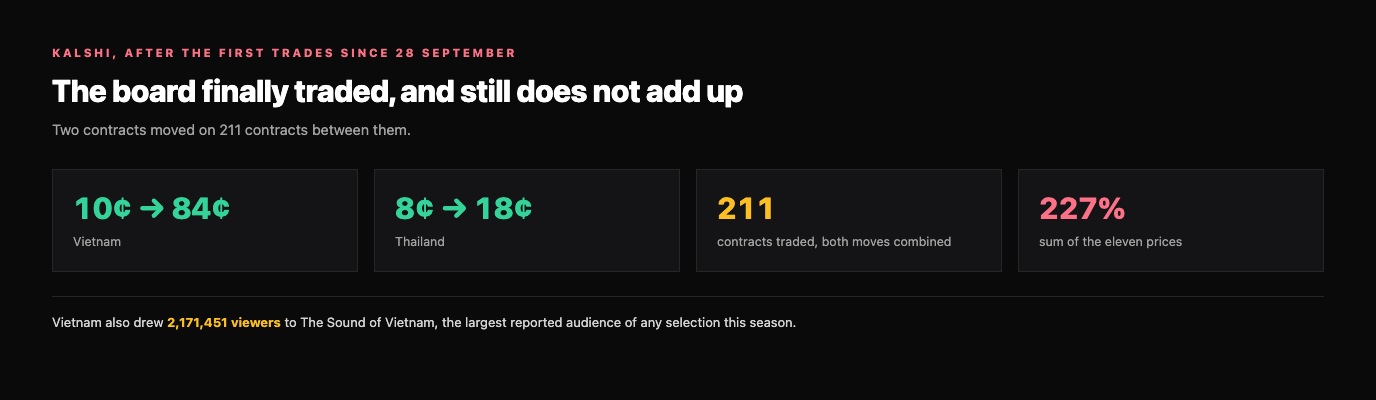
- The Kalshi board finally traded. Vietnam marked up from 10¢ to 84¢ and Thailand from 8¢ to 18¢ — on 211 contracts between them, leaving the eleven prices summing to 227%.
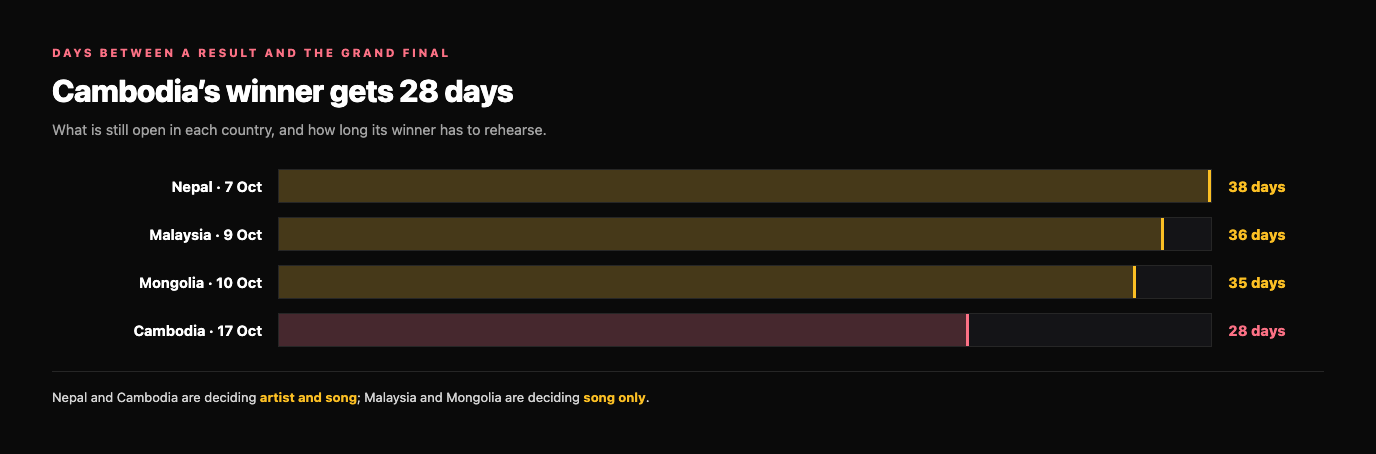
- Four entries remain unwritten with 39 days until the Grand Final. Cambodia’s winner will have 28 days to rehearse.
What’s on this page
The eleven days that finish the field · Cambodia names seven · Nepal votes first · Malaysia and Mongolia · Vietnam’s numbers · What the market did · What each result changes · Reading the board after the overround
The eleven days that finish the field
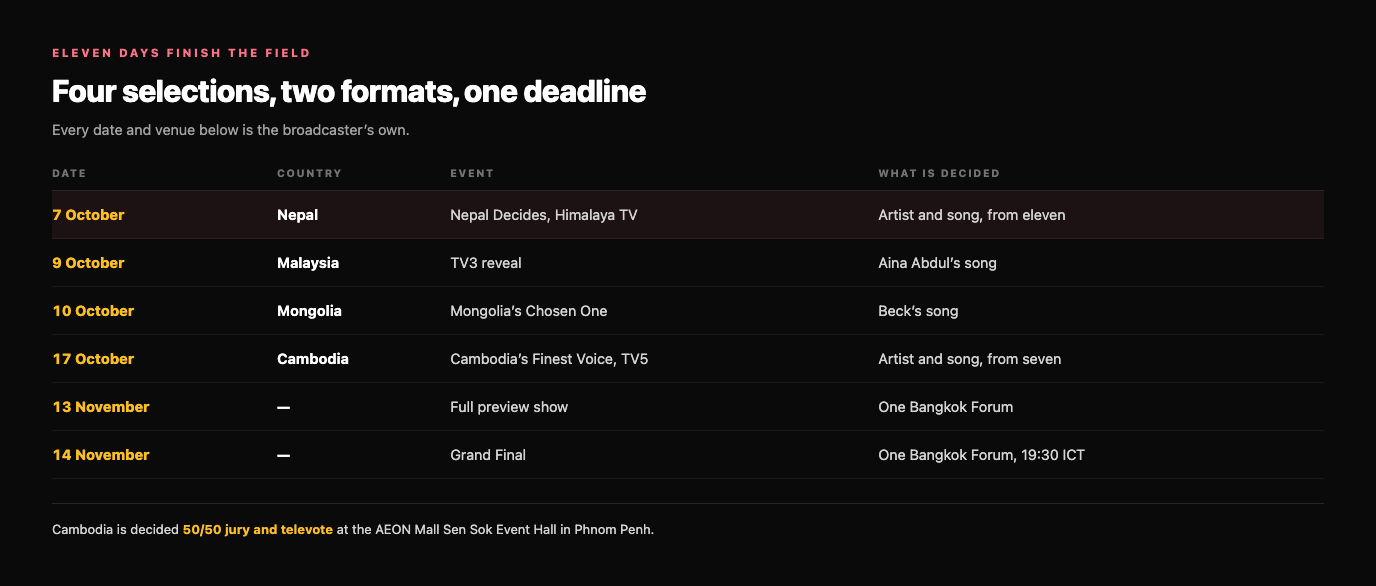
Seven of eleven countries have a complete entry — artist and song both settled. The remaining four all resolve inside the next eleven days.
| Date | Country | Event | What is decided |
|---|---|---|---|
| 7 October | Nepal | Nepal Decides, Himalaya TV | Artist and song, from eleven |
| 9 October | Malaysia | TV3 reveal | Aina Abdul’s song |
| 10 October | Mongolia | Mongolia’s Chosen One | Beck’s song |
| 17 October | Cambodia | Cambodia’s Finest Voice, TV5 | Artist and song, from seven |
| 13 November | — | Full preview show | One Bangkok Forum |
| 14 November | — | Grand Final | One Bangkok Forum, 20:30 ICT |
The gap at the bottom of that table is the story for Bangkok. Vietnam, confirmed on 3 October, has six weeks to build a staging. Cambodia’s winner will have 28 days, and will be the only act in the contest who has never performed the song in public before the preview show. In a contest decided on one live performance, that is a material disadvantage that has nothing to do with the music.
Cambodia names seven
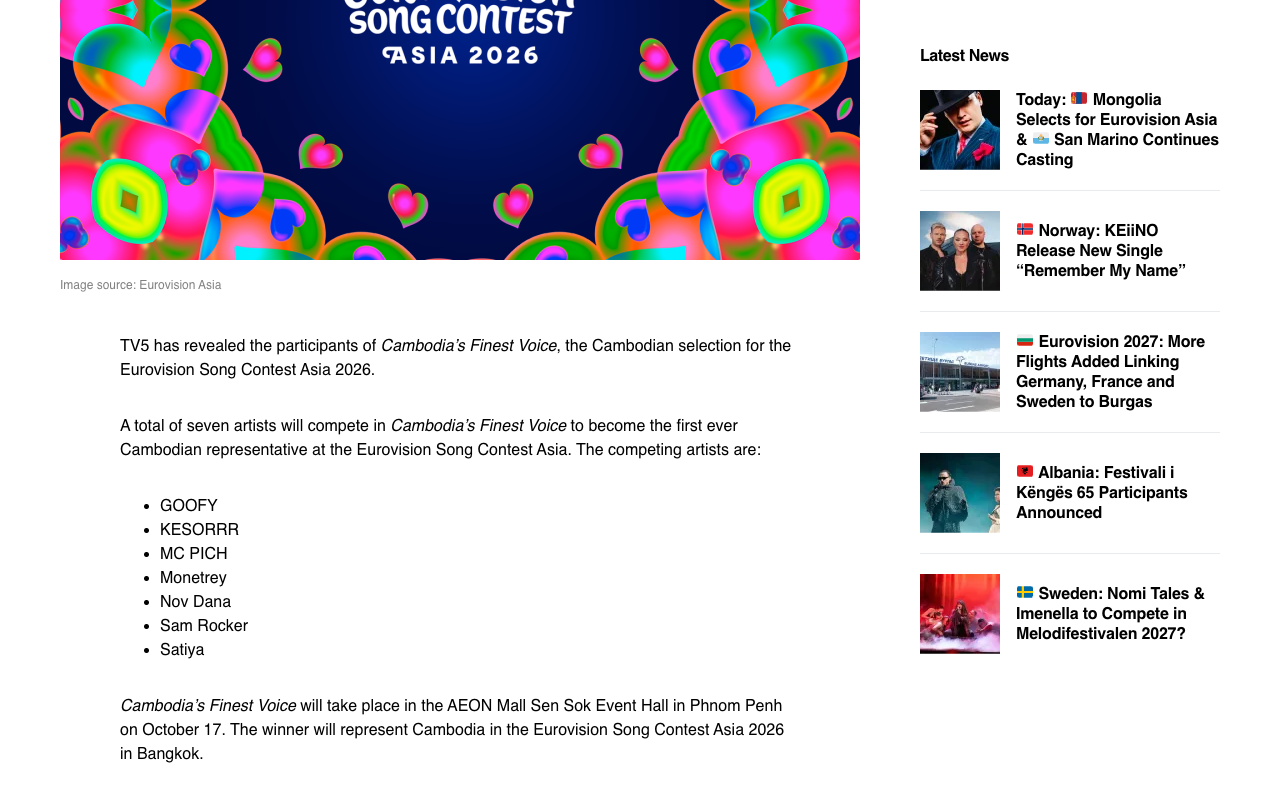
TV5 Cambodia published the line-up for Cambodia’s Finest Voice this week: seven acts, competing on 17 October at the AEON Mall Sen Sok Event Hall in Phnom Penh, with the winner decided under the contest’s fixed 40% jury, 40% domestic public and 20% rest-of-world split (Eurovoix reported 50/50; see the correction above).
- GOOFY
- KESORRR
- MC PICH
- Monetrey
- Nov Dana
- Sam Rocker
- Satiya
No song titles have been published, which makes this the least previewable selection of the season — seven acts, no music in public, eleven days out. We set out the format and the Khmer-pop context when TV5 first confirmed the show in June; the venue and the final date have both moved since, and the show has slipped from “early September” to the last slot on the calendar.
Note the voting split, because it is widely misreported. Eurovoix reported Cambodia’s show as 50/50 jury and televote, as it had reported Nepal’s. That is the Grand Final rule (clause 8.2). Every national selection runs on clause 8.1’s fixed 40/40/20 — 40% jury, 40% domestic public, 20% rest of world — and the terms make no allowance for a broadcaster to choose differently. Nepal ran on 40/40/20, as Vietnam, Laos, Thailand and Bangladesh did before it, and Cambodia should too unless TV5 says otherwise.
Nepal votes first
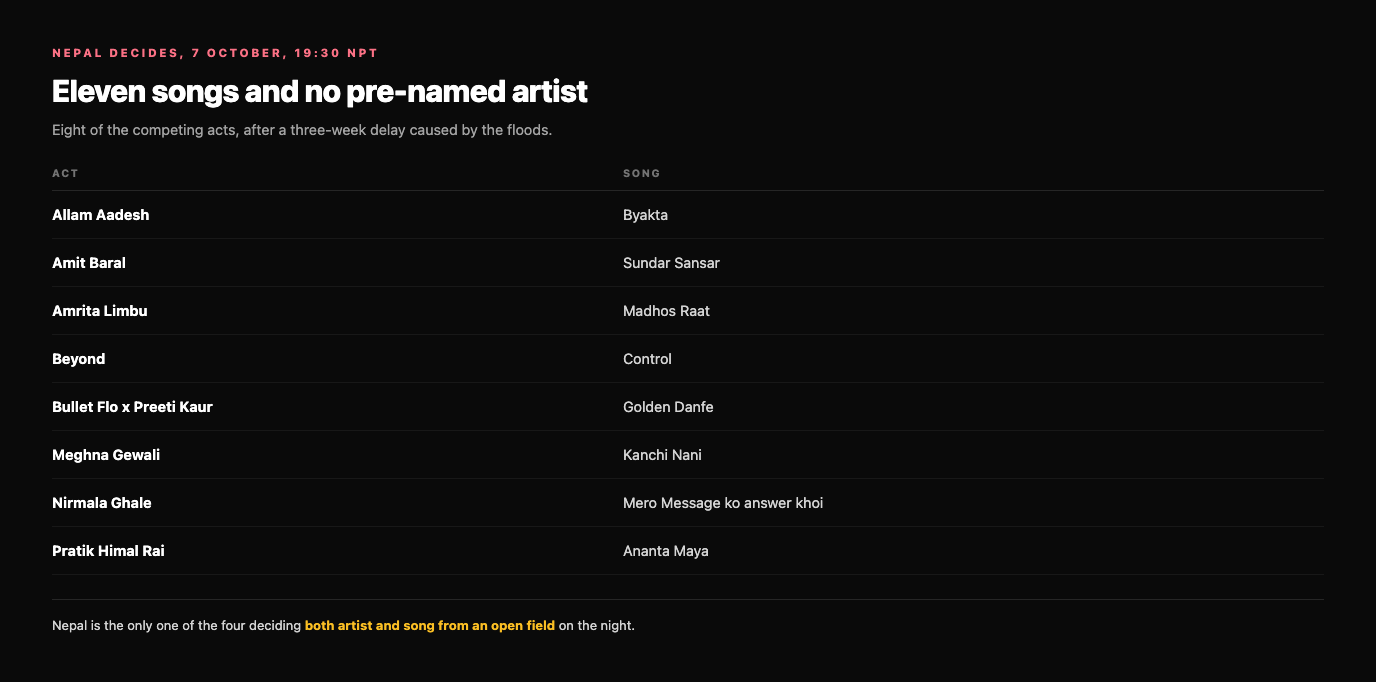
Nepal Decides airs on 7 October at 19:30 NPT (15:45 CEST) on Himalaya TV, and it is the largest single unknown left in the contest: eleven songs, and no artist named in advance. It was originally set for 19 September and was pushed back after flash flooding in the north of the country.
| Act | Song |
|---|---|
| Allam Aadesh | Byakta |
| Amit Baral | Sundar Sansar |
| Amrita Limbu | Madhos Raat |
| Beyond | Control |
| Bullet Flo x Preeti Kaur | Golden Danfe |
| Meghna Gewali | Kanchi Nani |
| Nirmala Ghale | Mero Message ko answer khoi |
| Pratik Himal Rai | Ananta Maya |
| Prithvi Khanal | Dhumba Talai Ma |
| RC Rimal | K maya yestai huncha ho |
| Suraj Tamang | Gorkhali Keto |
Nepal is the only country left that is choosing a performer as well as a song, which makes it the one selection that can still change the shape of the field rather than just fill a slot. The Nepal country page carries the running profile.
Malaysia and Mongolia
Malaysia is the outlier: no national selection at all. Aina Abdul was internally selected, and TV3 and the artist have both teased a reveal for 9 October — a date that remains, strictly, unconfirmed by a formal announcement. Treat it as likely rather than fixed.
Mongolia runs the same model Vietnam and Laos used: the artist is known and the public picks the song. Mongolia’s Chosen One airs on 10 October at 15:00 CEST (21:00 ULAT), with viewers choosing between songs all performed by Beck, confirmed by MNC on 1 October.
Vietnam’s numbers
Two figures published since Tóc Tiên won with “Em Tiên” are worth more attention than they have had.
On VTV’s own ratings data, 2,171,451 viewers watched at least one minute of the two-hour show, which averaged 867,985. It was the ninth most-watched programme on VTV3 and the sixth by reach. No other selection this season has reported an audience near it, and it is the first hard evidence that a Eurovision Asia national final can carry a mainstream domestic audience rather than a fan one.
The second is softer but matters for Bangkok: two independent English-language fan panels, Aussievision and That Eurovision Site, both ranked “Em Tiên” first out of the five candidates before the Vietnamese vote reached the same answer. We have set out the full case for why we think Vietnam wins this contest separately.
What the market did
There is still no fixed-odds bookmaker on Eurovision Asia and Polymarket lists no market for it. Kalshi’s eleven-country board is the only place Bangkok is priced, and after a week of nothing it finally traded.
Between 4 October 12:33 UTC and 5 October 14:58 UTC, Vietnam’s last price moved from 10¢ to 84¢ on about eleven contracts, and Thailand’s from 8¢ to 18¢ on roughly 200. Nothing else moved. Total board volume went from 3,277 to 3,488 contracts, and open interest from 1,815 to 2,015.
That is the board reacting to a completed entry for the first time, and it still cannot be read as a probability. The eleven last-traded marks now sum to 227% of a field in which exactly one country wins; ten of the eleven contracts have no bid at all; Vietnam’s 84¢ is the opening ask being lifted, not a two-sided price. Laos, on no public evidence anyone has produced, remains about 71% of all volume ever traded. We explained how this market is built and why its prices do not behave when it opened.
The Eurovision Asia hub carries the live state of the field, and the winner odds page covers what is actually priced.
What each of the four results actually changes
The four outstanding selections are not equivalent, and the calendar above flattens a real asymmetry. Three of the four countries have already named their performer: Malaysia’s 9 October slot and Mongolia’s 10 October slot are song reveals for artists — Aina Abdul and Beck — who were settled weeks ago. Only Nepal and Cambodia are still contests, and between them they account for both of the entries whose performer is still unknown.
That matters for how much the next eleven days can move. A song reveal narrows a known quantity; a selection that names a performer as well as a song introduces one. Nepal does the latter from eleven candidates on 7 October, Cambodia from seven on 17 October, and both run on the same fixed 40/40/20 split that produced Vietnam, Laos, Thailand and Bangladesh. The 20% rest-of-world slice is the part worth watching, because it is the only component of a national selection that resembles the audience Bangkok will have — and it is also the component no broadcaster has published separately.
The rehearsal clock is the second asymmetry, and it runs the other way:
| Country | Resolves | Days to the Grand Final | What is still open |
|---|---|---|---|
| Nepal | 7 October | 38 | Artist and song |
| Malaysia | 9 October | 36 | Song only |
| Mongolia | 10 October | 35 | Song only |
| Cambodia | 17 October | 28 | Artist and song |
Cambodia therefore carries both disadvantages at once: the shortest preparation window in the contest, and the only entry that will arrive at the 13 November preview show without ever having been performed in public. Nepal, ten days earlier, gets 38 days and the same unknown-performer problem — which is why the 7 October broadcast is the more consequential of the two despite Cambodia closing the season.
Reading the Kalshi board after the overround
The 227% sum is worth converting rather than simply quoting. Normalised across the eleven last-traded marks so that the field adds to one, Vietnam’s 84¢ becomes roughly 37% and Thailand’s 18¢ roughly 8% — a materially different picture from the headline prices, and the only arithmetic that makes the board internally consistent at all. Even that is generous. With no bid on ten of the eleven contracts, a last-traded mark records what somebody once paid, not what anyone will currently offer. Treat the normalised figures as the ceiling of what this market is saying, and the absent bids as the better evidence of how little it is saying.
On the one occasion the board did react — Vietnam’s completed entry on 4 and 5 October — it moved on a finished song with a named performer and a published audience figure behind it. That is the pattern worth watching over the next eleven days: Nepal and Cambodia are the only two results capable of producing the same kind of information, and the Malaysian and Mongolian reveals are unlikely to register on it at all.
Sources
- Eurovoix, 5 October 2026 — Cambodia’s seven acts, venue, date and voting split.
- Eurovoix, 23 September 2026 — the Nepal Decides field, timing and postponement.
- Viewing figures: VTV Ratings, reported by Eurovoix, 4 October 2026.
- Market figures read from Kalshi’s public API on 6 October 2026, against this site’s stored snapshots of 4 and 5 October. Polymarket’s Gamma API, read 6 October 2026, lists no Eurovision Asia market.
- Eurovision Song Contest Asia — contest dates and format.