
The EBU is consulting European broadcasters about a voting change it is already running in Asia. On 14 August a letter from EBU chief executive Jean Philip De Tender and Reference Group chair Ana Maria Bordas proposed that the Eurovision public vote move entirely online and that viewers be required to spread their vote across more than one entry — “three favourites” being the worked example.

18+ | New customers only | T&Cs apply | Please gamble responsibly
Eurovision Asia has been doing precisely that since 11 August. Its official voting page is unambiguous: “Every user gets 8 free votes.” And: “Spread them across at least 3 songs and make your voice heard.”
Same governing body. Same mechanism. One contest is consulting about it; the other is collecting live data.

The three systems, side by side
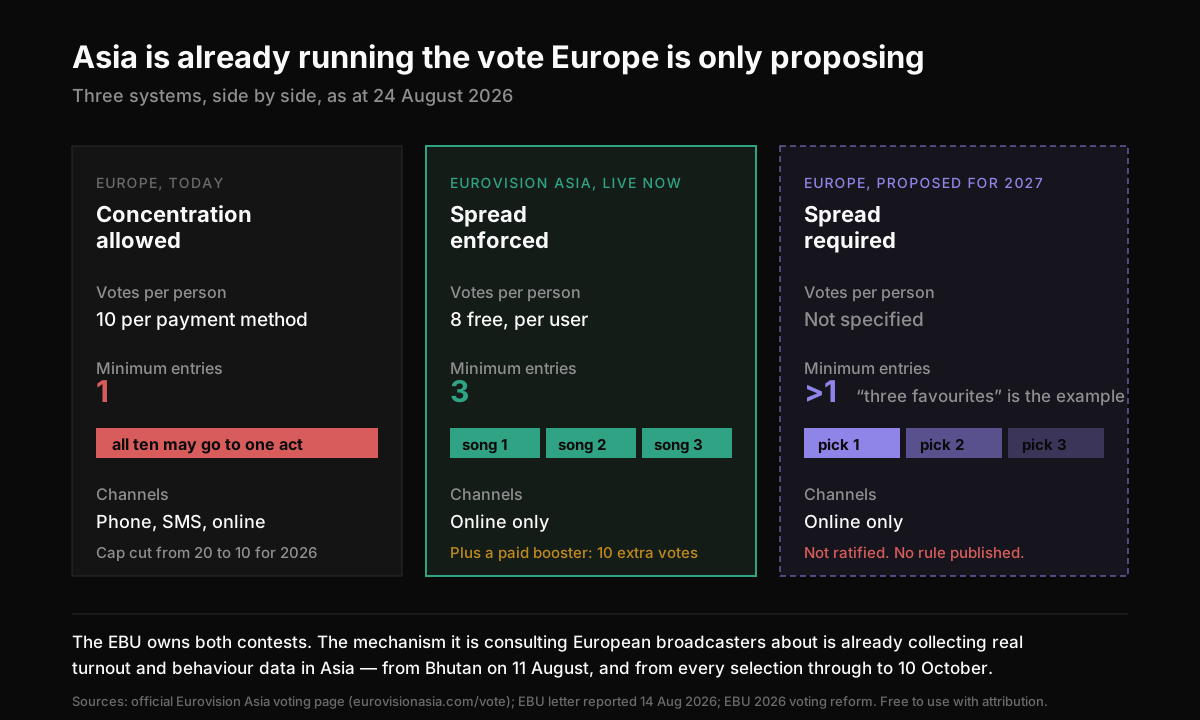
Europe today. Ten votes per payment method, cut from twenty for 2026, across phone, SMS and online. All ten may go to a single entry. Concentration is permitted, and that permission is the thing the reform programme exists to address.
Eurovision Asia today. Online only. Eight free votes per user. A minimum of three different songs. You physically cannot hand your whole allocation to one act.
Europe as proposed. Online only, spread across more than one entry, number unspecified and nothing ratified.
The middle column is not a thought experiment. It has been operating through Bhutan's national final on 11 August and will run through every remaining selection to Mongolia on 10 October, then the Bangkok Grand Final on 14 November. By the time European broadcasters have to form a view, the EBU will have a full season of behavioural data from eleven separate shows.
The wrinkle Europe has not proposed
There is a fourth line on the Asian voting page that has no counterpart in the European discussion: “Want more? You can buy a booster pack of 10 extra votes.”
So the Asian model is not simply “spread your vote.” It is: eight free votes that must be spread, plus a paid route to more than double your allocation.
That is a meaningfully different system, and it cuts against the reform's stated purpose in an interesting way. The forced spread dilutes concentrated enthusiasm. The paid booster re-concentrates it in the hands of whoever is willing to spend — and organised fandoms are, definitionally, the group most willing to spend. The two features pull in opposite directions.
It is worth being clear about what we do and do not know here. The booster's price is not published on the voting page, and the EBU has not said whether boosted votes are also subject to the three-song minimum. If they are, the dilution holds and the booster mostly raises revenue. If they are not, the booster is a paid exemption from the exact rule the system is built around. Nobody has asked the question publicly, and it is the single most important unanswered detail in the format.
What the betting reader should take from this
Four things.
The 2027 proposal is more likely to happen than a consultation letter usually implies. Governing bodies do not typically pilot a mechanism at continental scale and then abandon it. Eurovision Asia gives the EBU a live implementation, a vendor relationship and a season of turnout numbers to put in front of sceptical broadcasters. Anyone pricing 2027 outrights on the assumption that voting stays as it is should mark that assumption down.
Asia is where you can actually observe the effect before Europe prices it. This is the genuinely useful part. From 30 August onward you can watch, show by show, whether a forced three-song spread compresses results, whether it changes which kinds of act win, and whether the Rest of the World component behaves as the wildcard everyone assumes. That is empirical evidence about a mechanism that will be repriced in European markets a year later — available free, in public, to anyone who bothers to watch eleven national finals.
Watch for the divergence, not the winner. The informative signal in each Asian final is not who wins. It is the gap between the jury ranking and the public ranking. Under concentration, that gap is wide. If the forced spread is doing what the EBU hopes, the gap should narrow relative to what a comparable concentrated vote would produce. Three selections have confirmed a 40% jury / 40% domestic / 20% Rest of the World split, which is enough consistency to compare across shows.
Do not over-transfer. The Asian contest differs from Europe on things that matter: it is new, so there is no habitual voting bloc structure; the shows stream on YouTube rather than airing on national broadcast in most of the world; and the paid booster has no European equivalent. Evidence that the mechanism works in Asia is evidence, not proof. The first year of any new system is the year to size down.
The honest caveat on sourcing
The eight-votes-across-three-songs detail comes from the official Eurovision Asia voting page. It is not in the EBU's own reform communications, and the widely-linked fan explainer at songcontest.asia still says the technical details are unconfirmed. We verified it directly against the official page rather than relying on secondary coverage.
What is not established is intent. We have no statement from the EBU describing Eurovision Asia as a pilot for the European reform, and we are not asserting one. What we are asserting is narrower and checkable: the EBU is proposing a mechanism for 2027 that its own Asian contest is already running in 2026. Whether that is deliberate sequencing or convergent design, the data it generates exists either way.
Quick answers
How does Eurovision Asia voting work? Online only. Each user gets 8 free votes and must spread them across at least 3 songs. A booster pack of 10 extra votes can be purchased.
Is this the same as the EBU's 2027 proposal? The core is the same — online-only voting with a forced spread across multiple entries. The paid booster has no equivalent in the European proposal, and the European rule is not ratified.
Does the Rest of the World vote use the same system? Yes. The national selections' international component runs through the same online platform, open to viewers anywhere via the official stream.
When can I see the effect? Bhutan already ran under it on 11 August. Philippine Selection Night is on 30 August, Korea's Next Wave on 4 September, and the calendar runs to Mongolia on 10 October.
Will Europe definitely adopt it? No. It is a proposal in a letter to member broadcasters, and several of those broadcasters are simultaneously deciding whether to compete at all.