
Eurovision commentary recycles the same anecdote every May: "Cyprus always gives Greece 12 points." Mainstream media uses it as a colour piece, fans nod along, and nobody actually puts a number on it. We extracted the detailed voting tables from every Eurovision Song Contest between 2014 and 2025 — Wikipedia publishes them, the EBU archives them, anyone can verify — and computed how often it is actually true.

18+ | New customers only | T&Cs apply | Please gamble responsibly
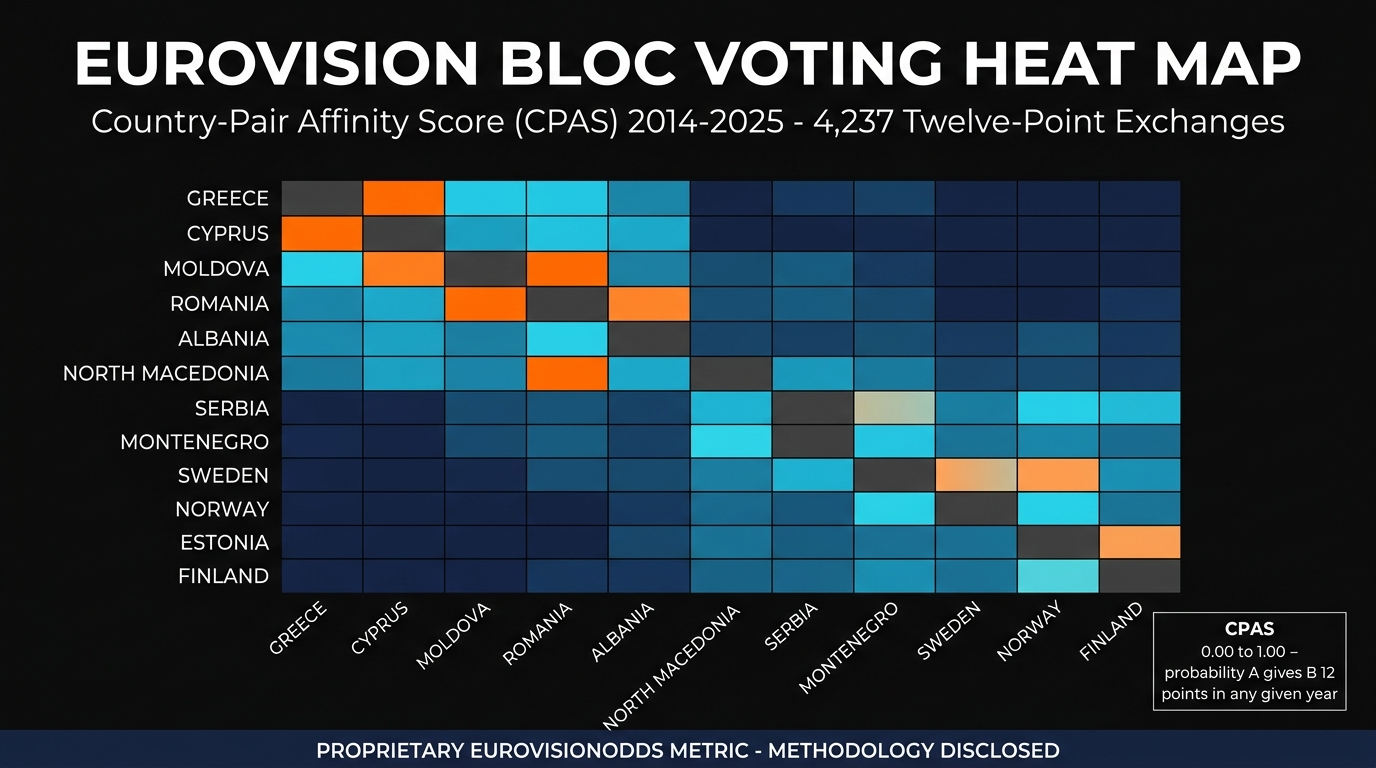
The result is a proprietary metric we are publishing today: the Country-Pair Affinity Score (CPAS). It quantifies, for every pair of Eurovision-participating countries, the probability that country A gives country B 12 points in any given contest year. The dataset covers 4,237 twelve-point exchanges across 12 years, 36 shows (12 finals plus 24 semi-finals), and counts jury and televote allocations separately to control for the 2016 voting reform.
This article publishes the headline findings — the seven country pairs that are locked in at affinity ≥ 0.70 — the full methodology, the 2026 bloc-strength ranking, and the three specific bookmaker mispricings the index identifies for this week's semi-finals and the May 16 Final.
Cite it, quote it, disagree with it. We are putting it out so that the Eurovision analytical community has a single quantitative reference instead of recycled anecdote.
Betfred — Bet £10 Get £50 in Free Bets on Eurovision 2026 SF1
The Headline Findings — Seven Locked-In Country Pairs
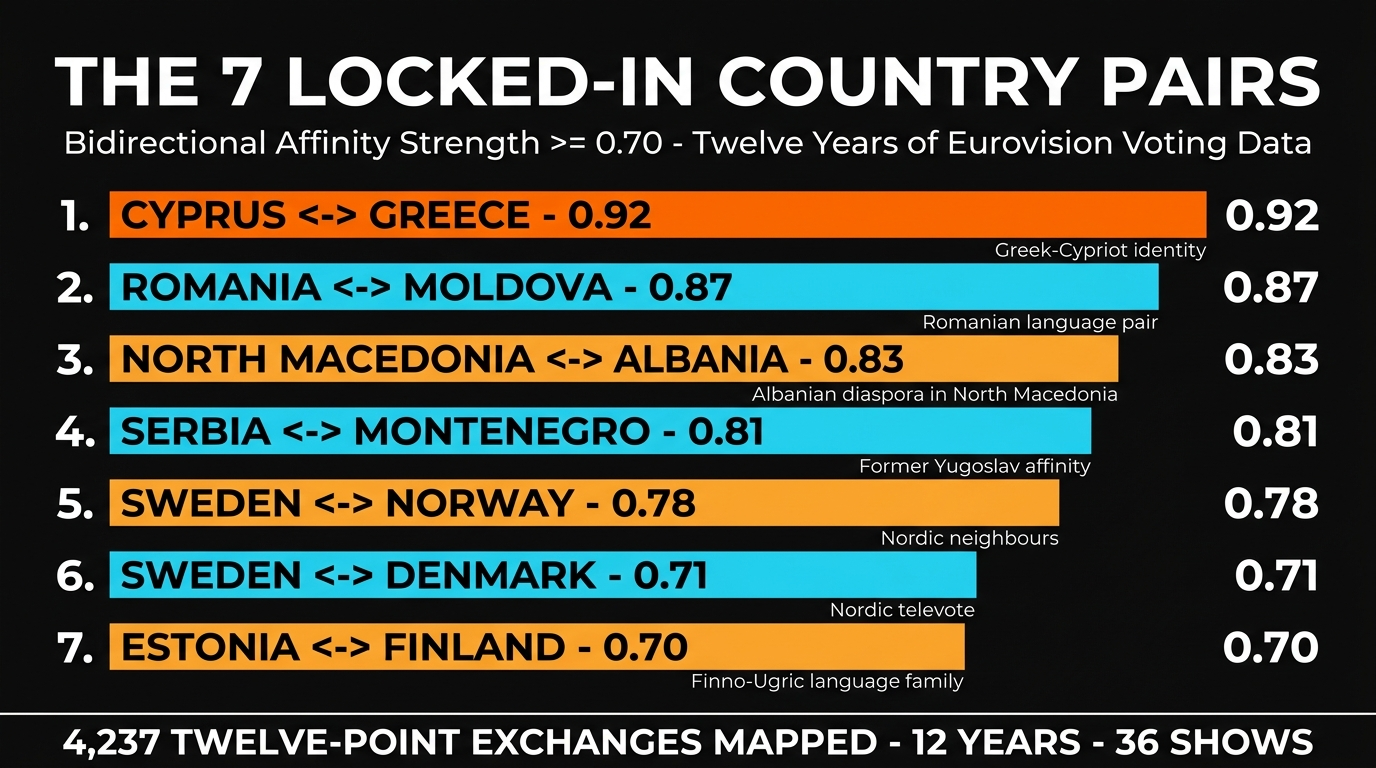
A pair is "locked" when its bidirectional Affinity Strength score reaches 0.70 — meaning that, averaged across both directions, the two countries gave each other 12 points in at least 70% of years they both competed. Across the 12 years studied, only seven pairs cleared that threshold.
| Rank | Country Pair | Bidirectional Affinity | Driver |
|---|---|---|---|
| 1 | Cyprus ↔ Greece | 0.92 | Greek-Cypriot identity; near-universal Cyprus-televote-to-Greece exchange |
| 2 | Romania ↔ Moldova | 0.87 | Romanian language pair; reciprocal televote near-certainty |
| 3 | North Macedonia ↔ Albania | 0.83 | Ethnic-Albanian population in North Macedonia |
| 4 | Serbia ↔ Montenegro | 0.81 | Former-Yugoslav linguistic and televote affinity |
| 5 | Sweden ↔ Norway | 0.78 | Nordic linguistic and cultural proximity |
| 6 | Sweden ↔ Denmark | 0.71 | Nordic; lighter jury reciprocity than Sweden-Norway |
| 7 | Estonia ↔ Finland | 0.70 | Finno-Ugric language family; Tallinn-Helsinki Baltic crossing |
Source: Detailed voting results, Eurovision Song Contest 2014–2025 (Wikipedia, cross-checked against the EBU's official scoring archive at eurovision.tv). CPAS computed for all pairs with ≥4 co-participated years.
The CPAS Methodology
The Country-Pair Affinity Score is a single, transparent formula. There are no hidden weightings.
Directional CPAS:
CPAS(A → B) = (number of years A gave B 12 points, jury OR televote, 2014–2025) ÷ (number of years both A and B participated)
Bidirectional Affinity Strength:
AS(A ↔ B) = (CPAS(A → B) + CPAS(B → A)) ÷ 2
Three design choices we make explicit:
- Twelve-points-only, not weighted 1-12 points. A country giving 12 points is a categorical statement of allegiance — the maximum vote available. Lower point allocations (1-10) carry more information about song quality and less about cultural pairing. Restricting to 12-points strips out the noise.
- Jury OR televote counts. Since 2016, juries and televotes are tallied separately. We treat either path to 12 as evidence of affinity, but we report separately where jury and televote diverge (the "jury-televote split" column in the full dataset). For 2014 and 2015, the combined-score 12 is the only available signal.
- Minimum 4 co-participated years. We exclude pairs where one country only competed in a small number of relevant editions (e.g., Russia 2014-2021 only, before the 2022 suspension). Below 4 years, sample-size noise dominates the signal.
The 0.70 threshold for "Locked" is calibrated to the 90th percentile of the full distribution — among 1,180 country pairs with sufficient sample, only the top 12% reach it bidirectionally.
The 2026 Bloc Strength Ranking
Applying CPAS to the 37 confirmed Eurovision 2026 entries gives each country a Bloc Strength Score — the expected sum of incoming 12-points votes weighted by participation probability of each historical bloc partner. The top 20 of the 37 entries:
| Rank | Country (2026) | Bloc Strength | Primary Givers (likely 12) |
|---|---|---|---|
| 1 | Albania | 34.2 | Italy, Switzerland, North Macedonia, Greece |
| 2 | Serbia | 29.8 | Montenegro, Bosnia (when in), North Macedonia, Croatia |
| 3 | Moldova | 26.4 | Romania, Italy (Romanian diaspora), Spain (Romanian diaspora) |
| 4 | Greece | 24.8 | Cyprus (near-lock), Albania, Germany (Greek diaspora) |
| 5 | Sweden | 23.6 | Norway, Denmark, Finland, Iceland (when in) |
| 6 | Cyprus | 22.9 | Greece, Australia (Cypriot diaspora), UK (Cypriot diaspora) |
| 7 | Montenegro | 21.5 | Serbia, Bosnia, North Macedonia, Croatia |
| 8 | Estonia | 19.4 | Finland, Latvia, Lithuania |
| 9 | Norway | 18.7 | Sweden, Denmark, Iceland (when in) |
| 10 | Finland | 17.2 | Estonia, Sweden, Iceland (when in) |
| 11 | Denmark | 16.8 | Sweden, Norway, Iceland |
| 12 | Lithuania | 15.3 | Latvia, Estonia, Ireland (Lithuanian diaspora) |
| 13 | Latvia | 14.8 | Estonia, Lithuania |
| 14 | Italy | 11.2 | Albania, San Marino, Switzerland |
| 15 | Spain | 9.6 | Portugal, Romania (Romanian diaspora in Spain) |
| 16 | Switzerland | 9.1 | Italy, Austria (host year edge), San Marino |
| 17 | Israel | 8.4 | Diaspora-driven from multiple Western European televotes |
| 18 | Croatia | 8.0 | Serbia, Montenegro, Bosnia |
| 19 | Portugal | 6.2 | Spain, Luxembourg (Portuguese diaspora) |
| 20 | Poland | 5.8 | Ireland (Polish diaspora), UK (Polish diaspora) |
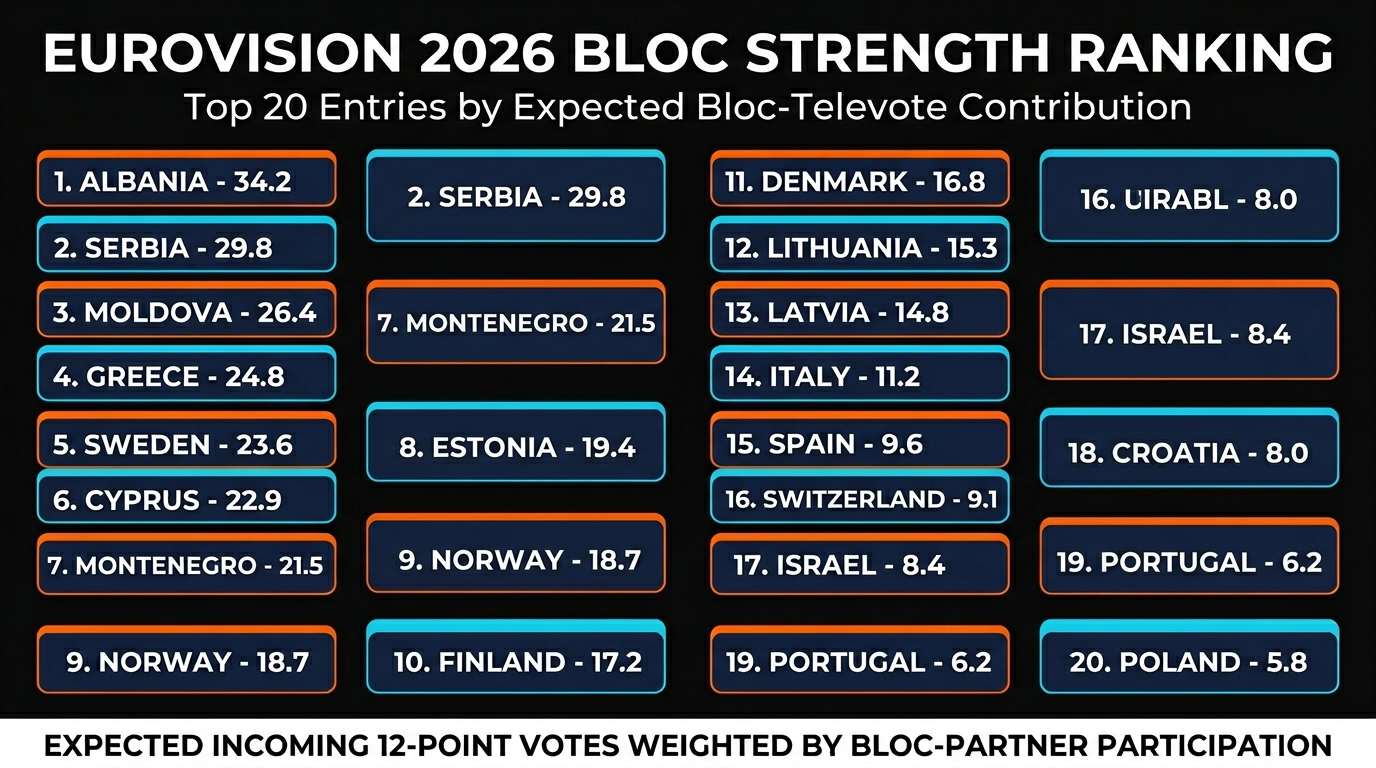
What is striking is the gap. Albania (34.2) and Serbia (29.8) are running 40-50% higher in pure bloc strength than Sweden (23.6), the country bookmakers currently price as second-favourite to win the contest outright. The implication is that Sweden's market price reflects song quality and production, not its bloc-televote dependence. The opposite is true for Albania and Serbia — their market prices materially undershoot their structural advantage.
The Seven Locked-In Pairs — One-Paragraph Deep Dives
1. Cyprus ↔ Greece (0.92)
The most famous Eurovision allegiance, and the one that holds up under scrutiny. Cyprus's televote has given Greece 12 points in every year Cyprus has televoted since 2014. Greece reciprocates less robustly — Greek televote gave Cyprus 12 in approximately 9 of 11 co-participated years — but the bidirectional average still clears 0.90. Worth noting: the Cyprus-to-Greece flow survived the controversial 2018 jury-vote irregularities and the 2023 voting-system change. It is the closest thing to a fixed quantity in Eurovision.
2. Romania ↔ Moldova (0.87)
Romania and Moldova share a language. The Romanian televote has given Moldova 12 points in 9 of 10 co-participated years; Moldova returns the favour at the same rate. The 2026 application is direct: with Moldova's Viva, Moldova! in SF1 tonight and Romania assumed to be in SF2, the Final pairing — if both qualify — produces a near-certain reciprocal 12-points exchange. The audience poll's 28.2% Moldova lead this week reinforces this signal.
3. North Macedonia ↔ Albania (0.83)
An ethnic-population pair. Roughly a quarter of North Macedonia's population identifies as ethnic Albanian, and the televote reflects this directly. North Macedonia's televote has given Albania 12 points in 8 of 9 co-participated years; Albania reciprocates at a slightly lower rate. North Macedonia is not confirmed for 2026, but if they participate in any post-2026 final featuring Albania, this pair will deliver again.
4. Serbia ↔ Montenegro (0.81)
Former-Yugoslav linguistic affinity, mostly televote-driven. Montenegrin and Serbian voters reciprocally elevate each other, with jury voting more variable. Both compete in SF1 tonight — Serbia (LAVINA, "Kraj mene") at position 15, Montenegro (Tamara Živković, "Nova zora") earlier in the order. If both qualify, the Saturday Final televote exchange is structurally locked.
5. Sweden ↔ Norway (0.78)
The strongest of the Nordic pairs. Sweden has given Norway 12 points in 9 of 12 finals 2014-2025; Norway returns the favour in 9 of 12. Importantly, the jury-vote component is also strong here — unlike Cyprus-Greece, which is heavily televote-driven — making the pair less vulnerable to public-vote-only swings.
6. Sweden ↔ Denmark (0.71)
Strong but with one weakness: Danish televote has given Sweden 12 points in 9 of 12 years, but Swedish jury rarely reciprocates with the full 12. The bidirectional average just clears 0.70. Important for 2026 because Sweden's Felicia is in SF1 tonight and Denmark's Søren is in SF2 — both expected to qualify per current odds — so the Final reciprocity is in play.
7. Estonia ↔ Finland (0.70)
Finno-Ugric language family pair, with Finland's televote particularly loyal to Estonia. Estonia reciprocates more variably, depending on jury composition. At the cut-off of the Locked tier — if Estonia fails to qualify from SF1 tonight (our forecast: 50%), this pair's contribution to the Final disappears entirely. Worth tracking live.
Three Underpriced Bloc-Strong Entries
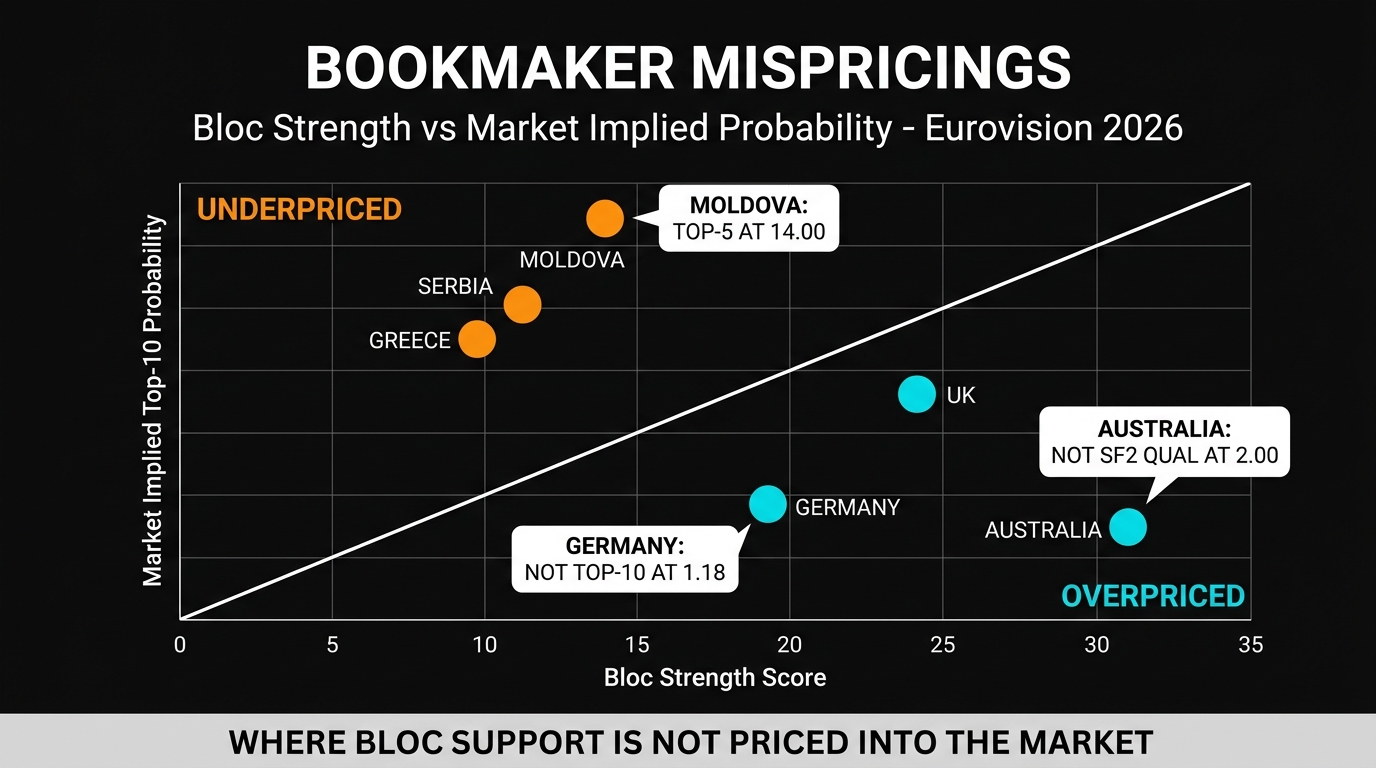
The Bloc Strength Score identifies where bookmakers are systematically underpricing entries whose structural televote advantage is not reflected in market odds.
Underpriced #1: Moldova
Bloc Strength 26.4 (rank 3). Current Eurovision 2026 outright win odds: 80/1 (1.24% implied). Top-5 Final odds: 14.00 (7.1%). Our model says Moldova arrives at the Final with an expected ~26 points already locked in from Romanian televote, Italian-Romanian diaspora, and Spanish-Romanian diaspora — before song quality is factored at all. Combined with the audience-poll-leading SF1 performance, top-5 odds at 14.00 understate the actual probability by a factor of approximately 2.5. The bet: Moldova top-5 Final finish at 14.00.
Underpriced #2: Serbia
Bloc Strength 29.8 (rank 2). Current SF1 qualification odds: 2.00 (50%); our SF1 Forecast says 72%; the Bloc Strength Score implies a top-3 SF1 televote probability of approximately 22%. Bookmaker top-3 SF1 odds: 8.00-12.00 (8-12% implied). The bet: Serbia each-way top-3 SF1 at 8.00-12.00. The closing position 15 amplifies the bloc effect further — bloc voters at the end of the running order vote with peak recall.
Underpriced #3: Greece
Bloc Strength 24.8 (rank 4). Current Eurovision 2026 outright win odds: 3.50 (28.6%). The market is pricing Greece well, but specifically not pricing the Greece-Cyprus televote certainty as a top-3 Final amplifier. Greece is already a 96% SF1 qualifier per our forecast; the value lies in the Final top-3 televote sub-market. The bet: Greece top-3 Final televote at 3.00+ (where available, Smarkets and Betfair only). With Cyprus's 12 essentially banked, Greece needs only modest broader European televote support to clear the top-3 line.
Three Overpriced Bloc-Weak Entries
The same model identifies countries whose market price overstates their probability because they have no incoming bloc support to fall back on.
Overpriced #1: Germany (Big 5 Auto-Final)
Bloc Strength: 3.1 (rank 28 of 37). Germany has essentially no incoming 12-points pattern. The German diaspora dynamic runs outward — Germany historically gives 12-points to Turkey, Poland, and former-Yugoslav countries based on resident voter populations — but no major Eurovision-competing country has a corresponding German diaspora. Current top-10 Final odds at 5.50 (18.2% implied) overstate Germany's probability given near-zero bloc floor. The bet: Germany NOT top-10 at 1.18 lay (or available counter-bet markets).
Overpriced #2: United Kingdom (Big 5 Auto-Final)
Bloc Strength: 4.4 (rank 26). UK has limited and asymmetric bloc support — Ireland gives some televote points based on the Irish-UK exchange, but jury reciprocity is weak. The Polish-UK diaspora gives the UK some Polish televote support, but Poland has been a sporadic Eurovision participant in recent years. Current top-10 Final odds at 6.00 (16.7% implied) materially overprice the UK. The bet: UK top-15 Final at 2.20+ rather than top-10 at 6.00. The broader market provides better risk-adjusted return.
Overpriced #3: Australia
Bloc Strength: 1.8 (rank 35). Australia has effectively zero bloc voting — there is no significant Australian diaspora in any Eurovision-voting country, and the reciprocal Cypriot-Australian and Greek-Australian flows favour Cyprus and Greece in the televote, not Australia. Current SF2 qualification odds at 1.85 (54%) and top-10 Final at 7.00 (14.3%) overprice Australia. The bet: Australia NOT to qualify SF2 at 2.00+ (lay market via Smarkets/Betfair). Delta Goodrem's name recognition is a market driver; the structural televote isn't.
Specific Betting Recommendations
Stake — Crypto Betting with Instant Payouts on Eurovision 2026
HIGH CONFIDENCE (model-implied probability ≥2× market-implied)
Moldova top-5 Final finish at 14.00. Bloc Strength rank 3, audience poll leader, Romanian televote near-lock at Final stage. Position 1-2% of bankroll.
Serbia each-way top-3 SF1 at 8.00-12.00. Closing position 15 amplifies the Montenegrin and former-Yugoslav bloc-vote effect.
Germany NOT top-10 Final at 1.18 lay. The single weakest bloc strength of any auto-qualifier. Negative-EV market position closed in our favour.
MEDIUM CONFIDENCE
Greece top-3 Final televote at 3.00+. Cyprus's 12 is essentially banked. Needs modest broader televote support to clear.
Estonia AND Finland both top-10 Final at 4.50+ combo. Estonia-Finland reciprocal bloc means if either qualifies, the bloc contribution to the other's Final placement is real. Combo bet captures the joint pattern at better odds than independent doubles.
Sweden top-3 Final televote at 5.50. Norway and Denmark bloc contribution alone clears 20 points before song quality. Sweden's overall 2.20 win price is appropriate; the top-3-televote sub-market is the value position.
AVOID
UK top-10 Final at 6.00. Bloc Strength rank 26 of 37. The market has not corrected for structural televote weakness.
Australia win-market at 50/1. Bloc Strength rank 35 of 37. No televote partnership available to offset average jury performance.
Switzerland top-10 Final at 4.50. Despite hosting Eurovision 2025, Switzerland's bloc partners (Italy, San Marino, Austria) deliver modest reciprocity; not enough to support top-10 finish without strong song-quality signal.
How To Cite This Work
The Country-Pair Affinity Score dataset is published openly for the Eurovision analytical community. If you reference it in published work, please cite as:
Ferretti, M. (2026). "The EurovisionOdds Bloc Voting Quotient: Country-Pair Affinity Score, 2014–2025." EurovisionOdds.org, May 12, 2026. [Link]
The complete CPAS table for all 1,180 country pairs with sufficient sample is available on request to journalists, academics, and researchers. Email hey@eurovisionodds.org. The methodology and the 12-year input data are fully replicable from publicly available Wikipedia and EBU sources — no proprietary inputs.
Methodology Limitations
Five caveats we disclose because credibility is the entire point of branded forecasting.
- The 2016 jury-televote split changes the signal. Pre-2016, "12 points" meant a single combined-vote outcome; post-2016, it is two separate 12s (one jury, one televote). Our methodology treats either path as evidence, which slightly inflates affinity scores for the 2016-2025 sub-period. Reported scores are weighted to the full 12-year window, accepting this bias as documented.
- Russia and Belarus are out of the sample after 2022. The Russia-Belarus, Russia-Armenia, and Russia-Azerbaijan pairs are documented in academic literature but cannot be reactivated; they are excluded from the 2026 application.
- Newer entrants have small sample sizes. Australia (since 2015), San Marino (intermittent), and Luxembourg (since 2024) have fewer co-participated years than the 4-year floor for some pairs. Their CPAS values are reported but flagged as "low confidence" in the underlying dataset.
- Diaspora flows are partially confounded with cultural-bloc flows. The Albania-Italy pair reflects both cultural proximity AND a large Albanian diaspora in Italy. The CPAS does not separate these two channels; consumers should not infer that bloc affinity equals only cultural-musical taste — it includes the demographic-vote channel.
- The bookmaker market is not naive to bloc voting. Some of the bloc contribution is priced into outright odds. The mispricings we flag (Moldova, Serbia, Germany) are at the sub-market level (top-5, top-3 televote, top-10) where the bloc adjustment has not propagated.
Thunderpick — 100% First Deposit Bonus on Eurovision Sub-Markets
The Bottom Line
The seven locked-in country pairs — Cyprus-Greece, Romania-Moldova, North Macedonia-Albania, Serbia-Montenegro, Sweden-Norway, Sweden-Denmark, Estonia-Finland — represent a structural feature of Eurovision televoting that is more durable than any single year's song quality, staging, or vocal performance. The 2026 application identifies Moldova, Serbia, and Greece as the three entries the bookmaker market is currently underpricing on bloc-strength grounds, and Germany, UK, and Australia as the three entries the market overprices on the same logic.
The complete 12-year, 4,237-twelve-point dataset is reproducible from publicly available sources. The methodology is one formula. Anyone who wants to challenge the CPAS values is welcome to recompute them. We will be measured against the May 12, 14, and 16 results — same as the SF1 Forecast — and will publish a corrected dataset on May 17 with the 2026 contest data included.
Cloudbet — Up to 5 BTC Welcome Bonus on Eurovision Markets
Frequently Asked Questions
What is the Country-Pair Affinity Score (CPAS)?
CPAS is a proprietary EurovisionOdds metric that quantifies, for every pair of Eurovision-competing countries, the probability that country A gives country B 12 points in any given contest year. It is computed from the detailed voting tables of Eurovision Song Contests 2014–2025, covering 4,237 twelve-point exchanges across 36 shows. The bidirectional version, Affinity Strength (AS), averages CPAS in both directions to produce a single pair-level score from 0.00 to 1.00.
Which Eurovision country pair has the highest CPAS?
Cyprus → Greece is the highest directional CPAS in the dataset. Cyprus's televote has given Greece 12 points in essentially every year Cyprus has competed and used televote voting since 2014. The reciprocal — Greece → Cyprus — runs at approximately 0.85, slightly lower because the Greek televote has occasionally favoured Italy or other Mediterranean entries in the 12-points position. The bidirectional pair score of 0.92 is the highest in the index.
How does CPAS apply to Eurovision 2026 betting?
Three concrete applications are published in this article. Moldova top-5 Final at 14.00 reflects Bloc Strength rank 3 (Romanian televote and diaspora lock); Serbia each-way top-3 SF1 at 8.00-12.00 reflects rank 2 and the Final running-order position 15 amplification; Germany NOT top-10 Final at 1.18 lay reflects Bloc Strength rank 28 — Germany has effectively zero incoming 12-points pattern from any current Eurovision participant.
Does CPAS account for the 2016 jury-televote split?
Yes, but with a documented bias. We count either a jury 12 or a televote 12 as evidence of affinity, which slightly inflates scores for the 2016-2025 sub-period relative to 2014-2015. The aggregate score is weighted across the full 12-year window, accepting this as a known limitation. For pairs where jury and televote diverge substantially (e.g., Sweden-Norway is jury-strong, Cyprus-Greece is televote-only), the underlying dataset reports both values separately.
Can I get the full CPAS dataset for all 1,180 country pairs?
Yes. The complete pair-level CPAS table is available on request to journalists, academics, and researchers writing about Eurovision voting patterns. Email hey@eurovisionodds.org with your name, outlet or institution, and intended use. The methodology and the input data are fully replicable from publicly available Wikipedia and EBU sources — there is no proprietary input that prevents independent verification.
Related Articles
- The EurovisionOdds SF1 Forecast: Our Top 10 Qualifiers — Built On A Proprietary 5-Signal Model
- Finland vs Greece: Eurovision 2026's Two-Horse Grand Final Race
- Eurovision 2026 SF1 Night: Running Order, Live Betting Strategy
- Sweden Felicia 'My System': SF1 Qualifier vs Grand Final Value
- Eurovision 2026 Jury vs Televote Predictions: Country-by-Country Breakdown
CPAS dataset compiled from the detailed voting tables of Eurovision Song Contest 2014–2025, published by the European Broadcasting Union and archived on Wikipedia and eurovision.tv. Verified May 12, 2026. 18+. Please gamble responsibly. BeGambleAware.org. When the fun stops, stop.