
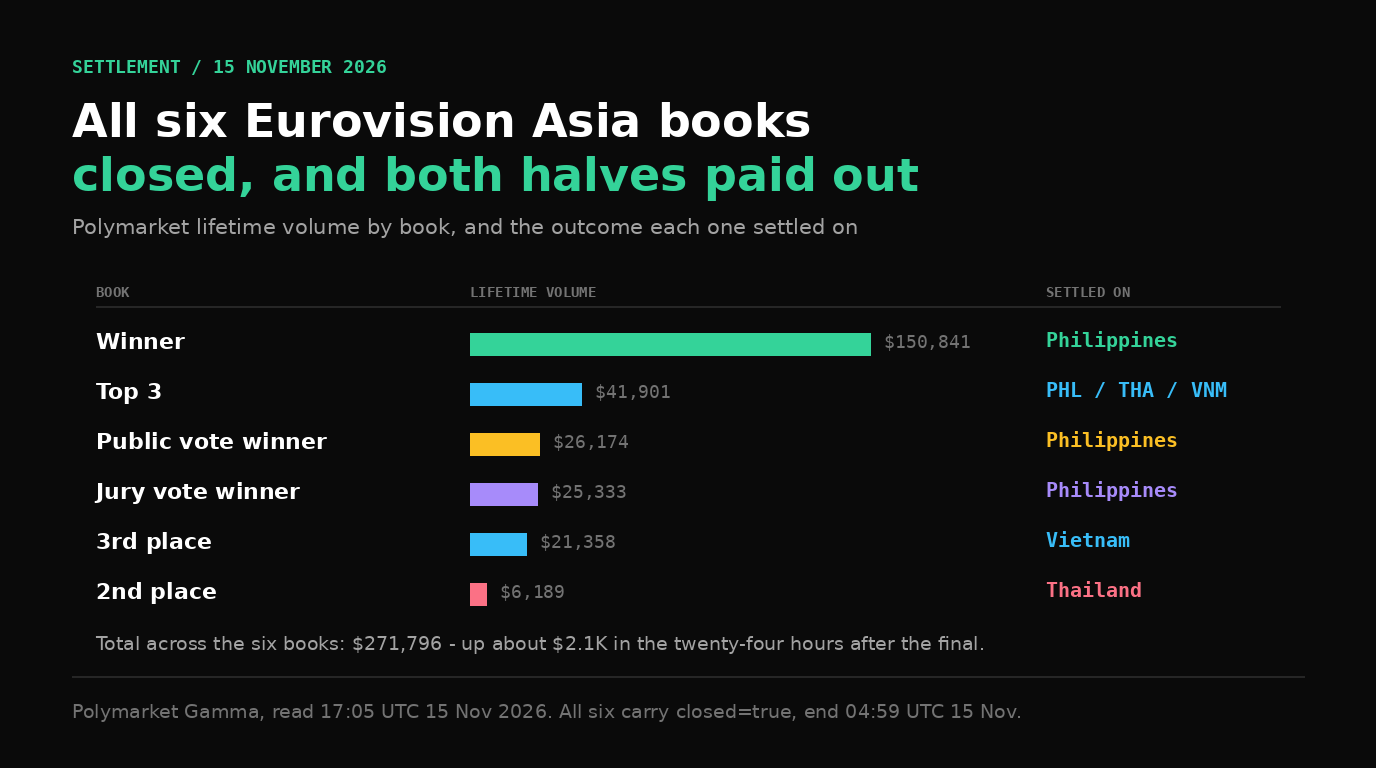
All six Eurovision Asia 2026 prediction markets have now closed and paid out. Polymarket

18+ | New customers only | T&Cs apply | Please gamble responsibly
stamped every one of them with an end time of 04:59 UTC on 15 November 2026, about fifteen
and a half hours after CARMELLE won the inaugural contest in Bangkok — and the two books that were still
open and arguing when this site last read them, the jury winner and the public-vote winner, both settled on
the Philippines.
That resolves the one genuinely open question left over from Saturday night. It also leaves behind the most
useful lesson of the whole contest for anyone who trades these markets, and it is not the one about the
favourite losing.
What the six Eurovision Asia books settled on
Read from the Polymarket Gamma API at 17:05 UTC on 15 November 2026, all six carry
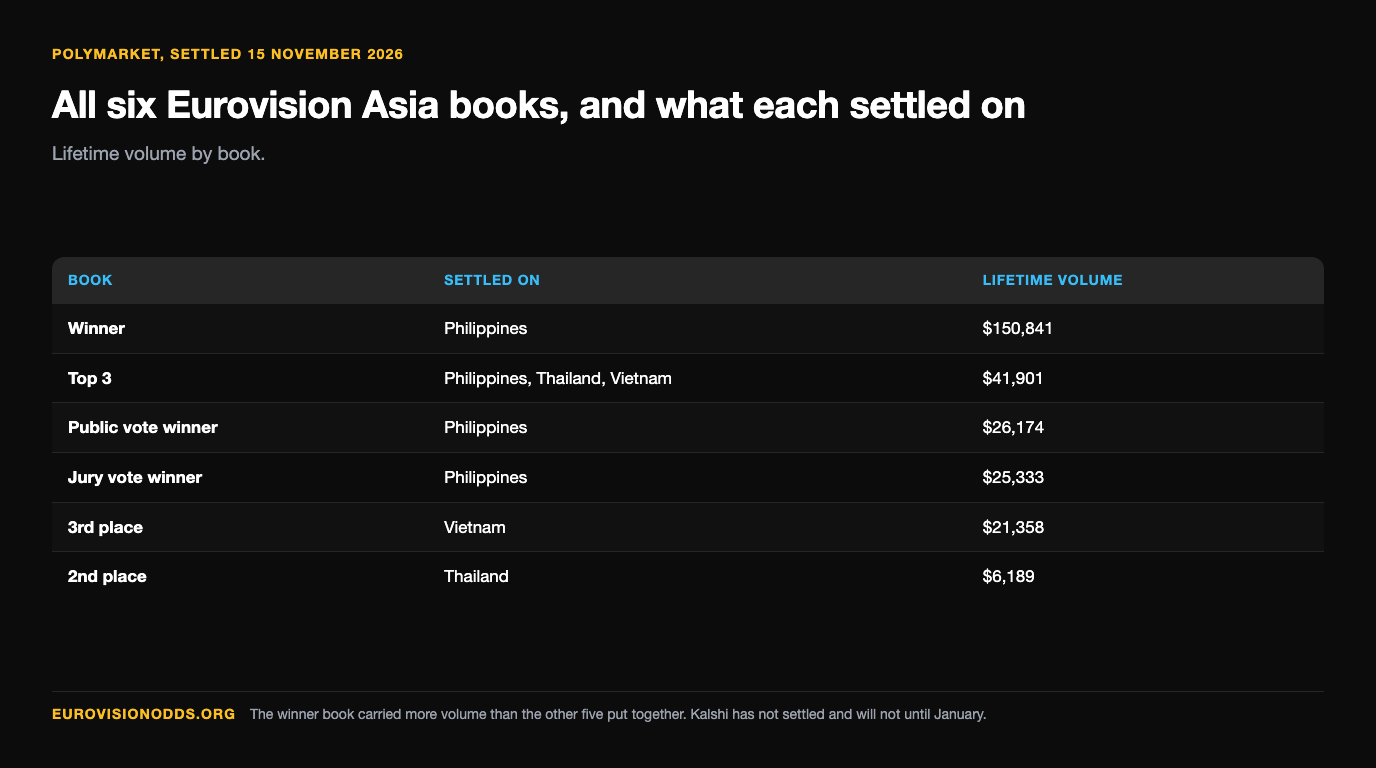
closed: true. The outcomes, with each book’s lifetime turnover:
| Book | Settled on | Lifetime volume |
|---|---|---|
| Winner | Philippines | $150,841 |
| Top 3 | Philippines, Thailand, Vietnam | $41,901 |
| Public vote winner | Philippines | $26,174 |
| Jury vote winner | Philippines | $25,333 |
| 3rd place | Vietnam | $21,358 |
| 2nd place | Thailand | $6,189 |
Total turnover across the six finished at about $271,796. That is up only about
$2.1K on the roughly $269.7K this site read at 17:04 UTC the day before — so the
enormous settlement churn of result night, when the six books put on about $122.3K in twenty-four hours, had
essentially finished within a day. The winner book alone took 55% of all money ever staked on
this contest.
Every settlement matched the scoreboard on our Eurovision Asia hub: the
Philippines first on 211, Thailand second on 170, Vietnam third on 164. There were no disputed resolutions and
no outcome reversed.
The real lesson: the settlement source was published before the market believed it
Here is the part worth keeping. When this site read the books at 17:04 UTC on 14 November,
roughly three and a half hours after the final ended, the public-vote book was quoting the Philippines at
about 84.6% — not 100% — and the jury book had not resolved either. The reason
given at the time, including here, was that the organisers had published no per-country scoreboard, so there
was nothing official for a split book to settle against.
That reasoning was wrong, and it is worth saying so plainly. A jury-winner book does not
need an eleven-row scoreboard. It needs one fact: which country topped the jury vote. The same goes for the
public-vote book. And both of those facts were already in the EBU’s own press release, published on the
night of the final, which states that CARMELLE scored 93 jury points and 118 public points and
that she topped both the jury and the public votes.
So the resolution source existed. What was missing — the full eleven-country split for places 6 to 11
— was never needed to settle either book. The market was pricing a documentation problem that did not
apply to the question it was actually asking.
In trading terms: at 84.6c, the public-vote contract was offering roughly 18% on a settlement that
an official EBU release had already determined, with about eleven and a half hours to run before the
books closed. That is as close to free information as this contest produced, and it came from reading the
primary source rather than the order book.
Three honest caveats, because this is the kind of claim that flatters a writer after the fact.
First, 84.6% was a midpoint, not a fill: the size actually available at that price is not something this site
observed, and on a book with $26,174 of lifetime volume it may have been small. Second, settlement risk is
real and not zero — a venue can resolve late, or against a source you did not expect, and “the EBU
said so” is a strong argument rather than a contractual guarantee. Third, we are the site that wrote the
wrong explanation on the night, so this is a correction of our own reasoning, not a victory lap over anybody
else’s.
Scoring the books: what the post-mortem found
The full scoring exercise ran here the day after the final and does not need repeating in detail —
the short version is that the outright book did its job and one book actively misinformed anyone who trusted
it. Measured by log-loss against the actual winner, with a no-information baseline of 2.398 for an eleven-way
field:
- Public vote — Philippines 46.5% at the close, log-loss 0.766. Comfortably the best
of the three.
- Outright winner — Philippines 31.0%, log-loss 1.171. Better than chance, and the
champion was its second favourite.
- Jury winner — Philippines 2.8%, log-loss 3.576. Worse than knowing
nothing at all.
The jury book is the one to carry forward, and the reason is structural rather than bad luck. The juries
had already voted at Friday’s Jury Final, so by the time of the closing read the jury half of the result
existed on paper. This site called that a sharpening force. It is the opposite: when the outcome is fixed but
unpublished, no new public evidence can arrive to correct a mistaken price, so the crowd simply compounds its
own prior until settlement. The full
post-mortem, scoring all six books against the result, has the workings.
Where the money actually went, and what it was worst at
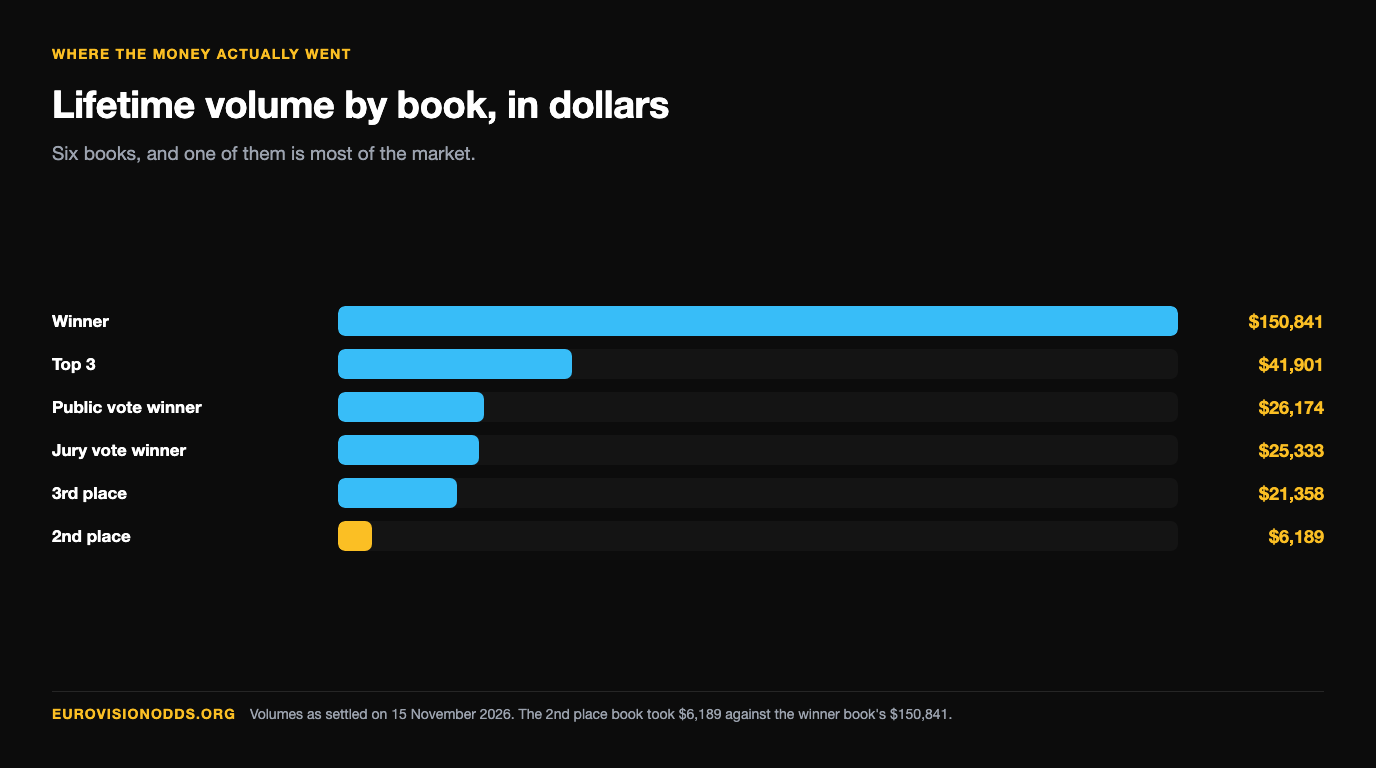
The volume split across the six books is worth a look on its own, because it says something about how a
new contest gets priced. The outright winner book took 55% of every dollar staked. The two
split books — jury and public — took about 19% between them. The
second-place book took $6,189, about 2.3% of the event, and it was
both the least traded and the worst priced.
That is not a coincidence. The second-place market asks the hardest question on the board — it
requires you to be right about a country finishing in one exact position, not merely finishing well —
and it attracted the least capital and the least attention. This site declined to quote it for four straight
days on the grounds that a book showing Nepal at 9.85% for second place and 0.15% for third, on under $100 of
turnover, was not describing anything. Nepal finished ninth. The book settled on Thailand, which had been
quoted around 12.0% for the position.
Thailand is the mispricing of the contest, and it should be stated without inventing a reason for
it. The host entry closed at 1.55% in the outright book after an unexplained
one-day collapse from 5.0% on 13 November, and then finished second, on 170 points and the
second-best public score of the night. This site published that collapse as unexplained at the time and still
has no explanation for it. The result makes it expensive; it does not make it explicable, and retrofitting a
cause now would be exactly the kind of storytelling a betting site should not do.
The pattern across all six books is consistent: money concentrated in the simplest question, and
accuracy did not follow it. The best-calibrated book of the six, the public vote, carried barely a
tenth of the event’s turnover.
Kalshi has not settled — and will not until January
The other venue is a different story, and it is the clearest illustration yet of why “the odds”
on this contest always needed a venue attached.
Kalshi’s regulated Eurovision Asia market, KXEUROVISIONASIA-26, opened on
14 September 2026 — seven weeks before Polymarket listed anything — and its
contracts were still marked active when this site read the board at 17:05 UTC on 15
November, with a scheduled close of 2 January 2027. The Philippines was marked at
98c with a 98c bid against a 100c offer. The contest had been decided for more than a day.
Two things follow, and they pull in opposite directions. The first is that a 2c gap on an event that has
already happened is, arithmetically, the price of waiting about seven weeks for a venue to settle. The second
is the reason not to get excited about that: on the same read, ten of the eleven contracts had no bid
at all, so there was no reliable way out before January, and several last-traded marks were stale
leftovers from a contest that no longer had any uncertainty in it — Vietnam at 10c and Thailand at 2c,
for countries that had by then finished third and second. Stale marks on an untraded board are not prices.
This site has said all autumn that where the two venues disagreed, the Kalshi marks were the ones to
distrust. Settlement week made the point for us: one venue closed its entire slate within sixteen hours of the
trophy, and the other is holding positions open into the new year. If you want the comparison across both,
the bookmakers and exchanges page keeps it current.
What is actually open to bet on now
There is no Eurovision Asia 2027 market anywhere. Not on Polymarket, not on Kalshi, and no
fixed-odds bookmaker has ever priced this contest at all. That will stay true at least until the organisers
confirm a second edition and a host, and talks with the eleven broadcasters are only due to begin about a week
after the final — see our 2027 outlook
for what is actually known.
The one Eurovision book still trading anywhere is European: Eurovision 2027 Participants,
about $96.6K of lifetime volume, read at 17:05 UTC on 15 November 2026. Eight of its
fourteen contracts have resolved YES — Israel, Belgium, Germany, Italy, North Macedonia, Moldova,
Austria and Canada — and four resolved NO: the Netherlands, Iceland, Ireland and Kazakhstan. Only two
remain open, and they are exactly the two countries the EBU left undecided when it published its 36-country
field for Burgas on 28 October: Slovenia at about 11.2% and Spain at about
6.5%, both with a December deadline from the EBU. RTVE’s board vote, trailed for mid-October,
still had no reported result as of 15 November. Our Eurovision 2027 page tracks
every confirmation and withdrawal, and the winner market covers the European
contest proper.
Three things to take into 2027
- Read the primary source before the order book. The public-vote book spent its final
hours mispricing a question the EBU had already answered in writing. The edge was in a press release.
- Be most sceptical of a book whose outcome is already fixed but unpublished. The jury
market was the worst performer of the six precisely because nothing could correct it between the Jury Final
and settlement.
- Name the venue, always. One exchange settled this contest in sixteen hours; the other
will take until January. “The odds on Eurovision Asia” was never a single number.
The full result, the eleven-country scoreboard and how it was verified are in
our result report, and the winner’s
own story is in who is CARMELLE. The EBU’s
own announcement is
here,
and Eurovoix’s 2027 reporting is
here.
All prices in this article are Polymarket midpoints and Kalshi marks read at 17:05 UTC on 15 November
2026 unless another date is given. Prediction markets are not bookmakers; contracts settle at 0 or 100 and can
be illiquid. 18+. Please gamble responsibly.