
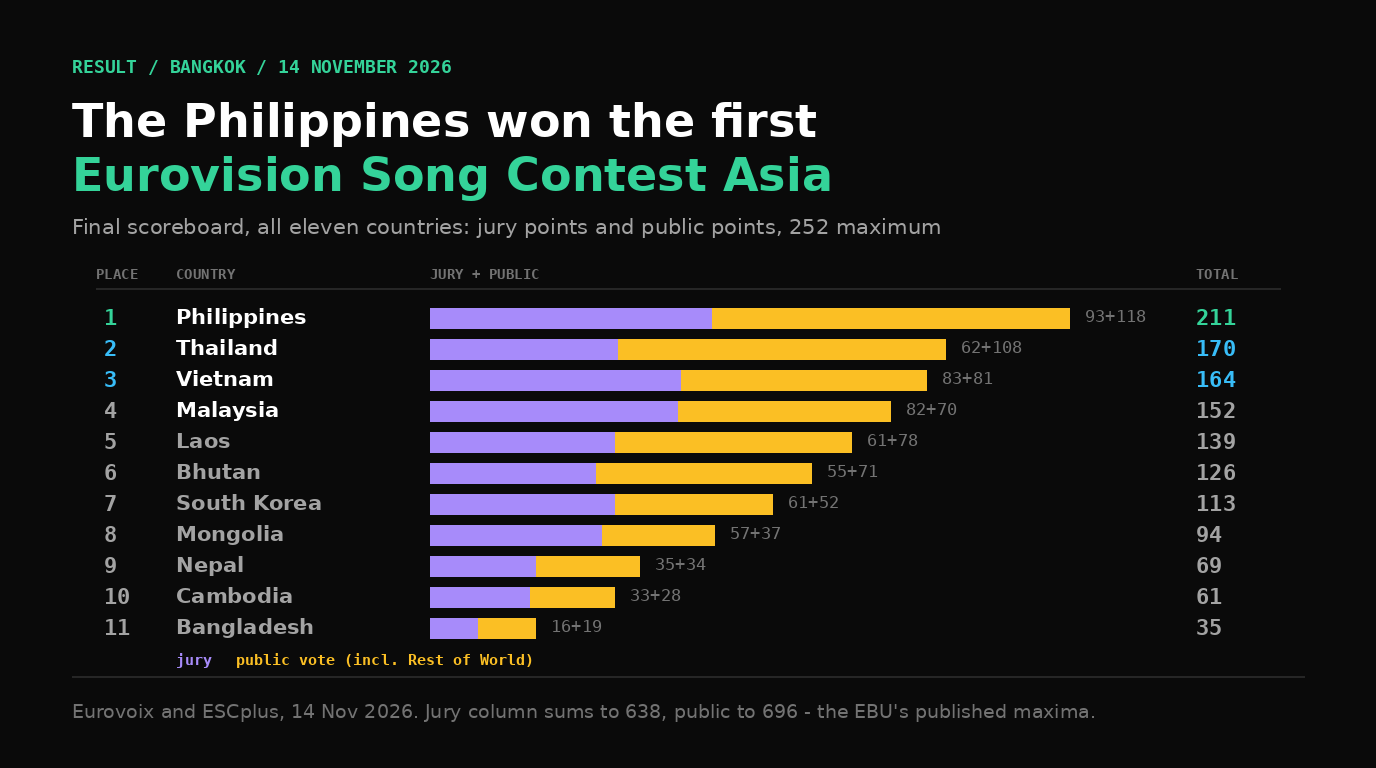
CARMELLE won Eurovision Asia 2026 for the Philippines. The question people have been

18+ | New customers only | T&Cs apply | Please gamble responsibly
searching all night — who won Eurovision Asia — has a short answer and a more interesting
scoreboard behind it. The 24-year-old from Quezon City took the inaugural Eurovision Song Contest Asia at the
One Bangkok Forum on Saturday 14 November 2026 with “Sobra-Sobra (Too Much)”, scoring
211 points: 93 from the eleven national juries and 118 from the public vote. Thailand’s
MANG x DAOU finished second on 170 and Vietnam’s Tóc Tiên third on 164. Malaysia’s
Aina Abdul, the favourite in every betting market for a fortnight, finished fourth.
This page carries the full Eurovision Asia 2026 results and scoreboard for all eleven countries, the jury
and public split for each, what the organisers did and did not publish, and what it means for the markets and
for 2027.
Who won Eurovision Asia 2026?
CARMELLE — Carmelle Collado — won for the Philippines with “Sobra-Sobra (Too Much)”,
the song that won her the ABS-CBN selection at the New Frontier Theater in Quezon City on 30 August 2026. She
is the first winner of the Eurovision Song Contest Asia, and the glass microphone she collected is the same
trophy design awarded at the European contest since 2008, rebranded for Asia.
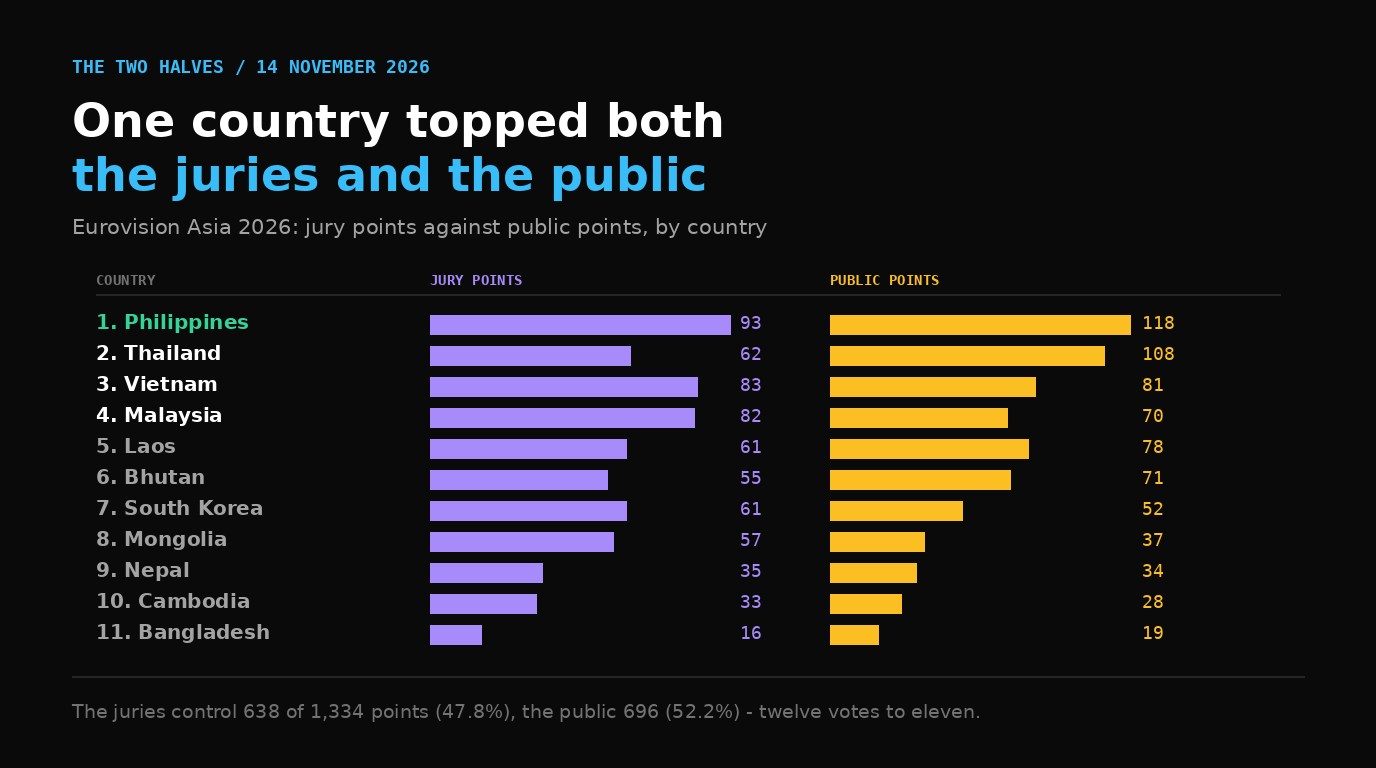
The margin was 41 points. More tellingly, she is the only act of the eleven to top both halves of
the vote. Under the official Voting Terms the Grand Final is a straight 50/50 between the eleven professional
juries and the public, and CARMELLE led the juries on 93 points and the public on 118. Five national juries
— Bhutan, Bangladesh, South Korea, Laos and Cambodia — gave the Philippines their maximum twelve.
Eurovision Asia 2026 full scoreboard
The complete Eurovision Asia 2026 scoreboard, all eleven countries, with the jury and public points that
make up each total:
| # | Country | Act | Song | Jury | Public | Total |
|---|---|---|---|---|---|---|
| 1 | Philippines | CARMELLE | “Sobra-Sobra (Too Much)” | 93 | 118 | 211 |
| 2 | Thailand | MANG x DAOU | “Aroma” | 62 | 108 | 170 |
| 3 | Vietnam | Tóc Tiên | “Em Tiên” | 83 | 81 | 164 |
| 4 | Malaysia | Aina Abdul | “Bluest Sky” | 82 | 70 | 152 |
| 5 | Laos | Thinla | “Bae” | 61 | 78 | 139 |
| 6 | Bhutan | Nyendra | “Lhayi Semo (The Angel)” | 55 | 71 | 126 |
| 7 | South Korea | JUNHEE | “Deep Dive” | 61 | 52 | 113 |
| 8 | Mongolia | Beck | “Chamguigeer (Without You)” | 57 | 37 | 94 |
| 9 | Nepal | Pratik Himal Rai | “Ananta Maya” | 35 | 34 | 69 |
| 10 | Cambodia | Monetrey | “I Let You Go” | 33 | 28 | 61 |
| 11 | Bangladesh | Beatmosphere | “Tumi Ele” | 16 | 19 | 35 |
A note on where these numbers come from, because it matters and almost nobody else is saying it: the
organisers did not publish a scoreboard. Voxovation and the EBU announced CARMELLE as the winner and
restated the voting method, but as of three hours after the show there was no official per-country breakdown
on eurovisionasia.com at
all. The table above is the one published by
and, independently and identically, by ESCplus.
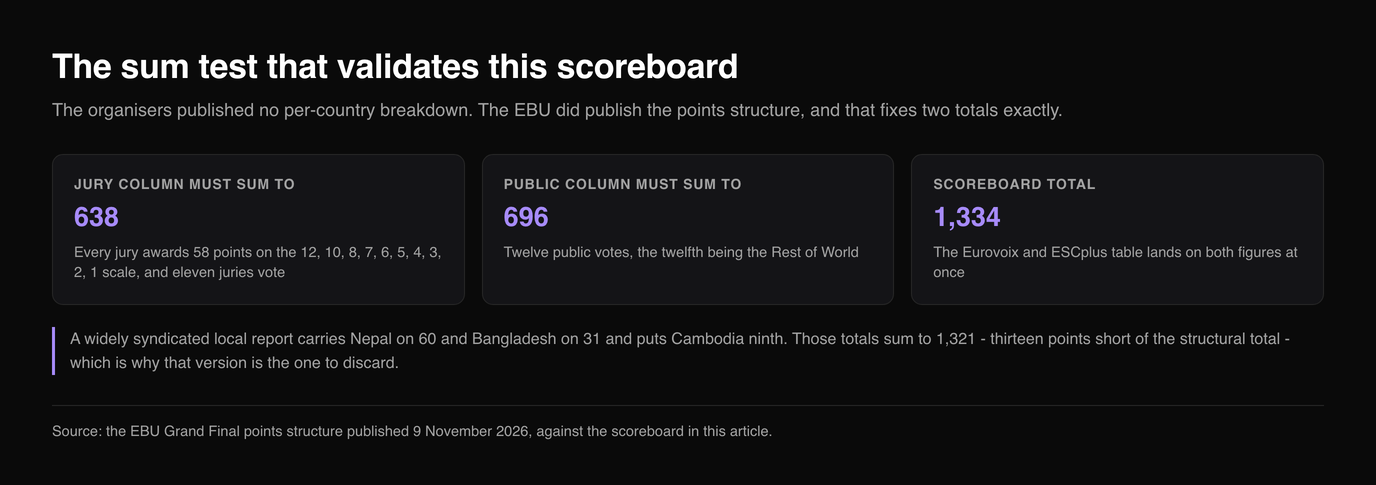
We are using it, and here is the checkable reason rather than a vague one. On 9 November the EBU published
the Grand Final points structure: both halves use the classic 12, 10, 8, 7, 6, 5, 4, 3, 2, 1 scale, and there
are 21 sets of points per song — ten national juries plus eleven public votes, the eleventh being the
Rest of World. That fixes two totals exactly. Every jury awards 58 points, so eleven juries distribute
638. Twelve public votes distribute 696. The scoreboard above sums to
precisely 638 in the jury column and precisely 696 in the public column, for 1,334 overall. Numbers that were
invented, mistyped or half-remembered do not land on both of those at once.
That test also settles a conflict worth flagging. A widely syndicated local report carries Nepal on 60 and
Bangladesh on 31, and puts Cambodia ninth ahead of Nepal. Those totals sum to 1,321 — thirteen points
short of the structural total — so that version is the one to discard. If the organisers publish an
official scoreboard that differs from the table above, we will correct this page and say that we did.
Thailand second: the host nation the market gave up on
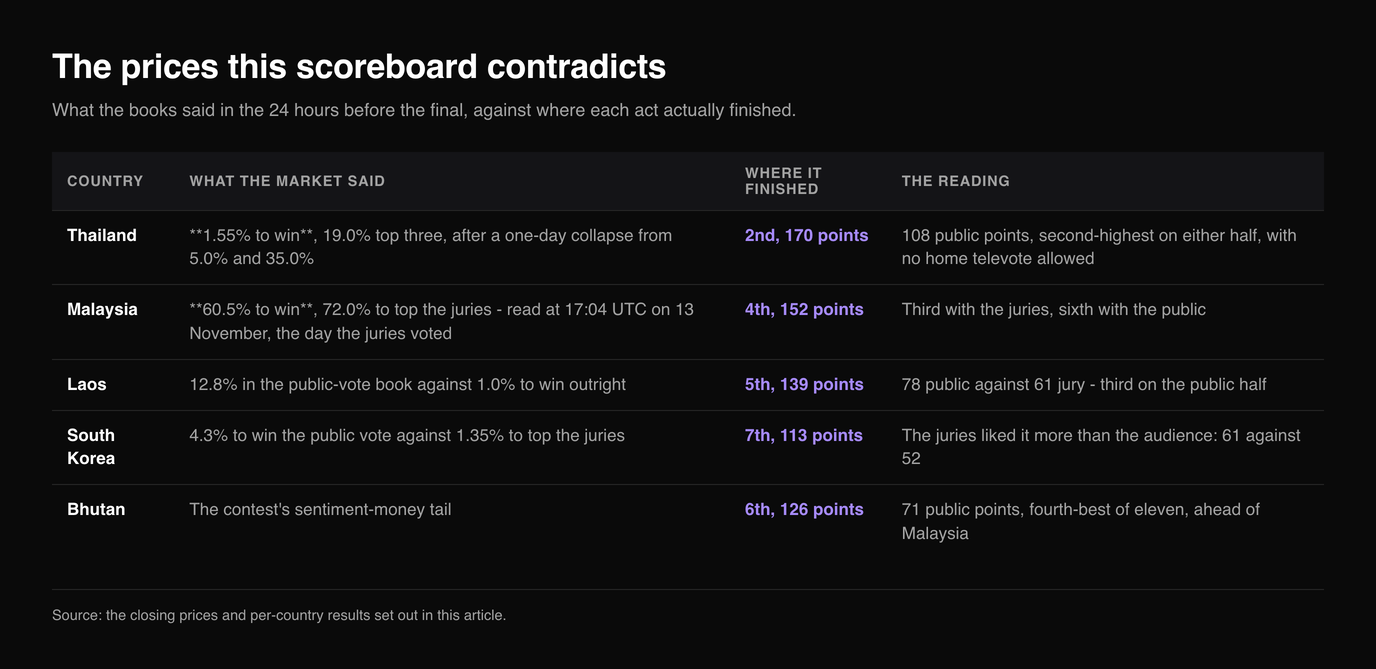
The second-place finish is the story the odds missed completely. MANG x DAOU took 170 points for the host
nation with “Aroma”, performed in Thai, and their 108 public points were the second-highest score
of the night on either half. They did it without a home televote: section 3.3 of the Voting Terms bars
residents from voting for their own country’s entry, so every one of those 108 points came from the other
ten countries and the Rest of World.
Twenty-four hours earlier Thailand had been priced at 1.55% to win and 19.0% for a top-three finish, after a
one-day collapse from 5.0% and 35.0% that no incident, staging problem or negative rehearsal report explained.
This site published that move as unexplained rather than inventing a reason for it. The result does not explain
it either — it just makes it considerably more expensive. A country quoted at 1.55% finished second.
Vietnam third, and the most balanced scoreline of the night
Tóc Tiên finished third on 164 points with “Em Tiên”, and her split is the
most even in the field: 83 jury points against 81 public, a gap of two. She was second with the juries behind
only the Philippines. The pre-contest worry about Vietnam, which this site wrote up in
its October piece on her chances, was that
a song chosen 40% by a Vietnamese public that already knows the singer has to travel to a final where Vietnamese
votes are one eleventh of the public half. It travelled.
Malaysia fourth: the favourite that led the wrong half
Aina Abdul finished fourth on 152 points. She was third with the juries on 82 — eleven behind the
Philippines, one behind Vietnam — and sixth with the public on 70, one point ahead of Bhutan.
The market had her at 60.5% to win the contest and 72.0% to top the juries, the latter read at 17:04 UTC on
13 November, which was the same day the eleven juries actually cast their votes at the Jury Final. That is the
single hardest number on the board to look at this morning: a 72% price on a jury outcome that had already
happened, and was wrong. We score all six books against the result in a
The rest of the field, 5th to 11th
Laos finished fifth on 139 points, and did it the way this site said it would if it did
anything at all: 78 public points against 61 jury. Thinla was third on the public half, behind only the
Philippines and Thailand. The
diaspora and bloc analysis published on 10 November
put roughly 286,000 Lao nationals inside Thailand’s public vote alone, and the public-vote book had Laos
at 12.8% against 1.0% to win outright — the starkest split on the board. That read was right.
Bhutan finished sixth on 126 points and is the night’s biggest overperformance against
its price. Nyendra, described on this site as the contest’s San Marino slot where sentiment money keeps
the tail honest, took 71 public points — fourth-best of the eleven, ahead of Malaysia — and the
Bhutanese jury handed the Philippines a maximum twelve.
South Korea finished seventh on 113, and the shape is the reverse of the pre-contest read.
JUNHEE was priced all week as a public-vote story (4.3% to win the public vote against 1.35% to top the juries);
in the event the juries liked “Deep Dive” rather more than the audience did, 61 against 52.
Mongolia finished eighth on 94 with the only entry in the field that is not the song its own
national selection chose: “Light” won Mongolia’s Chosen One on 10 October and was ruled
ineligible eight days later for a 2018 first release, so the runner-up was promoted without a re-vote. Beck took
57 jury points — on the jury half alone Mongolia would have finished seventh — against 37 public.
Nepal finished ninth on 69 in the country’s first entry in any Eurovision contest,
with almost perfectly even halves. Cambodia finished tenth on 61 with Monetrey’s
“I Let You Go”, the only three-language entry in the field and the last act chosen, on 17 October.
Bangladesh finished eleventh on 35: Beatmosphere’s “Tumi Ele” was the only
a cappella act in the contest — six voices, no instruments, no backing track — which was always
going to be either the most distinctive thing on the stage or the hardest sell on a single three-minute hearing.
What the missing scoreboard means for the markets
Six Polymarket books covered this contest, worth about $270,000 of turnover by the close of the night, and
they do not all settle cleanly. Every one of them settles on the official Grand Final ranking as
published. The winner is unambiguous, so the
winner book went to 99.95% on the Philippines within minutes, the
Top 3 and third-place books resolved to the right answers, and
the second-place book moved to Thailand.
The two split books are the problem. The jury winner and
public-vote winner markets carried roughly $51,000 of positions between them, and the
organisers have published no official per-country jury and public breakdown for them to settle against. You can
see the hesitation in the prices: three hours after the show, the public-vote book was quoting the Philippines
at about 84.6% rather than 100%, on an outcome that the fan-press scoreboard calls by a clear
ten points. This site flagged exactly this risk on 13 November, before the final, and it has landed. It is a
disclosure problem rather than an integrity one — nobody is suggesting the count was
wrong — but it is a real cost of a contest that published a full scoreboard for only one of its eleven
national selections all season.
What happens next
CARMELLE and the Philippines now hold the one concrete prize beyond the trophy: the Eurovision Asia winner
performs at the Eurovision Song Contest 2027 in Burgas, Bulgaria, the first
formal bridge between the Asian and European contests. A Filipino act is therefore scheduled to appear on the
European stage next May.
Hosting is a separate question, and Manila should not be assumed. Unlike the European contest, Eurovision
Asia does not hand the next edition to the winner: it uses a Junior Eurovision-style bidding process in which
interested broadcasters submit bids after the contest, assessed by the EBU and Voxovation on venue,
infrastructure, broadcast capacity and financial backing. Executive producer Assaf Blecher has said the
organisers are targeting 12 to 14 participating countries for future editions, with Kazakhstan publicly
exploring entry. The Eurovision Asia hub carries the full scoreboard, every
country’s page and the complete record of how the markets priced the inaugural contest.
Sources: Eurovoix
and ESCplus for the scoreboard (14 November 2026), the official
eurovisionasia.com winner
announcement, the EBU’s 9 November points structure, and the Polymarket Gamma API read at 17:04 UTC on
14 November 2026. Prices move; every figure here is dated.