
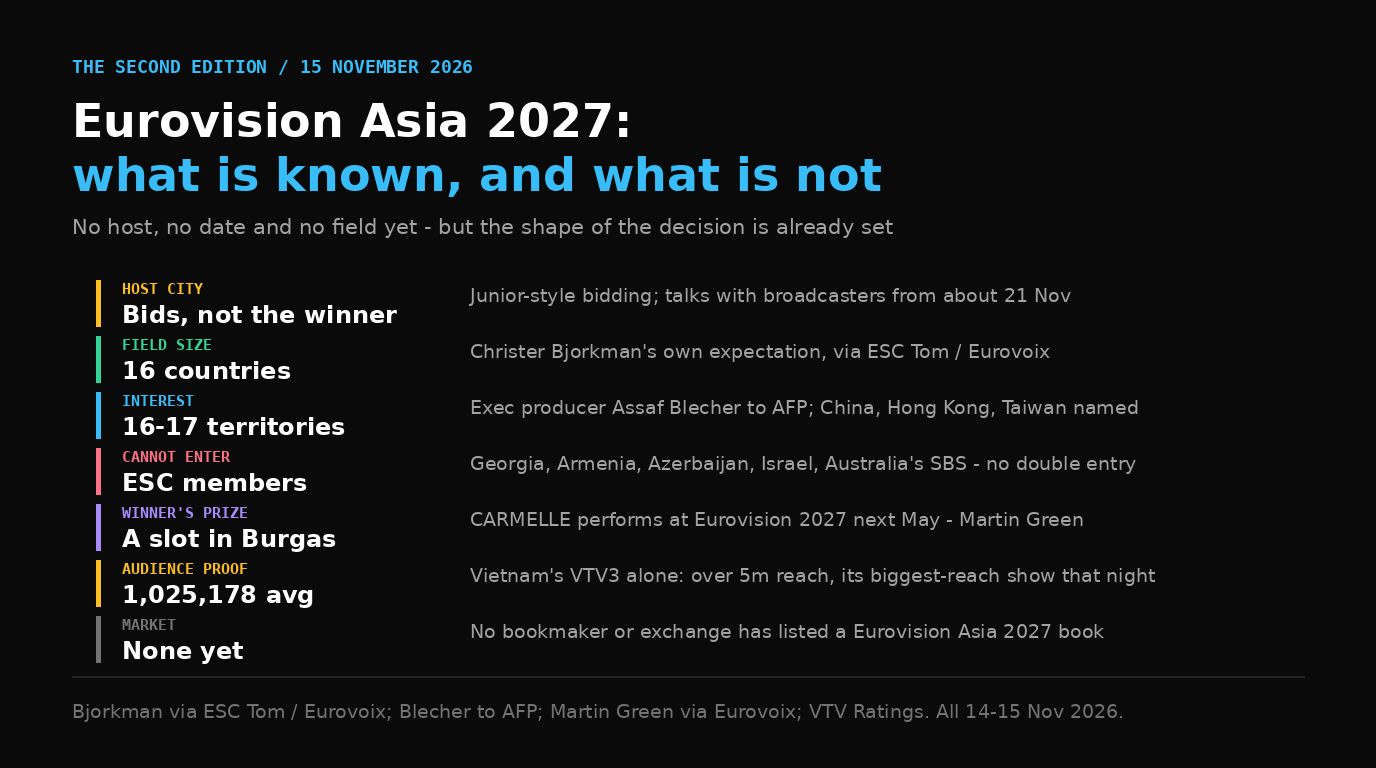
Talks on Eurovision Song Contest Asia 2027 begin about a week after Bangkok — so

18+ | New customers only | T&Cs apply | Please gamble responsibly
from roughly 21 November 2026 — and the single most important thing to understand about
the second edition is that the Philippines has not won the right to host it. Unlike the
European contest, Eurovision Asia does not hand the next show to the winner. It runs a bidding process.
Nothing about 2027 is confirmed yet: no host, no date, no field, and no market anywhere to bet on it. But
after a fortnight of organiser interviews around the final, the shape of the decision is now clear enough to
set out honestly, and to separate from the things fans are already assuming.
Who hosts Eurovision Asia 2027? Nobody knows yet — and the winner has no automatic claim
This is the question the search traffic is asking, and the answer is a process rather than a city.
Eurovoix, writing on the day of the final, is explicit: “Unlike the Eurovision Song Contest, the
winning country will not automatically host the next edition of the competition. A bidding process will be
held after the 2026 contest to determine where the 2027 contest will be held.” The model named is
the Junior Eurovision Song Contest, which for long stretches of its history let interested broadcasters bid
rather than rewarding the champion.
What exists so far is interest, not bids. At a press conference in Bangkok during contest week, organisers
confirmed that multiple cities in the countries that competed in 2026 want to host. No city
has been named publicly, and no bid has been lodged, evaluated or shortlisted. Anyone telling you Manila is
the favourite is guessing: a Philippine bid is plausible precisely because the Philippines competed, but so is
a bid from any of the other ten.
The practical timetable comes from Christer Björkman — Voxovation’s music
lead, and seven times Head of Contest at the European contest — speaking to the YouTube channel ESC Tom
in remarks
Discussions with each of the eleven competing broadcasters start a week after the contest concluded. That is
the point at which a second edition stops being an expectation and starts being a set of signatures.
How many countries will be in Eurovision Asia 2027?
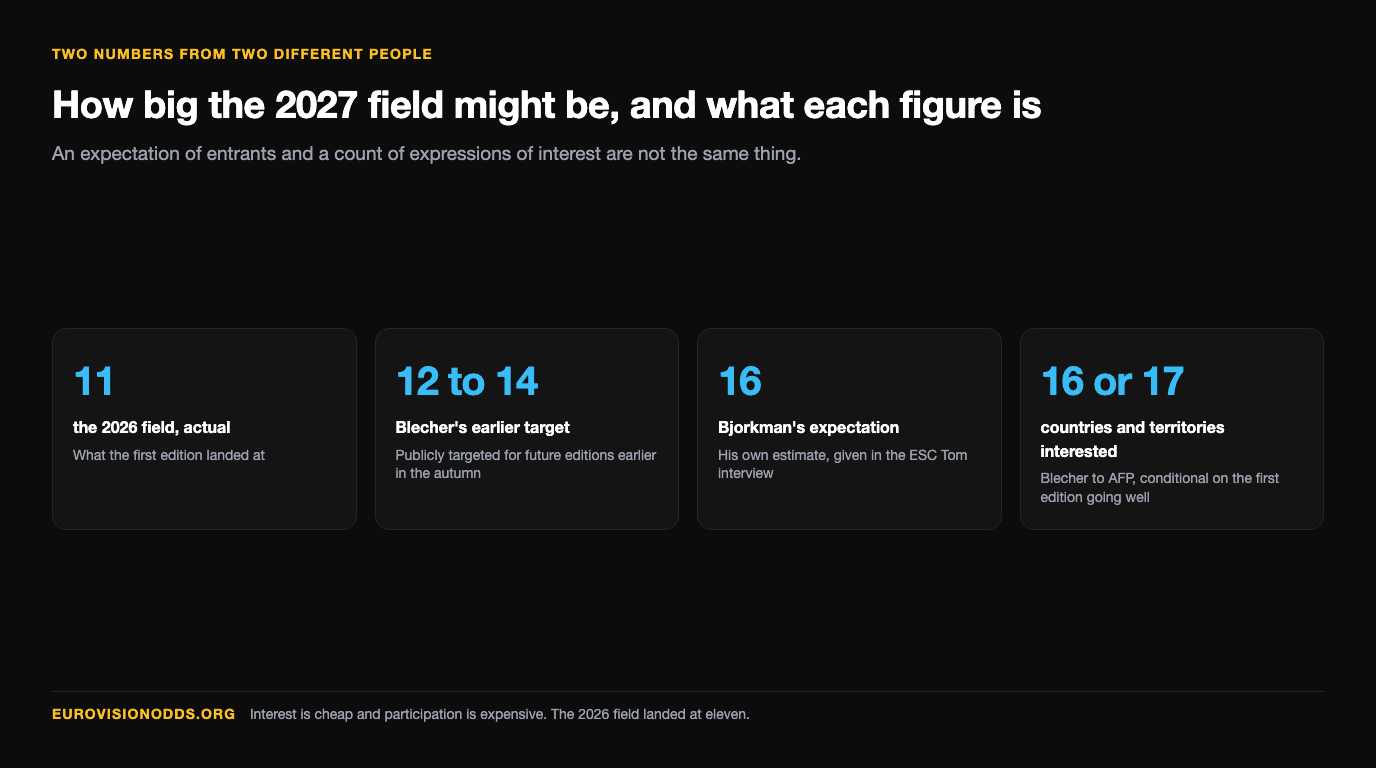
Two numbers are in circulation from two different people, and they are closer than they first look.
- Björkman expects sixteen countries to compete in the next edition — his own
estimate, given in the same ESC Tom interview.
- Executive producer Assaf Blecher told AFP that “16 or 17 countries and territories are
interested in joining”
in 2027, conditional on the first edition going well. He namedChina, Hong Kong and Taiwan among them.
Read those as what they are: an expectation of entrants and a count of expressions of interest. Interest is
cheap and participation is expensive, and this contest has already seen the gap — the 2026 field landed
at eleven. Still, both figures point the same way, and both are a substantial increase on the
12 to 14 countries Blecher was publicly targeting for future editions earlier in the autumn.
Our Eurovision Asia hub carries the current eleven and will track every addition.
The countries that cannot enter, whatever they want
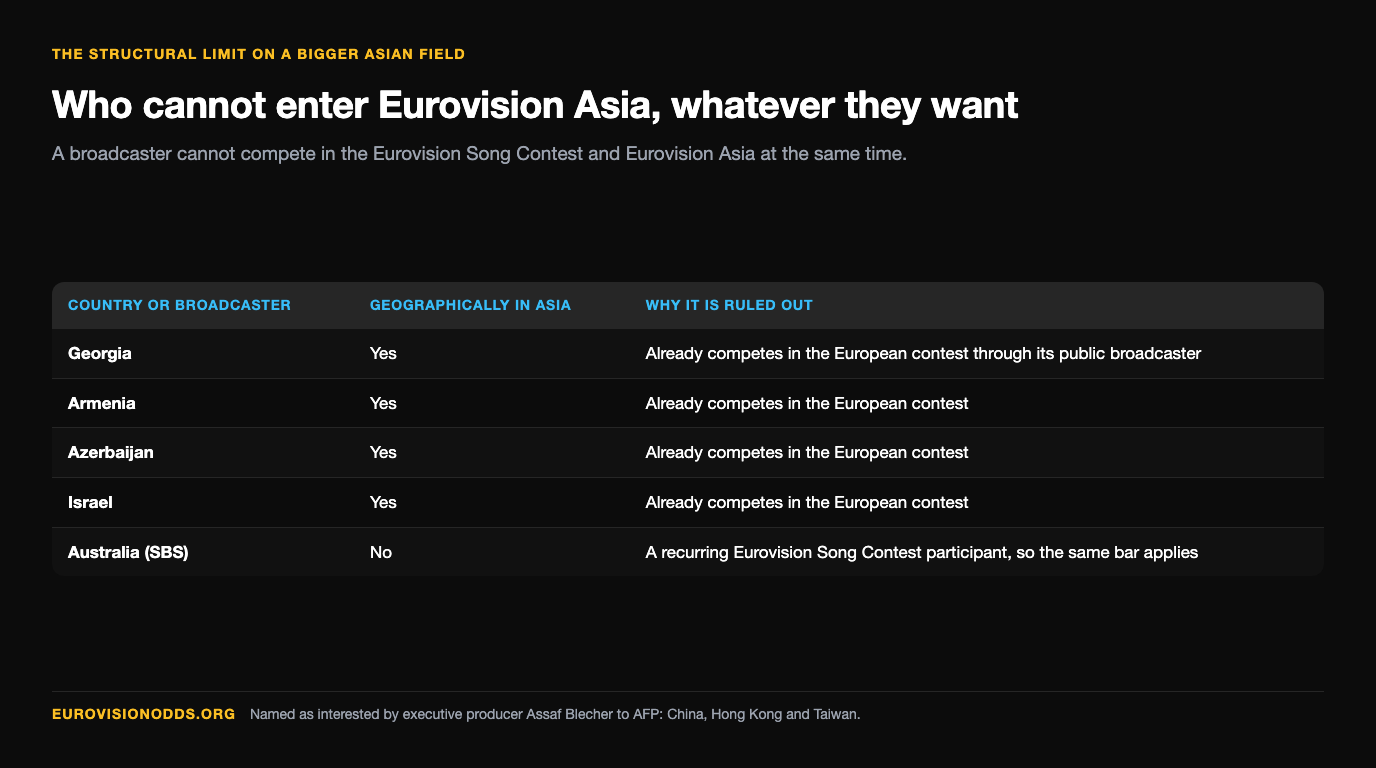
One structural limit is routinely missed in speculation about a bigger Asian field, and it is firm: a
broadcaster cannot compete in the Eurovision Song Contest and Eurovision Asia at the same time.
That rules out the obvious candidates. Georgia, Armenia, Azerbaijan and Israel are
geographically in Asia and already compete in the European contest through their public broadcasters, so those
broadcasters cannot enter the Asian one. Australia’s SBS is in the same position —
a recurring fan suggestion that the rule simply forecloses. Any growth to sixteen therefore has to come from
countries with no European contest entry, which is exactly why China, Hong Kong and Taiwan are the names being
floated.
What a sixteen-country field would actually change
This is where a bigger field stops being a press line and starts changing results, and the arithmetic is
worth following because it is the part nobody prices.
Eurovision Asia 2026 ran on the standard set of 12, 10, 8, 7, 6, 5, 4, 3, 2 and 1 points — ten
scoring positions, 58 points per voting entity. With eleven countries, every voter ranked exactly
ten rivals and handed out exactly ten sets of points, so every country scored from every
voter. That produced the eleven juries’ 638 points, the twelve public votes’ 696 (the eleven
countries plus Rest of the World), and the 1,334 total this site used to verify the scoreboard.
At sixteen countries the same ten scoring positions have to cover fifteen rivals. Five
countries get nothing at all from each voter. The pool grows — sixteen juries would distribute 928
points and seventeen public votes 986, about 1,914 in all — but the distribution gets far more brutal
at the bottom, and a weak entry that would have collected a steady stream of ones and twos in an
eleven-country field can finish on close to nothing.
For anyone pricing a future winner market, that cuts two ways: the favourites’ totals inflate, while
the gap between mid-table and last widens sharply. It also revives a question the first edition never had to
answer. Eurovision Asia 2026 had no semi-finals — all eleven acts went straight to one
Grand Final. Sixteen entries in a single live show is a long night by any broadcaster’s standard, and
whether the organisers add a semi-final is a format decision that would change qualification markets,
running-order effects and the whole shape of contest week.
What the Philippines actually won
Not a hosting slot — a stage. CARMELLE will perform at the Eurovision Song Contest 2027 in
Burgas, with Martin Green, Director of the Eurovision Song Contest, confirming that the first Asian
champion will appear next May. That is the first formal bridge between the two contests, and it is a real
prize: Burgas is a 15,000-capacity arena in front of the European audience, and it gives a 19-year-old from
Sipocot a platform her Bangkok win alone would not have.
There is precedent for the idea and a warning inside it. Junior Eurovision winners have appeared at the
senior contest before, and the American Song Contest winner was expected to be invited before that format
folded after a single year. A guest slot is an invitation, not a competing entry. Full details of the European
contest, its confirmed field and its open questions are on our Eurovision 2027
page, and the winner’s own story is in
Did anyone watch? The first real audience data
A second edition depends on whether the first one drew an audience, and the first hard figure has arrived
— from Vietnam, whose Tóc Tiên finished third.
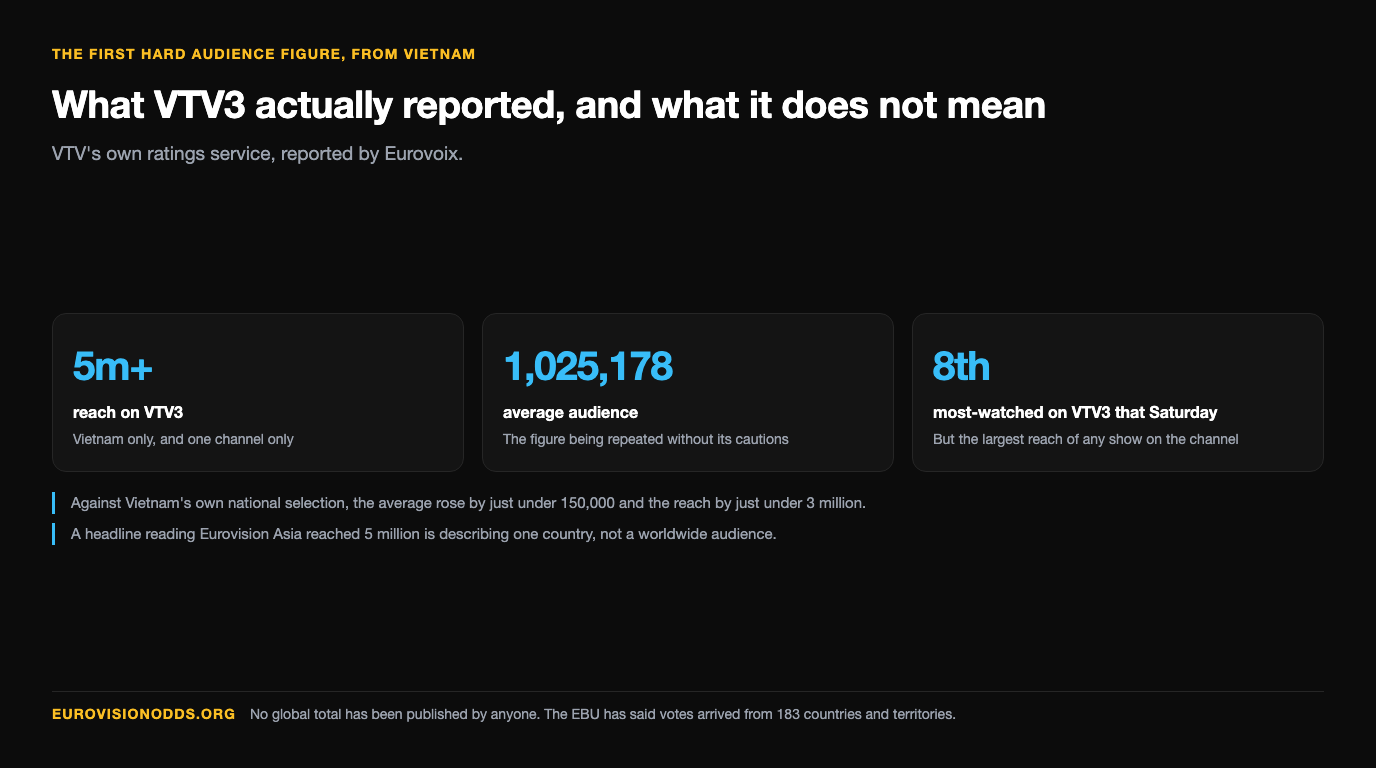
According to VTV’s own ratings service, reported by Eurovoix, the final
reached over 5 million viewers on VTV3 with an average audience of 1,025,178.
It was the eighth most-watched programme on VTV3 that Saturday, but had the largest reach of any show
on the channel. Against Vietnam’s own national selection, the average rose by just under
150,000 and the reach by just under 3 million.
Two cautions on that number, because it is already being repeated without them. It is a
Vietnam-only figure for a single channel — it is not a worldwide audience for the contest, and
headlines reading “Eurovision Asia reached 5 million” are describing one country. And no global
total has been published by anyone. What the EBU has said is that votes arrived from
183 countries and territories, with the Rest of the World pool awarding a set of points
equivalent to one participating country.
The governance question Bangkok left behind
One incident from the final is likely to follow the organisers into the bidding process. Eurovoix reported
on 15 November that the Malaysian broadcaster TV3 altered parts of its live broadcast to
remove Vice Ganda, the Philippine spokesperson and one of the best-known television
personalities in the Philippines, from sections of the jury points reveal; Malaysian viewers were shown the
contest logo instead. Malaysian law heavily restricts broadcast content regarded as promoting LGBTQ life.
This site is reporting it with the attribution it deserves: the account comes from a single outlet, and
the EBU, Voxovation and TV3 have all so far declined to comment. We have not seen the
broadcast ourselves and are not characterising anyone’s motives. The reason it belongs in a 2027 preview
is narrow and practical: a contest built on each country reading out its own jury points has to decide what
happens when a participating broadcaster will not show another country’s spokesperson, and that question
now sits with the same organisers who are about to choose a host.
The betting position: there is nothing to bet on
No bookmaker and no prediction market has listed a Eurovision Asia 2027 market of any kind
— not a host city, not a participant list, not a winner. That is a statement about today, 15 November
2026, and it is the honest one: the 2026 books
all settled on 15 November and nothing has
replaced them.
For what it is worth as a guide to timing, Polymarket did not list the 2026 contest until 3
November 2026, eleven days before the final, while Kalshi opened its board on 14 September
2026. If that pattern repeats, a 2027 Asia market is a story for next autumn, not this winter —
and a host-city market, if one ever appears, would need bids to exist first. We will flag it on the
bookmakers page the day anything lists.
The one Eurovision contract still trading is European: the Eurovision 2027 Participants book, where
Slovenia was about 11.2% and Spain about 6.5% when read at 17:05 UTC on 15 November 2026,
both facing an EBU decision deadline in December.
What to watch between now and the new year
- From about 21 November: organiser talks with the eleven 2026 broadcasters. A confirmed
second edition should emerge from these, not before them.
- Host bids. Interest from “multiple cities” becomes real when a broadcaster
and a venue are named together.
- The field. Watch for any of China, Hong Kong or Taiwan moving from interest to an
application, and remember the European-contest broadcasters are excluded.
- CARMELLE in Burgas, next May, as the contest’s shop window in Europe.
The full 2026 result and scoreboard are in
our result report, and the EBU’s own
announcement of the winner is
here.
Eurovoix’s overview of what is known about the second edition is
here.
Prices quoted are Polymarket midpoints read at 17:05 UTC on 15 November 2026. Prediction markets are
not bookmakers; contracts settle at 0 or 100 and can be illiquid. 18+. Please gamble responsibly.