
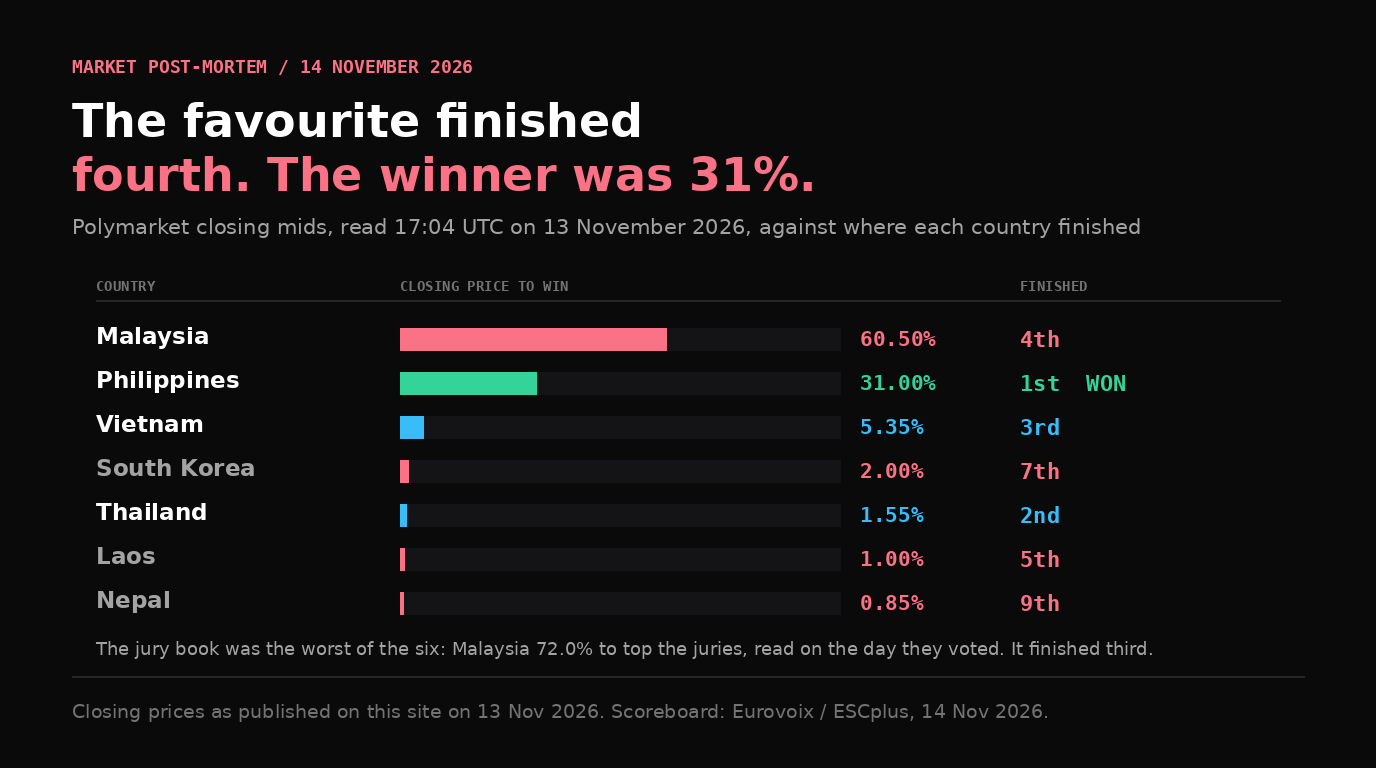
The favourite finished fourth. Malaysia closed at 60.5% to win Eurovision Asia 2026 and

18+ | New customers only | T&Cs apply | Please gamble responsibly
came home 152 points and three places behind the Philippines, who closed at 31.0% and won on 211. That is the
headline, and on its own it is the least interesting thing that happened to these markets on Saturday night.
The useful question is not whether the book was wrong — a 60.5% favourite loses roughly two times in
five, and nobody should be surprised by it. The useful question is which of the six Polymarket books on this
contest actually carried information, and which were noise dressed up as a price. Scored against the real
scoreboard, the answers are not the ones you would guess: one of these books performed worse than
knowing nothing at all, and it was not the winner market.
The closing book against the result
These are the Polymarket midpoints as this site recorded them at 17:04 UTC on 13 November, the last reading
before the Grand Final, published that evening in
the closing-prices post. Nothing here is
reconstructed after the fact:
| Country | Closing price to win | Finished | Points |
|---|---|---|---|
| Malaysia | 60.5% | 4th | 152 |
| Philippines | 31.0% | 1st — won | 211 |
| Vietnam | 5.35% | 3rd | 164 |
| South Korea | 2.0% | 7th | 113 |
| Thailand | 1.55% | 2nd | 170 |
| Laos | 1.0% | 5th | 139 |
| Nepal | 0.85% | 9th | 69 |
Two rows do the damage. Thailand at 1.55% finished second, on the second-highest public
score of the night. Malaysia at 60.5% finished fourth, and was not top of either half of the
vote. Between them they say something specific about where this market's information actually came from, which
we come to below.
Scoring the three outright-style books properly
“The favourite lost” is not a measure of anything. The standard way to score a probabilistic
forecast that named one of eleven outcomes is to ask how much probability it put on the thing that actually
happened, and compare that against knowing nothing — which here means 1/11, or 9.09%, on every country.
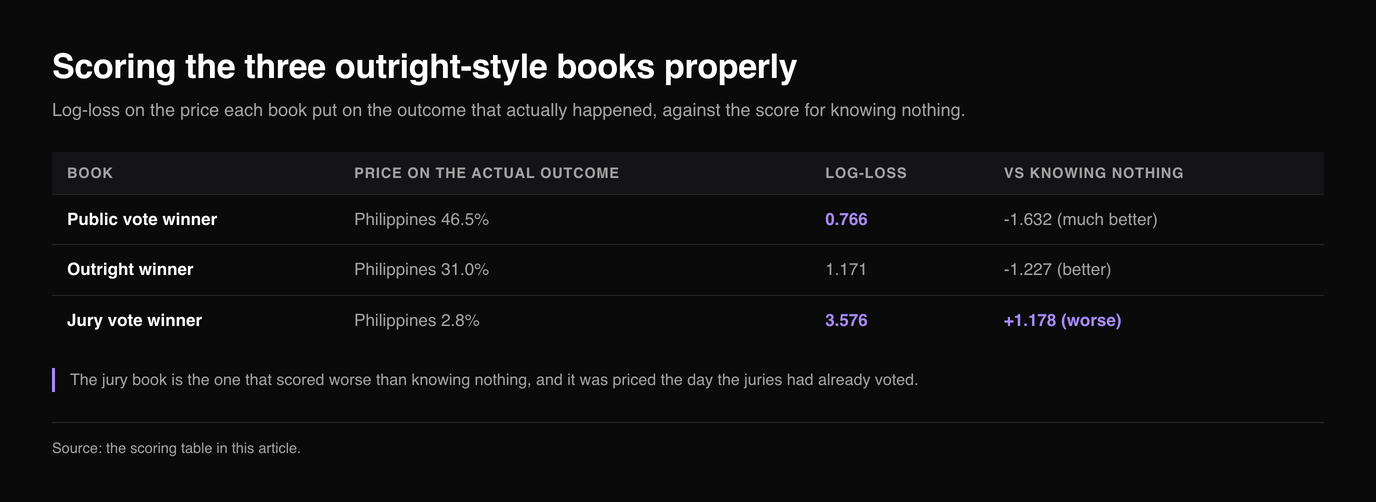
In log-loss terms (lower is better), knowing nothing scores 2.398.
| Book | Price on the actual outcome | Log-loss | vs knowing nothing |
|---|---|---|---|
| Public vote winner | Philippines 46.5% | 0.766 | −1.632 (much better) |
| Outright winner | Philippines 31.0% | 1.171 | −1.227 (better) |
| Jury vote winner | Philippines 2.8% | 3.576 | +1.178 (worse) |
So the winner book, the one that “got it wrong”, was in fact substantially better than
chance. It put the eventual champion second of eleven and gave her nearly three and a half times the
no-information probability. A market that names the winner as its second pick at 31% has done real work.
The public-vote book was the best of the three by a clear margin, and it was the one
that moved latest: the Philippines took that book back on 13 November, 34.5% to 46.5% in a day, a
seventeen-point swing in the gap. CARMELLE then won the public half by ten points, 118 to Thailand’s 108.
Whatever that money was reading, it was reading it correctly.
The jury book was worse than knowing nothing
And then there is the jury winner market. It closed with Malaysia at
72.0% — its high for the week — and the Philippines at 2.8%. The
Philippines topped the juries on 93 points. Malaysia was third, on 82.
A trader who ignored this book entirely and assigned 9.09% to all eleven countries would have scored better
than the market did. That is the finding worth keeping from this contest: not that a favourite lost, but that
one specific book carried negative information, and it is the book that should structurally have been
the best informed of the six.
Here is why that is damning rather than merely unlucky. The eleven national juries did not vote during the
live show. They voted at the Jury Final on Friday 13 November, watching the second dress
rehearsal and ranking the songs there. This site made that point in the closing post before the final: by the
time the 17:04 UTC reading was taken, the jury half of the Eurovision Asia 2026 result already existed on
paper. The jury book was not pricing an uncertain future event. It was pricing an unpublished past one,
and it priced it at 2.8% against 72.0% the wrong way round.
The lesson generalises to every future edition, and it is the opposite of the intuitive one. A market on a
resolved-but-unpublished outcome is not better informed because the event has happened — it is
worse informed, because no new public evidence can arrive to correct it. The price just sits there
compounding whatever the crowd already believed. Rehearsal clips and betting momentum had convinced that crowd
Malaysia was a jury act. Nothing after Friday afternoon could have told them otherwise.
The place books, and the one that went missing
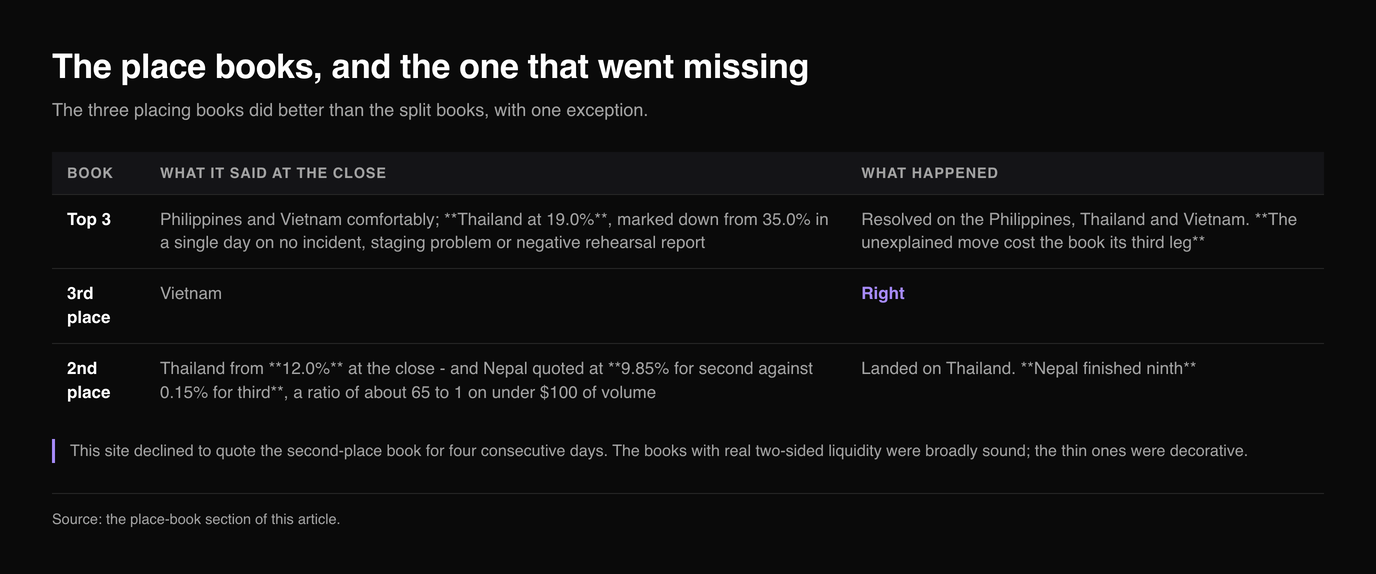
The three placing books did better than the split books, with one exception. The
Top 3 market resolved on the Philippines, Thailand and Vietnam. It had the Philippines
and Vietnam comfortably, and Thailand at 19.0% — having marked the host nation down from 35.0% in a
single day, a move this site published as unexplained because no incident, staging problem or negative
rehearsal report accounted for it. That move cost the book its third leg.
The third-place book got Vietnam right. The second-place
book — the one this site declined to quote for four consecutive days — landed on Thailand, from
12.0% at the close. It was the right answer from a book that had Nepal quoted at 9.85% for second and 0.15% for
third, a ratio of about 65 to 1 on under $100 of volume. Nepal finished ninth. Four days of refusing to put
that book in front of readers looks, in hindsight, like the correct editorial call rather than excessive
caution.
That is the general shape of it: the books with real two-sided liquidity were broadly sound, and
the thin ones were decorative. It is the same conclusion this site reached about Kalshi’s
eleven-contract board, where seven contracts had no bid at all and a last price with nothing underneath it is
an ask being lifted, not a market view.
Finals day turnover: the books nearly doubled
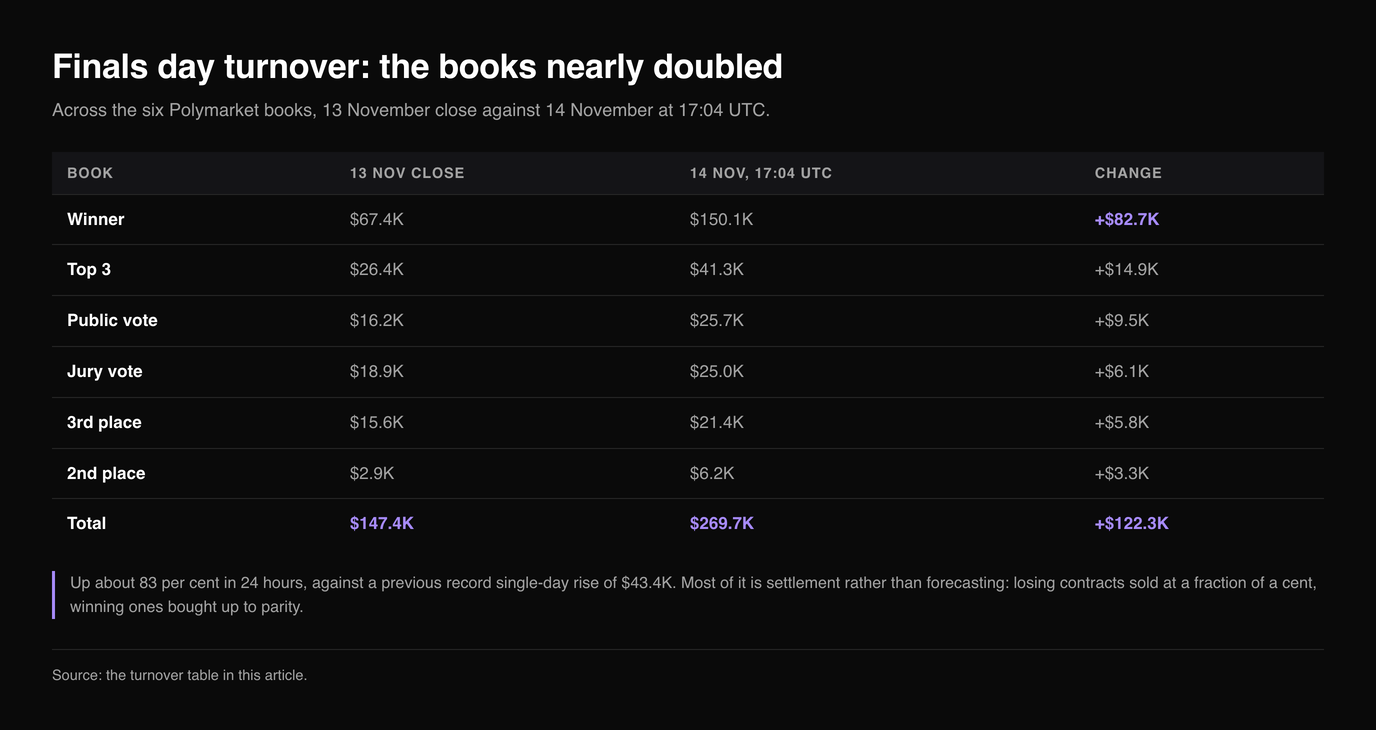
| Book | 13 Nov close | 14 Nov, 17:04 UTC | Change |
|---|---|---|---|
| Winner | $67.4K | $150.1K | +$82.7K |
| Top 3 | $26.4K | $41.3K | +$14.9K |
| Public vote | $16.2K | $25.7K | +$9.5K |
| Jury vote | $18.9K | $25.0K | +$6.1K |
| 3rd place | $15.6K | $21.4K | +$5.8K |
| 2nd place | $2.9K | $6.2K | +$3.3K |
| Total | $147.4K | $269.7K | +$122.3K |
Total turnover across the six books went from about $147.4K at the close on Friday to about
$269.7K by 17:04 UTC on Saturday — up about $122.3K, or 83%, in 24 hours, after a
previous record single-day rise of $43.4K. The winner book alone took $82.7K of that, more than doubling.
Most of that is not forecasting; it is settlement. Once the result is known, holders of losing contracts sell
at a fraction of a cent and holders of winning ones buy up to parity, and that churn prints as volume. The
proportions are still worth noting: the second-place book, the thinnest and least trustworthy all week, more
than doubled too, which is what a book looks like when it finally has something unambiguous to resolve against.
The unsettled half: no official scoreboard
One thing is still open as this is published, and it is the direct consequence of a risk this site flagged
before the final. The organisers announced CARMELLE as the winner but published no official
scoreboard — no per-country jury and public breakdown. The eleven-country split everyone is
using, including us, comes from the fan press; we explain in the
full result and scoreboard piece why it is
nevertheless trustworthy, and it comes down to the jury column summing to exactly 638 and the public column to
exactly 696, which are the structural maxima the EBU itself published on 9 November.
But a prediction market cannot settle on a plausibility argument. It settles on the official ranking as
published, and for the two split books there is nothing official to settle against. You can read the hesitation
straight off the screen: three hours after the show the public-vote book was quoting the Philippines at about
84.6% rather than 100%, on an outcome the available scoreboard calls by ten points. Roughly
$51K of positions across the jury and public books are waiting on a document that may never appear.
That is a disclosure failure, not an integrity failure. Nobody is alleging the count was wrong. But a contest
that published a full scoreboard for only one of its eleven national selections all season has now carried that
habit into its Grand Final, and it is the single most fixable thing on this list before 2027.
Where the two halves actually diverged
One more pattern is worth pulling out of the scoreboard, because it is the thing the markets were trying to
price all week and never resolved. Four countries scored materially better with the public than with the juries:
Laos (78 public against 61 jury), Bhutan (71 against 55), Thailand (108 against 62) and the Philippines (118
against 93). Three went the other way: Vietnam was almost exactly level (83 against 81), while Mongolia (57
against 37) and South Korea (61 against 52) were jury-leaning entries.
Malaysia is the interesting case, because it was neither. Aina Abdul took 82 jury points and 70 public
points — third and sixth respectively. The market had spent a fortnight treating her as a jury act,
pushing the jury book to 72.0% while letting her public line sag to 35.0%, and the scoreboard says the juries
did like her: 82 points is a strong jury score. It simply was not a winning one, because two other
countries scored higher with the juries as well. Being right about the direction of an entry and wrong about
its magnitude is the most expensive kind of half-correct there is, and it is what the 60.5% was built on.
Bhutan deserves a line of its own as the night’s biggest overperformance against price. Nyendra was
the longest shot on every board, described on this site as the contest’s San Marino slot, and she took 71
public points — fourth-best of the eleven, one more than Malaysia. No market anywhere priced that as a
live possibility, and no market needed to: it is the tail doing what tails do.
What to carry into Eurovision Asia 2027
Five things worth writing down while they are fresh:
- Score books, not favourites. The winner market was better than chance even though its
favourite finished fourth. A market that names the champion second at 31% is working.
- Distrust a book on an outcome that has already happened in private. The jury market was
the worst of the six and had the most information available to it. That is not a coincidence.
- The public half is bigger than the jury half. Twelve public votes against eleven juries,
696 points to 638, and the public book was the sharpest of the three. Weight it accordingly.
- A host nation with no home televote is not a dead entry. Thailand took 108 public points
from everyone except Thailand, and was priced at 1.55%.
- Ignore any book where the quotes are one-sided. Nepal at 65 to 1 between second and third
on under $100 of volume told you nothing, in either direction.
The full eleven-country scoreboard, every country’s page and the complete dated record of how these
markets moved through contest week are on the Eurovision Asia hub. For the
European contest, the 2027 winner market and the
Burgas participant list are already live, and the Eurovision Asia 2026 winner
now has a performance slot there.
Prices in this article are Polymarket midpoints recorded by this site at 17:04 UTC on 13 November 2026 and
re-read at 17:04 UTC on 14 November 2026 via the Gamma API. The scoreboard is from
and ESCplus, 14 November 2026. Prediction markets are not fixed-odds bookmakers and no UK bookmaker priced this
contest; see our bookmaker guide for what is and is not available.