
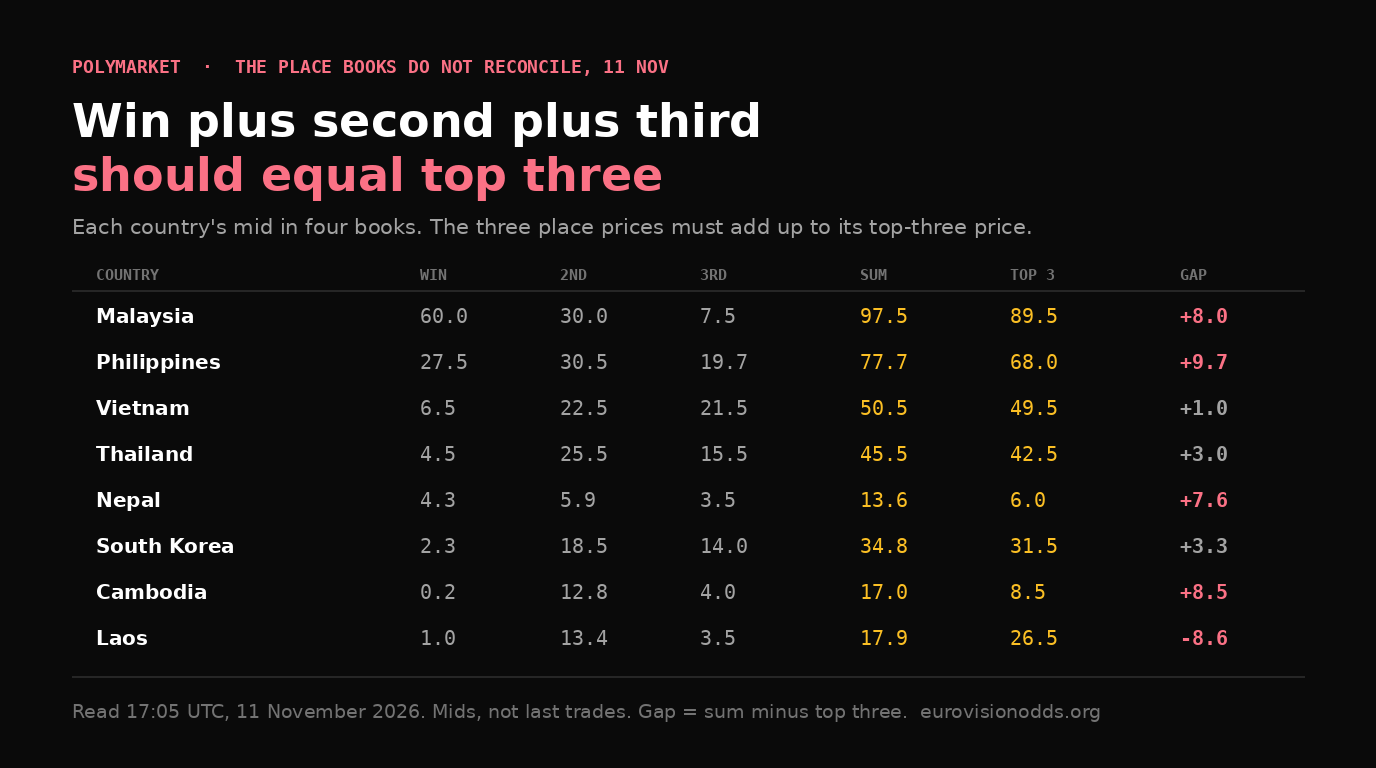
Polymarket now runs six Eurovision Asia books, and four of them price the same thing in ways that cannot all be true at once. A country’s chance of winning, plus its chance of finishing second, plus its chance of finishing third, has to equal its chance of a top-three finish. Read at 17:05 UTC on 11 November 2026, that sum is out by eight points for the favourite, nearly ten for the second favourite and nearly nine the other way for Laos.

18+ | New customers only | T&Cs apply | Please gamble responsibly
Key takeaways
- Malaysia is 60.0% to win, read at 17:05 UTC on 11 November, up from 59.5% a day earlier. The jury book moved again, to 70.0% from 66.0%.
- The 2nd-place book is the broken one. Exactly one country finishes second, so its eleven prices must sum to 100. The midpoints sum to about 171.
- But there is no free money in it. Buying all eleven at the offer would cost about 279 for a payout of 100. The spreads cover every discrepancy in all six books. This is a measurement of which prices to trust, not a trade.
- The bid-to-offer band is the honest trust metric. The winner book’s band is about 25 points wide; the 2nd-place book’s is about 216.
- The market’s favourite runner-up is not its favourite. The Philippines leads the 2nd-place book at 30.5%, just ahead of Malaysia.
- Bhutan is 7.5% to top the jury vote and 0.2% to win the contest. On $133 of lifetime turnover, that is a dead quote rather than a view.
- On Kalshi, read the bid and ignore the last trade. Only two of eleven contracts carry a bid; Laos lost its overnight.
- No fixed-odds bookmaker prices Eurovision Asia at all. Everything here is a prediction market.
What’s on this page
All six books, 11 November · The test every place book must pass · Where it breaks · The 2nd-place book · A trust metric that works · The favourite runner-up · Bhutan’s jury price · Kalshi: read the bid · How we would read it · FAQ · Sources
Eurovision Asia odds: all six books on 11 November
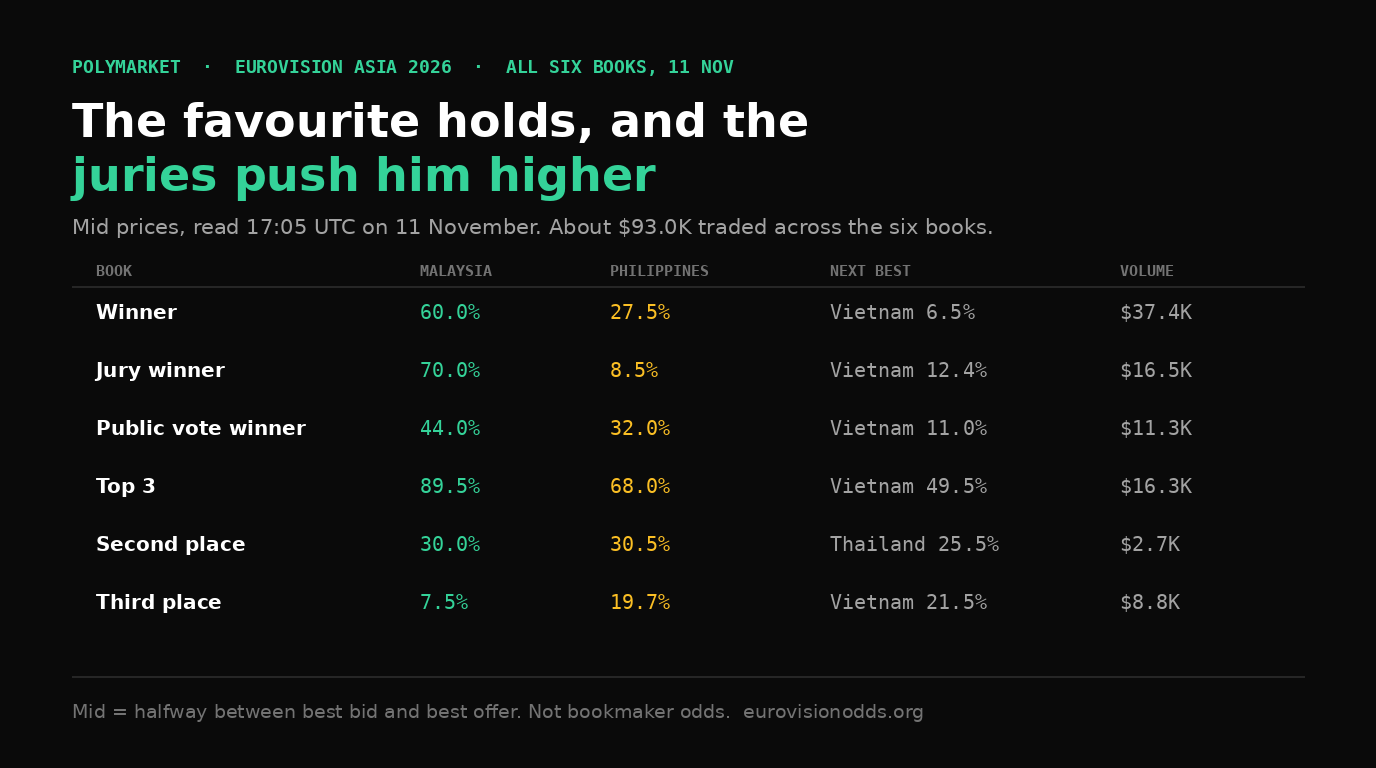
Every figure below is a midpoint between best bid and best offer on Polymarket, read through the public Gamma API at 17:05 UTC on 11 November 2026. Midpoints are not trades. Where that distinction matters, we say so.
| Book | Malaysia | Philippines | Next best | Volume |
|---|---|---|---|---|
| Winner | 60.0% | 27.5% | Vietnam 6.5% | $37.4K |
| Jury vote winner | 70.0% | 8.5% | Vietnam 12.4% | $16.5K |
| Public vote winner | 44.0% | 32.0% | Vietnam 11.0% | $11.3K |
| Top 3 | 89.5% | 68.0% | Vietnam 49.5% | $16.3K |
| Second place | 30.0% | 30.5% | Thailand 25.5% | $2.7K |
| Third place | 7.5% | 19.7% | Vietnam 21.5% | $8.8K |
Malaysia has now led every book for five consecutive days except the two place books, where by construction the favourite should not lead. Aina Abdul’s outright has gone 38.5% on 4 November, 55.0% on 7 November, 55.0% on the evening of 9 November, 59.5% on 10 November and 60.0% now. The jury book has gone 46%, 68.5%, 59.0%, 66.0% and 70.0%. The public vote, the closest of the three, has gone 27%, 36.5%, 41.5%, 42.5% and 44.0%.
The test every place book has to pass
Polymarket’s six Asia books are not six independent opinions. Four of them describe the same finishing order, and that imposes arithmetic you can check without knowing anything about music.
All six markets resolve on the official Grand Final ranking, with ties broken on total points, then jury points, then public points. That means the final placings are strictly ordered — no shared second place — and two things follow:
- Within a book, the prices must sum to the number of winners. One country wins, so the winner book sums to 100. One finishes second, so the 2nd-place book sums to 100. Three countries make the top three, so the top-three book sums to 300.
- Across the books, each country must reconcile with itself. Finishing first, second and third are mutually exclusive and together they are exactly “top three”. So win + 2nd + 3rd = top 3, for every country, exactly.
Here is how the six books score on the first test, on midpoints:
| Book | Mids sum to | Should sum to | Volume |
|---|---|---|---|
| Winner | 106.8 | 100 | $37.4K |
| Jury vote winner | 106.5 | 100 | $16.5K |
| Public vote winner | 105.0 | 100 | $11.3K |
| Third place | 95.4 | 100 | $8.8K |
| Top 3 | 338.6 | 300 | $16.3K |
| Second place | 170.7 | 100 | $2.7K |
Five of the six are within a sensible margin for a market that charges a spread. The sixth is not close.
Where the cross-book test breaks
The second test — win + 2nd + 3rd against top 3, country by country — is in the table at the top of this page. The gaps, in points of probability:
Philippines +9.7, Cambodia +8.5, Malaysia +8.0, Nepal +7.6, Bhutan +5.4, South Korea +3.3, Thailand +3.0, Mongolia −2.3, Bangladesh −1.3, Vietnam +1.0, Laos −8.6.
Vietnam is almost perfect. Laos is the only country whose place prices add up to less than its top-three price — 17.9 against 26.5 — which says Laos is priced as a country that makes the podium without finishing first, second or third, an event with no meaning.
Before anyone gets excited: none of this is tradeable, and saying so is the whole point of running the check.
The 2nd-place book is where it all comes from
Nine of the eleven worst numbers on this page trace to one market. The 2nd-place book has about $2,670 of lifetime turnover spread across eleven contracts — roughly one seventieth of the money on the winner book — and its quotes are correspondingly nominal: Malaysia 13c bid against 47c offered, Vietnam 8c against 37c, South Korea 6c against 31c, Laos 0.9c against 25.9c.
When a spread is thirty-four cents wide, its midpoint is not an estimate of anything. It is the average of two numbers nobody is willing to meet in the middle on. Eleven such midpoints summing to 171 is not a market making a mistake; it is a market that has not formed an opinion yet, being asked for one.
The proof is in the executable prices. If the midpoints were real, you could sell the whole book for 171 and pay out 100. You cannot: the bids sum to about 63, so selling all eleven at the price someone will actually pay collects 63 to cover a 100 liability. Buying it is worse — the offers sum to about 279 for a certain 100 back. The apparent 71-point edge sits entirely inside the spread, which is exactly where a thin book keeps it.
A trust metric that actually works
That gives a better way to rank these books than the overround, and one anybody can reproduce from the public API: take the sum of the bids and the sum of the offers, and measure the band between them against what the book must sum to.
| Book | Bids sum | Offers sum | Band width | Band vs target |
|---|---|---|---|---|
| Winner | 94.1 | 119.5 | 25.4 | 25% |
| Top 3 | 296.1 | 381.0 | 84.9 | 28% |
| Public vote winner | 85.0 | 125.1 | 40.1 | 40% |
| Jury vote winner | 83.1 | 130.0 | 46.9 | 47% |
| Third place | 59.2 | 131.5 | 72.3 | 72% |
| Second place | 62.6 | 278.7 | 216.1 | 216% |
The winner book is tight enough to quote without caveats. The top-three book, despite the ugliest-looking overround on the page, is the second most reliable once you account for the fact that it has to sum to 300 rather than 100. The two split books sit in the middle. The 2nd-place book is decoration.
That ordering matters for Friday, when the closing prices go on the record to be scored against the real scoreboard. A book with a 216% band cannot be scored against anything.
The market’s favourite runner-up is not its favourite
Underneath the noise, the place books do say something the winner book cannot. The Philippines leads the 2nd-place book at 30.5%, narrowly ahead of Malaysia’s 30.0%, and Vietnam leads the 3rd-place book at 21.5%.
Put beside the outright, that is a coherent picture of a two-horse race with a settled shape. Dividing each country’s win price by its top-three price gives the market’s implied “wins, given it medals”: Malaysia 67%, the Philippines 40%, Vietnam 13%, Thailand 11%, South Korea 7%. CARMELLE is priced as very likely to podium and unlikely to win from there.
The one number that still refuses to fit is Nepal at 72% on the same measure — a 4.3% win price against a 6.0% top-three price. We flagged this at 88% on 10 November; the market has taken about sixteen points out of it in a day without finishing the job. It remains the only country other than Malaysia priced as more likely to win than to merely place, on about $2.3K of turnover and a 1.3c-to-7.3c spread.
A jury price its own outright contradicts
One more, because it is the cleanest single illustration on the board. Bhutan is 7.5% to win the jury vote — fourth in that book, ahead of Thailand — and 0.2% to win the contest.
The juries are half the result. A country with a genuine 7.5% chance of topping the jury vote could not be a 1-in-500 shot overall. The reconciliation is the usual one: that quote sits on $133 of lifetime turnover across a 2.3c-to-12.6c spread. Cambodia at 12.8% in the 2nd-place book against 0.2% outright is the same artefact.
Nyendra may well be the critics’ pick of the field — the one published rehearsal photograph of Bhutan is the most striking of the three released so far. The jury book is not what is telling you that.
Kalshi: the bid rule holds, and Laos lost its bid
Kalshi, the CFTC-regulated US exchange, opened the first real-money Eurovision Asia market on 14 September 2026, almost seven weeks before Polymarket listed the contest. It is much the thinner of the two.
On 10 November we proposed a rule: on Kalshi, read the bid and ignore the last trade. On 11 November it holds, on a board that has got thinner rather than thicker. Only two of the eleven contracts now carry a bid at all, and both agree closely with Polymarket — Malaysia quoted 53c against 66c, Philippines 25c against 34c. The nine without a bid do not agree with anything: Vietnam’s last trade of 79c sits above its own 40c offer against 6.5% on Polymarket, South Korea’s 22c against 2.3%, Bhutan’s 15c against 0.2%.
Laos is the instructive one. It carried a live bid on 10 November and its price sat sensibly; overnight the bid disappeared, and its last trade of 2c is now the only number on the contract. Nothing about Laos changed. One market maker went home.
This is why our Eurovision Asia hub renders the Kalshi board from a data file rather than typing it into the page: the board’s state changes underneath any sentence you write about it. See also our guide to where Eurovision markets are actually priced.
How we would read it three days out
Our position has not changed and the market has moved towards it rather than away: Malaysia to win, the Philippines second, Vietnam third. The things we would actually watch between now and Saturday:
- The jury book, not the outright. It has moved 46 → 68.5 → 59 → 66 → 70 while the outright crept from 55 to 60. The jury line is where the opinion is being expressed.
- The public vote as the live half. Malaysia 44.0% against the Philippines 32.0% is the narrowest gap of the three headline books, and under the published 252-point scale the public half is marginally the larger one — the juries can award a song at most 120 points against the public’s 132.
- Volume, as a sanity check. About $93.0K across six books, up $4.8K in a day. Contest week is adding money more slowly each day, not faster, which argues against reading any single move as information.
- Nothing from the 2nd-place book until its band is narrower than its prices.
And the standing caveat, which matters more than any of it: there is still no fixed-odds bookmaker on Eurovision Asia 2026. Every price in this article is a prediction-market quote, several of them on four-figure turnover. Our full ranking of all eleven acts sets out where we disagree with these books, and the winner odds page carries the European contest for comparison.
Frequently asked questions
What are the Eurovision Asia 2026 odds right now?
On Polymarket at 17:05 UTC on 11 November 2026: Malaysia 60.0%, the Philippines 27.5%, Vietnam 6.5%, Thailand 4.5%, Nepal 4.3%, South Korea 2.3%, Laos 1.0% and the remaining four at or below 0.3%. No fixed-odds bookmaker prices the contest.
Why do the Polymarket Eurovision Asia prices not add up?
Because four of the six books describe the same finishing order and are priced with very different amounts of money behind them. The 2nd-place book has about $2,670 of lifetime turnover, so its midpoints sum to roughly 171 instead of 100.
Is there an arbitrage in the Eurovision Asia markets?
No. We checked at executable prices: buying every 2nd-place contract at the offer costs about 279 to collect 100, and selling every one at the bid collects about 63 against a 100 liability. Every discrepancy sits inside the spread.
Who is favourite to finish second at Eurovision Asia 2026?
The Philippines, at 30.5%, marginally ahead of Malaysia at 30.0% — though on a book thin enough that the figure should be treated as indicative only.
Why is Bhutan 7.5% with the juries and 0.2% to win?
Because the jury contract has about $133 of lifetime turnover and a ten-cent spread. It is a stale quote, not a forecast.
Sources
- Polymarket Gamma API — winner, jury, public vote, top 3, 2nd place and 3rd place, all read at 17:05 UTC on 11 November 2026.
- Kalshi KXEUROVISIONASIA-26, read 17:05 UTC on 11 November 2026.
- Eurovision Song Contest Asia voting terms and conditions §8.2, for the 50/50 Grand Final split.