
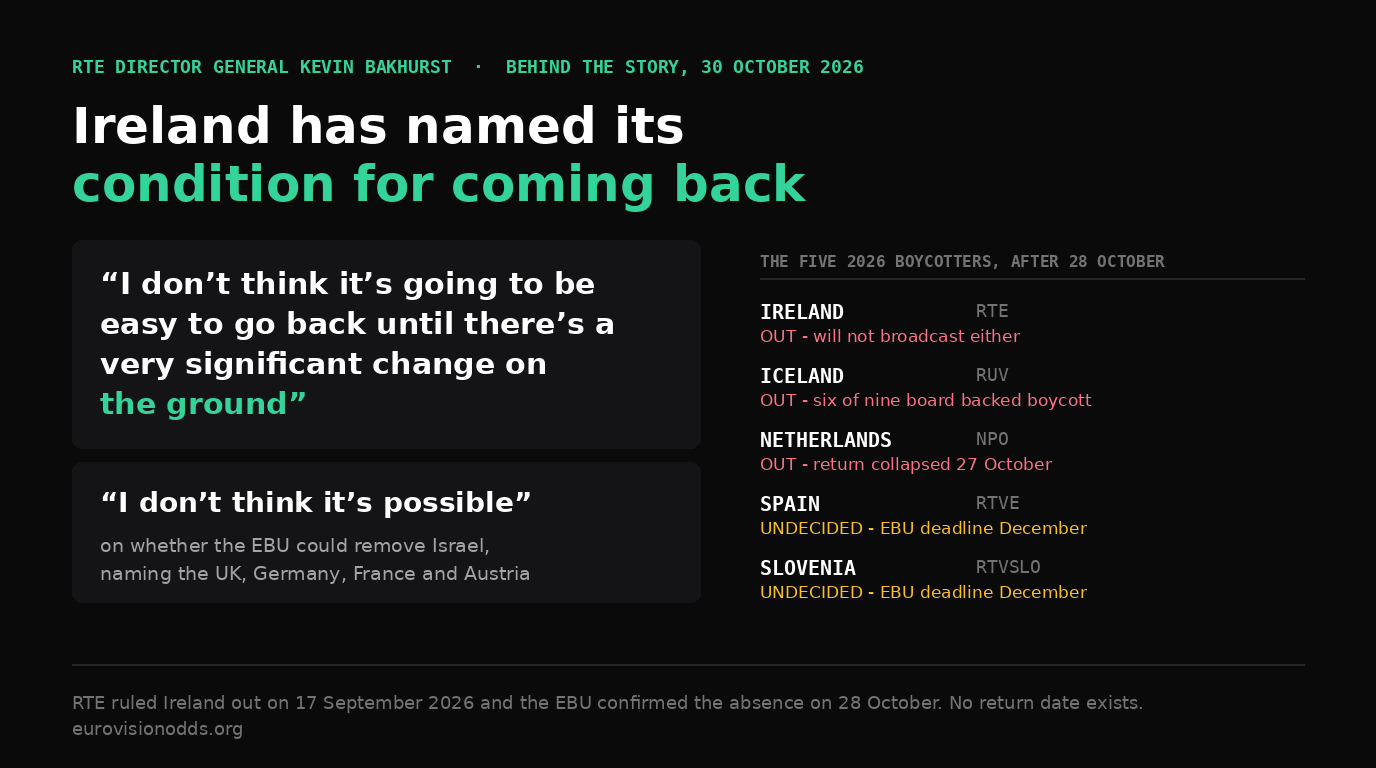
RTÉ Director General Kevin Bakhurst has given the first public account of what would have to change before Ireland returns to the Eurovision Song Contest, and in the same interview said he does not believe the EBU is able to remove Israel from it. Speaking on RTÉ’s Behind the Story podcast, reported by the broadcaster’s own newsroom on 30 October 2026, he said it would not be easy for Ireland to go back “until there’s a very significant change on the ground” in Gaza and the West Bank, or until Israel is no longer competing.

18+ | New customers only | T&Cs apply | Please gamble responsibly
Illustration: a designed quote card. No real person is depicted.
Key takeaways
- Ireland is already out of Eurovision 2027. RTÉ ruled the country out on 17 September 2026 and will neither enter nor broadcast the contest. The EBU confirmed the absence when it published its official 36-country field on 28 October.
- What is new is the condition for a return. Bakhurst named two routes back: a very significant change on the ground in Gaza and the West Bank, or Israel no longer being in the contest.
- He does not think the second route is available. Asked whether the EBU could remove Israel, he said: “I don’t think it’s possible.” He pointed to the UK, Germany, France and Austria having publicly opposed exclusion, and noted that the EBU is run by its members.
- He did not criticise the EBU, saying it has been “treading a very, very difficult line” and that RTÉ’s relationship with it remains strong.
- No date, no process, no review. Nothing in the interview commits RTÉ to reconsidering at any point, and the 2028 contest has no host city, no participant list and no market.
- Two 2026 boycotters are still undecided. The EBU has given RTVE in Spain and RTVSLO in Slovenia until December to say whether they will compete in Burgas.
What the RTÉ Director General said
Bakhurst was speaking on RTÉ’s own Behind the Story podcast, in an interview that mostly concerned the broadcaster’s funding and its critics. The Eurovision section is short and unusually direct. He described Irish participation in the 2026 contest as “unconscionable”, said RTÉ decided early on 2027 because taking part would have been very difficult given conditions in Gaza and the West Bank and the views of Irish audiences, and then set out the terms for any future entry.
“I don’t think it’s going to be easy to go back until there’s a very significant change on the ground,” he said. The alternative he named was Israel no longer being in the contest — and he went on to say, in the same breath, that he does not think the EBU can bring that about. “I don’t think it’s possible,” he said, on the question of removal, adding that the EBU “is run by its members” and that significant members including the UK, Germany, France and Austria have publicly opposed exclusion.
He declined to blame the EBU for that position: “I wouldn’t criticise the EBU on that front at all,” he said, and “I think they’ve been treading a very, very difficult line on it.”
Why an interview matters more than it looks
Ireland’s withdrawal is not news; we covered it when RTÉ ruled Ireland out of Eurovision 2027 in September. What this interview adds is the shape of the exit, and that is the part with consequences.
Until now, every boycotting broadcaster’s position has been read as contingent: they are out of this edition, and the assumption has been that the contingency resolves one way or another before the next one. Bakhurst has described something closer to a standing condition, and then explained why he thinks one half of it cannot be met by any process inside the EBU. Read together, those two statements describe an absence with no mechanism to end it.
That reading is strengthened by Ireland’s particular structure. RTÉ is the only Irish EBU member, so there is no second broadcaster to take the mandate — the manoeuvre the Netherlands attempted when NPO took the entry from AVROTROS in September. That route did not survive either: NPO withdrew on 27 October after no member broadcaster would carry the entry, and the Dutch contract that had traded in the nineties for a month settled at zero.
Where the five 2026 boycotters now stand
| Country | Broadcaster | 2027 position |
|---|---|---|
| Ireland | RTÉ | Out. Will not enter and will not broadcast. |
| Iceland | RÚV | Out. Six of nine board members backed continuing the boycott on 30 September. |
| Netherlands | NPO | Out. Returned on 23 September, withdrew again on 27 October. |
| Spain | RTVE | Undecided. EBU deadline of December; the board vote trailed for mid-October has still produced no reported result. |
| Slovenia | RTVSLO | Undecided. EBU deadline of December; nothing published by the broadcaster since 22 September. |
Three of the five are settled and all three are out. The two that are not settled are the two the EBU explicitly left room for, and both have the same December deadline. The full record for each, with sources and dates, sits on our Eurovision 2027 tracker.
One thing Bakhurst’s remarks do not do is tell you anything about those two. Spain’s position has been driven by its own board and its president’s statement to the Senate; Slovenia’s is tied to a programming and production plan and to money. Ireland setting out a condition for 2028 is not evidence about what Madrid or Ljubljana decide in December.
The betting position, stated plainly
There is nothing to bet here. Polymarket’s Ireland participation contract for 2027 resolved NO at zero on 28 October when the EBU list published, with about 2.9 thousand dollars of lifetime volume across its life. No market exists on Eurovision 2028 participation at any venue, because the 2028 contest has no published host, no field and no calendar. We are not going to quote a number for something nobody is pricing.
What the interview does change is the prior you carry into the next one. When a 2028 participation market eventually opens, the base case for Ireland now has a named condition attached to it and a Director General on the record saying that the EBU route to meeting that condition is, in his assessment, closed. Anyone pricing an Irish return as a coin flip on vague future goodwill has not read what the broadcaster actually said.
The one caveat worth holding onto is that an interview is not a decision. Bakhurst was answering questions on a podcast, not announcing a policy, and directors general change, as do governments, and as does the situation he was describing. The 2026 and 2027 withdrawals were both formal board-level processes with published statements. Nothing of that kind has happened for 2028 and nothing is scheduled.
What to watch next
- December 2026 — the EBU deadline for RTVE and RTVSLO. Two contracts on Polymarket still trade on it, and they are the only two left open in that market.
- Any EBU statement on eligibility. Bakhurst’s claim is that the members will not permit exclusion. A published eligibility framework, which Belgium asked for and did not get before confirming, would be the first real test of it.
- The 2028 host announcement, which will start the clock on the next round of participation decisions and the first market that can price them.
Sources: RTÉ, “Not going to be easy to return to Eurovision”, 30 October 2026; Eurovoix, 31 October 2026; and the EBU’s participant announcement of 28 October 2026 at eurovision.tv.