
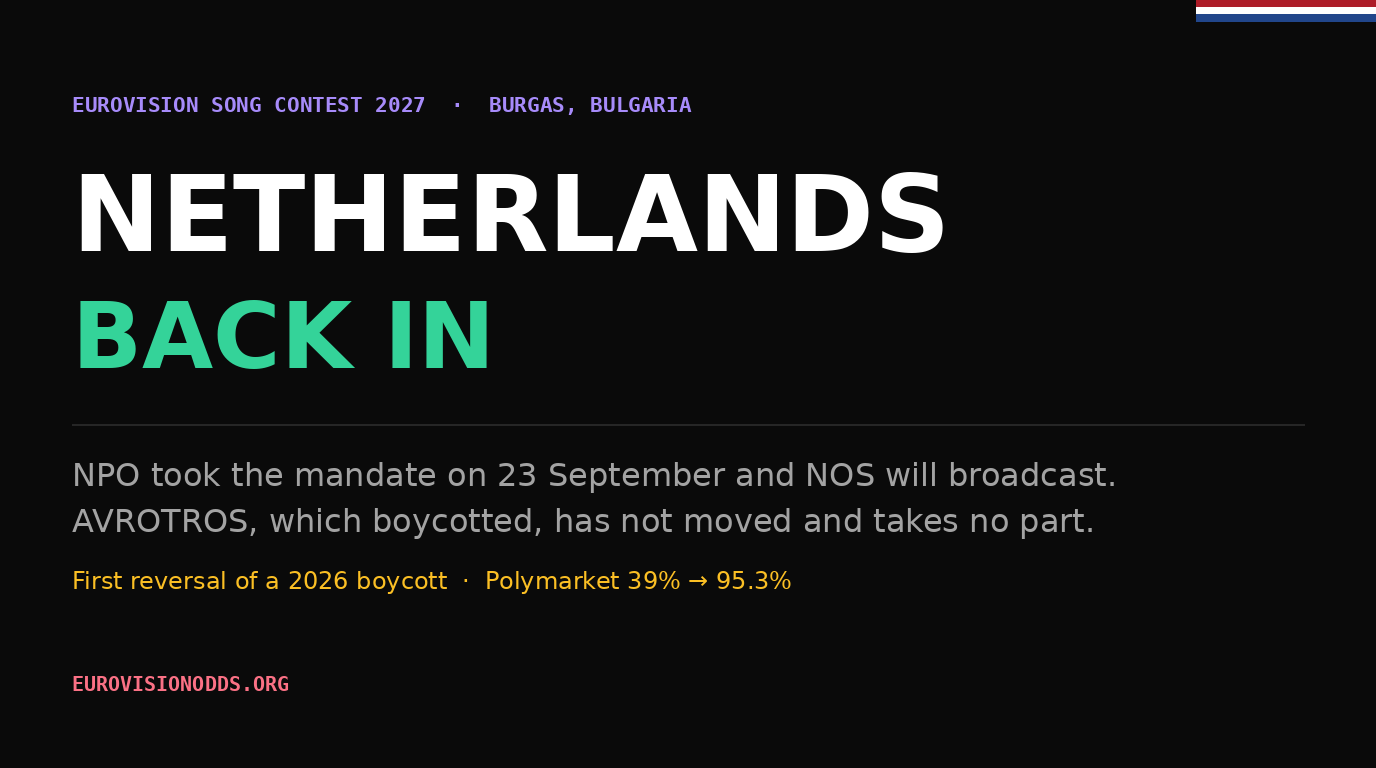
The Netherlands will compete at Eurovision 2027 after all. NPO, the Dutch public broadcasting umbrella, confirmed on 23 September 2026 that it is taking the mandate for Burgas, with NOS producing and broadcasting the shows. It is the first reversal of any of the five boycotts that hit the 2026 contest — and it came without AVROTROS, the broadcaster that actually boycotted, changing its position by a single word.

18+ | New customers only | T&Cs apply | Please gamble responsibly
That distinction is the whole story, and it is also why Polymarket spent a month pricing this wrong.
Key takeaways
- The Netherlands is back, and AVROTROS is not. NPO took the 2027 mandate on 23 September with NOS producing and broadcasting. AVROTROS, the broadcaster that actually boycotted, has not moved a word and plays no part in the new selection.
- Participation and a broadcaster’s position are two different variables. Any country with more than one EBU member has a route back that does not need the objector to reverse. Ireland has no second member, which is why its contract can be read straight off RTÉ.
- Polymarket priced the wrong question all month. The heaviest contract on the board moved 32 points on Talpa Network — a commercial group that could not have entered — and never priced the NPO/NOS restructure at all, then repriced 56 points in two days.
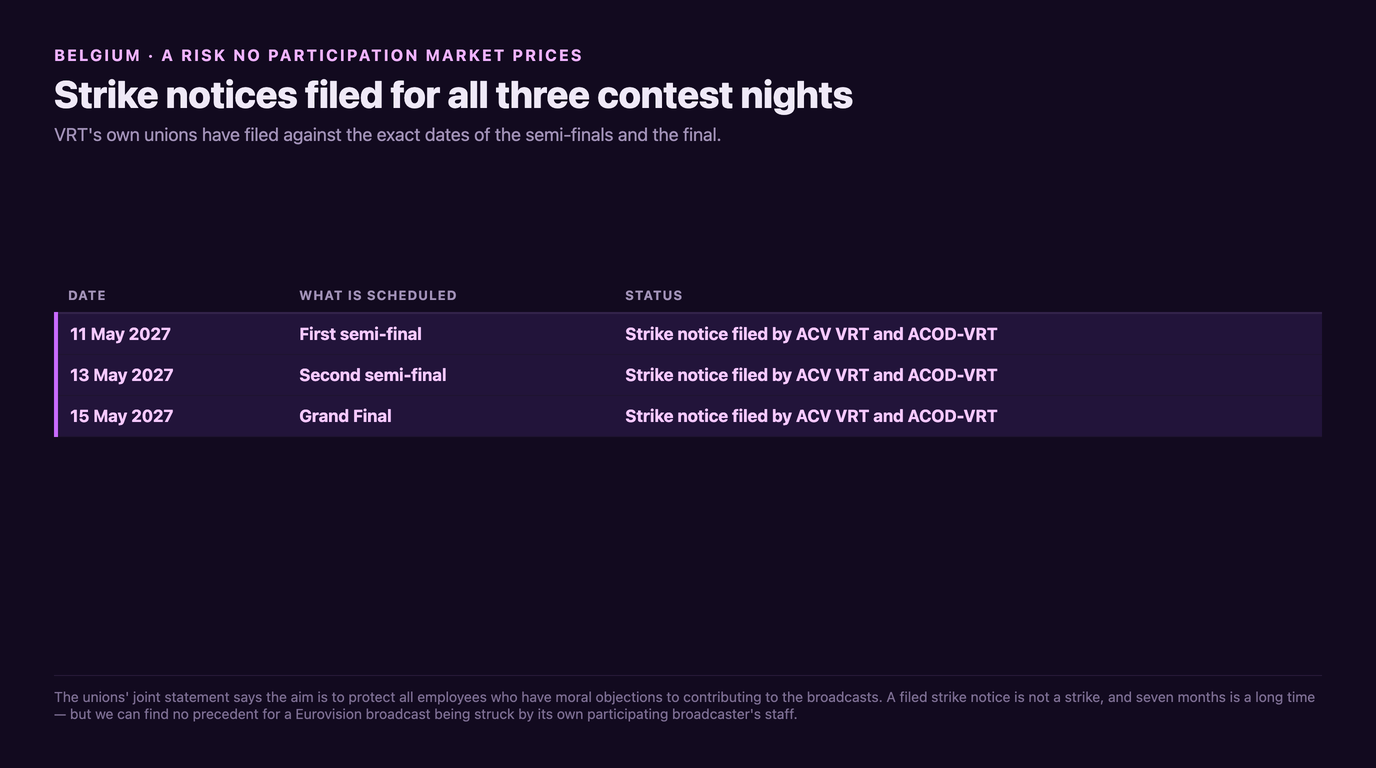
- Belgium is confirmed and contested. VRT entered after saying participation was “unlikely”; its own unions have filed strike notices covering 11, 13 and 15 May 2027 — the two semi-finals and the final.
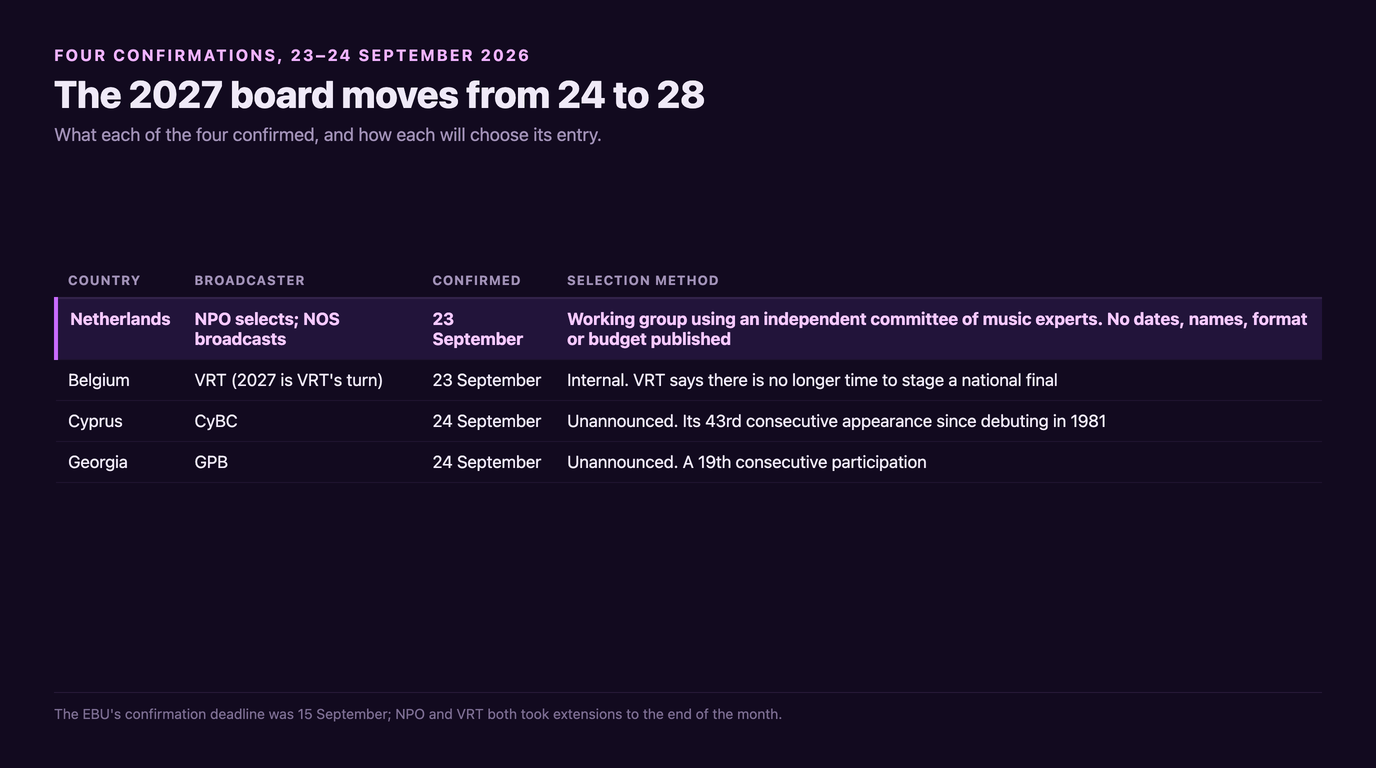
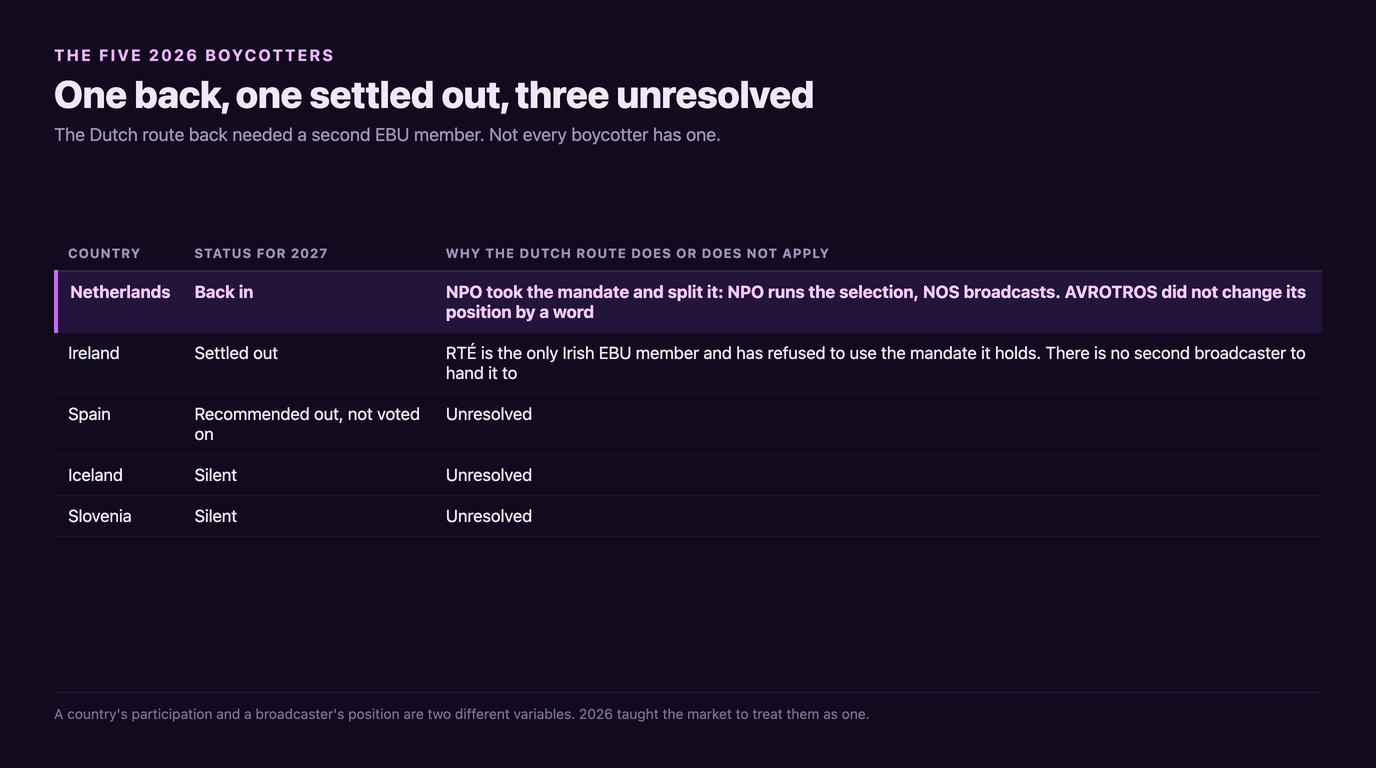
- The 2027 board is now 28 countries. Of the five 2026 boycotters: one back (Netherlands), one settled out (Ireland), one recommended out but not voted on (Spain), two silent (Iceland, Slovenia).
- We got Slovenia wrong and have corrected it. RTVSLO says it never requested or received a deadline extension. Slovenia still trades at 60.5% on a price partly built on that reporting.
On this page
- Key takeaways
- What NPO actually decided
- AVROTROS has not changed its mind
- Belgium confirmed — and its unions filed strike notices
- Cyprus, Georgia and where the 2027 field stands
- What Polymarket got wrong
- Slovenia: a correction we owe readers
- What to watch next
What NPO Actually Decided
AVROTROS had held the Dutch Eurovision mandate since 2010. It withdrew from the 2026 contest in December 2025 over Israel’s participation, and on 24 August 2026 confirmed it would stay out of 2027 as well, handing the question back to NPO. Through September, NPO members ruled themselves out one after another: KRO-NCRV and BNNVARA on 25 August, Omroep MAX on 2 September. We covered that sequence as it happened, and the reasonable reading at the time was that the Netherlands was out by default, because nobody eligible wanted it.
What changed is that NPO stopped looking for a member broadcaster to take the entry and restructured the job instead. NPO itself is not a broadcaster — it is the umbrella organisation — so it has split the task in two. NPO runs the selection, through a working group using an independent committee of music experts. NOS, the statutory public broadcaster responsible for events of national importance, handles the broadcast: previews, both semi-finals, the final and commentary from Bulgaria.
NPO executive board chair Jet de Ranitz framed the return around restoring the contest’s “unifying character”. The expert-committee mechanism is explicitly designed to keep the artist and song choice out of politics. No dates, names, format or budget have been published, and the Netherlands now has less runway than almost any other participant.
On timing: the EBU’s confirmation deadline was 15 September. NPO asked for an extension to the end of September and got it. EBU contest director Martin Green welcomed the return.
AVROTROS Has Not Changed Its Mind
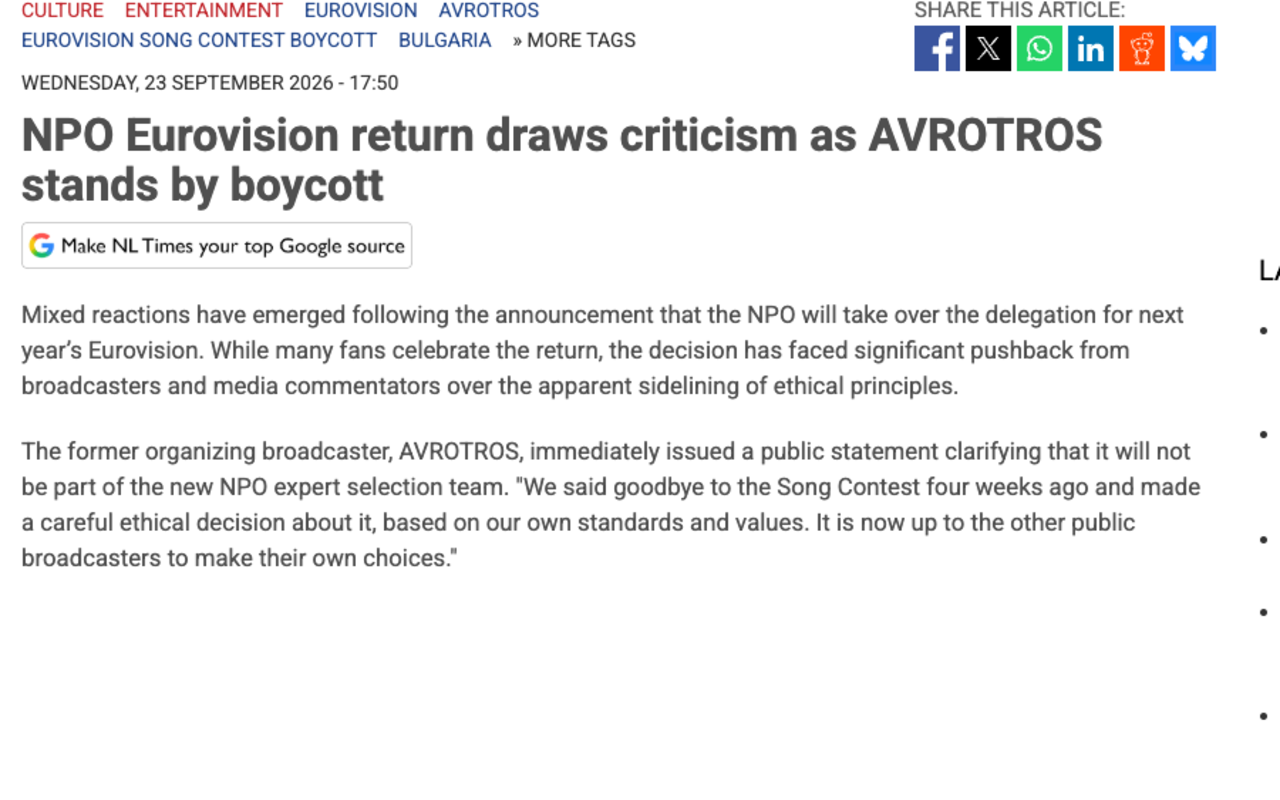
This is the part most coverage compresses, and it matters for anyone reading the Dutch return as a signal about the other boycotters. AVROTROS is not coming back and will play no part in the new selection. Its statement was blunt: it “said goodbye to the Song Contest four weeks ago and made a careful ethical decision about it, based on our own standards and values”.
So nothing that caused the boycott has been resolved. The war in Gaza continues, the EBU has not barred KAN from Burgas, and the broadcaster that objected still objects. What changed is which organisation carries the Dutch entry. That is precisely the criticism now being made in the Dutch press — that this was a procedural workaround on billing and delegation rather than an answer to the ethical question, and that it lets AVROTROS’s argument disappear without anyone having to rebut it.
We are not taking a position on the politics. The point for a betting audience is narrower and more useful: a country’s participation and a broadcaster’s position are two different variables, and 2026 taught the market to treat them as one. Any country with more than one EBU member broadcaster has a route back that does not require the objecting broadcaster to reverse. That applies to the Netherlands. It does not apply to Ireland, where RTÉ is the only Irish EBU member and has refused to use the mandate it holds.
Belgium Confirmed Too — And Its Own Unions Filed Strike Notices
The same day, VRT confirmed Belgium for Burgas. It had also taken an extension past 15 September, and it had spent months signalling the opposite: VRT said in May 2026 that participation was “unlikely” without a direct vote of member broadcasters on Israel’s participation and a published framework setting out when a country can and cannot compete. It got neither, and entered anyway. Belgium alternates between VRT and RTBF, and 2027 is VRT’s turn. The entry will be chosen internally — VRT says there is no longer time to stage a national final.
The decision is contested inside the building. Trade unions ACV VRT and ACOD-VRT have filed strike notices covering 11, 13 and 15 May 2027 — the exact dates of the two semi-finals and the grand final. Their joint statement says the aim is to “protect all employees who have moral objections to contribute from far or near to the programs and broadcasts of and about the Eurovision Song Contest”.
We can find no precedent for a Eurovision broadcast being struck by its own participating broadcaster’s staff. A filed strike notice is not a strike, and seven months is a long time, but this is a live operational risk to a confirmed participant — the kind of thing that never appears in a participation market and occasionally decides whether a delegation actually travels.
Cyprus, Georgia, And Where The 2027 Field Stands
Two more confirmations landed on 24 September. CyBC confirmed Cyprus, which will be its 43rd consecutive appearance since debuting in 1981; the selection method is unannounced, though Cypriot media have reported a production company offering to fund a televised national final, which would be the first since 2015. GPB confirmed Georgia to ESCToday, a 19th consecutive participation, method also unannounced.
Adding Belgium, the Netherlands, Cyprus and Georgia takes our confirmed 2027 participation board from 24 countries to 28. Of the five 2026 boycotters, the tally is now: one back (Netherlands), one settled out (Ireland), one recommended out but not voted on (Spain), and two silent (Iceland, Slovenia).
What Polymarket Got Wrong, And What It Is Pricing Now
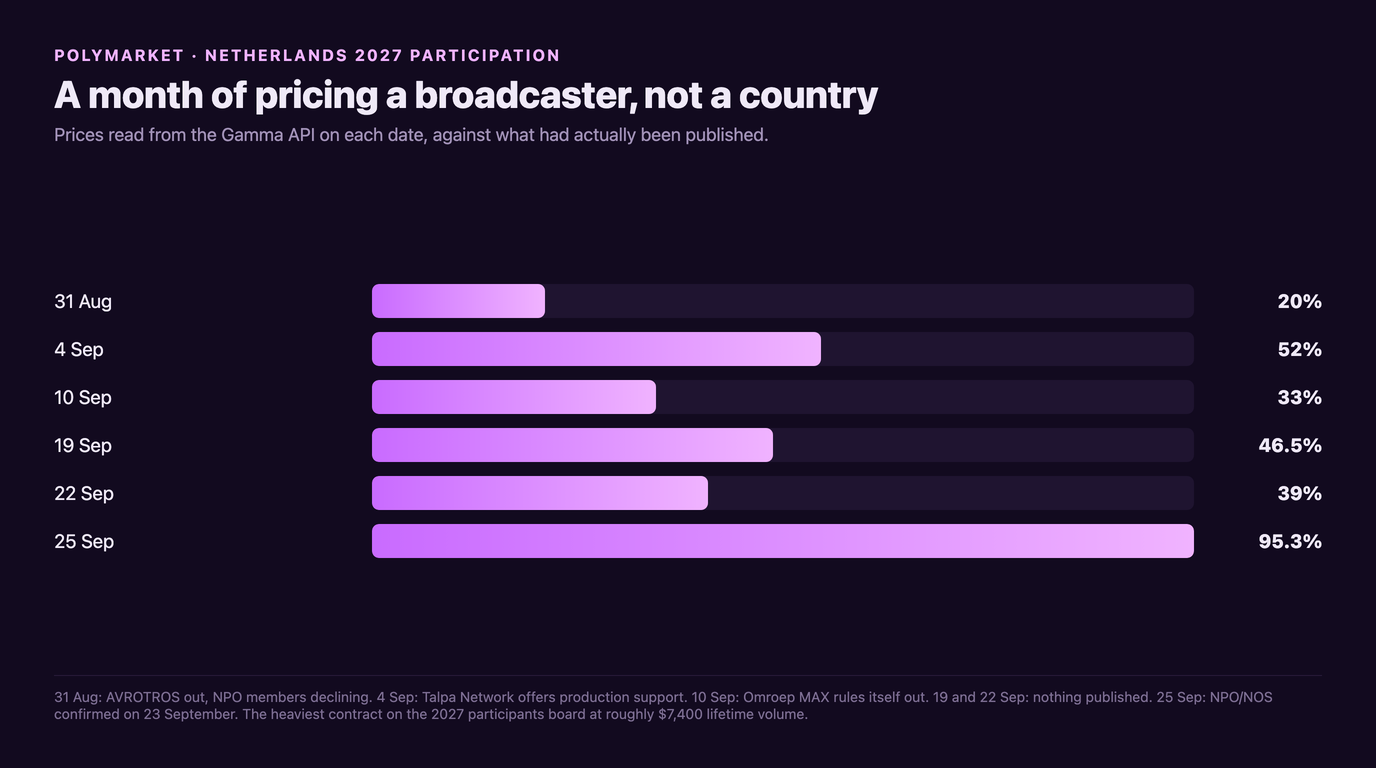
Dutch participation is the heaviest contract on Polymarket’s 2027 participants board at roughly $7,400 of lifetime volume. It spent September doing this, on prices we read from the Gamma API on each date:
| Date | Netherlands | What was published |
|---|---|---|
| 31 Aug | 20% | AVROTROS out; NPO members declining |
| 4 Sep | 52% | Talpa Network offers production support |
| 10 Sep | 33% | Omroep MAX rules itself out |
| 19 Sep | 46.5% | nothing |
| 22 Sep | 39% | nothing |
| 25 Sep | 95.3% | NPO/NOS confirmed, 23 September |
The instructive failure is the 4 September spike. The market moved 32 points on Talpa Network publicly offering to help — and Talpa is a commercial group, not an NPO member, and could not have entered the contest. Meanwhile the route that actually worked, NPO restructuring the mandate around NOS, was never priced at all, because nobody had publicly proposed it. The heaviest book on the board traded an irrelevant headline hard and the real mechanism not at all, then repriced 56 points in two days once it was announced.
The general lesson, and it is one this site has been burned by before in the other direction: a thin market reacts to what is reported, not to what is possible. When an outcome depends on institutional plumbing rather than on a public statement, expect the price to be uninformative right up until the announcement.
The rest of the board on 25 September 2026, all read from Polymarket’s Gamma API the same day, on about $26,000 of lifetime volume across 14 contracts: Canada 96.7%, Germany 95.6%, Netherlands 95.3%, Austria 92.6%, Moldova 90.5%, Israel 90.4%, Belgium 86.5%, Iceland 73%, Italy 64.7%, Slovenia 60.5%, North Macedonia 58.7%, Kazakhstan 14.2%, Ireland 3.7%, Spain 5.5%.
| Country | Price, 25 Sep 2026 | Status |
|---|---|---|
| Canada | 96.7% | Confirmed |
| Germany | 95.6% | Confirmed |
| Netherlands | 95.3% | Confirmed 23 Sep (NPO/NOS) |
| Austria | 92.6% | Confirmed (2026 host) |
| Moldova | 90.5% | Confirmed |
| Israel | 90.4% | Confirmed; up from 71.6% |
| Belgium | 86.5% | Confirmed 23 Sep (VRT) |
| Iceland | 73% | 2026 boycotter, silent — $239 lifetime volume |
| Italy | 64.7% | Not yet confirmed |
| Slovenia | 60.5% | 2026 boycotter, silent; no EBU extension |
| North Macedonia | 58.7% | Not yet confirmed |
| Kazakhstan | 14.2% | Associate member, never yet admitted |
| Spain | 5.5% | RTVE president proposes a second absence; board has not voted |
| Ireland | 3.7% | Settled out — RTÉ is the only Irish EBU member |
Read the two columns together rather than the price alone. Every contract above 86% has a published confirmation behind it; every contract below 65% is priced on an absence of news, and two of them — Iceland and Slovenia — are the four-figure-price, three-figure-volume contracts that a single trade moves.
Two of those deserve a flag. Israel jumped from 71.6% to 90.4%, which looks like the market reading the Dutch and Belgian confirmations as evidence the EBU will not move against KAN. And Iceland sits at 73% on $239 of lifetime volume having traded 64.5%, then 30%, then 30%, then 73% inside eight days with nothing published by RÚV in either direction. That is not an opinion; it is a book too thin to carry one. If you are tempted to read anything into Icelandic participation, read the volume column first. We keep a running note on which of these contracts are liquid enough to mean anything at our bookmakers and markets page, and the mature-market comparison is on the Eurovision winner odds.
What the September mis-pricing actually cost
Two of the six moves in the table above happened on days with nothing published: 19 September at 46.5% and 22 September at 39%. Between them the contract travelled 7.5 points on no news at all, which is a market trading its own guesses about a decision being taken inside a building it could not see into.
The error was not the level. Twenty per cent on 31 August was defensible: AVROTROS was out and NPO's members were declining one after another. The error was the variable. Every price in that column was an estimate of whether a member broadcaster would take the mandate, and that question was never the one the contract resolved on. NPO answered a different question — it stopped looking for a member and restructured the job — and the contract went to 95.3% on an option nobody on the board had been pricing.
The reusable lesson is narrow and worth writing down before the remaining boycotters resolve: where a country has more than one EBU member, a participation contract is not a referendum on the objecting broadcaster. It is a question about whether any eligible organisation will carry the entry, and umbrella bodies can invent structures that no list of member broadcasters would suggest. Spain and Iceland both have that optionality. Ireland does not, which is why its contract is the only one of the five that can be read straight off the objecting broadcaster's position.
Slovenia: A Correction We Owe Readers
This site previously reported that the EBU had granted RTVSLO extra time beyond the ordinary deadline, and described it as the only slot the EBU was publicly holding open. On the broadcaster’s own account, that was wrong.
On 22 September RTVSLO stated that it “didn’t request an extension of the deadline for the final decision on participation and therefore did not receive one from the EBU”, and that it “did not send its intention to participate in the 2027 Eurovision Song Contest to the EBU” at all. It also denied that any RTVSLO representative attended the Eurovision Workshop in Montenegro. What remains is “informative conversations”, with the decision tied to the preparation and adoption of RTVSLO’s 2027 Programming and Production Plan and constrained by money. We have corrected the 2027 board accordingly.
This is worth stating plainly because Slovenia is still priced at 60.5% — the highest of the four unresolved boycott questions — and part of that price was built on a 74.5% spike on 19 September, in the window when the extension was being reported. A market that repriced on an extension the broadcaster says never existed has not fully given the move back.
What To Watch Next
Three things, in order of how much they would move a board. First, Spain’s RTVE board vote: president José Pablo López told the Senate on 22 September he will propose a second consecutive absence, but the board has not voted and no date has been published. Spain trades at 5.5%, below Ireland’s settled withdrawal, which prices the vote as a formality it is not on paper. Second, Iceland, whose RÚV board was due to take the question in September and has published nothing with the month nearly gone. Third, Slovenia’s 2027 Programming and Production Plan, which is now the document that decides it rather than any EBU deadline.
And one non-market item: whether those Belgian strike notices survive to May. Sources for this piece: ESCXTRA on the NPO/NOS structure, NL Times for the AVROTROS statement and the domestic criticism, and Eurovoix on the VRT confirmation and the union strike notices. All prices read from Polymarket’s Gamma API on 25 September 2026.