
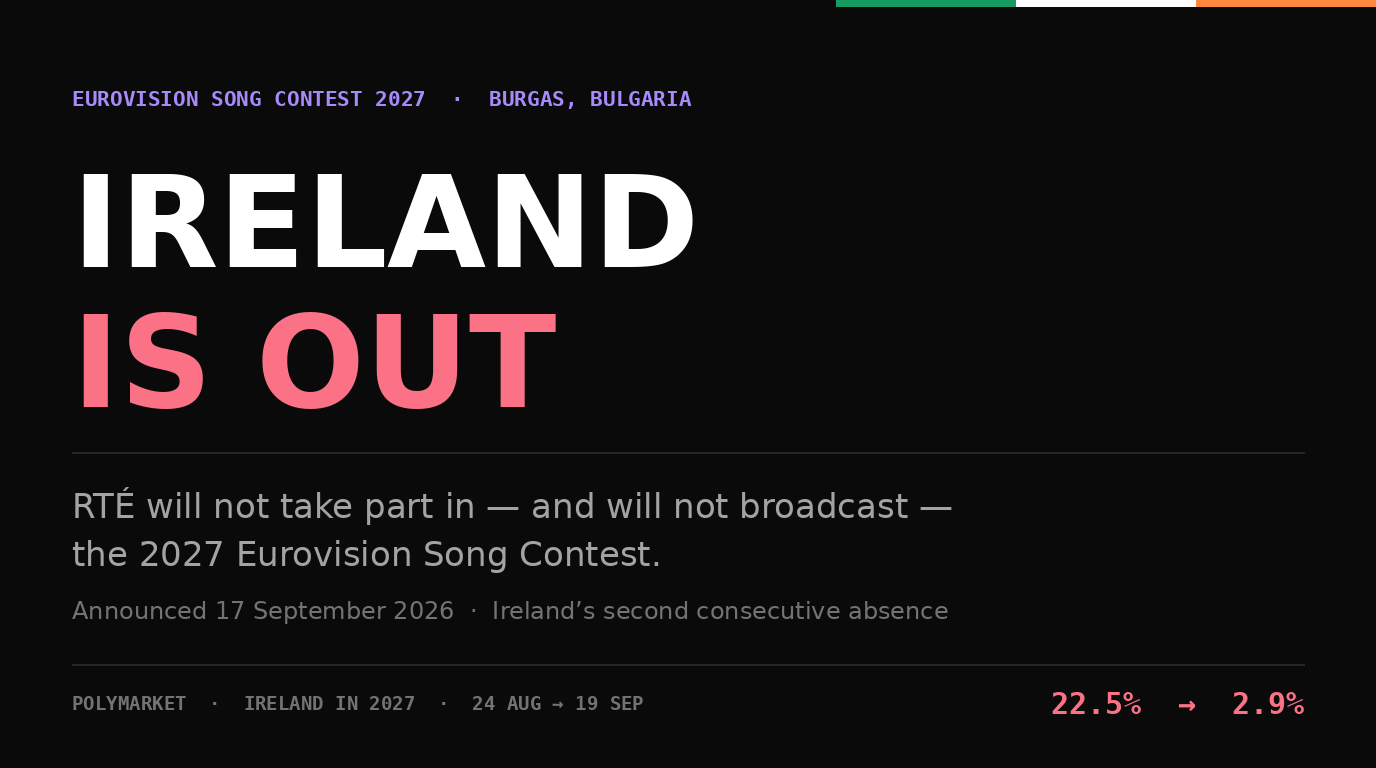
RTÉ will not take part in the Eurovision Song Contest 2027, and will not broadcast it either. The Irish public broadcaster published the decision on 17 September 2026, ruling Ireland out of the Burgas contest and confirming a second consecutive absence for a country that is the joint record holder, with Sweden, on seven wins. It is the second of the five broadcasters that boycotted Eurovision 2026 to settle its 2027 position, and the first to withdraw the television coverage as well as the entry.

18+ | New customers only | T&Cs apply | Please gamble responsibly
What RTÉ actually said
The statement is short and it does not hedge. Ireland’s participation, RTÉ said, “cannot be justified given the appalling and ongoing loss of lives in Gaza and the humanitarian crisis there which continues to put the lives of so many civilians at risk”. The broadcaster added that it remains deeply concerned by “the continued denial of independent access to international journalists” to the territory. Read it at the source: RTÉ's statement on the 2027 Eurovision Song Contest.
Two things are worth noting about the framing. RTÉ does not name Israel’s broadcaster KAN, and it does not make its return conditional on anything the EBU could decide. There is no “unless” in the statement — no rule change, no vote, no review that would reopen the question. That matters for anyone trying to price a 2028 return, because the broadcasters that left a condition on the table (Spain and Slovenia among them) have given the market something to trade. RTÉ has not.
The broadcast blackout is the genuinely new part
Ireland is not the first country out of Eurovision 2027. It is the first to say it will not show the contest. AVROTROS withdrew the Dutch entry on 24 August and said nothing about blacking out the broadcast; the five 2026 boycotters all still carried the Vienna final in one form or another. RTÉ is removing Eurovision from Irish television altogether.
That is a bigger commercial decision than the entry fee it saves. Eurovision is reliably one of RTÉ’s largest live audiences of the year, and the national final — Eurosong, in its various formats — is a schedule fixture with its own sponsorship. Giving up the entry costs a participation fee. Giving up the broadcast costs advertising revenue and a night of guaranteed reach. Broadcasters do not usually pay twice for a position they intend to revisit quickly, which is the strongest available signal that RTÉ expects to be out for more than one year.
The EBU’s response
Martin Green CBE, the Eurovision Song Contest director, replied the same day: “We regret that RTÉ will not be participating in the Eurovision Song Contest in 2027, but we fully respect their decision and recognise the huge contribution they have made to the Contest.” He said the contest brings broadcasters together to share music and create connections between audiences, and that this is “even more important now in an increasingly difficult and divided world”, before adding that the EBU “will remain in dialogue with RTÉ and hope to welcome them back to the Contest in the future”.
It is close to word-for-word the response the EBU gave AVROTROS in August: regret, respect, an acknowledgement of past contribution, a hope of return, and no engagement at all with the stated reason. We wrote about that pattern when the Dutch mandate collapsed — see the EBU goes looking for a replacement. The consistency is the point: the EBU is treating each withdrawal as an individual broadcaster’s choice rather than as evidence of a structural problem, and it has now done so twice in four weeks.
Where the five 2026 boycotters stand now
| Broadcaster | 2027 position | Dated | Polymarket, 19 Sep |
|---|---|---|---|
| 🇮🇪 RTÉ (Ireland) | Out. Will not enter or broadcast | 17 Sep 2026 | 2.9% |
| 🇳🇱 AVROTROS (Netherlands) | Out. Mandate returned to NPO; no member has taken it | 24 Aug 2026 | 46.5% |
| 🇸🇮 RTVSLO (Slovenia) | Undecided — in talks with the EBU, deadline extended | 17 Sep 2026 | 74.5% |
| 🇪🇸 RTVE (Spain) | Undecided — board postponed the decision | 16 Sep 2026 | 21.5% |
| 🇮🇸 RÚV (Iceland) | Undecided — board was due to decide in September, nothing published | — | 30% |
Two settled absences, three open questions, and not one of the three has signalled a return. The Netherlands row is the odd one: the contract still prices at 46.5% even though AVROTROS is out, because the market is pricing whether some other NPO member picks up the mandate rather than whether AVROTROS changes its mind. Slovenia at 74.5% is the market taking the EBU’s deadline extension as a strong tell. All five rows, with sources, sit on our Eurovision 2027 participants and national selections page.
What the market did
Polymarket’s Eurovision 2027 Participants event carries a contract on Irish participation. It traded at 22.5% when we last wrote about Ireland on 24 August. On 17 September, the morning of the announcement, we read it at 20.5%. Two days later it is at 2.9%, on a book of roughly $977 in lifetime volume. Prices read from Polymarket’s Gamma API on 19 September 2026.
The same 48 hours moved two other contracts in ways that track the news precisely. Slovenia went from 30.5% to 74.5% on the day RTVSLO confirmed it is in talks with the EBU. Spain barely moved — 21% to 21.5% — across RTVE’s board postponing its decision, which is the market saying a delay told it nothing it had not already assumed. The outlier is Iceland, which fell from 64.5% to 30% with nothing published to explain it, on a book of about $219. On a market that thin, that is a price, not news, and we would not report it as anything else.
A word on what these numbers are worth. The entire Eurovision 2027 Participants event has turned over about $18.4K since it opened. For scale, the Eurovision 2026 winner market closed near $194M. These are opinions expressed at very low stakes, and the Ireland contract at 2.9% is not a forecast any more — it is settlement risk on a fact that has already happened. There is no trade left in it.
Our August call, and the trade we did not take
On 24 August we published an analysis putting the probability of an Irish boycott at about 85%, against a market that had it at 22.5% the other way. The reasoning was that Ireland’s stated condition — Israel not competing — had already been closed off, that domestic pressure ran one way, and that the application deadline had a default: staying out required RTÉ to do nothing at all. That call was right.
The same piece said 22.5% was not a trade, and that was the part we got wrong — or at least the part worth re-examining. The stated reason was liquidity: a few hundred dollars of depth, months of capital lockup, and a resolution date in December. Those objections were real and they are still real. But they are objections to the size of the position, not to its direction, and a call made at 85% against a 22.5% price is either worth acting on in some size or is not really an 85% call. We are writing that down here because the honest record is more useful than the flattering one, and because it is the sort of thing a betting site should say out loud when it happens.
What it means for the 2027 field
Ireland debuted in 1965 and, before 2026, had never missed a contest. Seven wins, three of them consecutive in 1992, 1993 and 1994 — still the only time any country has managed that — and Johnny Logan remains the only person with three Eurovision victories in any capacity. The full record is on our Eurovision statistics page. A two-year gap for that country is a genuine structural change to the contest, not a rounding error in the participant count.
For Burgas specifically, the practical consequences are narrow. Ireland has not qualified for a Grand Final since 2024 and was not a contender, so the winner market is barely touched — current prices are on our Eurovision winner odds page. The semi-final maths is where it shows: each withdrawal shrinks the qualifying pool, which marginally improves every remaining semi-finalist’s odds of reaching the final. With the Netherlands and Ireland both out and three more undecided, the 2027 field is the smallest open question of the season and the one with the shortest fuse. The EBU’s application window closes in the autumn.
The other consequence is votes. Ireland has been a reliable source of points for the UK and for the Nordic bloc, and those points do not transfer — they disappear. Anyone modelling 2027 televote patterns off 2025 data is now carrying two missing electorates rather than one.
The betting position
There is nothing to back here, and we would rather say that than manufacture a market. The Ireland contract has resolved in all but name. The three live questions are Slovenia, Spain and Iceland, and of those only Iceland looks mispriced to us — a 34-point fall with no published cause, on a $219 book, is the kind of move that reverses on a single headline. It is also a $219 book, which is the whole argument against doing anything about it.
No UK-facing bookmaker has priced 2027 participation at all, so Polymarket is the only board on this question. We poll Polymarket’s Gamma API on a running basis and will update the 2027 board as Slovenia, Spain and Iceland resolve. 18+. Please gamble responsibly.
Sources: RTÉ's statement of 17 September 2026 (about.rte.ie) and RTÉ News; the EBU's response via Eurovoix; prices from Polymarket's Gamma API, read 19 September 2026.