
Yes. We think Ireland stays out. Not as a lean or a shrug — we would put it at roughly 85% that RTÉ does not compete at Eurovision 2027 in Burgas. That is a firmer position than Polymarket's, which prices Ireland at 22.5% to participate, implying 77.5% out.

18+ | New customers only | T&Cs apply | Please gamble responsibly
The reasoning below is structural, not vibes-based, and it starts with a fact about the deadline that most coverage of “will Ireland return?” leaves out entirely.
The asymmetry nobody mentions
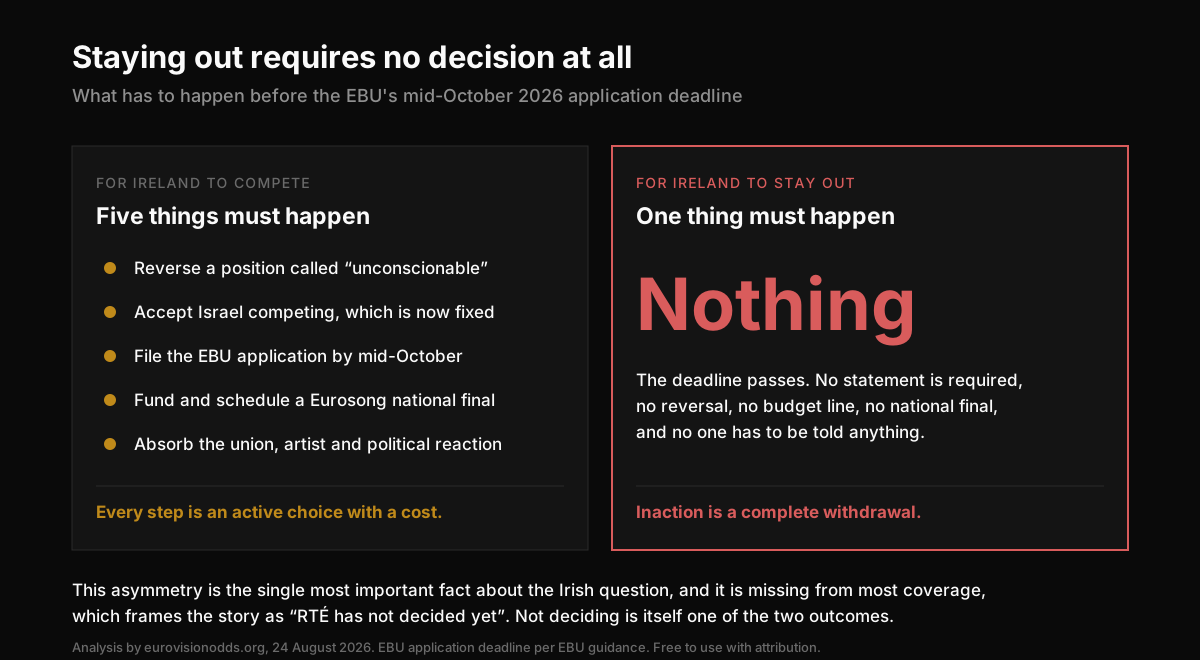
EBU applications close in mid-October 2026. Work through what each outcome actually requires of RTÉ.
To compete, RTÉ must publicly reverse a position it described as a matter of conscience, accept that Israel is in the room, file the application, find and schedule a Eurosong national final, and then absorb the reaction from the unions, artists and politicians who have spent a year praising the boycott. Five active steps, each with a cost.
To stay out, RTÉ must do nothing. The deadline passes. No statement, no reversal, no budget line, no national final, nobody has to be told anything.
Most coverage frames this as “RTÉ hasn't decided yet.” That framing is wrong. Not deciding is one of the two outcomes, and it happens to be the one that requires no courage, no explanation and no meeting. When a decision has that shape, you should put heavy weight on the default.
The stated condition cannot be met
RTÉ's reason for leaving was specific. In September 2025 director general Kevin Bakhurst said Irish participation “would be unconscionable given the ongoing and appalling loss of lives in Gaza” if Israel took part. In December 2025 RTÉ confirmed it would neither compete in nor broadcast the 2026 contest.
That condition — Israel not competing — is now closed off. Israel confirmed for 2027 on 12 July, and the contest director has said there will be no further votes on excluding it. There is no mechanism left through which Ireland's stated precondition gets satisfied.
Bakhurst's May 2026 update on Morning Ireland is the most-quoted line in this whole story, usually truncated. The full version matters:
“For us as a public service broadcaster, who believes in the importance of protecting journalists and believes in human rights, there's no reason at the moment to change our decision.”
And the rationale:
“We haven't started to think about next year and there is a long way to go. Our rationale still holds, civilians are dying in smaller numbers, but they are still dying in significant numbers in Gaza, and also in Lebanon. Journalists are still being targeted, and they still have been up to recently.”
Notice that this is two conditions, not one. Civilian deaths, and the targeting of journalists. Even a material improvement on the first leaves the second untouched — and journalist safety is a professional, institutional concern for a newsroom in a way that generalised humanitarian sentiment is not. It is the argument least likely to be quietly dropped.
The AVROTROS test, run this morning
We do not have to speculate about whether the EBU's reform package satisfies a boycotting broadcaster. That experiment ran today.
AVROTROS announced its second consecutive withdrawal on 24 August, saying explicitly that the EBU's recently announced changes “do not provide sufficient confidence that the independent and neutral character of the Eurovision Song Contest has been restored.”
The Dutch and Irish asks were near-identical: transparent rules on the participation of countries involved in military conflict. The EBU delivered a host-security clause, tighter promotion limits, an age change and a voting proposal. None of that addresses journalist safety, and none of it gives member broadcasters the direct vote on participation that VRT has also demanded.
If that package was not enough for the Netherlands, there is no obvious reason it is enough for Ireland, whose stated grounds are if anything narrower and more specific.
The domestic pressure runs one way
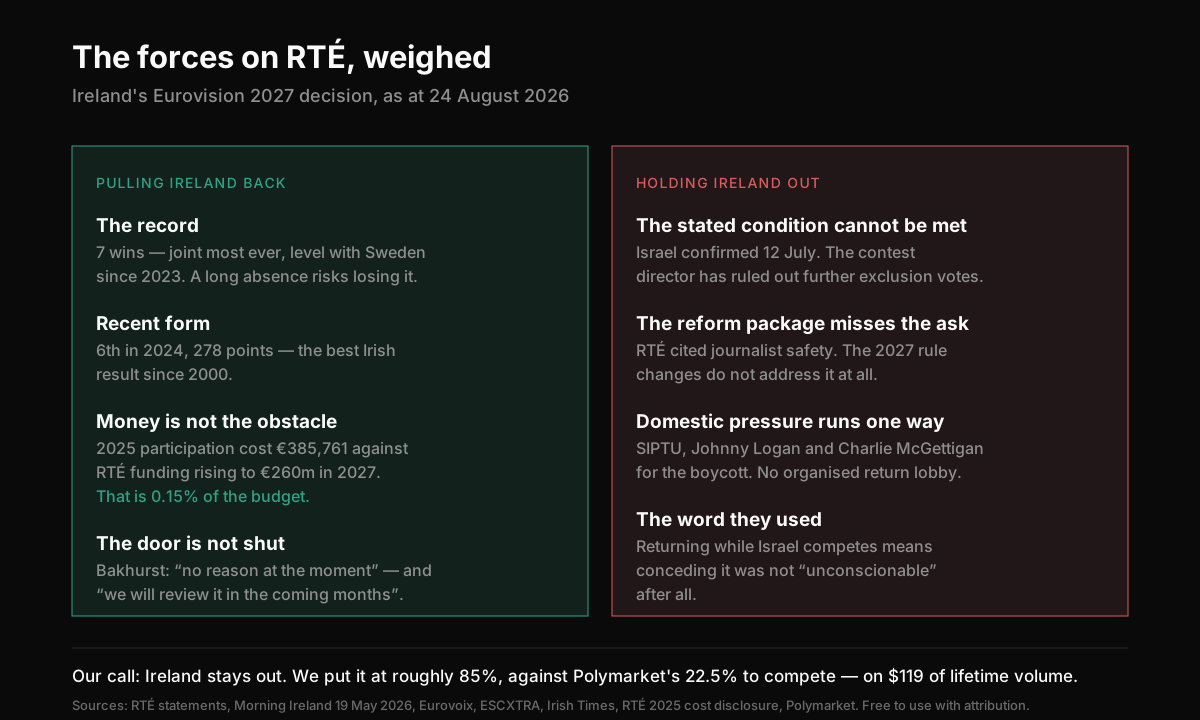
SIPTU, Ireland's largest trade union, wrote to RTÉ asking it to maintain the boycott while Israel participates — and went further, asking RTÉ to drop coverage of Ireland's football fixtures against Israel, praising the broadcaster's “moral courage”.
RTÉ's answer to that second request is quietly revealing. It declined on the grounds that refusing to broadcast the football would breach contractual obligations and damage future sports rights deals, while noting it has freedom regarding Eurovision participation.
Read that again. RTÉ has publicly categorised Eurovision as the discretionary one — the commitment it is free to walk away from without penalty. That is not the framing of an organisation looking for a route back.
On the artist side: Johnny Logan, the only performer to win Eurovision twice as a singer and the most recognisable Irish figure in the contest's history, has backed the withdrawal. Charlie McGettigan, the 1994 winner, said he would return his trophy in protest. The main dissenting voice is Dana Rosemary Scallon, the 1970 winner, arguing the contest should stay apolitical.
One legendary winner against the boycott, two for it, plus the country's biggest union. There is no organised constituency campaigning for a return, and no cost to RTÉ in continuing.
Money is not the story either way
It is tempting to reach for RTÉ's finances as an explanation. It does not work, in either direction.
RTÉ's 2025 participation cost €385,761 in total, of which €100,270 was the EBU fee — a figure that also bought broadcast rights to nine hours of live coverage. Against RTÉ's guaranteed funding of €260m in 2027, up from €240m in 2026, Eurovision is 0.15% of the budget.
Yes, licence fee sales have fallen by nearly 200,000 in four years and RTÉ needs €54m of direct exchequer money in 2026. But the funding floor is rising into 2027, and a sum this small is not what a cost-cutting programme turns on. Anyone arguing Ireland stays out to save money, or returns because the finances improved, is arguing about a rounding error.
The strongest case for being wrong
We got the Netherlands wrong this morning, so it is worth setting out honestly what would beat this call.
Bakhurst left the door visibly open. “No reason at the moment” and “we will review it in the coming months” is not locked language. He also said RTÉ hadn't started thinking about 2027 — which, if taken literally in May, means the real decision is being made about now.
The record is a genuine emotional lever. Ireland's seven wins are the joint most in history, level with Sweden since 2023. Every year Ireland sits out is a year Sweden might take the record outright. For a country whose Eurovision identity is built almost entirely on that number, this is not a trivial consideration, and it is the argument most likely to be made loudly inside RTÉ.
The cluster could break. Slovenia has moved from withdrawal to actively considering a return. If Slovenia and Spain both go back and Ireland is left standing with only a handful of others, the isolation changes the politics. We have run the same exercise on Iceland, where we land at a softer 65%.
A material change in Gaza before mid-October would weaken the first half of the stated rationale, and Bakhurst has already acknowledged casualties falling.
Those are real. They are also, collectively, why our number is 85% and not 95%.
The call, and why it is not a bet
Ireland does not compete at Eurovision 2027. Roughly 85% confidence.
The core of it: a stated condition that cannot now be satisfied, a reform package that has already failed this exact test with another broadcaster today, one-directional domestic pressure, no financial reason to return, and a deadline whose default outcome is withdrawal.
Polymarket has Ireland at 22.5% to participate. We think that is a touch generous to a return, but the gap between 22.5% and our 15% is not the interesting part — the market has traded $119 in its entire lifetime. That is not a price you can act on, and after this morning we are not going to pretend a thin market's number is a trading opportunity just because we disagree with it by seven points.
Call it a view, held with reasons, on the record. Not a bet. The full field picture is in our Eurovision 2027 participation board, and the contest itself runs 11, 13 and 15 May 2027 in Burgas.
Quick answers
Will Ireland be at Eurovision 2027? Our view is no, at roughly 85% confidence. RTÉ has not formally announced a 2027 decision. Applications close mid-October 2026.
Why did Ireland withdraw? RTÉ said participation would be “unconscionable” while Israel competes, citing civilian deaths in Gaza and the targeting of journalists. It neither entered nor broadcast the 2026 contest, airing the Father Ted episode A Song for Europe instead.
Has RTÉ ruled out 2027? Not formally. Kevin Bakhurst said in May 2026 there was “no reason at the moment” to change the decision, and that it would be reviewed.
Is money a factor? Not meaningfully. Participation cost €385,761 in 2025 against RTÉ funding rising to €260m in 2027.
How many times has Ireland won Eurovision? Seven — the joint record with Sweden. The last was 1996, Eimear Quinn with “The Voice”. See the full all-time wins table.
What do the markets say? Polymarket prices Ireland at 22.5% to participate in 2027, on $119 of lifetime volume. Treat that as an indication, not a price.