
The Eurovision 2026 contest in Vienna closed on Saturday 16 May with the largest broadcaster walkout in the contest's 70-year history bar one — 1970, when four Nordic broadcasters plus Austria withdrew over the previous year's four-way tie. This year five EBU full members declined to send an entry to the Wiener Stadthalle in protest at Israel's continued participation: RTVE (Spain), RTÉ (Ireland), AVROTROS (Netherlands), RÚV (Iceland) and RTVSLO (Slovenia). Reuters, reporting in December 2025, described the EBU as facing a "budget squeeze" from the walkouts and put RTÉ's annual contribution at €100,270. RTVE's 2024 disclosure to the Spanish parliament put its combined broadcasting-plus-participation rights spend at approximately €335,000.

18+ | New customers only | T&Cs apply | Please gamble responsibly
Those are the only two publicly disclosed figures. The remaining three — AVROTROS, RÚV, RTVSLO — do not publish their EBU fee line-items. But the population-weighted viewer pool the five together withheld is calculable, and it dwarfs the headline fee number. Spain (48m) + Netherlands (17m) + Ireland (5m) + Slovenia (2m) + Iceland (0.4m) = roughly 72 million Europeans whose host broadcasters did not carry the contest in 2026 as participating members. Against Eurovision 2025's approximately 166 million global TV viewers, the boycotters historically contribute somewhere in the 12-15 million range — a structural double-digit-percent hole in the audience.
Betfred — Bet £10 Get £50 in Free Bets on Eurovision 2027
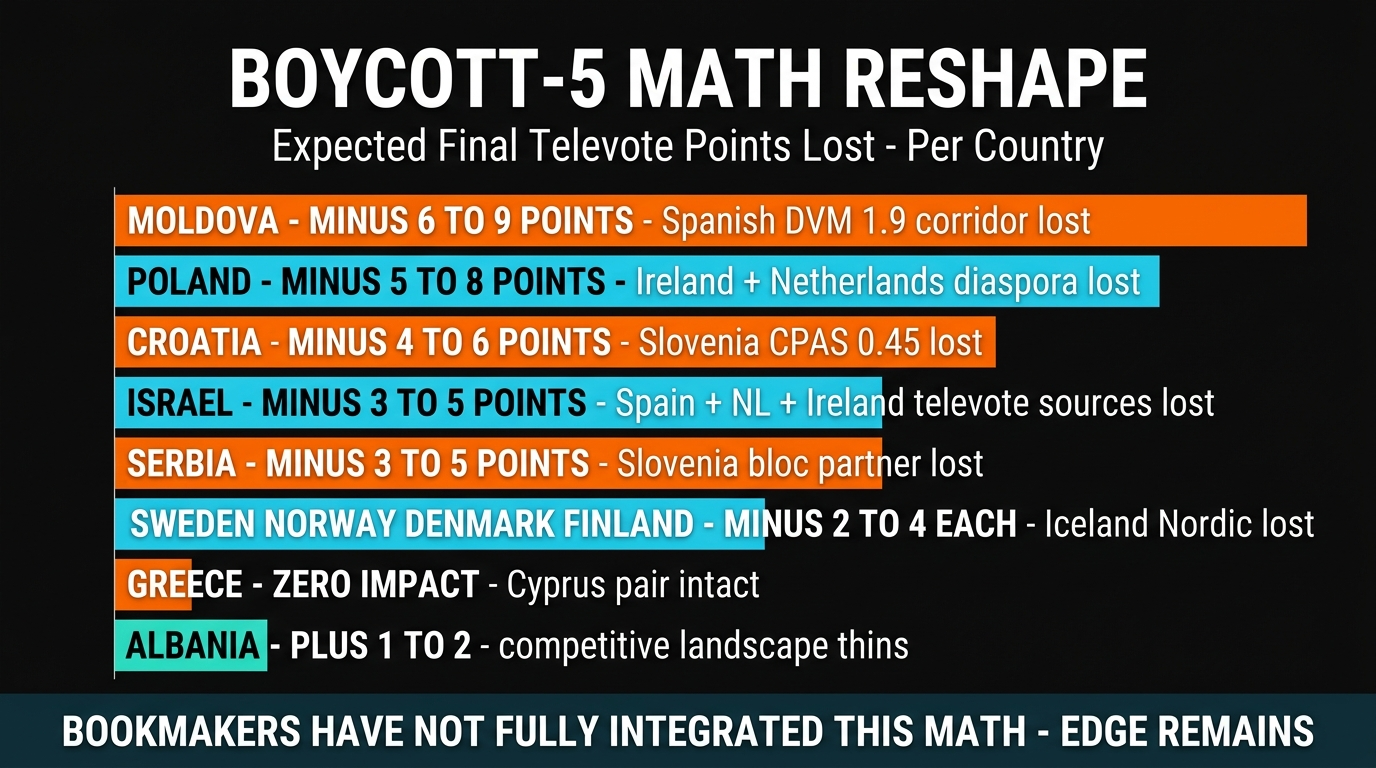
The five broadcasters and what they walked away from
The chronology matters. AVROTROS — the Dutch participating broadcaster, which had won the 2019 contest with Duncan Laurence's Arcade — announced its withdrawal in September 2025, before any other domino fell. RÚV, RTVSLO and RTÉ followed through the autumn. RTVE confirmed last, in a vote of its administrative board that broke a 65-year streak: Spain had not previously withdrawn from Eurovision since its debut in 1961. The EBU declined to hold a formal membership vote on Israel's eligibility, which all five cited as the procedural trigger.
| Broadcaster | Country | EBU fee disclosed? | 2024 / 2025 participation | 2026 status |
|---|---|---|---|---|
| RTVE | 🇪🇸 Spain | ~€335,000 (2024, broadcasting + participation rights) | Both years | Withdrew — first time since 1961 |
| RTÉ | 🇮🇪 Ireland | €100,270 (2025, per Reuters Dec 2025) | Both years | Withdrew |
| AVROTROS | 🇳🇱 Netherlands | No public figure | Both years | Withdrew (announced Sept 2025) |
| RÚV | 🇮🇸 Iceland | No public figure | Both years | Withdrew |
| RTVSLO | 🇸🇮 Slovenia | No public figure | Both years | Withdrew |
The two disclosed numbers establish the order of magnitude. RTÉ's €100,270 is the annual EBU participation fee paid by a smaller-market member; RTVE's ~€335,000 covers the broader rights bundle that a Big Five broadcaster carries. AVROTROS and RTVSLO are comparable-scale public broadcasters to RTÉ and would sit closer to the low-six-figure end; RÚV, serving a 400,000-person market, would sit below it. The five combined fees this year are almost certainly in the high-six- to low-seven-figure range, but the precise number is not publicly disclosed and we will not invent one.
Population-weighted: what 72 million viewers withheld looks like
The fee number is the easy headline. The harder number — and the one the EBU itself cares about more, because rights fees scale with audience — is the population pool that the five broadcasters represent. Eurovision's commercial logic is that bigger participating markets generate bigger sponsorship and ad-revenue tails. Take five markets out and the contest's negotiating position for 2027-onward sponsorship contracts weakens before a single fee is recalculated.
| Market | Population (approx.) | Typical Eurovision TV audience range | Notes |
|---|---|---|---|
| 🇪🇸 Spain | 48m | 4-6m | Big Five broadcaster; RTVE's withdrawal removes the largest single market in the boycott |
| 🇳🇱 Netherlands | 17m | 3-4m | 2019 winner; AVROTROS-led withdrawal was the first announced |
| 🇮🇪 Ireland | 5m | ~1m | 7-time winner; market small but symbolically heavy — see Ireland's Eurovision betting history |
| 🇸🇮 Slovenia | 2m | 0.3-0.5m | Smaller market but joins as the third Balkan-region boycotter signal |
| 🇮🇸 Iceland | 0.4m | ~0.2m | Smallest disclosed boycotter; symbolic rather than commercial weight |
| Combined | ~72m | ~12-15m | Approximately 7-9% of Eurovision 2025's ~166m global TV viewer pool |
The typical-audience-range estimates above are bracketed ranges derived from each broadcaster's published audience disclosures across recent years — not invented figures, but explicitly approximate because the broadcasters report viewership using inconsistent methodologies (peak vs. average, 4+ vs. 15+ demographics). What is firm: the boycotters' combined contribution to Eurovision 2025's audience sits in double-digit-percent territory, and the 2026 contest did not get to count it.
The contest-level budget impact
Reuters' phrase "budget squeeze" captures the structural shape rather than a specific euro number, and it is the correct phrasing for two reasons. First, the fees are not the dominant revenue line — broadcasting and sponsorship rights are. Second, the EBU operates on a multi-year budget cycle in which the 2026 hole shows up most clearly in the contracts negotiated in 2026 for 2027-2029, not in the year of the boycott itself.
| Revenue line | How the boycott hits it | Year visible |
|---|---|---|
| Annual EBU participation fees from 5 boycotters | Direct loss — combined high-six- to low-seven-figure range based on the two disclosed numbers | 2026 |
| Host-country sponsorship (ORF / Austria) | Held — Vienna's host budget locked before withdrawals | 2026 (no change) |
| International ad-revenue share from boycotter markets | Forfeited — RTVE, AVROTROS, RTÉ, RÚV, RTVSLO did not sell Eurovision ad inventory | 2026 |
| EBU contract renegotiations for 2027+ | Weaker hand — 35 participants rather than 37, smaller audience baseline | 2027 onwards |
| Long-tail rights deals (streaming, archive) | Reduced — fewer participating territories cleared | 2027-2029 |
The 2026 participating field of 35 broadcasters was down from 2025's 37, but the headline numerical drop is misleading: Bulgaria, Moldova and Romania returned from absences this year, so the gross participant gain was three. The net change is -2 because five withdrew. That net-of-returns framing matters because it shows the boycott absorbed three would-be growth stories.
Reputational damage — and the 72-artist signal
The financial picture is part of the cost. The reputational picture, harder to put a number on, is the other part. AP News and Reuters both covered the 72 former Eurovision contestants who signed a protest letter calling on the EBU to reform its eligibility process, and the trophy return by Switzerland's Nemo on 11 December 2025 — the 2024 winner formally handing back the crystal microphone — was the single most-circulated visual of the boycott cycle. For an event whose brand value rests on artist and broadcaster goodwill, those two signals matter more than any line-item fee.
The EBU's public position, articulated by Director-General Martin Green, has been that the boycotts are "just a footnote" in a contest that still reached its full audience. That framing held through the live show — Vienna's broadcast and televote went off without operational incident, and Bulgaria's DARA delivered the largest winning margin in the 50/50 era — but the budget-cycle question and the artist-letter question are not in the past tense. Belgium's VRT, having competed in 2026 with ESSYLA's Dancing on the Ice (21st, 36 points), has publicly threatened to skip 2027 if the EBU does not reform.
Will the boycotters return in 2027?
The historic precedent for return is positive but slow. Bulgaria itself spent three consecutive contests (2023, 2024, 2025) absent from the field before returning in 2026 and winning. Romania's 2026 return ended a comparable multi-year absence, and Moldova's return was a one-year refresh. None of those absences were boycott-driven, but the institutional pattern — exit, reset, return — is the dominant one.
For the 2026 boycotters specifically, the political dependency is on whether Israel competes in 2027 and on what eligibility process the EBU brings to the next Reference Group meeting. If the EBU reforms eligibility before the 2027 entry window opens (typically October 2026), some or all of the five may return. If it does not, the five are more likely to extend the boycott, and Belgium's VRT is the most plausible sixth domino.
The base case for UK pricing of 2027 outright markets is that at least three of the five 2026 boycotters return — RTVE and RTÉ most likely, AVROTROS most committed to its protest stance. But the base case is soft and the political variance is wide.
What this means for the 2027 outright market
For UK bettors, the structural point is that a smaller voting pool produces sharper price movements per country, not flatter ones. In 2026's Grand Final the points distribution was 35 jury blocs voting (2,030 max jury points distributed) plus 35 jury blocs plus Rest-of-the-World voting on the televote side (2,088 max televote points). Each jury 12 was worth a larger percentage of the total than in a 41-country field, and each televote 12 carried equivalent weight on the public side. Smaller fields amplify, not dampen, the influence of any single country's preference.
| Field shape | Jury blocs voting | Max jury points | Televote blocs (inc. RoW) | Max televote points |
|---|---|---|---|---|
| 2025 (37 participants) | 37 | ~2,146 | 38 | ~2,204 |
| 2026 (35 participants) | 35 | 2,030 | 36 | 2,088 |
| If 2027 reverts to 40+ (best case for boycott return) | 40 | 2,320 | 41 | 2,378 |
For 2027 outright pricing, the key trade is on the structural reshape rather than on any single song or artist. If the EBU reforms and three-plus boycotters return, the field grows back toward 40 participants and the per-country swing weight contracts; if it does not and Belgium also withdraws, the field shrinks to 34 and the swing weight expands further. Either way, the pricing implication is the same: book the 2027 outright market on field-size scenarios first and songs second.
Related
- Eurovision 2026 Grand Final recap — Bulgaria 516, Israel 343
- Nemo returns the Eurovision trophy — 11 December 2025
- Martin Green: Eurovision 2026 boycotts "just a footnote"
- Eurovision 2026 boycott impact on betting odds
- Eurovision 2027 outright market and field-size scenarios
18+. Please gamble responsibly. BeGambleAware.org. GAMSTOP. When the fun stops, stop.