
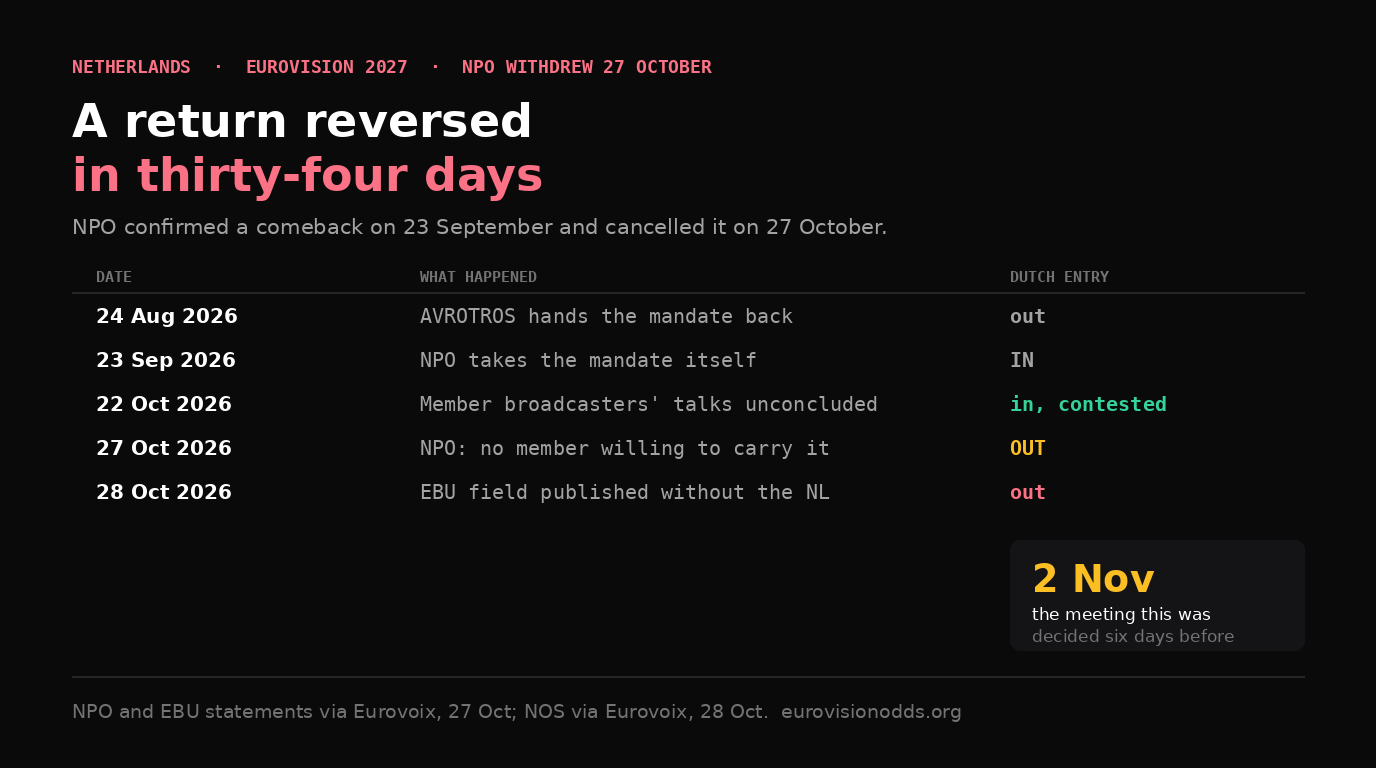
The Netherlands will not compete at Eurovision 2027. NPO announced on 27 October 2026 that it has withdrawn the participation it confirmed only thirty-four days earlier, leaving the Dutch out of Burgas and making this the second consecutive absence for a founding country that has entered all but four contests since 1956. The EBU published its official 36-country field the following day without the Netherlands on it.

18+ | New customers only | T&Cs apply | Please gamble responsibly
Illustration: a designed card showing the dated sequence of decisions. No real person or venue is depicted.
What NPO actually said
The reason given is internal and it is narrow. NPO is not itself a broadcaster — it is the coordinating body for the Dutch public system — so an entry has to be carried by one of its member broadcasters. It could not find one willing to do it.
Chairperson Jet de Ranitz put it this way in the press release:
“In our coordinating role, we held discussions with the broadcasters to investigate whether there are any broadcasters willing to facilitate the participation of a Dutch artist. In those discussions, we initially felt there was sufficient support to return. Unfortunately, we were unable to find a suitable format for this. As a result, we must conclude that it is currently too early to participate in the Eurovision Song Contest in 2027. Due to the sensitivities surrounding the themes currently at play, we have decided to take a step back for the time being.”
Read the scope of that carefully, because it is doing less work than a withdrawal statement usually does. It does not say the Netherlands objects to Israel’s participation. It does not set a condition for returning. It says NPO initially believed it had enough support, could not convert that into a workable arrangement, and has stepped back “for the time being”.
The detail that actually decided it
NPO had a route in and chose not to take it. This is the part of the story that was almost absent from the first wave of coverage, and it is the part that explains why this is a decision rather than an impasse.
Under Dutch media regulations, NTR carries a statutory task of filling gaps in public programming. That gives NPO the right to assign the Eurovision duties to NTR whether or not NTR volunteers. De Ranitz was asked about it and declined:
“We did not do that. If we conclude that the subject is so sensitive that it creates such divisive reactions, I consider it irresponsible to force a broadcaster to take over participation for 2027.”
So the Netherlands is not out because there was no legal mechanism to get it in. It is out because NPO judged that compelling a reluctant broadcaster to carry a contested entry would cost more than the entry was worth. That is a judgement call, and it is reversible in a way that a principled boycott is not.
Willing to help, unwilling to host
NOS reported on 28 October that the support NPO described was real but would not stretch far enough. According to multiple sources, EO and WNL were each willing to help make Dutch participation possible. EO director Arjan Lock said the broadcaster had been looking at ways alongside NPO to do it. But an EO spokesperson drew the line precisely:
“We do believe that Eurovision belongs in public broadcasting, but we do not think it fits with EO.”
WNL said it too had been willing to explore how a Dutch entry might work, but that “there proved to be insufficient support within public broadcasting. For a journalistic broadcaster like WNL, doing it alone is not an option.”
That is the gap that closed this. Two broadcasters agreed the contest belongs in public broadcasting and neither would put its own name on it. “Willing to co-operate” and “willing to be the broadcaster of record” turned out to be different propositions, and only the second one would have produced an entry.
How the Dutch return collapsed in five weeks
- 24 August 2026 — AVROTROS, which had held the Dutch mandate since 2010, withdraws from Eurovision 2027 and hands it back, citing its own ethical assessment.
- 23 September 2026 — NPO takes the mandate itself, with NOS to produce and broadcast and an independent committee of music experts to choose artist and song. It is the first reversal of a 2026 boycott by any of the five countries that stayed away.
- 22 October 2026 — The Council of Broadcasters confirms NPO and its members are in unconcluded talks over the decision-making process, the organisation and the financing. Around 500 member-broadcaster staff have signed a protest. A meeting with de Ranitz is set for 2 November.
- 23 October 2026 — AD reports that Davina Michelle, Marnix Emanuel and Tangarine are the front runners and that Claudia van der Pas will lead the delegation. NPO confirms none of it.
- 27 October 2026 — NPO withdraws. The 2 November meeting is overtaken by six days.
We flagged the 2 November meeting as the next hard date on this story. It never got the chance to matter, which is worth recording rather than quietly dropping: the decision came from the search for a carrier broadcaster, not from the staff protest that had a date attached to it.
The contest still airs in the Netherlands
One important distinction from the other withdrawal this season. NPO will broadcast both semi-finals and the final with Dutch commentary. Dutch viewers keep the show and keep their votes in the Rest of the World pool; what they lose is an entry to vote for.
That is unlike Ireland, where RTÉ withdrew the broadcast as well as the entry, taking Eurovision off Irish public television entirely. Of the five broadcasters that boycotted in 2026, RTÉ remains the only one to have done both.
What the EBU said
Martin Green, Director of the Eurovision Song Contest, responded the same day. The EBU is “deeply sorry”, understands the decision and respects “the strength of feeling behind it in the Netherlands”. He noted the country is a founding member, present at the first contest in 1956, and added:
“We recognise that opinions about the Contest are deeply and sincerely held at the moment, and that they differ widely, both within countries and between them. We do not dismiss any of those views. Public service media exist to serve their audiences, and it is right that our Members weigh these questions carefully, in dialogue with their own communities.”
He closed by saying the EBU looks forward “to welcoming a Dutch entry again whenever NPO, its members and audiences feel the time is right”. The full Eurovision 2027 participation tracker now carries the Netherlands in the ruled-out table.
The betting position, and it is an unusually blunt one
Polymarket’s Netherlands contract resolved to zero, and it was the heaviest book in the entire event. About $30.2K of lifetime volume — roughly three times the next largest contract on the board.
The price history is the uncomfortable part. After NPO’s 23 September announcement the contract jumped to 95.3% and simply stayed there: 95.55% on 12 October, 95.10% on 16 October, 96.20% on 22 October, 95.25% on 25 October. Anyone holding YES at that last price lost effectively the whole stake two days later.
We wrote repeatedly across those reads that the movement was quote drift rather than repricing, because the last trade never moved from 94.1c across four consecutive checks — including before and after the Council of Broadcasters story and before and after the AD shortlist report. That reading was correct about the trading and useless as a warning. The risk was never in the quote. It was in a story the market had stopped trading on, and a market that is not trading is not disagreeing with you — it is not looking.
These contracts settle on whether a country appears in the EBU’s first official participant list, which is precisely why the 28 October announcement closed them. Twelve of the fourteen have now resolved. Only Spain and Slovenia are still trading, and they are the only two countries the EBU left undecided, with a December deadline. We track every open price on the Eurovision winner odds page, and the licensed books that carry Eurovision markets are listed under bookmakers.
There is no Dutch market left to take a position on. That is the honest answer, and it is better than inventing one.
What happens next
Nothing is scheduled. NPO’s wording — “too early”, “for the time being” — leaves 2028 open without committing to it, and the EBU has said it will keep talking. The structural problem does not resolve itself: AVROTROS has not reversed its August decision, and NPO has now established that it will not compel NTR to carry an entry its own members will not take on.
The field for Burgas stands at 36 countries, with Spain and Slovenia able to take it to 38 if they decide to compete by December. Canada debuts, North Macedonia returns after 2022, and Iceland, Ireland and the Netherlands all stay away. The contest runs on 11, 13 and 15 May 2027.
Sources: NPO and EBU statements via Eurovoix, 27 October 2026; NOS via Eurovoix, 28 October 2026; EBU participant list, 28 October 2026. Market data read from Polymarket’s Gamma API on 28 October 2026.