
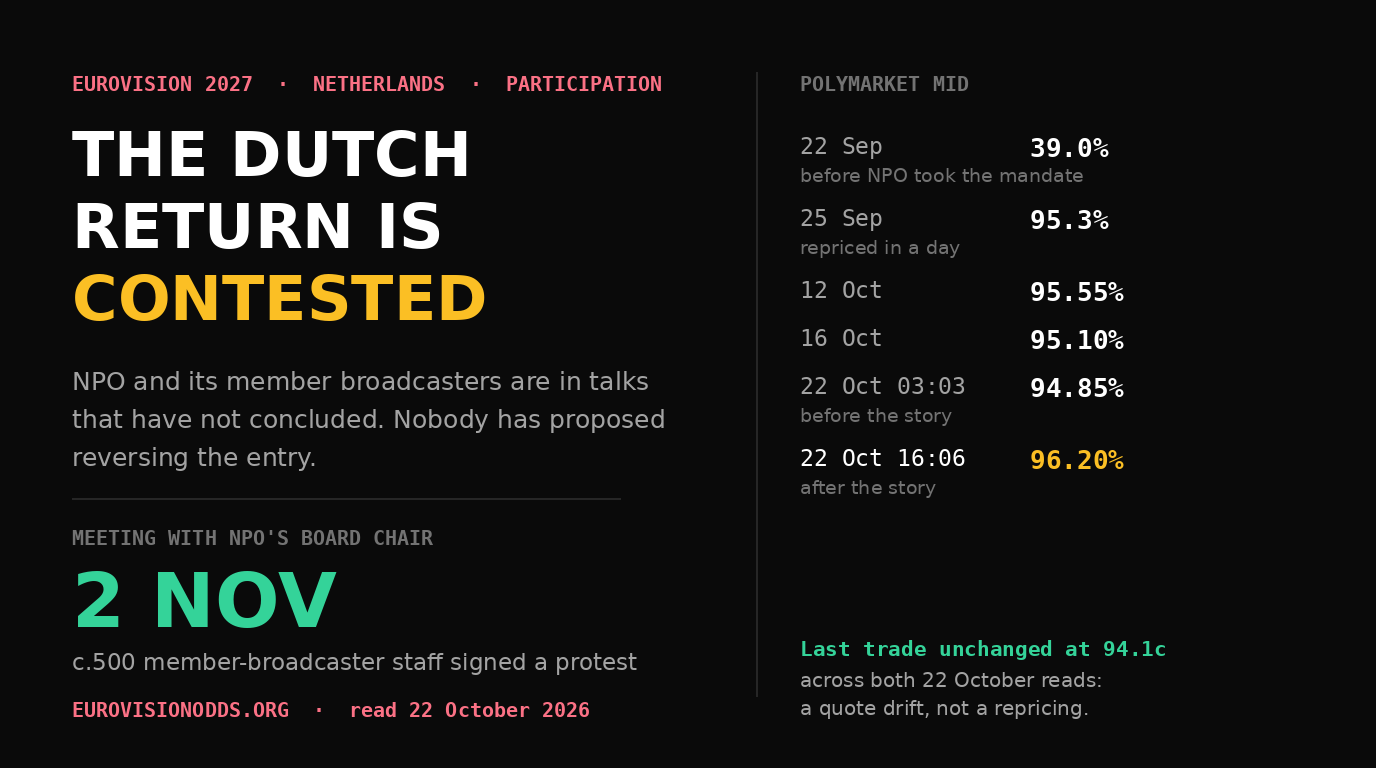
NPO and its member broadcasters are in unconcluded talks about the Dutch entry to Eurovision 2027, a spokesperson for the Council of Broadcasters (CvO) confirmed on 22 October 2026. The members want clarity on three things — “the decision-making process, the organisation, and the financing of the participation” — and the parties have agreed to say nothing further until the talks finish. Around 500 staff across the member broadcasters have signed a protest against competing at all, and a meeting between NPO executive board chair Jet de Ranitz and a delegation of them is set for 2 November. It is the first sign since 23 September that the Dutch return is not settled inside the system that decided it.

18+ | New customers only | T&Cs apply | Please gamble responsibly
Illustration: a designed card showing the dated price series and the meeting date. No real person or venue is depicted.
Key takeaways
- The talks are real and unfinished. The CvO confirmed them on the record and declined to give details or a conclusion date.
- Nobody has proposed reversing the entry. The dispute is over process, organisation and money — not a withdrawal motion.
- NPO holds the mandate itself, not through a member broadcaster, which is exactly why an objecting member cannot hand the entry back the way AVROTROS did.
- A date to watch: 2 November, when De Ranitz meets a delegation of the c.500 protesting staff.
- Polymarket moved the other way. The Netherlands read 94.85% at 03:03 UTC on 22 October and 96.20% at 16:06 UTC, after the story published.
- The last trade did not move at all, sitting at 94.1¢ through both reads. The afternoon leg is a quote drift on an untraded book.
- The contract may not be the bet you think it is. It resolves on the EBU’s first official participant list, not on whether the Netherlands ultimately performs.
What’s on this page
What the Council of Broadcasters actually said · What this is not · The market moved the wrong way · What the contract resolves on · What to watch · The betting position
What the Council of Broadcasters Actually Said
The statement is short and deliberately uninformative. “Discussions are underway, but we have agreed not to provide further details until they have concluded”, the CvO spokesperson said. Asked when that would be, the spokesperson could not say.
The substance sits in the second half. The member broadcasters want clarity from NPO “regarding three matters: the decision-making process, the organisation, and the financing of the participation”. Those are governance complaints, and they are specific: how the call was made, who runs the entry, and who pays for it. NPO has declined to answer questions on the issue for several weeks, repeating only that it “remains in dialogue with all parties”.
Behind the governance row is an ethical one that has not gone anywhere. At the end of September the member broadcasters told NPO their staff objected to the decision to compete. Around 500 of those staff have since signed a protest arguing that it is “indefensible for NPO to prioritise a song contest over the countless lives of people being killed” in Gaza. That protest is what produced the 2 November meeting with De Ranitz.
The reporting is by Noordhollands Dagblad, picked up by Eurovoix on 22 October. The CvO spokesperson is quoted directly, so this is an attributed on-the-record confirmation rather than fan-press inference — but NPO itself has still said nothing beyond its holding line.
What This Is Not
Read the scope carefully, because the temptation is to file this as “the Netherlands might pull out again” and that is not what anyone has said.
Nobody has proposed reversing the entry. There is no withdrawal motion, no deadline, and no member broadcaster claiming the power to cancel. What there is, is a set of members who dislike how the decision was reached and want the process, the organisation and the budget explained before they let it rest.
The structural point matters more than the mood. When NPO took the Dutch mandate on 23 September, it did something unusual: it kept the job rather than finding a member broadcaster willing to take it. AVROTROS had held the mandate since 2010 and handed it back on 24 August; KRO-NCRV, BNNVARA and Omroep MAX all ruled themselves out through late August and early September. Instead of hunting for a fourth volunteer, NPO split the work — NPO runs the selection through a working group using an independent committee of music experts, and NOS, the statutory broadcaster for events of national importance, produces and broadcasts the shows from Bulgaria.
That structure is the reason this row is a governance fight rather than an existential one. An objecting member broadcaster has no entry to hand back, because it does not hold the entry. The route AVROTROS used to take the Netherlands out of the 2026 contest is simply not available to the members now complaining.
What they do have is leverage of a slower kind: funding, staff cooperation, and the ability to make the arrangement politically expensive. None of that shows up on a prediction market, and none of it has a deadline attached.
The Market Moved the Wrong Way, on No Trades
We read Polymarket’s Gamma API twice on 22 October — once at 03:03 UTC, before the story published, and again at 16:06 UTC, after. Both reads are our own.
| Read | Mid | Bid / offer | Last trade |
|---|---|---|---|
| 22 Sep 2026 | 39.0% | — | — |
| 25 Sep 2026 | 95.3% | — | — |
| 12 Oct 2026 | 95.55% | — | — |
| 16 Oct 2026 | 95.10% | 94.0¢ / 96.2¢ | 94.6¢ |
| 22 Oct, 03:03 UTC | 94.85% | 94.1¢ / 95.6¢ | 94.1¢ |
| 22 Oct, 16:06 UTC | 96.20% | 95.5¢ / 96.9¢ | 94.1¢ |
On its face the contract rose 1.35 points on the day a story broke that is, if anything, mildly bad for Dutch participation. That is the wrong direction, and it is worth being precise about why it is not evidence of anything.
The last trade did not move. It sat at 94.1¢ through both reads. The midpoint Polymarket displays is the middle of the best bid and the best offer, so it can travel a long way without a single contract changing hands — and here it did exactly that. Somebody raised a resting bid from 94.1¢ to 95.5¢ and somebody lifted an offer from 95.6¢ to 96.9¢. Nobody bought or sold on the news.
This is the same failure mode we documented on this exact contract in September, when it spent a month pricing a route back in that nobody had publicly proposed, moved 32 points on a commercial group that could not legally have entered, and then repriced 56 points in two days once the actual answer arrived. It is the heaviest-traded end of this market — about $9,101 of lifetime volume, second only to Belgium’s book on an event carrying roughly $43.8K in all — and it still routinely drifts on quotes rather than trades.
So: do not read 96.20% as the market disagreeing with the news. Read it as the market not having traded on the news at all.
What the Contract Actually Resolves On
This is the part that decides whether any of the above is bettable, and it cuts against the obvious trade.
Each country line on Polymarket’s 2027 participants board resolves on whether that country is named in the EBU’s first official participant list — the roll the official Eurovision site publishes for each contest — expected at the end of 2026. The rules state that withdrawals after that list do not affect resolution.
Apply that to the Dutch position. NPO confirmed participation in September and has not retracted it. For the Netherlands to resolve NO, the row would have to escalate from “unconcluded talks” to a reversed decision, and it would have to do so before the EBU publishes that list — which is plausibly six to ten weeks away. The 2 November meeting is inside that window. Almost nothing else about this dispute is.
In other words, a reader who thinks the Dutch entry is in genuine trouble still has to win a race against a publication date, not just against NPO. That is a materially harder bet than the headline suggests, and it is the main reason we are not calling 96.20% obviously too high.
What to Watch
- 2 November — De Ranitz meets the staff delegation. The first hard date this story has produced.
- The end of the CvO talks. No date has been published. The CvO has committed to saying nothing until they conclude, so the next real signal is the conclusion itself.
- The EBU’s first participant list, expected around the end of 2026. That is what the contract settles on.
- Whether NPO names a selection format, artist or budget. Nothing has been published since 23 September, and “the financing of the participation” is one of the three things the members are asking about.
- AVROTROS. Still out, still not part of the new selection, and still the broadcaster whose position never changed.
The Betting Position
There is no fixed-odds market on whether the Netherlands competes in 2027. No bookmaker we track prices national participation — the firms we list open Eurovision markets on winners and qualifiers once there are songs to price, which for Burgas means well into 2027. The only venue pricing this question is Polymarket, and the only number it will give you is the one above.
On that number: we are not recommending a side. The news is mildly negative for Dutch participation, the price moved mildly positive, and the gap between those two facts is explained entirely by the absence of trading rather than by anyone’s judgement. A 95.5¢ bid against a 96.9¢ offer also leaves very little room — you are risking most of a dollar to make a few cents, on a contract that settles on a list rather than on a stage.
What this does change is the confidence with which the Dutch return should be described. Until 22 October it was reasonable to call the Netherlands settled for Burgas. It is now reasonable to call it decided but contested, with a date on the calendar. That is a smaller claim, and it is the accurate one. The rest of the 2027 field — 33 countries provisionally in after Serbia confirmed on 20 October — is unaffected.
Prices in this article were read from Polymarket’s public Gamma API at 03:03 and 16:06 UTC on 22 October 2026 and will have moved since. We do not publish a price we have not just checked.