
Bulgaria withdrew for 3 years, came back, and won. That's the precedent. Will Belgium follow it — or join Hungary and Turkey in the no-return column?

18+ | New customers only | T&Cs apply | Please gamble responsibly
On Sunday morning, 17 May 2026, hours after DARA lifted the Eurovision trophy on a 173-point margin in Vienna, Belgium's Flemish public broadcaster VRT issued the kind of statement that resets a betting market a year in advance. VRT said the "chances are slim" that Belgium will send an artist to Eurovision 2027 in Bulgaria unless the European Broadcasting Union institutes binding human-rights standards in country selection, greater transparency in the voting process, and cost stability for member broadcasters. VRT is the broadcaster behind ESSYLA's Dancing on the Ice entry this year, which finished 21st in Vienna on 36 points — jury-only, zero televote — and it is the Flemish half of Belgium's two-broadcaster rotation. Sofia 2027 falls in an odd year, which under the long-standing VRT/RTBF rotation would normally be RTBF's turn to handle Belgian representation. But VRT controls the Flemish-language broadcast and editorial cooperation matters: a hostile VRT can pull resources, refuse co-promotion, and effectively cap Belgium's market value even when RTBF is technically in the producer chair.
Betfred — Bet £10 Get £50 in Free Bets on Eurovision 2027
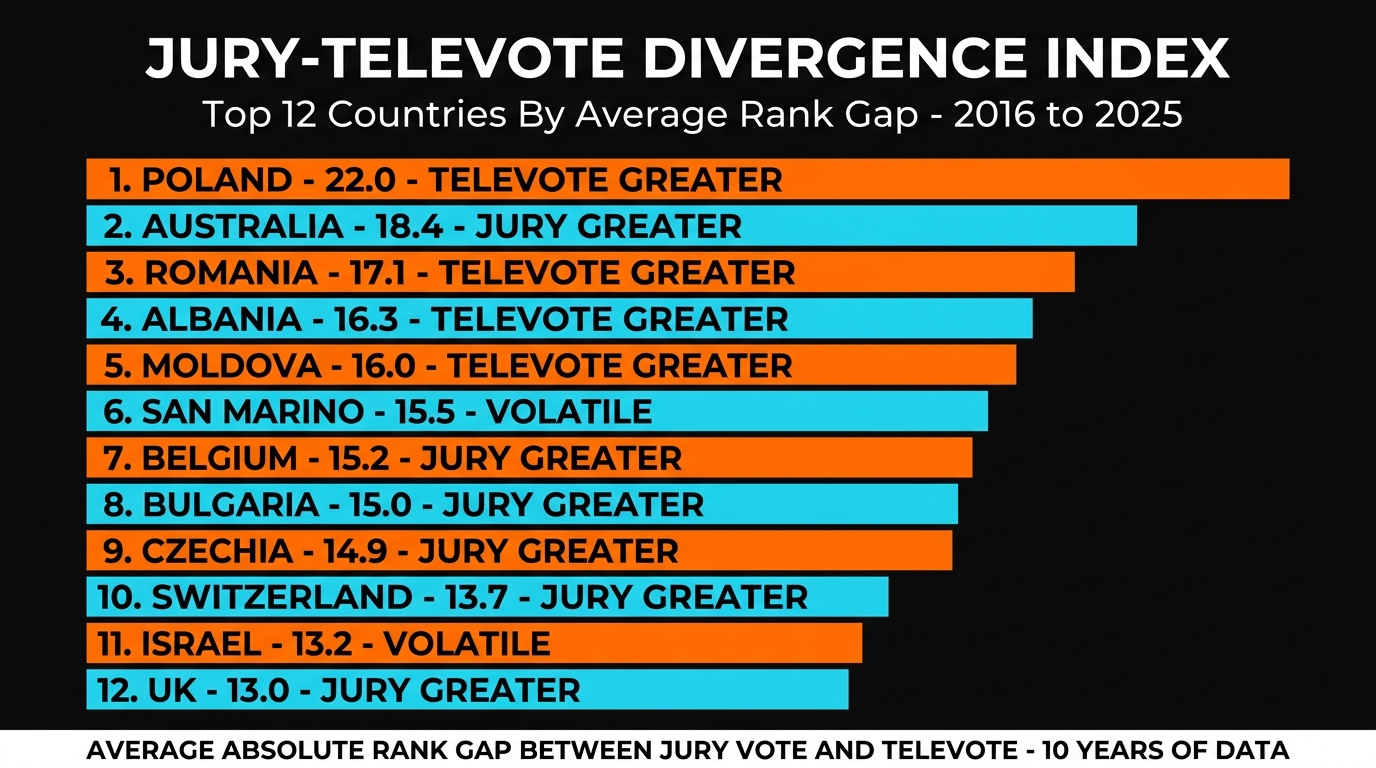
The hero question — and the data that answers it
Belgium's threat is not idle. Five broadcasters did boycott Eurovision 2026: RTVE (Spain), RTÉ (Ireland), AVROTROS (Netherlands), RÚV (Iceland) and RTVSLO (Slovenia). RTVE's pull-out was Spain's first Eurovision absence since 1961 — a 65-year unbroken streak ended. Seventy-two former Eurovision contestants signed an open protest letter against Israel's continued inclusion in the contest. Net participation in Vienna dropped from 37 broadcasters in 2025 to 35 in 2026, even with three returners (Bulgaria, Romania, Moldova) entering the field. The threat to 2027 is real because the threat to 2026 was real and partially delivered.
The historical question is whether protest-driven withdrawals are usually short or long. The cleanest cut is to look at every modern broadcaster withdrawal since 2010 and sort by whether the broadcaster returned and how many years it stayed away.
Modern Eurovision broadcaster withdrawals since 2010 — who came back, who didn't
| Broadcaster | Country | Withdrew after | Returned in | Years away | Status (May 2026) |
|---|---|---|---|---|---|
| RTVS | 🇸🇰 Slovakia | 2012 | — | 13+ | No announced return |
| TRT | 🇹🇷 Turkey | 2012 | — | 13+ | No announced return |
| MTVA | 🇭🇺 Hungary | 2019 | — | 6+ | No announced return |
| BNT | 🇧🇬 Bulgaria | 2022 (out 2023–25) | 2026 | 3 | Returned — won 2026 |
| TRM | 🇲🇩 Moldova | 2024 (out 2025) | 2026 | 1 | Returned — 8th, 226 pts |
| TVR | 🇷🇴 Romania | 2023 (out 2024) | 2026 | 2 | Returned — 3rd, 296 pts |
| CyBC | 🇨🇾 Cyprus | multiple short gaps | recurring | ≤2 | Active |
| RTVE | 🇪🇸 Spain | 2025 (out 2026) | TBD | ≥1 | 2026 boycott (first since 1961) |
| RTÉ | 🇮🇪 Ireland | 2025 (out 2026) | TBD | ≥1 | 2026 boycott |
| AVROTROS | 🇳🇱 Netherlands | 2025 (out 2026) | TBD | ≥1 | 2026 boycott |
| RÚV | 🇮🇸 Iceland | 2025 (out 2026) | TBD | ≥1 | 2026 boycott |
| RTVSLO | 🇸🇮 Slovenia | 2025 (out 2026) | TBD | ≥1 | 2026 boycott |
Important: Hungary, Turkey and Slovakia did not withdraw for the same reasons the 2026 boycotters did. TRT's 2012 departure was driven largely by a long-standing dispute with the EBU over the "Big Five" automatic-qualifier rule and over scoring weightings, with broadcaster-strategy and audience considerations layered in. RTVS in 2012 cited cost and audience-share concerns. MTVA's 2019 absence was officially explained by Hungarian state broadcaster strategic direction. None of these three was a 2024–26-style protest withdrawal over a specific human-rights objection. Conflating them with the 2026 wave overstates the precedent for permanent absence.
What the data does show is a clearer pattern: where the proximate cause is a protest at EBU governance or contest content rather than a strategic broadcaster decision, returns within one to three years have been the modal outcome — Bulgaria 3 years, Romania 2 years, Moldova 1 year, all in 2026.
2026's three returners — first contest back, finishing positions
| Country | Years away | 2026 finish | 2026 points | Last finish before withdrawal |
|---|---|---|---|---|
| 🇧🇬 Bulgaria — DARA, Bangaranga | 3 (2023–25) | 1st | 516 (204 jury + 312 televote) | 2022 — Intelligent Music Project, 16th in SF (did not qualify) |
| 🇷🇴 Romania — Alexandra Căpitănescu, Choke Me | 2 (2024–25) | 3rd | 296 | 2023 — Theodor Andrei, 17th in SF (did not qualify) |
| 🇲🇩 Moldova — Satoshi, Viva, Moldova! | 1 (2025) | 8th | 226 | 2024 — Natalia Barbu, 19th in SF (did not qualify) |
The most useful row in that table is Bulgaria's. All three returners had failed to qualify in their last pre-withdrawal contest. All three came back and finished in the Grand Final top eight. The implication for any broadcaster sitting out 2027 is straightforward: a withdrawal period does not appear to damage subsequent competitive performance and can — at least in the 2026 dataset — coincide with a substantial improvement.
Belgium's last 10 Grand Final finishes — what would Sofia actually be losing?
| Year | Broadcaster | Artist / song | Final position | Points |
|---|---|---|---|---|
| 2026 | VRT | ESSYLA — Dancing on the Ice | 21st | 36 (jury only) |
| 2024 | VRT | Mustii — Before the Party's Over | did not qualify | — |
| 2022 | VRT | Jérémie Makiese — Miss You | 19th | 64 |
| 2021 | RTBF | Hooverphonic — The Wrong Place | 19th | 74 |
| 2019 | VRT | Eliot — Wake Up | did not qualify | — |
| 2018 | VRT | Sennek — A Matter of Time | did not qualify | — |
| 2017 | RTBF | Blanche — City Lights | 4th | 363 |
| 2016 | RTBF | Laura Tesoro — What's the Pressure | 10th | 181 |
| 2015 | VRT | Loïc Nottet — Rhythm Inside | 4th | 217 |
| 2013 | RTBF | Roberto Bellarosa — Love Kills | 12th | 71 |
Two structural facts are visible in that table. First, the strongest Belgian results of the past decade have come from RTBF (Blanche 4th, Tesoro 10th, Bellarosa 12th) rather than VRT (Loïc Nottet's 4th in 2015 is the lone VRT top-10 in the window). Second, VRT-cycle years since 2018 have produced three non-qualifiers and a 19th-place finish — the broadcaster's record is the weaker of the two halves of the rotation. A protest withdrawal in 2027 would, on paper, remove an RTBF year. RTBF has not publicly aligned with VRT's statement and is expected to take a decision independently. If RTBF participates as planned, Belgium 2027 is structurally the more competitive half of the rotation regardless of the VRT row.
What VRT is actually asking for
VRT's three demands, articulated in the 17 May statement, are concrete enough to be tracked against EBU action between now and the 2027 deadline broadcasters have to confirm participation.
- Human-rights standards in selection. A formal, written test that competing broadcasters must meet to be admitted to the contest — codifying what is currently a case-by-case EBU executive decision.
- Greater transparency in voting. Specifically the Rest-of-the-World online vote and the per-country jury composition, both of which have produced controversy in successive recent contests.
- Cost stability for EBU members. A cap or a published cost-share formula so that the participating-broadcaster fee for the contest does not continue to escalate year on year. Several smaller broadcasters have flagged the rising participation cost as a separate withdrawal pressure independent of the human-rights argument.
EBU Director-General Noel Curran and Eurovision executive supervisor Martin Green have to date addressed the human-rights demand only via existing membership-rules language — see Martin Green's framing of the 2026 boycotts as "just a footnote" — and have not committed to a formal new test. The transparency demand maps onto an existing internal review of the Rest-of-the-World vote ordered after the controversy of recent years. The cost demand is the demand with the clearest technical fix but the worst political optics: any cap effectively transfers cost to the host broadcaster, in 2027 Bulgaria's BNT, which can least afford it.
Belgium's market value — where the 2027 outright lists currently price it
Without quoting a specific UK price (the market is in early-discovery mode the morning after the 2026 Grand Final, lines have not yet stabilised across more than two or three books), current outright pricing has Belgium in the 40-60 range in the early 2027 winner markets — a long-shot pool that reflects RTBF's stronger record in odd years but discounts heavily for the VRT cooperation risk now publicly disclosed.
The structural anchors against which that price should be read:
- RTBF year: two top-four finishes in the last decade (Nottet 2015, Blanche 2017), plus Tesoro 10th in 2016. Pre-statement, Belgium 2027 would have been a fair single-digit-range outsider rather than a 40s/50s shot.
- VRT statement discount: books are pricing the threat as roughly a 30–40% probability of full withdrawal, with a further drag on production quality if VRT pulls cooperation but RTBF still competes. That is the proximate driver of the long price.
- Re-rate trigger: any EBU concession on the three demands before the September 2026 confirmation window closes will compress Belgium materially. The cleanest signal to watch is an EBU statement addressing cost-share specifically — that is the demand the EBU has the most institutional reason to grant.
What happens to the 2027 outright market if VRT pulls out
If Belgium does not appear in Sofia, the immediate market effects are quantifiable from 2026 precedent.
- Smaller voting pool. Eurovision 2026 had 35 participating broadcasters voting in the Grand Final. Each broadcaster missing removes one jury set and one televote set. The marginal effect on any given country's score is roughly 8–10 points of expected total value at the median, weighted toward neighbours — for Belgium that means Netherlands, France, Luxembourg and Germany lose a reciprocal source of points.
- More swing in the outright market. A 34-broadcaster contest with five 2026-boycotters still out and Belgium added produces a market with materially higher variance. Any country whose pre-rehearsal price is 8/1 or shorter is more likely to drift wider on negative semi-final signal than in a full 41-broadcaster field.
- Cap adjustments are unlikely. UK bookmakers historically do not adjust per-customer outright stake caps based on field size. The cap-adjustment risk lives in specials markets — top-five-finish, top-10, qualifier yes/no — where a smaller field changes implied probabilities by enough to force a re-rate. Books that did not re-rate top-10 markets after the 2026 boycotts (and were exposed accordingly) are likely to be more aggressive on 2027 specials this time.
- Host-protection language. Bulgaria's BNT, as host, has no withdrawal optionality. Whatever the field looks like, BNT is participating and the show is happening. That backstop is what makes a 2027 contest with VRT and even one or two further pull-outs commercially viable for the EBU.
The base case, reading the data straight, is that VRT either receives partial EBU concessions and returns under protest, or sits out a single edition and returns in 2028. The hard-no precedent — Hungary, Turkey, Slovakia — is anchored in broadcaster-strategy considerations rather than the kind of human-rights/transparency demand VRT has issued, and the recent same-cause-class precedent — Bulgaria, Romania, Moldova — is uniformly a return within one to three years.
Related
- Grand Final recap — Bulgaria wins 2026 on 516, record 173-point margin
- Eurovision 2027 — Sofia hub, host-city bids and early outright market
- Martin Green called the 2026 boycotts "just a footnote" — was he right?
- Eurovision 2026 boycott impact on the outright market — five-country pull-out, modelled
18+. Please gamble responsibly. BeGambleAware.org. GAMSTOP. When the fun stops, stop.