
South Korea's eight Eurovision Asia entries are out. ENA released the full songs for Korea's Next Wave on 23 August, following a snippet drop three days earlier. The show is on Friday 4 September at 23:00 KST and streams worldwide on the official Eurovision YouTube channel. The winner takes the fourth ticket to Bangkok.

18+ | New customers only | T&Cs apply | Please gamble responsibly
Of every national final in the Eurovision Asia calendar, this is the one most likely to produce the pre-contest favourite. It is also the smallest field.

The eight entries
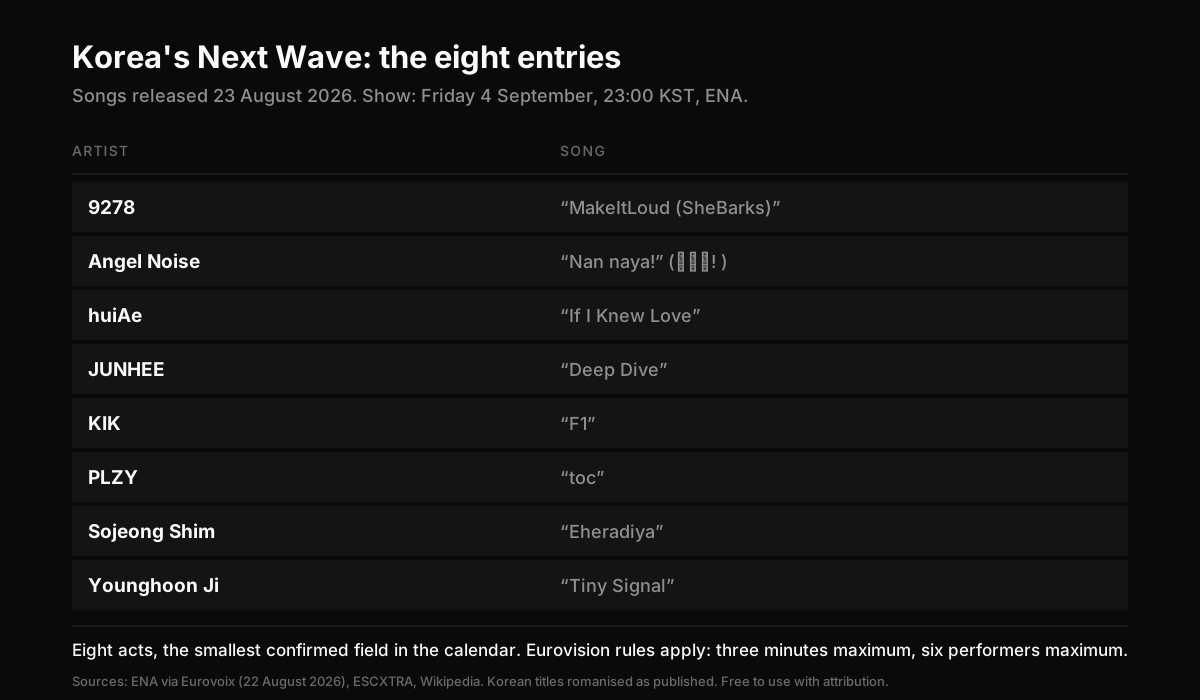
Eight acts, against ten in the Philippines and ten in Thailand. A smaller field is not a weaker one — it means each act gets more airtime on the night, and in a show decided partly by a live audience watching eight performances rather than ten, the marginal act has fewer rivals to be forgotten behind.
The naming conventions tell you something about how ENA has cast this. 9278, KIK, PLZY and Angel Noise read as contemporary project-style acts; Sojeong Shim and Younghoon Ji are conventional artist billings. Song titles run from the aggressively styled — “MakeItLoud (SheBarks)”, “F1”, “toc” — to the straightforwardly balladic, “If I Knew Love” and “Tiny Signal”. Two entries carry Korean-language titles: Angel Noise's “Nan naya!” and Sojeong Shim's “Eheradiya”, the latter drawing on traditional Korean vocal phrasing.
That spread is deliberate. It gives the jury classical vocal material to reward and gives the public vote high-energy material to mobilise behind, which is exactly how you build a field when you do not yet know which half of the electorate will show up.
Why Korea is the field's centre of gravity
Three reasons this show matters more than its eight-act size implies.
Korea exports music at a scale no other participant does. Every Eurovision Asia national final carries a Rest of the World public vote open to viewers anywhere. That component is worth a fifth of the result in the selections that have published their weighting, and it is the single most favourable structural feature imaginable for a Korean act. K-pop fandoms are the most practised organised-voting communities on the internet, and this is a contest that streams its national finals on YouTube and takes votes from anywhere.
The production infrastructure is already there. A Korean entry arrives in Bangkok with choreography, staging and camera-blocking conventions built by an industry that has been optimising exactly those things for a global audience for fifteen years. Eurovision is a three-minute staging competition as much as a song competition, and this is the participant least likely to be caught out by that.
Nothing has been priced. There is still no bookmaker or prediction market on Eurovision Asia — not on the contest, not on any national final. When books do open, the widespread assumption that Korea is the favourite will already be baked into the first prices. If you want an edge on this contest, the work has to be done now, while the only cost of being early is your time.
The one thing we cannot yet tell you
The voting format for Korea's Next Wave specifically has not been published.
This matters and it is worth being precise about. Three selections have confirmed a 40% jury / 40% domestic public / 20% Rest of the World split: Bhutan, the Philippines and Mongolia. The Grand Final in Bangkok is a straight 50% jury / 50% public. Neither ENA nor Channel 3 has confirmed which applies to the Korean and Thai selections, and several outlets have reported the Grand Final's 50/50 in articles about the national finals in a way that is easy to misread as the national-final rule.
We made exactly that mistake with the Philippines earlier this month and corrected it. So: assume 40/40/20 is the likely default on the strength of three confirmations, but treat Korea as unconfirmed until ENA says so. If it is 40/40/20, the Rest of the World component described above is worth a fifth of the Korean result, and that is a very large thumb on the scale.
What is confirmed is the rulebook: Eurovision rules apply, so three minutes maximum and no more than six performers on stage.
Where this sits in the calendar
Two artists are confirmed for Bangkok so far — Nyendra for Bhutan and Aina Abdul for Malaysia. Philippine Selection Night on 30 August makes three, and Korea on 4 September makes four.
Then Cambodia in early September, Nepal on 19 September, Laos on 23–24 September, Thailand on 27 September, Bangladesh on 30 September and Mongolia on 10 October. Vietnam still has no date. The full eleven-country picture is here.
Quick answers
When is Korea's Next Wave? Friday 4 September 2026, 23:00 KST, on ENA. It streams live worldwide on the official Eurovision Song Contest YouTube channel.
How many acts are competing? Eight. 9278, Angel Noise, huiAe, JUNHEE, KIK, PLZY, Sojeong Shim and Younghoon Ji.
Where can I hear the songs? All eight full entries were released on 23 August 2026, after 15-second snippets on 20 August.
How is the winner decided? ENA has not published the split. Three other selections use 40% jury, 40% domestic public and 20% international public; the Bangkok Grand Final is 50/50 jury and public. Treat Korea as unconfirmed.
Can I vote from outside Korea? Yes. Every Eurovision Asia national selection carries a Rest of the World public vote, open via the official stream.
Is South Korea the favourite for Eurovision Asia? No market exists yet. On structure — export reach, staging capability and an open international vote — Korea has the strongest case of any participant, but no song has been staged and no odds have been posted.
Correction, 1 October 2026: this article said no prediction market had listed a Eurovision Asia market. That was true on the day it was published and is not true now. Kalshi, the CFTC-regulated US exchange, opened an eleven-country Eurovision Asia winner market on 14 September 2026. It is thin and should not be read as odds: on 1 October the last trades summed to 143% of the field, eight of the eleven contracts had no bid at all, the whole board recorded no trades in 24 hours, and Laos accounts for about three-quarters of every contract ever traded. Our full coverage of the first Eurovision Asia market →