

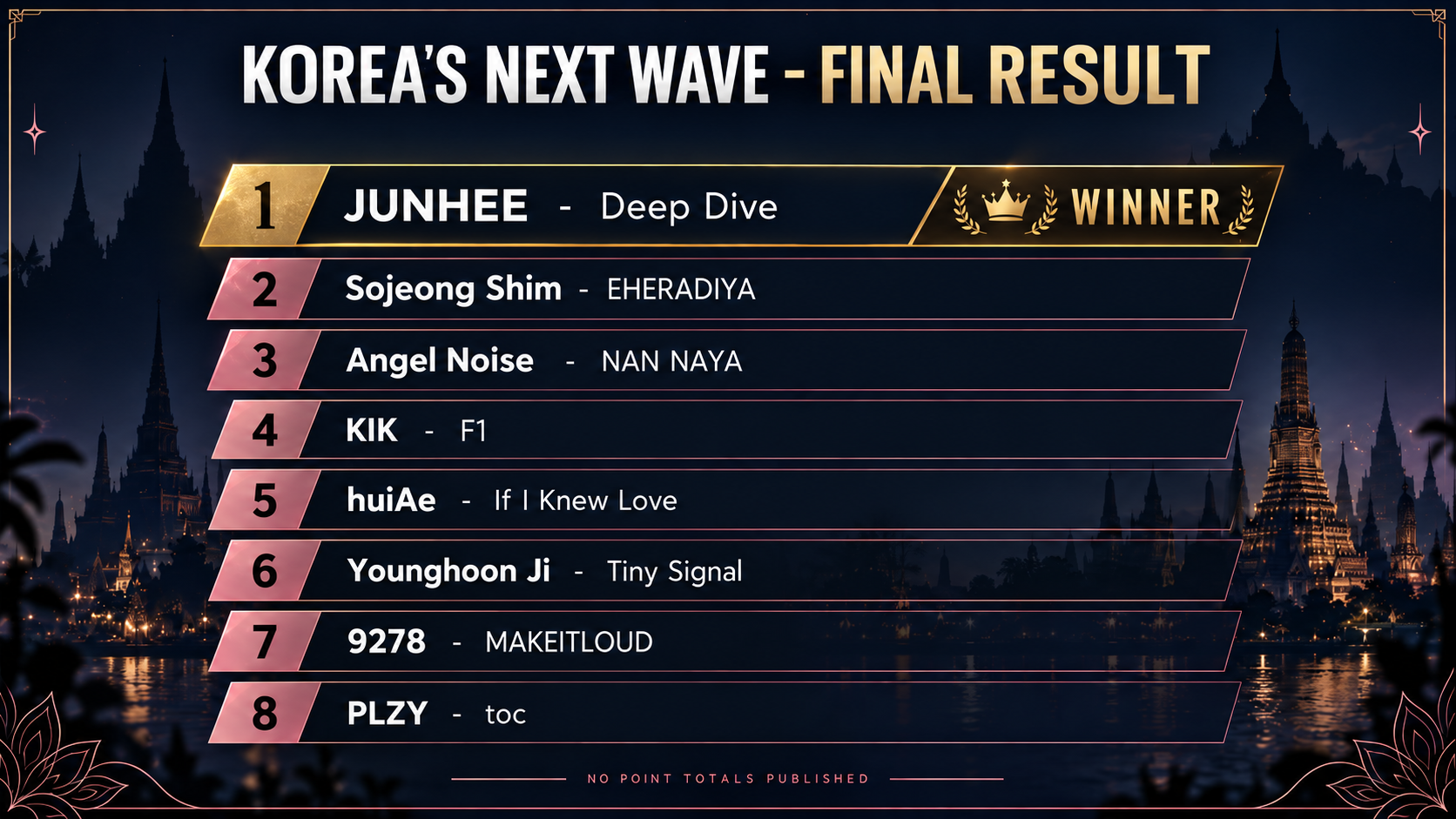
JUNHEE won Korea’s Next Wave on 4 September 2026 and will represent South Korea at the inaugural Eurovision Song Contest Asia in Bangkok on 14 November. The winning song is “Deep Dive”. Sojeong Shim, who opened the show, finished second with “EHERADIYA”, and Angel Noise placed third with “(NAN NAYA!)”.

18+ | New customers only | T&Cs apply | Please gamble responsibly
South Korea is the fourth of eleven acts confirmed for Eurovision Asia 2026, after Bhutan, Malaysia and the Philippines. It is also the most closely watched of the four: Korea is the largest music-export market in the contest and the country most people assume will be favourite when a betting market finally opens. As of today, none has.
Korea’s Next Wave: the full result
ENA — the KT Group entertainment channel running Korea’s participation, rather than one of the traditional big three of KBS, MBC and SBS — broadcast the final on 4 September with eight songs. Jo Kwon, of 2AM, hosted. The jury panel giving feedback after each performance was JOO YOUNG HOON, CHAERINA, Yoonhan, Hyungtag Lee and KLOZER.
ENA has not published individual point totals, so the finishing order below is the result as reported, not a scoreboard. That is worth stating plainly: several outlets will infer margins from the running order over the next few days, and there is no published figure to support any of it.
| # | Artist | Song |
|---|---|---|
| 1 | JUNHEE | “Deep Dive” — winner |
| 2 | Sojeong Shim | “EHERADIYA” |
| 3 | Angel Noise | “(NAN NAYA!)” |
| 4 | KIK | “F1” |
| 5 | huiAe | “If I Knew Love” |
| 6 | Younghoon Ji | “Tiny Signal” |
| 7 | 9278 | “MAKEITLOUD (SHEBARKS)” |
| 8 | PLZY | “toc” |

Sojeong Shim drew the opening slot when the running order was published on 30 August, and finishing second from first on stage is a genuinely strong result — the opening position is historically the worst draw in any Eurovision-format final. Whatever the jury and public split was, it was not a running-order effect.
The voting split — and the number that keeps getting misreported
Korea’s Next Wave was decided by 40% jury, 40% Korean public vote and 20% international online vote. That is the same three-way split Bhutan, Malaysia, Mongolia and the Philippines have used, and it is now effectively the standard national-final mechanic across the contest.
It is not 50/50. The 50% jury / 50% televote figure that circulates in coverage of these shows belongs to the Bangkok grand final on 14 November, not to the national selections feeding it. Our own South Korea country page carried that error until today and has been corrected. If you see a Korean national-final result described as a 50/50 decision, it is the grand-final rule pasted onto the wrong show.
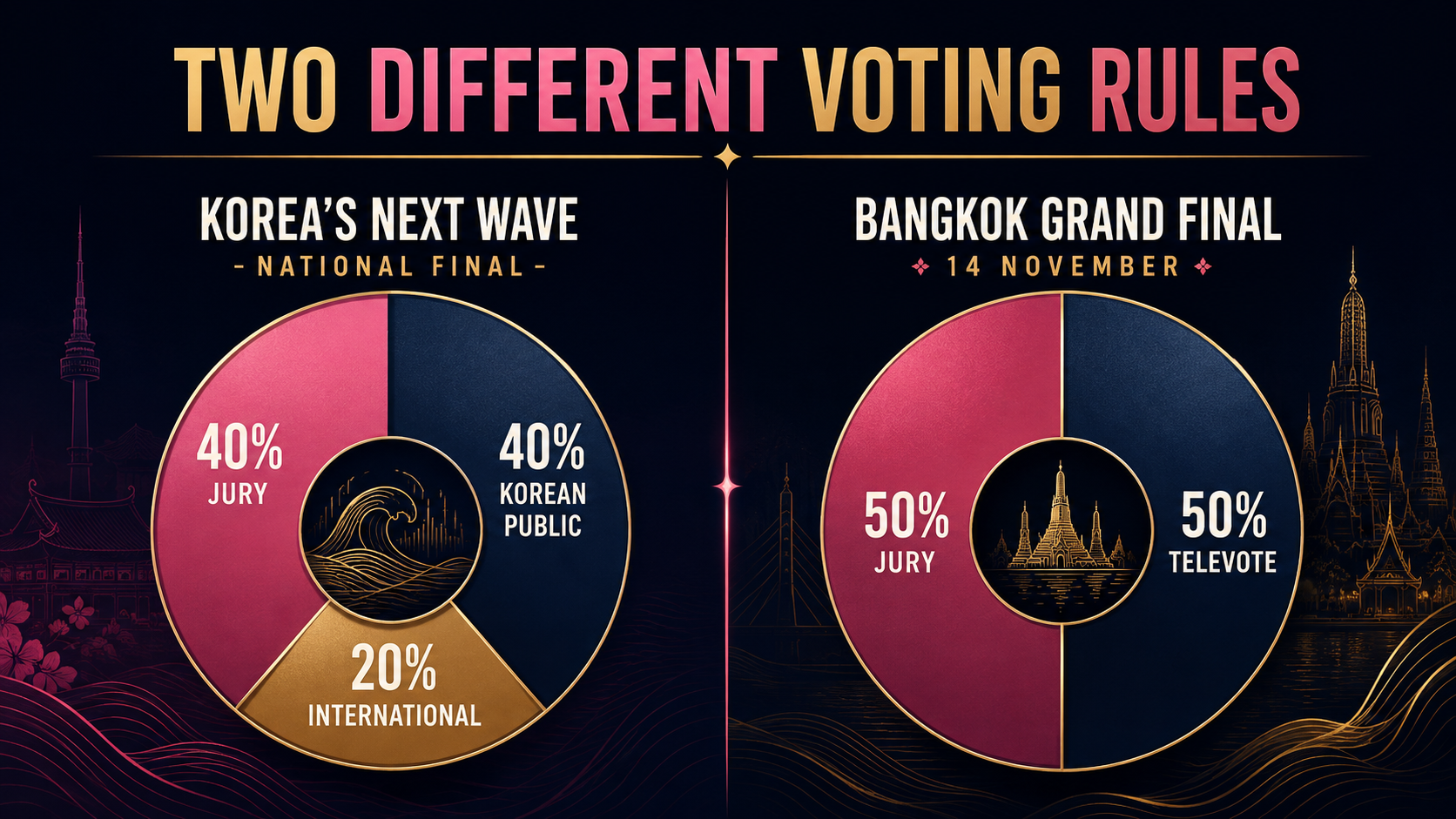
The 20% international component is the part worth watching from a market perspective. It gives an organised overseas fanbase real leverage in a national final, and Korea has the largest and most organised overseas fanbase of any country in this contest. It did not produce an upset here, but it is a structural edge that will matter more once the field is complete.
View this post on Instagram (@eurovisionasia)
What JUNHEE’s win says about the K-pop majors
The pre-selection thesis on this site was that HYBE, SM, JYP and YG would sit the first edition out, leaving the lane to soloists, mid-tier idol acts and indie names. That has held. ENA’s open call — any Korean national aged 18 or over, submissions through June — was never the route a major label uses to place an artist, and the eight-song final that resulted was a soloist-and-small-act field.
The consequence for anyone pricing this contest is that the Korean entry is not the pre-packaged major-label product the K-pop framing implies. That cuts both ways. It removes the automatic promotional machine a HYBE or SM act would bring; it also means the international vote in Bangkok will be responding to the song rather than to an existing fandom. Betting previews that treat “South Korea” and “K-pop juggernaut” as the same input are pricing an entry that did not turn up.
Is there a market on Eurovision Asia yet? No
We check this every run, and the answer has not changed. As of 4 September 2026, Polymarket’s Gamma API lists no Eurovision Asia market of any kind — no winner market, no country markets, nothing. No UK fixed-odds bookmaker we track has priced it either. Ten weeks from the grand final, with four of eleven acts known, there is nothing to bet on.
That is the honest position and we would rather print it than imply a price exists. If you find a “Eurovision Asia odds” page quoting numbers today, it is modelling, not a market you can get on at.
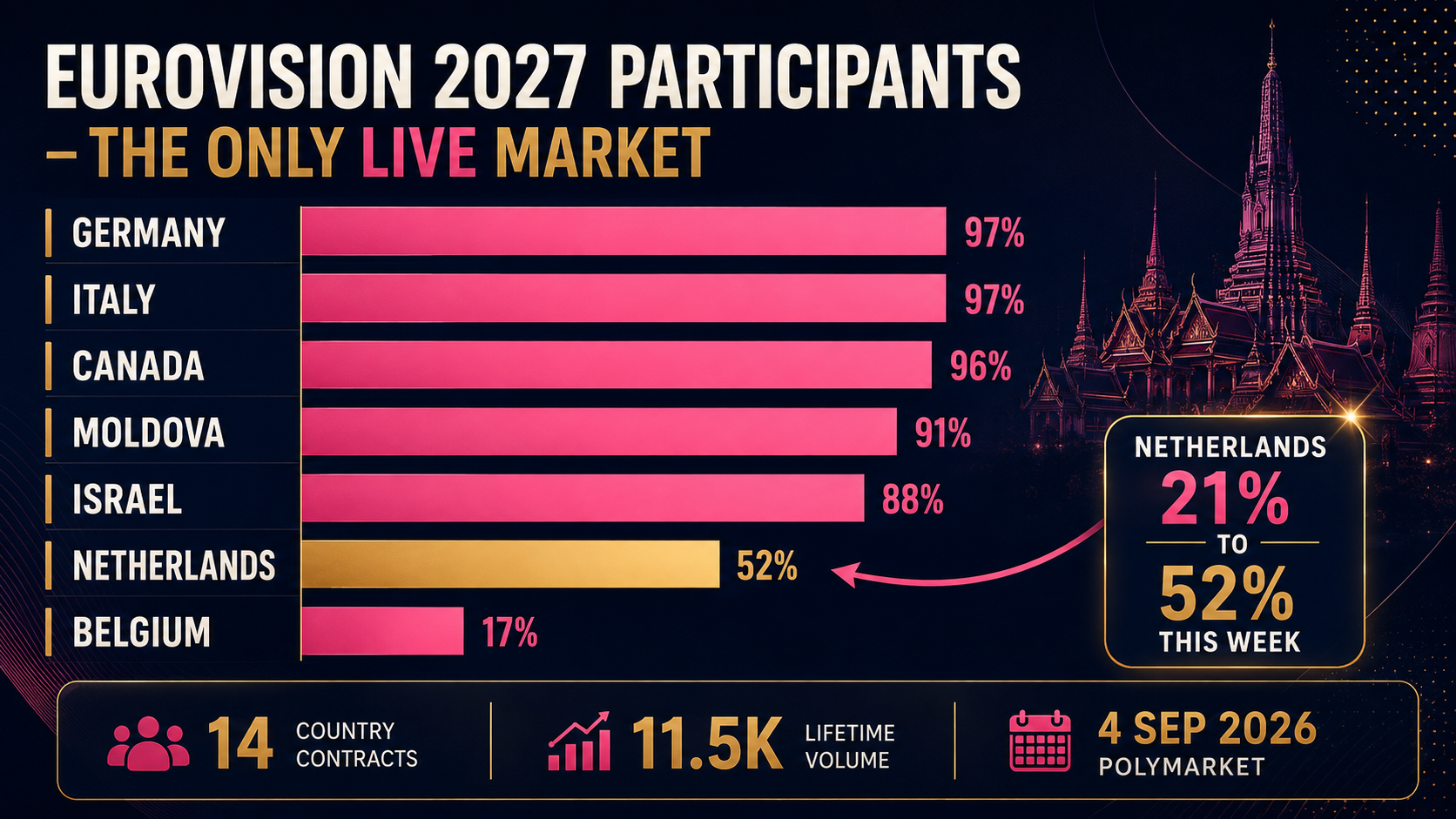
The only live Eurovision market anywhere is Eurovision 2027 Participants, with 14 country contracts and about $11.5K of lifetime volume — a European market about who turns up in Burgas, not an Asian one. Germany and Italy sit at 97%, Canada 96%, Moldova 91%, Israel 88%; Belgium is the cheapest at 17%. The week’s big mover is the Netherlands, from 21% to 52%. All prices Polymarket, checked 4 September 2026. Our full read on that board is in the Polymarket Eurovision trading guide, and the European field is tracked on Eurovision 2027.
When an Asia market does open, the useful thing to have ready is a view formed before the price exists. Four entries are now public and the remaining seven land inside six weeks. That is the window in which an opinion is worth forming; the current Eurovision winner odds pages cover the European contest only.
The rest of the Eurovision Asia calendar — now complete
A second piece of news this week matters more than it looks. On 3 September, Cambodia’s Finest Voice was finally dated: 17 October, streamed on the official Eurovision YouTube channel. TV5 Cambodia had been indicating “early September”, so this is a six-week slip — but it means all eleven selections now have a date for the first time.
| Date | Country | Selection |
|---|---|---|
| Done — 11 Aug | 🇧🇹 Bhutan | Nyendra, “Lhayi Semo (The Angel)” |
| Done — 15 Aug | 🇲🇾 Malaysia | Aina Abdul (song unreleased) |
| Done — 30 Aug | 🇵🇭 Philippines | Carmelle, “Sobra-Sobra (Too Much)” |
| Done — 4 Sep | 🇰🇷 South Korea | JUNHEE, “Deep Dive” |
| 19 September | 🇳🇵 Nepal | Nepal Decides |
| 23 September | 🇱🇦 Laos | Sieng Lao: The One |
| 27 September | 🇹🇭 Thailand | Thailand’s Chosen One (host nation) |
| 30 September | 🇧🇩 Bangladesh | Voice of Bangladesh |
| 3 October | 🇻🇳 Vietnam | The Sound of Vietnam |
| 10 October | 🇲🇳 Mongolia | Mongolia’s Chosen One |
| 17 October | 🇰🇭 Cambodia | Cambodia’s Finest Voice |


One caution on Vietnam. Vietnamese outlet Tuổi Trẻ reported on 2 September that Tóc Tiên will represent the country. Neither VTV nor the production company behind the Vietnamese entry has commented, and The Sound of Vietnam is still scheduled for 3 October with an unpublished format. This site has been burned before by treating a single-sourced media report of an unannounced decision as a fact, so we are logging it as a report and nothing more.
What happens next for JUNHEE
The Eurovision Asia 2026 winner earns a guest performance at Eurovision 2027 in Burgas, which gives the Bangkok result a direct line into the European contest — and gives this contest a stake that the American Song Contest never had. Between now and 14 November, the things that will actually move a Korean price are a promotional schedule, a music video, and whether “Deep Dive” travels outside Korea on streaming.
Full country detail, the sentiment tracking and the betting position are on our South Korea at Eurovision Asia page, updated with today’s result. The next selection is Nepal on 19 September.
Sources
Result and running order: Eurovoix, 4 September 2026. Host, jury and voting split: Eurovoix, 2 September 2026. Cambodia’s date: Eurovoix, 3 September 2026. Market prices: Polymarket Gamma API, checked 4 September 2026.
Featured photo: JUNHEE after winning Korea’s Next Wave. Photo: Eurovision Song Contest Asia (eurovisionasia.com).