
All ten Philippine Selection Night songs are out, and the vote is not 50/50. ABS-CBN released the full entries to streaming platforms at 6pm on 17 August, and the confirmed weighting is 40% Filipino jury, 40% Filipino public, 20% international public — the same 40/40/20 formula Bhutan used and Mongolia has since adopted. Not the 50/50 jury-televote split we reported on 12 August. That was our error, and it changes the analysis.

18+ | New customers only | T&Cs apply | Please gamble responsibly
The final is on Sunday 30 August at the New Frontier Theater in Quezon City, hosted by Vice Ganda, starting 21:45 Philippine time. Six days out, here is what the field looks like.

The ten entries
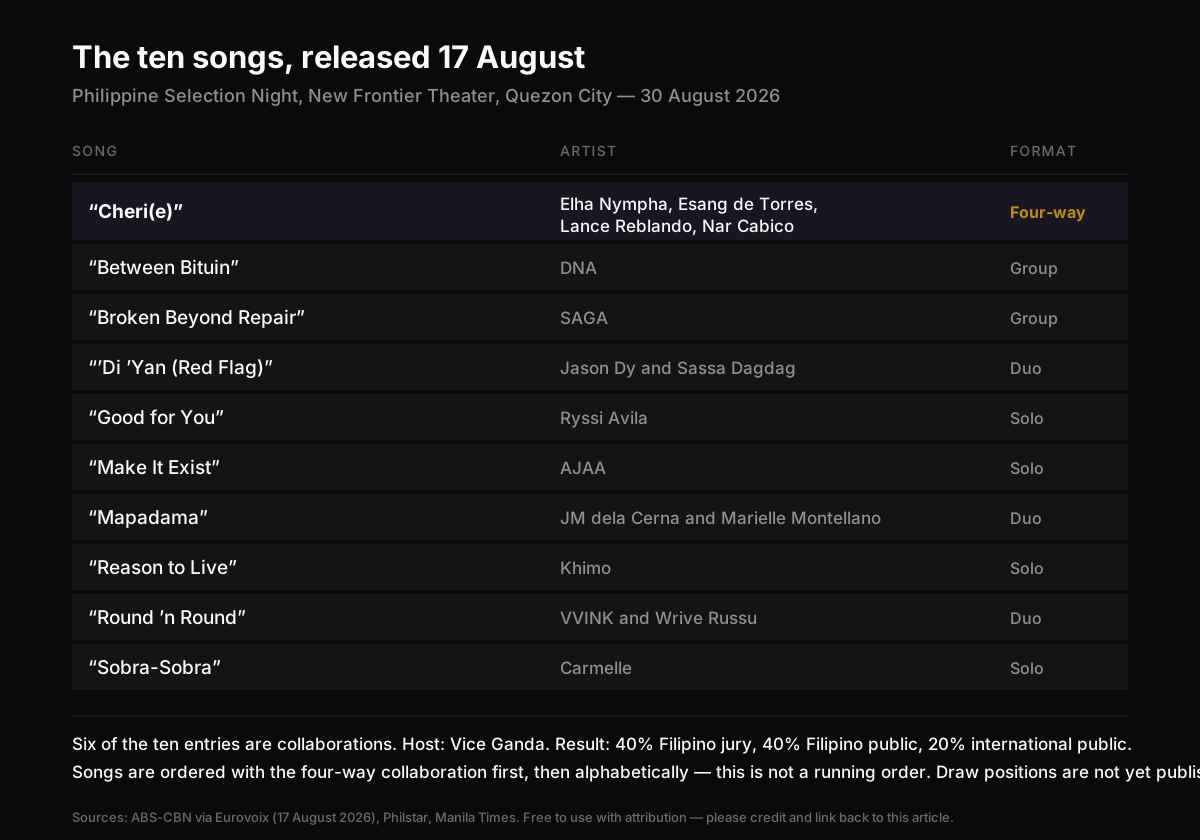
Ten songs, and a field composition that tells you something about how ABS-CBN built it: four solo acts, three duos, two groups and one four-way collaboration. Six of ten entries are collaborations. For a broadcaster with a large talent roster staging a three-week rollout, pairings generate more promotional surface than solo acts do, and the shape of the field looks deliberate rather than accidental.
The songwriting names repeat in a way worth noting. Jungee Marcelo has two entries in the field — “Between Bituin” for DNA, and “Mapadama” co-written with Jeremy Glinoga for JM dela Cerna and Marielle Montellano. Nar Cabico both wrote and performs on “Cheri(e)”.
The correction, and why it matters
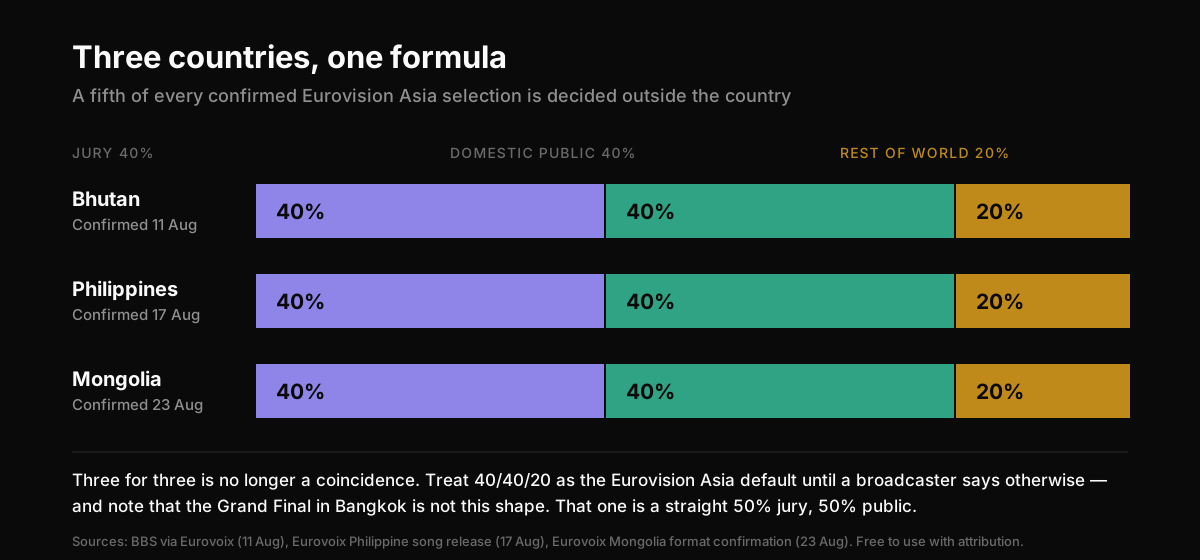
Our 12 August piece said Philippine Selection Night would run 50% televote and 50% jury. That is the format for the Grand Final in Bangkok. We applied it to the national final, and the national final does not use it. The original article is corrected.
The difference is not cosmetic. Under a 50/50 split, the jury is half the result and a technically superior vocal performance is close to decisive. Under 40/40/20, the jury's share drops to two-fifths and a fifth of the result moves outside the Philippines entirely.
So the analysis we published — that a heavy jury weight favours the proven vocalists in “Cheri(e)” — was directionally reasonable but overstated. The jury matters less than we said, and there is a third electorate we did not account for at all.
The Rest of the World 20% is the Philippine advantage
This is the part that should shape anyone's read of the contest, not just this show.
Every Eurovision Asia national final carries a Rest of the World vote, open to anyone watching the official stream from anywhere. In most participating countries that component is a wildcard. For the Philippines it is close to a home advantage played twice.
The Filipino diaspora is one of the largest and most digitally mobilised in the world, and Filipino music fandoms have a long record of dominating open international voting on exactly this kind of platform. A vote that is nominally “international” and open to all is, in the Philippine case, substantially a second Filipino electorate voting from abroad.
Which means the practical weighting on 30 August is less “40 domestic / 20 foreign” and closer to 40% jury and 60% Filipino-aligned public. That is a lower jury influence than our original 50/50 reading implied, and it pushes the result toward whichever act has the largest mobilised fanbase rather than the cleanest vocal.
The same logic runs the other way in November. When the Philippines competes in Bangkok, it does so under a straight 50% jury / 50% public split with no Rest of the World component — and a global public vote in which the Filipino diaspora is one voice among many. The structural advantage that may decide 30 August does not transfer to the Grand Final at anything like full strength.
Reading the field six days out
Three observations, with the confidence they deserve.
“Cheri(e)” is the name-recognition leader and that is now worth more, not less. Elha Nympha, Esang de Torres, Lance Reblando and Nar Cabico on one entry is an unusual concentration of established audiences, and four fanbases stacked on one song is precisely the asset a 60%-public result rewards. Eurovision rules cap the stage at six performers, so a four-way is legal. The risk is the standard one for supergroups: a song built to give four vocalists a moment can end up without a shape.
The solo entries need a different route. Ryssi Avila, AJAA, Khimo and Carmelle cannot out-mobilise a four-way collaboration on fanbase alone. Their path is the jury's 40% plus a live performance that reframes the song — which is genuinely available, because a national final performance is the first time most voters see these entries staged.
Nobody should be pricing this from the studio recordings. The songs have been public for a week. The stagings have not. Eurovision-format selections are decided disproportionately in the three minutes on the night, and the New Frontier Theater is a proper theatre with a live audience, not a TV studio. Draw positions have not been published either, and in a ten-song field a late draw is worth real points.
Market status
No operator has opened a book on Philippine Selection Night. There are no Eurovision Asia markets on Polymarket, and no traditional bookmaker is pricing any national final in the calendar. Anyone telling you the odds on this show is quoting a fan poll.
We track market status daily on the Eurovision Asia hub. Our expectation remains that books open once the Bangkok field is complete in mid-October, not before.
What happens next
The winner of 30 August joins Nyendra of Bhutan and Malaysia's Aina Abdul as the third confirmed act for Bangkok. Then the calendar moves straight to South Korea's Korea's Next Wave on 4 September — the show most likely to produce the pre-contest favourite. The full state of play across all eleven countries has the rest of the dates.
Quick answers
When is Philippine Selection Night 2026? Sunday 30 August 2026, 21:45 Philippine time, at the New Frontier Theater in Quezon City. Hosted by Vice Ganda, broadcast by ABS-CBN and streamed on the official Eurovision YouTube channel.
How is the winner decided? 40% Filipino jury, 40% Filipino public vote, 20% international public vote. It is not 50/50 — that is the Bangkok Grand Final format.
Where can I hear the songs? All ten entries were released to streaming platforms on 17 August 2026.
Who is the favourite? No market exists. On the structure of the vote, the four-way “Cheri(e)” collaboration has the largest mobilisable audience in a result that is roughly 60% public. Stagings and draw order are still unknown, and both matter more than the studio recordings.
Can I vote from outside the Philippines? Yes. The international public vote is worth 20% and is open to viewers anywhere via the official stream.
Correction, 1 October 2026: this article said no prediction market had listed a Eurovision Asia market. That was true on the day it was published and is not true now. Kalshi, the CFTC-regulated US exchange, opened an eleven-country Eurovision Asia winner market on 14 September 2026. It is thin and should not be read as odds: on 1 October the last trades summed to 143% of the field, eight of the eleven contracts had no bid at all, the whole board recorded no trades in 24 hours, and Laos accounts for about three-quarters of every contract ever traded. Our full coverage of the first Eurovision Asia market →