
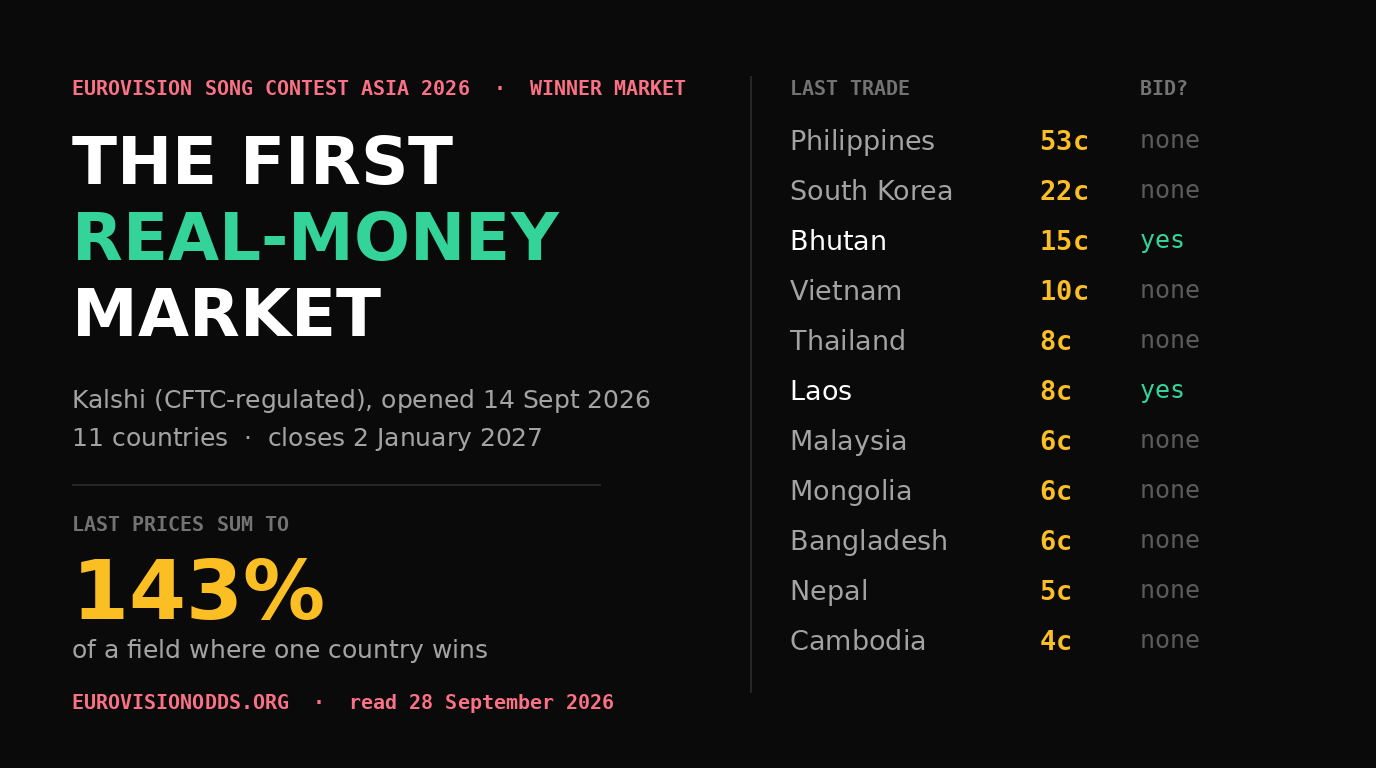
There is now a real-money market on the winner of the first Eurovision Song Contest Asia. Kalshi, the CFTC-regulated US exchange, listed an eleven-country winner market on 14 September 2026 under the series ticker KXEUROVISIONASIA. It is the first and so far the only venue of any kind — exchange or bookmaker — to put a price on the contest. It is also almost completely untraded, and the honest way to use it is as a list of stale marks rather than as odds.

18+ | New customers only | T&Cs apply | Please gamble responsibly
This article also corrects something this site published three times. See what we got wrong below.
Key takeaways
- What opened: eleven mutually exclusive country contracts, one per participating broadcaster, on the event ticker KXEUROVISIONASIA-26. Trading opened 14 September 2026 at 18:30 UTC. The market closes 2 January 2027 and is expected to settle on 15 November, the day after the Grand Final.
- The board on 28 September: Philippines 53¢, South Korea 22¢, Bhutan 15¢, Vietnam 10¢, Thailand 8¢, Laos 8¢, Malaysia, Mongolia and Bangladesh 6¢, Nepal 5¢, Cambodia 4¢.
- Those eleven numbers add up to 143% in a market where exactly one country wins. They are last-trade prints from different moments, not simultaneous quotes.
- Nine of the eleven contracts have no bid at all. Only Bhutan (8¢) and Laos (12¢) have anyone willing to buy. Asks sit between 15¢ and 95¢.
- Laos is about three-quarters of the entire market. 2,464 of the 3,279 contracts ever traded on the event, and 1,189 of roughly 1,816 contracts of open interest.
- No fixed-odds bookmaker prices the contest, and Polymarket still lists nothing for it — our tenth consecutive check.
What Kalshi actually listed
The series is titled, in Kalshi’s own words, “who will win eurovision asia”. It is a one-off entertainment series with a single event, KXEUROVISIONASIA-26, holding one binary contract for each of the eleven participating countries: Bangladesh, Bhutan, Cambodia, Laos, Malaysia, Mongolia, Nepal, the Philippines, South Korea, Thailand and Vietnam. The event is flagged mutually exclusive, so the eleven contracts are collateralised against each other — exactly one of them can settle Yes.
Each contract resolves Yes if that country is “officially declared the winner of Eurovision Song Contest Asia 2026”. Two details in the rules are worth reading before trading anything on it:
- The entry is the country and its broadcaster, not the act. Kalshi’s secondary rules say plainly that “a change to its artist or song does not change the entry’s identity”. If a country replaced its performer between now and 14 November — which has happened in the European contest — the contract would follow the country.
- Settlement defers to the organisers, not to the press. The listed settlement sources run from the wires and broadcasters through to the European Broadcasting Union and Voxovation, under licence from the EBU, with ultimate deference to an official written press release from Voxovation and the EBU. “Unofficial reports, leaks, predictions, rumors, and premature announcements do not count.”
That second clause is better drafted than it may look. This contest has spent the season producing results that the fan press reported before, and sometimes differently from, the organisers — including a national final this site had to correct on dates and another on the voting split. Anchoring settlement to the organisers’ own written announcement removes the obvious dispute.
How to read a board that adds up to 143%
A fixed-odds bookmaker’s prices add up to more than 100% on purpose. That excess is the overround, the margin the book takes for making a market, and on a Eurovision winner book it is typically somewhere between 110% and 130% depending on the size of the field. It is a cost you can measure and shop around.
Kalshi’s 143% is not that. An exchange does not set prices; it matches buyers and sellers, and the number shown is the last traded price on each contract — a print from whenever that contract last changed hands, which for most of these was days ago and for several was a single opening trade. Adding eleven prints taken at eleven different moments and expecting them to sum to 100% is a category error. The 143% is not a margin being charged to anyone. It is evidence that the marks are stale.
The tell is the bid side. On a functioning market you price off the best bid and the best ask, and the midpoint approximates a fair value. Here, nine of the eleven contracts have no bid at all — there is literally no price at which anyone is currently offering to buy the Philippines, South Korea, Vietnam, Thailand, Malaysia, Mongolia, Bangladesh, Nepal or Cambodia. The asks on those same contracts sit at 73–95¢. A spread from zero to ninety-odd cents does not contain information; it means nobody is making a market.
The concentration compounds it. Laos alone accounts for 2,464 of the 3,279 contracts traded on the whole event, and 1,189 of about 1,816 contracts of open interest. Strip Laos out and the entire rest of the Eurovision Asia market — ten countries, seven weeks from the final — is roughly 800 contracts. That is not a market with a view on the Philippines; it is a market that has barely met the Philippines.
Is the Philippines really a 53% chance?
No, and nothing about the number supports treating it that way. The Philippines contract has 84 contracts of lifetime volume, no bid, and an ask of 86¢. Its 53¢ last print is one trade. You could not sell at 53¢ today if you wanted to, because there is no bid; you could only buy at 86¢. The quoted price and the executable price are 33 cents apart.
What the board does contain, weakly, is an ordering that matches the obvious priors: the countries with the largest domestic music industries and the most visible acts — the Philippines, South Korea — sit above the smaller markets. That ordering is worth about as much as a straw poll, because it is a straw poll. Our own country-by-country read on the Eurovision Asia hub is reasoning, not pricing, and we label it that way.
For scale: the one live Eurovision market on Polymarket, on which countries will take part in Eurovision 2027, has about $27,000 of lifetime volume across fourteen contracts, and we already treat that as too thin to read as opinion. The Kalshi Asia event is 3,279 contracts, so at most a few thousand dollars of notional across eleven countries. A market that small does not aggregate information; it records whoever clicked most recently.
The board set against the actual field
The most useful thing you can do with a market this thin is check it against what is actually known about the entries. Nine of the eleven selections have happened; here is each contract next to the entry it is pricing, as of 28 September 2026.
| Country | Act | Song | Last trade | Bid |
|---|---|---|---|---|
| Philippines | Carmelle | “Sobra-Sobra (Too Much)” | 53¢ | none |
| South Korea | JUNHEE | “Deep Dive” | 22¢ | none |
| Bhutan | Nyendra | “Lhayi Semo (The Angel)” | 15¢ | 8¢ |
| Vietnam | Tóc Tiên | Chosen 3 October | 10¢ | none |
| Thailand | MANG x DAOU | “Aroma” | 8¢ | none |
| Laos | Thinla | “Bae” | 8¢ | 12¢ |
| Malaysia | Aina Abdul | Unreleased, no date | 6¢ | none |
| Mongolia | Selects 10 October | — | 6¢ | none |
| Bangladesh | Selects 30 September | — | 6¢ | none |
| Nepal | Selects 7 October | — | 5¢ | none |
| Cambodia | Selects 17 October | — | 4¢ | none |
Two things jump out. The first is that the ordering is essentially a ranking of domestic music-industry size, not of entries — four of the eleven contracts are pricing a country that has not yet chosen an act at all, and they cluster at 4–6¢ purely because there is nothing to say about them. The second is that Laos, which carries three-quarters of the volume and one of only two bids, sits at 8¢ — below Bhutan, which has traded a twentieth as much. The country people actually traded is not the country the market rates. That is what concentrated, one-sided flow looks like: somebody had a view on one entry, and the rest of the board never moved to accommodate it.
The Bhutan line is the closest thing here to a genuine two-sided price: 8¢ bid, 73¢ ask, 15¢ last. Even that is a spread of 65 cents. Nothing on this board is currently investable at a price that would survive being marked to the other side of its own quote.
What we got wrong
This site published the sentence “no bookmaker and no prediction market has listed one”, or a close variant of it, in articles dated 17, 22 and 25 September 2026 — after Kalshi had opened this market on 14 September. The reason is simple and not a good one: our market check ran against Polymarket’s API and nowhere else. Polymarket genuinely had nothing. We reported that as though it described every venue.
Those articles now carry dated corrections, and the routine that produces them now queries Kalshi on every run alongside Polymarket. The general lesson is worth stating because it is not specific to this site: “no market exists” is a claim about every venue, and you cannot support it by checking one. On a page that people read to decide whether something is bettable, that is the difference between a gap in coverage and a false statement.
The related point is that Kalshi and Polymarket are not interchangeable. Kalshi is a CFTC-designated contract market and lists US-regulated event contracts; Polymarket runs on a different regulatory footing and a different listing process. A contest with an audience concentrated in South and South-East Asia was always more likely to surface on one than the other, and assuming a single venue speaks for the category is how this was missed.
What would make this market worth watching
Three things, in order of how much they would change the picture:
- Bids appearing. The single most informative change would be non-zero bids on the contracts that currently have none. Two-sided quotes on five or six countries would turn a list of prints into something you could read.
- Volume after a completed field. Four selections remain — Bangladesh on 30 September, Vietnam’s song on 3 October, Nepal on 7 October, Mongolia on 10 October and Cambodia on 17 October. Once every entry is known and every song is public, there is finally something to handicap. If volume has not arrived by late October, it is not going to before the final.
- A fixed-odds bookmaker opening a book. None has. When one does, it will publish an overround-laden but genuinely two-sided price on all eleven, which would give this exchange something to arbitrage against and would be the first properly comparable set of Eurovision Asia odds. Our bookmaker page covers who prices the European contest today.
Until at least the first of those happens, the correct position on Eurovision Asia is no position. There is nothing wrong with saying that on a betting site — a market you cannot get out of at a sane price is not an opportunity, however novel the event.
And the European contest?
Kalshi has no open market on Eurovision 2027 at all: the KXEUROVISION series returns an empty market list, checked 28 September 2026. Polymarket’s only live Eurovision event is the 2027 participants market, where the Netherlands trades at 94.9% after NPO took the Dutch mandate on 23 September and Spain at 5.3% with its board vote still unscheduled. The 2027 host-city market has resolved and closed — Burgas won on 13 August 2026. Our winner odds page tracks the European contest, where fixed-odds books have been open for months.
Sources
All prices, volumes, open interest and rules quoted here were read on 28 September 2026 from Kalshi’s public trading API at api.elections.kalshi.com, with the contract wording checked against the published EUROVISIONASIAWIN contract terms. Polymarket figures come from its Gamma API on the same date. Contest details — eleven countries, One Bangkok Forum, 14 November — from the official Eurovision Song Contest Asia site. Prices move; check them before acting on anything here. Our latest result coverage is Thailand’s selection of MANG x DAOU.