
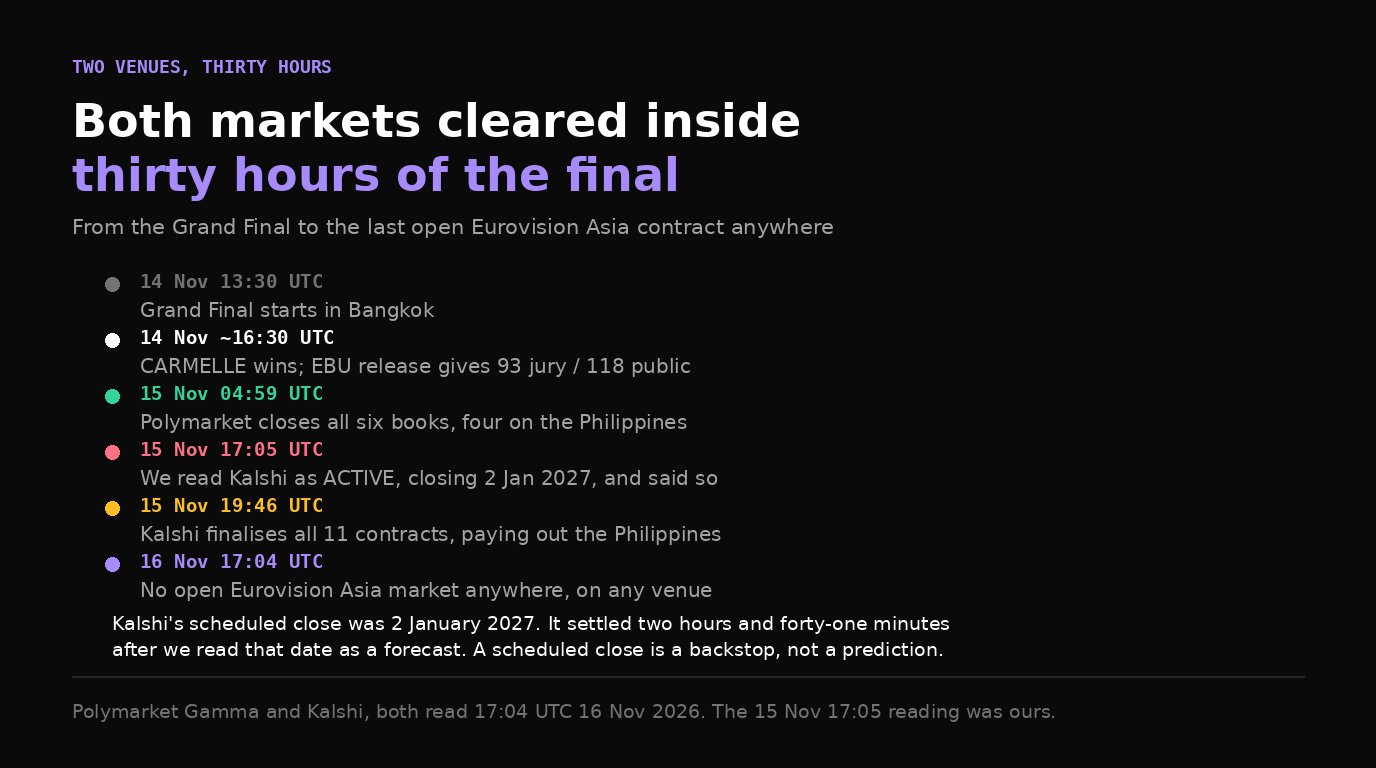
Kalshi settled its Eurovision Asia 2026 winner market at 19:46 UTC on 15 November, paying out on the Philippines and closing all eleven contracts at once. That is roughly thirty hours after the Grand Final ended in Bangkok, and more than six weeks earlier than the board’s own scheduled close of 2 January 2027.

18+ | New customers only | T&Cs apply | Please gamble responsibly
It also happened two hours and forty-one minutes after this site read the board, found it still marked active, and wrote that it would hold positions into the new year. That was wrong, and the correction is the useful part of this piece.
Both venues have now cleared
Two exchanges priced the inaugural Eurovision Asia, and no fixed-odds bookmaker ever did. Both are now closed.
- Polymarket listed the contest on 3 November 2026 and ran six books on it. It closed every one at 04:59 UTC on 15 November — about fifteen and a half hours after the final. The winner book, the Top 3, the jury-winner book and the public-vote book all settled on the Philippines; third place settled on Vietnam and second on Thailand. Lifetime turnover across the six finished at roughly $271,796, of which the outright alone took about $150,841.
- Kalshi, the CFTC-regulated US exchange, opened the first Eurovision Asia market anywhere on 14 September 2026. It finalised all eleven contracts at 19:46 UTC on 15 November. The Philippines contract resolved YES; the other ten resolved NO.
Checked again at 17:04 UTC on 16 November, there is no open Eurovision Asia market on either venue — not on 2026, and nothing has been listed on 2027. Kalshi returns no open Eurovision market at all, on either contest. Polymarket has exactly one, and it is European.
The correction, stated plainly
On 15 November this site read Kalshi at 17:05 UTC, found the board still marked active with a scheduled close of 2 January 2027, and drew a contrast: one venue had cleared its whole slate inside sixteen hours, the other would hold positions into the new year.
The reading was accurate. The inference was not. A scheduled close on an event contract is a backstop — the latest date by which the exchange commits to resolving — not a forecast of when it will. Kalshi resolves when the settlement source is unambiguous, and for a contest whose winner had been announced on stage and confirmed in an EBU release, that condition was met long before January. We treated an administrative deadline as a prediction, and the market corrected us within three hours.
It is the second time in two days that this contest has taught the same lesson in a different costume. Our settlement piece recorded the first: on the night of the final, Polymarket’s public-vote book quoted the Philippines at about 84.6% rather than 100%, and we explained that by the absence of an official per-country scoreboard — when in fact the EBU’s own release, published that night, had already named CARMELLE as the winner of both halves. Read the primary source before the order book, and do not infer intent from a market’s plumbing.
Kalshi settled the contest without ever pricing it
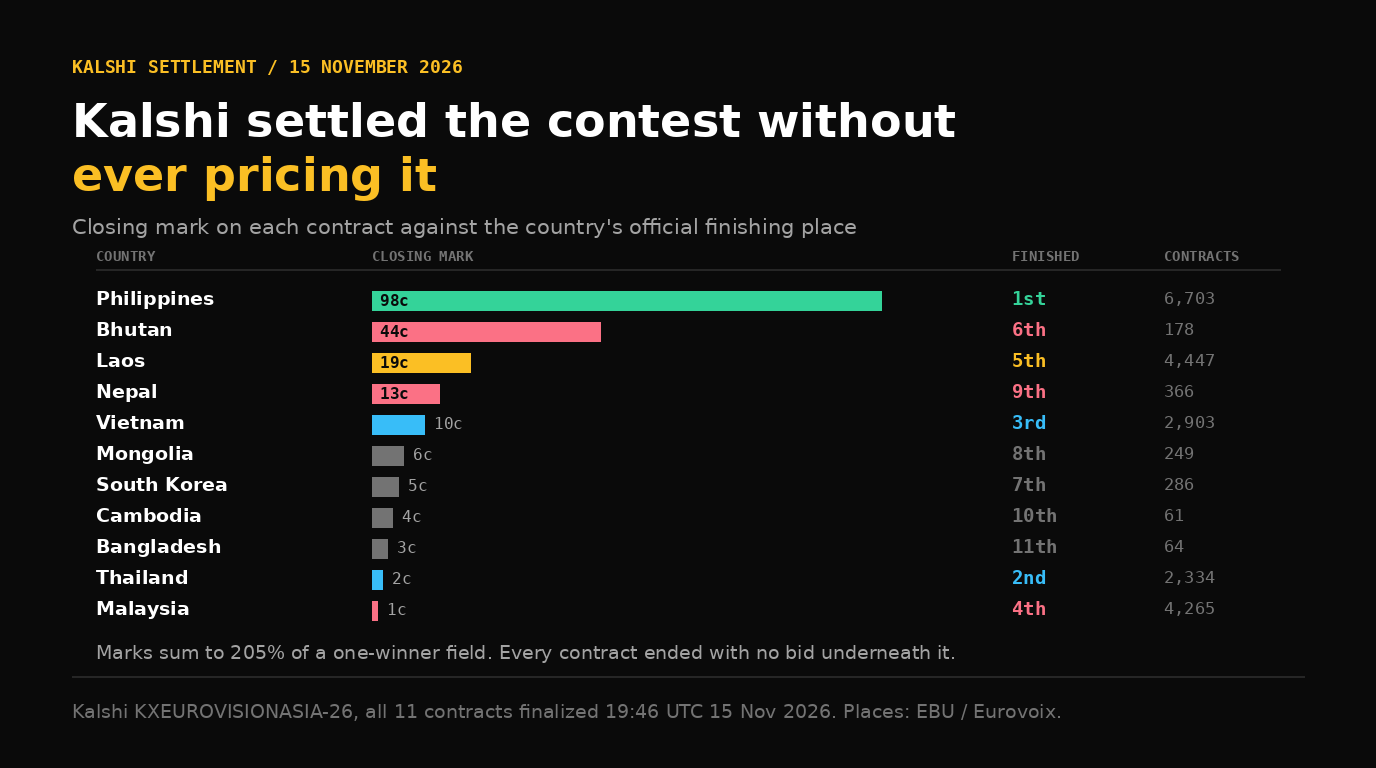
The striking thing about the Kalshi board is not when it settled but what it settled from. Its closing marks bore almost no relationship to the result they were resolving.
| Country | Closing mark | Finished | Contracts traded |
|---|---|---|---|
| Philippines | 98c | 1st | 6,703 |
| Bhutan | 44c | 6th | 178 |
| Laos | 19c | 5th | 4,447 |
| Nepal | 13c | 9th | 366 |
| Vietnam | 10c | 3rd | 2,903 |
| Mongolia | 6c | 8th | 249 |
| South Korea | 5c | 7th | 286 |
| Cambodia | 4c | 10th | 61 |
| Bangladesh | 3c | 11th | 64 |
| Thailand | 2c | 2nd | 2,334 |
| Malaysia | 1c | 4th | 4,265 |
Kalshi KXEUROVISIONASIA-26, all eleven contracts finalized 19:46 UTC 15 November 2026. Finishing places per the official result.
Read that column against the scoreboard and the board looks almost random below the top line. Thailand finished second and closed at 2c. Malaysia finished fourth and closed at 1c. Bhutan finished sixth and closed at 44c — the single worst mark either venue left behind, on a contract with 178 lifetime contracts of volume. The eleven marks sum to 205% of a field in which exactly one country wins, and every one of the eleven ended with no bid underneath it.
That last point is the explanation rather than an aggravating detail. A last-traded price on a contract nobody will bid for is not an estimate of anything; it is the residue of whoever most recently lifted an offer. Bhutan’s 44c does not mean the market thought Bhutan had a 44% chance. It means someone once paid 44c for a Bhutan contract and nothing has happened since. We have said throughout that these were marks and not odds, and the settlement is the proof: a board that was genuinely pricing the contest could not have closed with the eventual second- and fourth-placed countries at 2c and 1c.
Polymarket, by contrast, was a real market with real two-sided quotes, and it was still wrong about the outcome — it closed Malaysia as favourite and Malaysia finished fourth. Our post-mortem scored all six books against the scoreboard. The difference is that being wrong and being uninformative are not the same failure. Polymarket made a bad forecast. Kalshi never made one.
What the volume says about who was actually trading
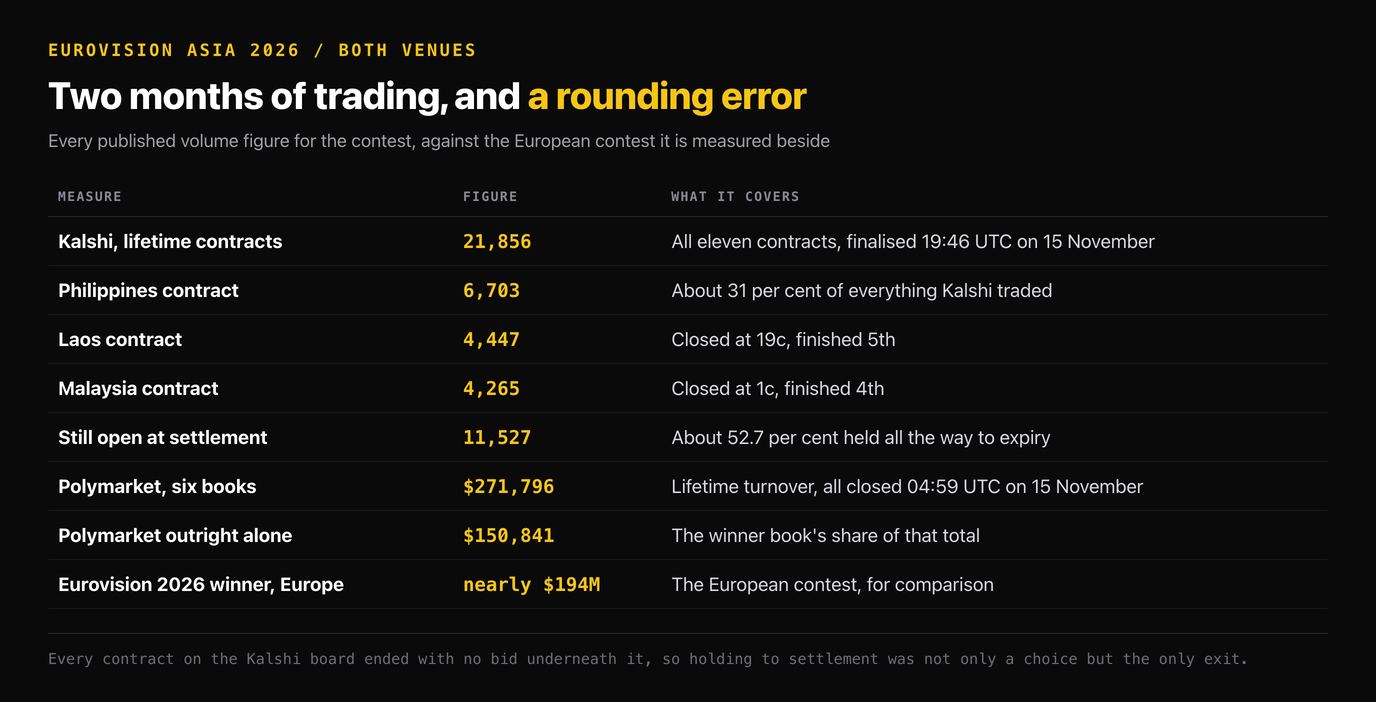
Kalshi’s eleven contracts turned over 21,856 lifetime contracts between them. The Philippines accounted for about 31% of that, at 6,703. Laos took 4,447 and Malaysia 4,265 — on a contract that closed at 1c.
Set that against Polymarket’s $271,796 across six books and the asymmetry is stark: the venue that opened first, had two months’ head start and is the regulated one finished as the thinner and less informative of the two by a wide margin. Polymarket listed Asia eleven days before the final and took roughly an order of magnitude more money.
For comparison, the European Eurovision 2026 winner market closed at nearly $194M of volume. Eurovision Asia’s entire real-money footprint across both venues, over two months, was a rounding error against a single European contest. That is the honest scale of this market in year one, and it is worth remembering when anyone describes Eurovision Asia as having had “betting markets” in any meaningful sense.
More than half the board was still open at settlement
One number on the Kalshi board is genuinely informative, and it is not a price. Against 21,856 contracts of lifetime volume, 11,527 were still open when the exchange finalised — about 52.7% of everything ever traded was held all the way to expiry rather than closed out beforehand.
On a contest that had already been decided on stage, that is a deliberate choice rather than inattention. Holding to settlement means collecting the full dollar on a YES, or keeping the whole premium on a NO, instead of paying the spread to exit into a book with no bids. Given that every contract on this board ended bidless, holders had no realistic way out anyway: selling would have meant hitting a bid that did not exist. The open interest is less a signal of conviction than a measure of how illiquid the exit was.
The split by contract is where it gets interesting. The Philippines carried 4,279 contracts of open interest against 6,703 traded, so roughly 64% of all Philippines positions ran to settlement — unsurprising for the eventual winner. But Vietnam shows 2,201 open against 2,903 traded, about 76%, the highest ratio on the board, on a contract that closed at 10c and finished third. Laos and Malaysia, the next two by volume, sat near 39%. There is no way to tell from public data whether those Vietnam positions were long YES holders who never got out or short NO holders content to run the clock, and we are not going to guess. What it does confirm is that the board’s activity was concentrated in a handful of names and that most of it never unwound.
What is open now, and what is not
Nothing on Eurovision Asia. No 2027 winner market, no participants market, no host-city market, on any venue, as of 16 November 2026. No fixed-odds bookmaker has ever priced this contest, and none has indicated it will. That matters more than usual right now, because the 2027 picture is genuinely unsettled: the winner does not automatically host, no city has lodged a public bid, and organiser talks with the eleven broadcasters begin around 21 November. Those are exactly the conditions that produce a participants market, if one is going to appear.
The one Eurovision market still trading on either venue is Polymarket’s Eurovision 2027 Participants book, on the European contest. Read at 17:04 UTC on 16 November, it stands at about $97,000 of lifetime volume with two contracts open: Slovenia at about 16.5%, up from about 11.2% a day earlier on a last trade of 13c, and Spain at about 7.4% on a last trade of 7.3c. Both resolve on whether the country appears in the EBU’s official participant list, and both broadcasters have until December.
The Slovenian move is the only real price action anywhere in Eurovision this week, and it came with nothing published by RTVSLO. Spain’s position is the longer-running story: RTVE’s Santander board vote, trailed for mid-October, still has no reported result some nine weeks on. One report suggests the board may discuss Eurovision 2027 on 17 November; we have not been able to confirm that against RTVE itself and are treating it as unconfirmed. Our running account of the 2027 field is on the Eurovision 2027 page, and the full Asia board history is on the Eurovision Asia hub.
Three things worth carrying into 2027
- A scheduled close is a backstop, not a forecast. Both venues resolved far inside their stated deadlines once the settlement source was unambiguous. Do not read an administrative date as a prediction — we did, and it was wrong within three hours.
- A last price without a bid is not a probability. Bhutan at 44c into a sixth-place finish is the cleanest illustration this contest produced. Check the bid before you read the mark.
- Depth arrived late and mattered more than seniority. The first venue to list was the worse one. If a 2027 market opens, the question to ask is not who lists first but who gets two-sided quotes.
Sources: Kalshi KXEUROVISIONASIA-26 read directly from api.elections.kalshi.com at 17:04 UTC on 16 November 2026 — all eleven contracts status finalized, the Philippines contract result: yes, close time 2026-11-15T19:46:22Z. Polymarket book volumes, close times and the 2027 Participants quotes read from the Gamma API at the same time. Finishing places and points from the official result, corroborated by the EBU’s release of 14 November 2026, as reported by Eurovoix.