

The only market pricing Eurovision Asia 2026 now has two near-certain winners. Between 10 and 11 October, Kalshi’s Philippines contract went from 53¢ to 95¢ on about 29 contracts — on a board where Vietnam already sat at 84¢. Two countries in a one-winner contest are now marked at a combined 179%, the board as a whole sums to 269%, and the Philippines has become the market’s favourite without a single bid under it. Here is what actually traded, what the numbers mean once you strip out the overround, and why we still do not agree with it.

18+ | New customers only | T&Cs apply | Please gamble responsibly
Image: CARMELLE performing “Sobra-Sobra (Too Much)” at Philippine Selection Night, 30 August 2026 — a frame from the official winning-performance video, Eurovision Song Contest Asia.
Key takeaways
- What traded: about 29 Philippines contracts between our snapshots of 10 October 16:12 UTC and 11 October 13:06 UTC, taking the last price from 53¢ to 95¢. Nothing has moved on the board since.
- There is still no bid on the Philippines. You could not sell a single contract at any price. The offer now sits at 94¢ for 350 contracts.
- Normalised, the Philippines is about 35% and Vietnam about 31% — the only honest way to read a board that sums to 269%.
- Our view has not changed: Vietnam is the better song and our pick. We would put the Philippines at roughly half the market’s normalised figure.
- This is the second time the same thing has happened. On 5 October about eleven contracts lifted Vietnam from 10¢ to 84¢. Both moves were buyers paying the offer on a contract with no bid.
- Cambodia decides on 17 October and still has not published a single song, five days out. That is the last unknown before Bangkok.
What’s on this page
What actually traded · The board, normalised · Why “no bid” is the whole story · The case for the Philippines · Why we still prefer Vietnam · A pattern, not a forecast · What happens next
What actually traded
Kalshi, the CFTC-regulated US exchange, has run an eleven-country winner market on Eurovision Asia 2026 since 14 September (KXEUROVISIONASIA-26). There is still no fixed-odds bookmaker pricing the contest, and Polymarket lists no market for it. This site reads the Kalshi board several times a day and keeps each snapshot, which is how the move below can be pinned down.
From 7 October through the afternoon of 10 October, nothing on the board changed. Nepal completed its entry on 7 October and Mongolia on 10 October; neither produced a trade on its own contract. Then, between our 10 October 16:12 UTC and 11 October 13:06 UTC reads, this happened:
| Contract | 10 Oct, 16:12 UTC | 11 Oct, 13:06 UTC | Lifetime volume | Bid now | Offer now |
|---|---|---|---|---|---|
| Philippines | 53¢ | 95¢ | 83 → 112 | none | 94¢ × 350 |
| Vietnam | 84¢ | 84¢ | 124 → 124 | none | 84¢ |
| South Korea | 22¢ | 22¢ | 61 → 61 | none | 80¢ |
| Thailand | 18¢ | 18¢ | 261 → 261 | none | 84¢ |
| Whole board | sum 227% | sum 269% | 3,488 → 3,517 | 10 of 11 contracts with no bid | |
About 29 contracts changed hands, all on the Philippines, and the last print was 95¢. Before the trade, the Philippines offer had been 86¢. Our read at 03:35 UTC on 12 October found the board unchanged since: zero volume in the previous 24 hours on every contract.
Put in money: Kalshi contracts pay $1 if the outcome happens, so 29 contracts at prices up to 95¢ is something under $30. That is what moved the favourite of the only market on this contest.
The board, normalised
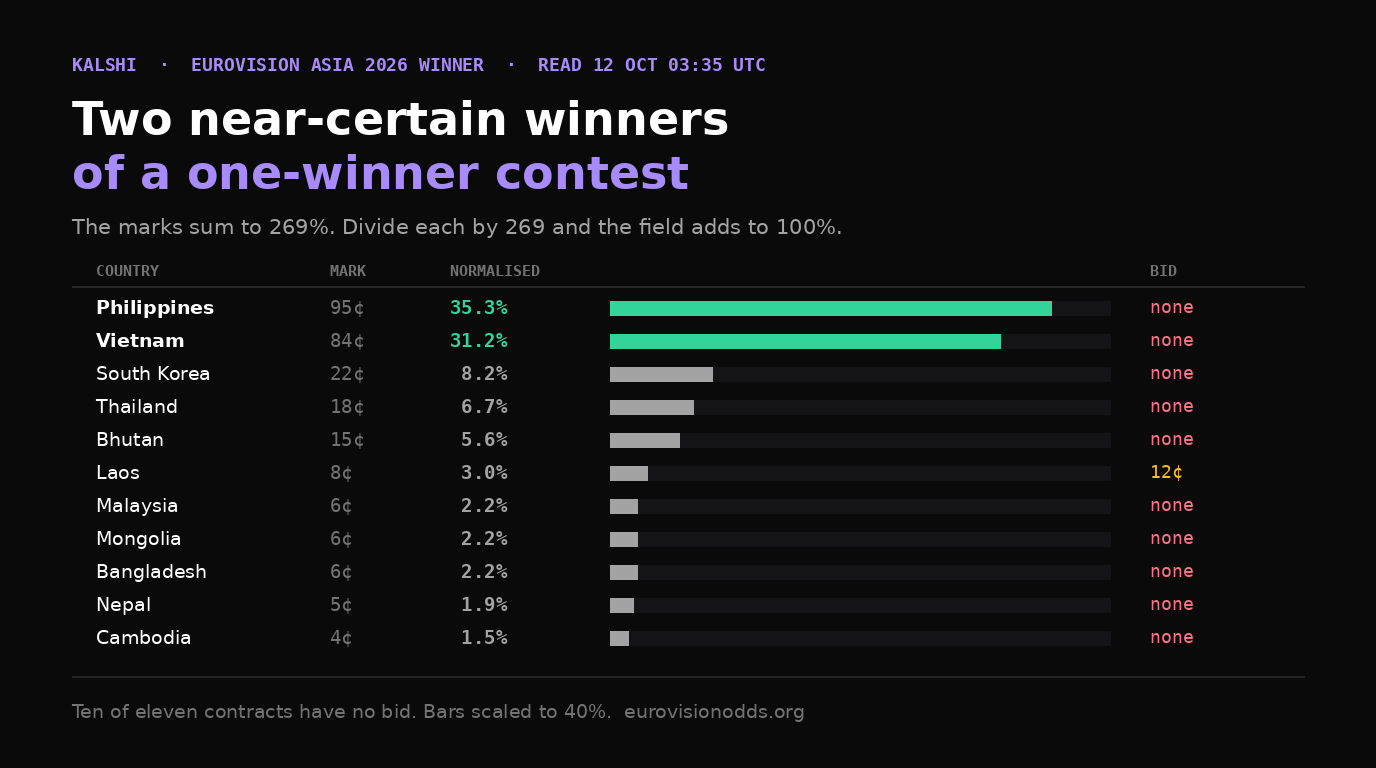
A winner market should add up to 100%, because exactly one country wins. This one adds up to 269%, which means none of its prices can be read as a probability directly. The simplest repair is to divide every mark by the total. It does not make thin prices informative, but it does make them comparable:
| Country | Act | Last mark | Normalised | Bid |
|---|---|---|---|---|
| Philippines | CARMELLE — Sobra-Sobra | 95¢ | 35.3% | none |
| Vietnam | Tóc Tiên — Em Tiên | 84¢ | 31.2% | none |
| South Korea | JUNHEE — Deep Dive | 22¢ | 8.2% | none |
| Thailand | MANG x DAOU — Aroma | 18¢ | 6.7% | none |
| Bhutan | Nyendra — Lhayi Semo | 15¢ | 5.6% | none |
| Laos | Thinla — Bae | 8¢ | 3.0% | 12¢ |
| Malaysia | Aina Abdul — Bluest Sky | 6¢ | 2.2% | none |
| Mongolia | Beck — Light | 6¢ | 2.2% | none |
| Bangladesh | Beatmosphere — Tumi Ele | 6¢ | 2.2% | none |
| Nepal | Pratik Himal Rai — Ananta Maya | 5¢ | 1.9% | none |
| Cambodia | decided 17 October | 4¢ | 1.5% | none |
Two things stand out. First, the top two are close — 35.3% against 31.2% — so the market is not really saying the Philippines is a clear favourite; it is saying the contest is between two countries. Second, everything below them is small: the other nine entries add up to about a third of the field between them. The normalised board, in other words, is a two-horse picture, and that is the one part of it we broadly agree with.
Laos is the only contract on the board with a bid at all (12¢), and it also accounts for about 70% of all the volume ever traded here — nearly 2,500 contracts, almost all of it from September. The most-traded contract is priced at 3%, and the favourite has never had a buyer willing to stand in the book. That tells you more about who has been using this market than about Bangkok.
Why “no bid” is the whole story
A price is only meaningful if two sides agree on it. On the Philippines contract there is currently no bid at all: nobody is offering to buy a single contract at any price. The 95¢ is the price someone paid when they bought from the offer, and the offer is the only side of the book that exists.
The current offer is 94¢ for 350 contracts. On Kalshi a resting offer to sell “yes” at 94¢ is the same thing as someone willing to buy “no” at 6¢. So, read plainly: there is a trader prepared to take the other side of anyone who thinks the Philippines is more than 94% to win, for up to 350 contracts — and since 11 October, nobody has.
That is the useful signal on this board. Not that someone paid 95¢, but that at 94¢ the market has gone quiet. We explained how this market is built and why its prices behave this way when it opened. For comparison, the European Eurovision 2026 winner market traded close to $194M on Polymarket. This one has traded 3,517 contracts in four weeks.
The case for the Philippines
We do not think the buyer is mad, and there is a real argument for the Philippines entry.
The vocal. CARMELLE — Carmelle Allyza San Juan Collado, 19, from Sipocot in Camarines Sur — came up through the Philippine reality-competition circuit: first runner-up on season 4 of The Voice Kids in 2019, and winner of Tawag ng Tanghalan: The School Showdown in January 2025. In our field table on 6 October we called hers the strongest pure vocal in the contest, and nothing since has changed that.
The song is not a plain pop record — and we undersold it. In our 6 October field table we called it the most conventional song in the contest. Looking again at what is in it, that was wrong. “Sobra-Sobra (Too Much)”, written by Nica del Rosario and Mat Olavides of FlipMusic, is bilingual Filipino and English dance-pop with a rap section and Filipino ethnic percussion — kulintang and kubing — built into the track. That is the same kind of fusion we credited “Em Tiên” with, and it would be inconsistent of us to pretend it only counts for Vietnam.
The staging is already proven. The Philippine Selection Night performance on 30 August is one of the most complete stage shows any country has put out this season — dancers, choreography, a set built around the song’s patterns. Two entries in this field, Malaysia’s and Cambodia’s, have not yet been performed on a selection stage at all. The Philippines has a staging it can scale up.
The Grand Final rules. Bangkok is decided 50% jury and 50% public under clause 8.2 of the Voting Terms, not the 40/40/20 used at national selections. A technically strong vocal is the thing a professional jury most reliably rewards.
Why we still prefer Vietnam
Our call, made on 6 October, was that “Em Tiên” is the best song in the field, at roughly 30%. The market’s normalised Vietnam number, 31.2%, is close to ours. Where we disagree is the Philippines: we would put it at something like half the market’s 35%.
Three reasons. First, the evidence that “Em Tiên” travels is stronger: two independent fan panels outside Vietnam ranked it first out of five before the domestic vote did. Nothing comparable exists for “Sobra-Sobra”. Second, “Sobra-Sobra” is busier — dance, rap section, percussion, bilingual hook — and three minutes is not long; the risk with a song doing that much is that a jury hears the parts rather than the whole. Third, “Em Tiên” carries a star: Tóc Tiên has been releasing records since 2007 and won a Mnet Asian Music Award in 2017, while CARMELLE is a nineteen-year-old at the start of her career. In a first edition with no voting history, recognisability is worth something.
None of that is decisive, and we said on 6 October that this contest is too new for anyone to be confident. But a 95¢ mark on 29 contracts is not new information about either song. It is somebody’s opinion, bought for under $30.
A pattern, not a forecast
This is now the second time the board has moved this way, and both times in the same shape:
- 5 October: about eleven contracts lifted Vietnam from 10¢ to 84¢, two days after it completed its entry. No bid before, no bid after.
- 10–11 October: about 29 contracts lifted the Philippines from 53¢ to 95¢. No bid before, no bid after.
In both cases a buyer paid the offer on a contract nobody else was bidding for, and the mark jumped to wherever the offer happened to be. Neither move was a market forming a consensus. Each was one side of a trade arriving at a book with only one side. That is why we normalise rather than quote these prices, and why a big move on this board should be read as “someone bought”, not “the market thinks”.
What happens next
Cambodia’s Finest Voice is on Saturday 17 October at the AEON Mall Sen Sok Event Hall in Phnom Penh, from 18:00 local time (13:00 CET), on TV5 Cambodia. Seven acts compete: GOOFY, KESORRR, MC PICH, Monetrey, Nov Dana, Sam Rocker and Satiya. Five days out, none of their songs has been published, which makes it the least previewable selection of the season. It is decided on the fixed 40/40/20 national-selection split. When it is done, all eleven entries will be known.
After that the next real information is the staging. Rehearsals at the One Bangkok Forum come before the full preview show on 13 November and the Grand Final on 14 November. That is when the case for either the Philippines or Vietnam stops being an argument about recordings and becomes an argument about three minutes on a stage. The Eurovision Asia hub carries the live board and the full field.
Sources
- Prices, volumes, bids and offers read from Kalshi’s public API, against this site’s stored snapshots of 10 October 16:12 UTC and 11 October 13:06 UTC, and a fresh read at 03:35 UTC on 12 October 2026.
- Grand Final weighting: Eurovision Song Contest Asia Voting Terms and Conditions, clause 8.2 (updated 28 August 2026).
- Cambodia’s field, venue and timing: Eurovoix, 5 October 2026, and Eurovision Fun, October 2026.
- CARMELLE’s background and the “Sobra-Sobra” credits: this site’s Philippines country profile, compiled from the organisers’ and the broadcaster’s published material.
Prediction-market prices move, and on a book this thin a handful of contracts can move them a long way. Check the live board before acting on anything here. 18+. Markets carry risk.