
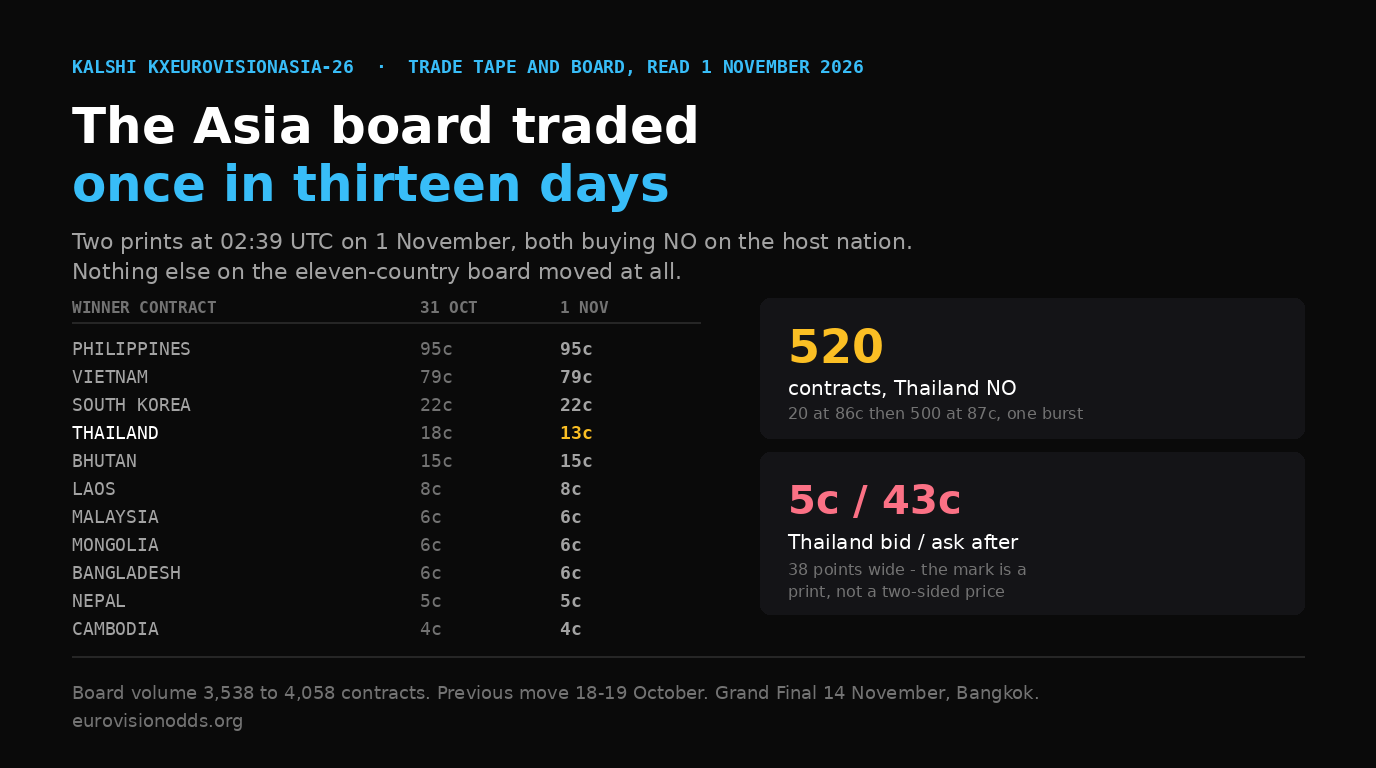
The only real-money Eurovision Asia market traded for the first time in thirteen days in the early hours of 1 November 2026, and the entire trade was a bet against the host nation. Two prints went through Kalshi’s eleven-country winner board at 02:39 UTC: 20 contracts and then 500 more, both of them buying NO on Thailand. That marked Thailand down from 18 cents to 13 and lifted the board’s lifetime volume from 3,538 contracts to 4,058. Nothing else on the board moved at all.

18+ | New customers only | T&Cs apply | Please gamble responsibly
Illustration: a designed card showing the trade tape and the board. No real person is depicted.
Key takeaways
- One contract traded, and it was Thailand. 20 contracts at a YES price of 14 cents, then 500 at 13 cents, both at 02:39:16 UTC on 1 November 2026. Read from the Kalshi trade tape for KXEUROVISIONASIA-26-THA on 1 November.
- Both prints were NO buyers lifting the offer, paying 86 and 87 cents for the proposition that Thailand does not win in Bangkok. Thailand’s YES mark fell to 13 cents as the mechanical consequence, not because anyone sold out of a position.
- The board had not moved since 18 to 19 October. Our stored daily snapshots of the Kalshi board held total volume at 3,538 contracts through every reading from 19 October to 31 October.
- Thailand is now quoted 5 cents bid against 43 cents offered. That is a 38-point spread on a contract whose last trade was 13 cents, so the mark is a print rather than a price you could deal on in either direction.
- No fixed-odds bookmaker prices this contest at all, and Polymarket has still listed no Eurovision Asia market on our twenty-third consecutive check. Kalshi remains the only venue.
- The Grand Final is on 14 November 2026 in Bangkok, thirteen days after this trade, with all eleven songs released and the running order published on 29 October.
What actually traded on the Eurovision Asia odds board
Kalshi, the US CFTC-regulated exchange, opened KXEUROVISIONASIA-26 on 14 September 2026 as the first real-money market on the inaugural Eurovision Song Contest Asia. It lists one winner contract per country, eleven in all, and closes on 2 January 2027. It is a genuinely thin book: before 1 November the whole market had traded 3,538 contracts in seven weeks, and roughly 60% of that volume sits in a single country, Laos.
The tape for 1 November is short enough to print in full. At 02:39:16 UTC a taker bought 20 NO contracts on Thailand at 86 cents, and in the same second bought 500 more at 87 cents. Both were taken against the resting offer. Nothing else printed anywhere on the board that day, which we can state with confidence because the per-country volumes in our stored snapshot are otherwise identical to the reading taken at 16:09 UTC on 31 October.
In YES terms, which is how the board displays itself, Thailand went from 18 cents to 13. That is the first change to any Thailand mark since 4 October, when 200 contracts went through at 18 cents, and the first change to any mark on the board since a 14-contract print between our snapshots of 18 and 19 October.
Why 13 cents is not a 13% chance
This site has said the same thing about this board since September and it has not stopped being true. A last price is the record of one transaction. It is a probability estimate only when there is a two-sided market standing behind it, and on this board there mostly is not.
After the trade Thailand is quoted 5 cents bid against 43 cents offered. If you wanted to back Thailand you would pay 43 cents, more than three times the mark. If you wanted to lay it you would receive 5 cents, well under half. Seven of the eleven contracts show no bid at all, which means that for most of the field there is no price at which anyone has publicly offered to buy. A number on a screen in that condition is a quote, not a consensus.
The honest reading of the 1 November trade is narrower and more interesting than a repriced probability. Somebody was willing to stake about 452 dollars to win about 68 if Thailand does not win the contest, a gross return of roughly 15% over thirteen days. That is a yield trade on a near-certainty, and it tells you what one participant thought about the host nation rather than what the market as a whole believes.
The rest of the Eurovision Asia board, unchanged
| Country | Act | Last price, 31 Oct | Last price, 1 Nov |
|---|---|---|---|
| Philippines | Carmelle | 95c | 95c |
| Vietnam | Tóc Tiên | 79c | 79c |
| Republic of Korea | JUNHEE | 22c | 22c |
| Thailand | MANG x DAOU | 18c | 13c |
| Bhutan | Nyendra | 15c | 15c |
| Laos | Thinla | 8c | 8c |
| Malaysia | Aina Abdul | 6c | 6c |
| Mongolia | Beck | 6c | 6c |
| Bangladesh | Beatmosphere | 6c | 6c |
| Nepal | Pratik Himal Rai | 5c | 5c |
| Cambodia | Monetrey | 4c | 4c |
Two features of that table are worth naming rather than glossing. The first is that the Philippines and Vietnam are both marked near the top of a contest only one of them can win, which is arithmetically impossible as a pair of probabilities and is simply what happens when asks get lifted on contracts that have no bids underneath them. The second is that the marks have been static for weeks on nine of the eleven contracts, so the board is better read as a record of the few trades that have happened than as a live opinion about Bangkok.
Our live Kalshi figures, including the sum of the last prices and the number of contracts showing no bid, are rendered on the Eurovision Asia hub directly from a data file that refreshes daily, so they are current rather than typed into prose that ages.
Every move this board has made since it opened
Because the board is so quiet, its entire trading history fits in a list, and that list is far more informative than any single mark on it. These are the moves this site has recorded from the Kalshi tape and from our own daily snapshots since the market opened on 14 September 2026.
- 14 to 16 September — the opening trades, including the Laos contract that still accounts for about 60% of all volume on the board.
- 4 October — Thailand, 200 contracts at a YES price of 18 cents, up from 8 cents. A NO buyer took the offer, exactly as on 1 November.
- 5 October — Vietnam, about eleven contracts, 10 cents to 84 cents, two days after Tóc Tiên completed her entry.
- 10 to 11 October — the Philippines, about 29 contracts, 53 cents to 95 cents, which left two countries marked as near-certain winners of a contest with one winner.
- 18 to 19 October — a 14-contract print, the last change to the board before November.
- 1 November — Thailand, 520 contracts, the single largest print on the board outside Laos.
Set out that way, two things are obvious. The board does not respond to news: it did not move when Nepal completed its entry on 7 October, when Mongolia completed its own on 10 October, when Mongolia’s original song was disqualified on 19 October, or when the running order was drawn on 29 October. And it is moved almost entirely by buyers of NO lifting offers on contracts with no bid underneath, which is why nine of the eleven marks have not changed in three weeks while the implied field keeps adding up to far more than one certainty.
The 1 November trade is the largest of these by a distance, and it is the first one that arrived in contest fortnight rather than in the long gap between national finals. Whether that is the beginning of pre-contest interest or one trader clearing a yield idea will be answerable only by what prints next.
What a bet against the host nation might be reading
Thailand is the host. MANG x DAOU perform “Aroma”, and under the published running order Thailand sings eighth of eleven, with Vietnam opening and Malaysia closing. Host status at the European contest has historically been worth very little and occasionally been actively unhelpful, and this is a first edition with no history of its own to draw on, so there is no established home advantage here to fade.
There is one structural point that cuts against any home-crowd theory, and it is in the rules rather than the sentiment. The Bangkok Grand Final is scored 50% public vote and 50% jury under section 8.2 of the official Eurovision Asia voting terms, which is a different formula from the 40% domestic, 40% jury, 20% rest of world split that governed every national selection. Viewers cannot vote for their own country. A host nation therefore gets no vote from its own televoters at all, which is the opposite of the usual assumption people carry over from a domestic music contest.
None of that makes 13 cents right or wrong. It does mean a trade against the host is not obviously naive, which is the most that can be said about a single order on a book this size.
Where this leaves anyone wanting a bet
Plainly: there is still no good way to bet this contest. No fixed-odds bookmaker on our bookmaker comparison has opened a Eurovision Asia market, and Polymarket has listed nothing on it across twenty-three consecutive checks since the contest was announced. Kalshi is the only venue, and its spreads are wide enough that the round-trip cost on most of this board would swallow any edge a view could generate.
That is a different position from the European contest, where the winner market is priced by a dozen books and the 2026 edition traded nearly 194 million dollars of volume on Polymarket alone. If you want a comparison of how a liquid Eurovision market behaves, our coverage of the Eurovision 2027 participation board is the nearer example, and even that one is small.
The useful thing to do with the Kalshi board over the next two weeks is to watch it rather than trade it. A contest-week market that is still this thin will move a long way on small orders, and those moves will mostly be order flow rather than information. We will keep reporting them as dated history, with the size attached, because a price without its volume is not a fact worth acting on.
The calendar from here
- 13 November 2026 — the preview show in Bangkok, the first time all eleven acts perform on the contest stage.
- 14 November 2026 — the Grand Final at One Bangkok Forum, scored 50% public and 50% jury, with the running order already drawn: Vietnam, Cambodia, Laos, Mongolia, Bhutan, Philippines, Bangladesh, Thailand, Republic of Korea, Nepal, Malaysia.
- 2 January 2027 — the Kalshi winner contracts close.
All prices in this article were read on 1 November 2026: the trade tape at 16:10 UTC and the board snapshot at 16:05 UTC, both from Kalshi. Running order and voting formula from the organisers at eurovisionasia.com. Prices move; check them before acting on anything here.