
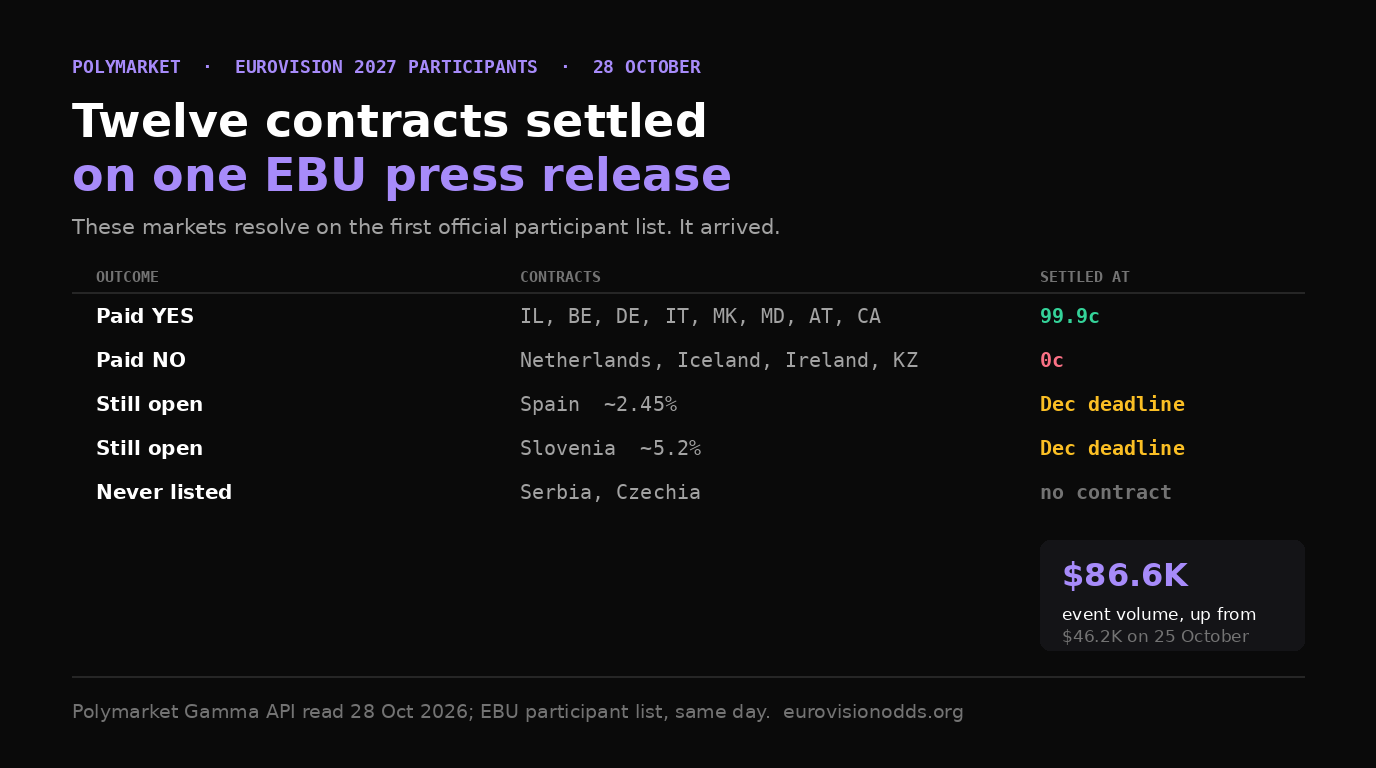
Polymarket’s Eurovision 2027 participants market has largely settled, and the heaviest contract on it resolved to zero. The EBU published its official 36-country field on 28 October 2026; these contracts pay out on exactly that list, so twelve of the fourteen closed on the announcement. The Netherlands, which had traded in the nineties for a month and read 95.25% three days earlier, paid nothing at all.

18+ | New customers only | T&Cs apply | Please gamble responsibly
Illustration: a designed card showing the resolution board. No real person or venue is depicted.
How the board settled
| Outcome | Contracts | Settled at |
|---|---|---|
| Paid YES | Israel, Belgium, Germany, Italy, North Macedonia, Moldova, Austria, Canada | 99.9c |
| Paid NO | Netherlands, Iceland, Ireland, Kazakhstan | 0c |
| Still open | Spain (~2.45%), Slovenia (~5.2%) | EBU deadline in December |
| Never listed | Serbia, Czechia | no contract existed |
Event volume nearly doubled in three days, from about $46.2K when we read it on 25 October to about $86.6K on 28 October. Prices read from Polymarket’s Gamma API on 28 October 2026.
The Dutch contract, and the most expensive lesson of this season
The Netherlands was the largest book in the event at roughly $30.2K of lifetime volume — about three times the next biggest. It resolved to nothing.
Here is the full series we recorded, each figure read on the date shown:
| Date | Mid | Last trade |
|---|---|---|
| 31 August 2026 | 20% | — |
| 4 September 2026 | 52% | — |
| 22 September 2026 | 39% | — |
| 25 September 2026 | 95.3% | — |
| 12 October 2026 | 95.55% | 94.1c |
| 16 October 2026 | 95.10% | 94.1c |
| 22 October 2026 | 96.20% | 94.1c |
| 25 October 2026 | 95.25% | 94.1c |
| 28 October 2026 | 0% | resolved NO |
Look at the last-trade column. It does not move for four consecutive reads across sixteen days. We pointed that out each time, and we were right about what it meant mechanically: the mid was drifting on quote changes, not repricing on trades. We wrote on 25 October that “nothing about the CvO dispute has been traded in either direction”.
That was an accurate reading of the order book and a worthless warning, and it is worth being blunt about why. We treated an untraded market as a quiet one. A market that has stopped trading is not expressing confidence in a 95% number — it has stopped looking at the question. The information that mattered was not in the book at all. It was in a story we were already covering: NPO had been unable to conclude talks with its member broadcasters, the members wanted clarity on process, organisation and financing, and around 500 staff had signed a protest. We reported all of that on 22 October and still treated the 95% as the base case because the price had not moved.
The correct read was available: a contract priced at 95% whose underlying question is “will an organisation that cannot find anyone willing to do this find someone willing to do this” is not a 95% proposition just because nobody is trading it.
What these contracts actually settled on
This matters for reading the resolution correctly. Each contract resolves on whether the country appears in the EBU’s first official participant list, and the rules state explicitly that withdrawals after that list do not affect resolution.
So the 28 October announcement was always going to be the settlement event. It also explains two outcomes that look odd:
- Czechia had no contract — and it actually withdrew, on 6 October, on cost grounds. The board could not price a real withdrawal because it had never listed the country.
- Serbia had no contract — and RTS confirmed on 20 October. Same blind spot, opposite direction.
A participants market that lists fourteen of thirty-eight possible countries is pricing the countries someone thought were interesting in August, not the question in general. Two of the season’s genuine changes happened entirely outside it.
Where the market got it right
It would be dishonest to write this up as a market failure across the board, because it was not. Kazakhstan was priced out well before the announcement — 26.15% on 13 October, 12.65% on 16 October, 5.15% on 19 October — and resolved NO. Iceland was the cleanest news-driven move of the season, falling from 66.0% to 10.0% in the three days around the RÚV board vote on 30 September, and resolving NO. Canada, Italy, Germany, Austria and Moldova all sat in the high nineties for weeks and all paid out.
The board was accurate on every contract where the underlying question had a published answer. It failed on the one where the answer depended on an unresolved internal negotiation — and that is a useful boundary to know, because it is precisely the kind of question these markets are usually sold as being good at.
The two contracts still trading
Spain and Slovenia are the only ones open, and that is exactly right — they are the only two countries the EBU left undecided, with RTVE and RTVSLO given until December.
Spain reads about 2.45%, quoted 1c against 3.9c with its last trade at 6.4c, on roughly $11.1K of lifetime volume — now the heaviest open book. It has fallen from 16.4% on 22 October and 7.1% on 25 October. That unwinds the entire jump it took when RTVE named eighteen Benidorm Fest 2027 acts on 14 October, which is what we said a festival line-up was worth: Benidorm Fest also ran in 2026 with no Eurovision ticket attached. The Santander board vote trailed for mid-October still has no reported result, close to seven weeks on, and RTVE president José Pablo López’s recommendation to stay out remains a recommendation.
Slovenia reads about 5.2%, quoted 3.5c against 6.9c with its last trade at 7c, down from 29.0% on 25 October after a month of round trips on nothing RTVSLO published. It now has a published decision date for the first time, and it came from the EBU rather than from the broadcaster.
Read both for what they are: the market is pricing two broadcasters that have each been recommended or expected to stay away, against a deadline. Neither price reflects news, because there has not been any.
What is still not priced anywhere
There is no outright winner market for Eurovision 2027. No bookmaker has opened one and Polymarket has not listed one. The participants market was never a winner market, and with it mostly settled there is now very little Eurovision exposure available anywhere until the national finals produce songs.
For Eurovision Asia 2026, Polymarket still lists nothing on our twenty-first consecutive check. Kalshi remains the only venue, and its board is thin enough that most contracts show no bid at all. The full participation picture for Burgas is on our Eurovision 2027 page, the confirmation of the field is covered in our report on the EBU list, and the reasons behind the Dutch resolution are in our piece on NPO’s withdrawal. Prices we track as they open go on the winner odds page.
Sources: Polymarket Gamma API, read 28 October 2026 (event eurovision-2027-participants); EBU participant list via Eurovoix, 28 October 2026; NPO statement via Eurovoix, 27 October 2026. Historical prices are this site’s own dated reads.