
RTSH published eight more Festivali i Këngës 65 song titles on 22 November 2026, taking the field from four named entries to twelve of twenty-nine. Albania selects before any other country, so these are the first identified Eurovision 2027 songs anywhere. Seventeen entries still have no published title — including both of the acts the betting market prices shortest.

18+ | New customers only | T&Cs apply | Please gamble responsibly
Key takeaways
- Twelve of twenty-nine songs are now named, released in batches on RTSH’s own Instagram rather than through a reveal programme.
- Former Albanian Eurovision representatives keep appearing as songwriters, not performers — Ronela Hajati (2022) and Anxhela Peristeri (2021) have both written entries in this field.
- One entry is credited to Ismail Kadare, the name of Albania’s most internationally known writer. We report the credit as published and make no identification.
- The two clear favourites are still untitled. Kejsi Tola and Sara Bajraktari are the only acts quoted above 10c, and neither has a published song.
- One price collapsed. Kejsi Jazxhi went from a 16c bid to a 1c bid, with the last trade falling from 20c to 4c on real volume, on no song reveal and no news.
- RTSH still has not published the format — no voting split, no semi-final structure, five weeks out.
What’s on this page
The eight new titles · The representatives are writing, not singing · The Ismail Kadare credit · What RTSH still has not published · The market is pricing names, not songs · The Kejsi Jazxhi collapse · What a December winner means for Burgas
The eight new Festivali i Këngës 65 songs
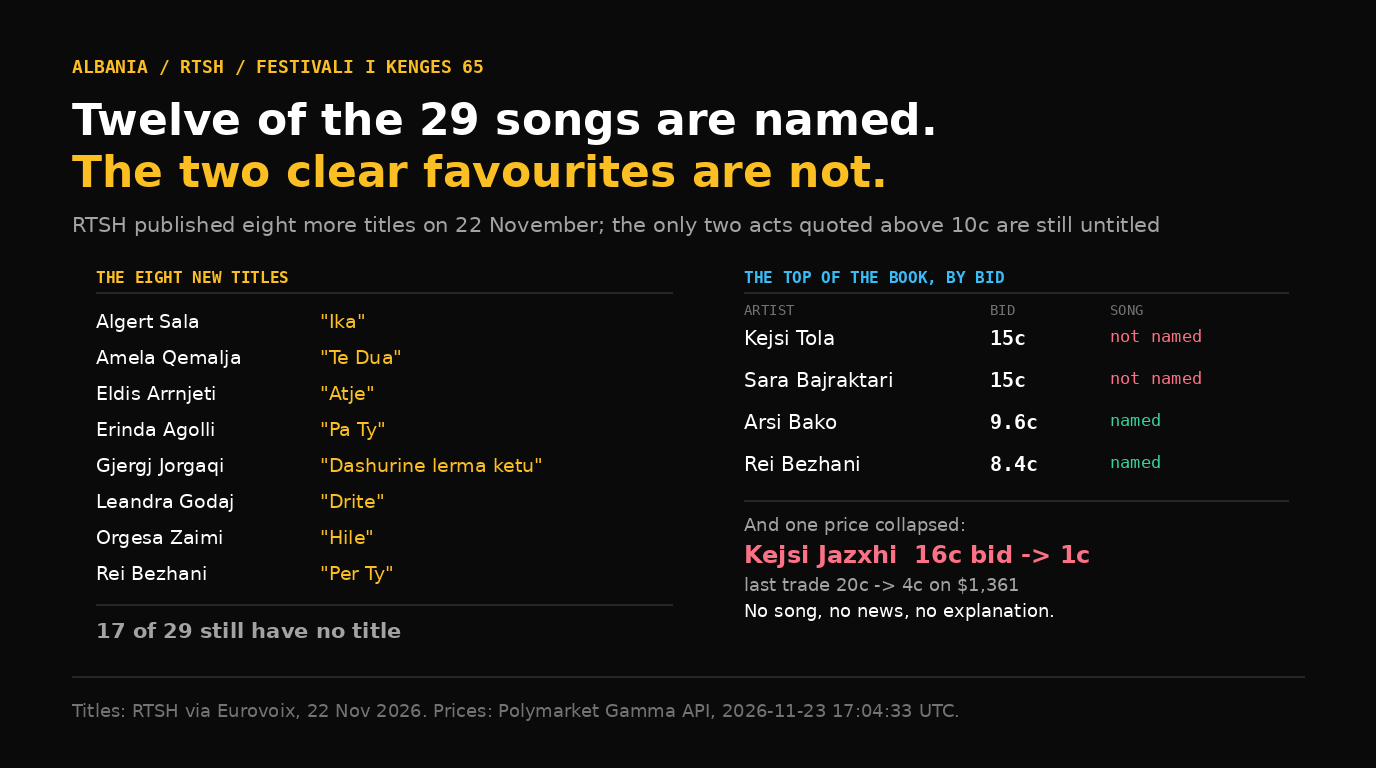
| Artist | Song | Music | Lyrics | Orchestration |
|---|---|---|---|---|
| Algert Sala | “Ika” (I left) | Algert Sala | Algert Sala | Algert Sala |
| Amela Qemalja | “Të Dua” (I Love You) | Valter Beqo | Martin Pano | Valter Beqo |
| Eldis Arrnjeti | “Atje” (There) | Eldis Arnjeti | Eldis Arnjeti | Sergio Hajdini |
| Erinda Agolli | “Pa Ty” (Without You) | Erinda Agolli | Ismail Kadare | Alban Dhamo |
| Gjergj Jorgaqi | “Dashurinë lërma këtu” | Gjergj Jorgaqi | Gjergj Jorgaqi | Niki Zaimi |
| Leandra Godaj | “Dritë” (Light) | Klodian Rexhepaj | Chiara Sala | Rexhepaj & Koçllari |
| Orgesa Zaimi | “Hile” (Trick) | Ronela Hajati | Ronela Hajati | Jeris Kaso |
| Rei Bezhani | “Për Ty” (For You) | Rei Bezhani | Rei Bezhani | Enis Mullaj |
The English glosses are the ones Eurovoix gave; where a source did not translate a title, we have not invented one. These eight join the four published on 21 November — Ardit Çuni “Çike”, Arsi Bako “Kurajo”, Auron Deva & DJ Sardi “Bashkë” and Martina Serreqi “Flasin” — which this site covered in its report on the first songs of the 2027 season.
Four of the eight are written entirely by the performer: Algert Sala credits himself with music, lyrics and orchestration, and Eldis Arrnjeti, Gjergj Jorgaqi and Rei Bezhani all write their own words and music. That is a high proportion of self-penned entries by the standards of a festival that has historically paired singers with a stable of established composers, and it is worth noting ahead of a contest where the songwriting credit travels with the entry.
Albania’s Eurovision alumni are writing, not singing
The clearest pattern across the two batches is not in the titles. It is in the credits. Orgesa Zaimi’s “Hile” is written, words and music, by Ronela Hajati, who represented Albania at Eurovision 2022 in Turin with “Sekret”. In the 21 November batch, Auron Deva & DJ Sardi’s “Bashkë” carries lyrics by Anxhela Peristeri, Albania’s 2021 representative in Rotterdam with “Karma”.
Two returning representatives in one field would normally be a story about comebacks. Here neither is competing. Both have moved behind the desk, and in a selection whose winner gets close to five months to revamp before Burgas, the identity of the writer is arguably the more durable signal: the performer can be re-staged and the arrangement rebuilt, but the song is the thing that travels.
There is a third alumnus in the field as a performer. Kejsi Tola won Festivali i Këngës 47 and represented Albania at Eurovision 2009 in Moscow with “Carry Me in Your Dreams”. She is also, as of 23 November, joint-shortest in the betting with no published song — which is the subject of the second half of this piece.
The Ismail Kadare credit
One line in the 22 November batch stands out. Erinda Agolli’s “Pa Ty” is listed with music by Agolli, orchestration by Alban Dhamo and lyrics by Ismail Kadare.
That is the name of Albania’s most internationally celebrated writer, the novelist and poet who won the inaugural Man Booker International Prize in 2005 and died in Tirana in 2024. A lyric credit to him in a 2026 festival would therefore be a setting of an existing text rather than a commission.
We are reporting the credit, not making the identification. Neither RTSH nor Eurovoix states which Ismail Kadare is meant, whether the lyric is drawn from a published poem, or whether an estate approved it; and Kadare is not a vanishingly rare Albanian name. Until RTSH says so, the responsible statement is that the entry is credited to a lyricist of that name and that the obvious inference has not been confirmed by anyone. If the festival does confirm it, it would be among the more unusual songwriting credits in the contest’s recent history, and we will update this page.
What RTSH still has not published
Five weeks out, the festival’s structure remains unannounced. RTSH has confirmed that Festivali i Këngës 65 runs from 17 to 20 December 2026 at the Palace of Congresses in Tirana, and that the winner is chosen by a combination of jury and public voting. It has not published the weighting between them, nor how the four nights divide into semi-finals and a final.
Recent editions are a guide and not a confirmation, so this site is not assigning a split or a show structure until RTSH publishes one. The practical consequence for anyone pricing the event is that the single largest unknown is not which song is best but how the votes are counted, and that is true for every contract in the book equally.
Rehearsals began at the RTSH Orchestra Hall in mid-November, with each of the twenty-nine acts rehearsing with the RTSH Orchestra — the festival’s long-standing live-orchestra format, and one of the few remaining national finals where the orchestration credit means what it says.
The market is pricing names, not songs
Polymarket has run a Festivali i Këngës 65 winner book since 18 November. Read at 2026-11-23 17:04:33 UTC it had taken about $4,153, up from $2,391 a day earlier, across twenty-nine contracts. Ranked by best bid — the only number in a thin book that someone is committed to — the top looks like this:
| Artist | Best bid | Last trade | Volume | Song published? |
|---|---|---|---|---|
| Kejsi Tola | 15c | 21c | $100 | No |
| Sara Bajraktari | 15c | 15c | $1,130 | No |
| Arsi Bako | 9.6c | 9c | $70 | Yes — “Kurajo” |
| Rei Bezhani | 8.4c | 9.9c | $110 | Yes — “Për Ty” |
| Gigliola Haveriku | 2.2c | no trade | $971 | No |
The two acts quoted above 10c are the two with no published song, and they are also the two most recognisable names in the field: Kejsi Tola, a previous Eurovision representative, and Sara Bajraktari, who carries more money than any other contract in the book. The market is pricing reputation, because reputation is the only information it has about them.
That is not a criticism of the traders. It is a description of the stage the field is at, and it is the reason to be careful with these prices for another few weeks. Twelve of the twenty-nine now have something to be judged on; seventeen do not. A book in which the favourites are the acts nobody can yet evaluate is a book that will reprice when the remaining titles land, and RTSH is publishing them in batches with no announced schedule.
One contract shows what happens when attention arrives without information. Gigliola Haveriku’s volume went from about $10 to about $971 in a day — the second-largest turnover in the book — and her best bid finished at 2.2c. A great deal of money changed hands at very low prices on an act with no published song. Her quote also narrowed sharply, from a 36.1c offer to 12.4c, which is where most of the book’s apparent overround reduction came from: the midpoints now sum to 188.5%, against 207.7% a day earlier, with nobody changing their mind about anything.
The Kejsi Jazxhi collapse
The sharpest move in the book went the other way, and it is the one we cannot explain. Kejsi Jazxhi’s best bid fell from 16.0c to 1c in twenty-four hours. Unlike most moves in this book, it was not a quote artefact: the last trade fell from 20.0c to 4c and the contract’s volume roughly doubled, from about $651 to about $1,361. People sold, at progressively lower prices, and the bid followed them down.
As recently as 22 November, Jazxhi was part of a three-way tie at the top of this book alongside Kejsi Tola and Sara Bajraktari, all quoted 16c. A day later the other two are unchanged at 15c and she is at a penny. No song was published for her, no withdrawal has been announced, and RTSH has made no statement about her entry. Eurovoix noted a line-up change when rehearsals began — Amela Qemalja joined the field — but stated plainly that it was not known whom she replaced, and this site has not named anyone on that basis.
It is worth saying what this does and does not establish. A fifteen-point fall on roughly $710 of turnover is a real repricing in the sense that trades happened; it is also, in absolute terms, a few hundred dollars. In a book this size a single seller can produce a collapse that looks like consensus. If a withdrawal is announced in the next few days, this move will look prescient. If nothing is announced, it will look like one person leaving.
Meanwhile Rei Bezhani, whose 21% midpoint this site called an artefact on 21 November and which collapsed to 5.75% when first tested on 22 November, has traded back up to a 9.9c last on a 8.4c bid now that his song has a title. That is a more orderly sequence: a phantom price, a correction, and then a real one.
What a December winner means for Burgas
Albania is the first of the thirty-six confirmed broadcasters to pick its Eurovision 2027 entry, six weeks before the 30 January triple-header of Luxembourg, Eesti Laul and Moldova. That early date comes with the longest revamp window in the contest: close to five months between the Festivali final on 20 December and the Grand Final in Burgas on 15 May.
Albania has used that window before, and the precedent is instructive. Kejsi Tola won Festivali i Këngës 47 with the Albanian-language “Më merr në ëndërr” and took a substantially revamped English version to Moscow. Treat a Festivali winner as a strong signal of who Albania sends and a weak signal of what it will sound like — which is another reason the current prices on untitled songs should be held loosely.
Full details of every confirmed broadcaster, selection show and date are on our Eurovision 2027 hub, and the market context is in our report on the Canada’s Choice reprice, where the money moving into national-final books this week is set out in full. For the markets reachable from the UK, see our bookmaker comparison.
What to watch next
- The remaining seventeen titles, published by RTSH on Instagram in batches with no announced schedule.
- The format: the voting split and the semi-final structure are the largest unknowns in the event.
- Any statement about Kejsi Jazxhi, whose price collapsed on real volume with nothing published to explain it.
- 17–20 December: the festival itself, at the Palace of Congresses in Tirana, and the first 2027 national final anywhere to resolve.
Song titles and credits from RTSH via Eurovoix, 22 November 2026; venue and voting method from ESCXTRA, 14 October 2026. Prices read from the Polymarket Gamma API at 2026-11-23 17:04:33 UTC and stored in this site’s market feed; the 22 November figures are the committed snapshot of the same file. No fixed-odds bookmaker prices Festivali i Këngës, and Polymarket is not accessible from Great Britain. Nothing here is a tip.