
Malaysia has become the first of the eleven countries to name the jury that will vote in the Eurovision Asia 2026 Grand Final. TV3 published five names on 12 November, two days before the contest: a head of jury, a second producer, a concert promoter, a film director and a newspaper entertainment editor. It arrived on the same day the six Polymarket books on the contest tightened sharply, and on the same day the organisers quietly posted an auditor’s logo to their media library.

18+ | New customers only | T&Cs apply | Please gamble responsibly
Key takeaways
- Malaysia named five jurors, headed by music producer AG Coco. It is the first published jury of the eleven.
- A country’s jury cannot vote for its own entry. These five do not decide Malaysia’s score; they decide where Malaysia’s points go. Most coverage gets this backwards.
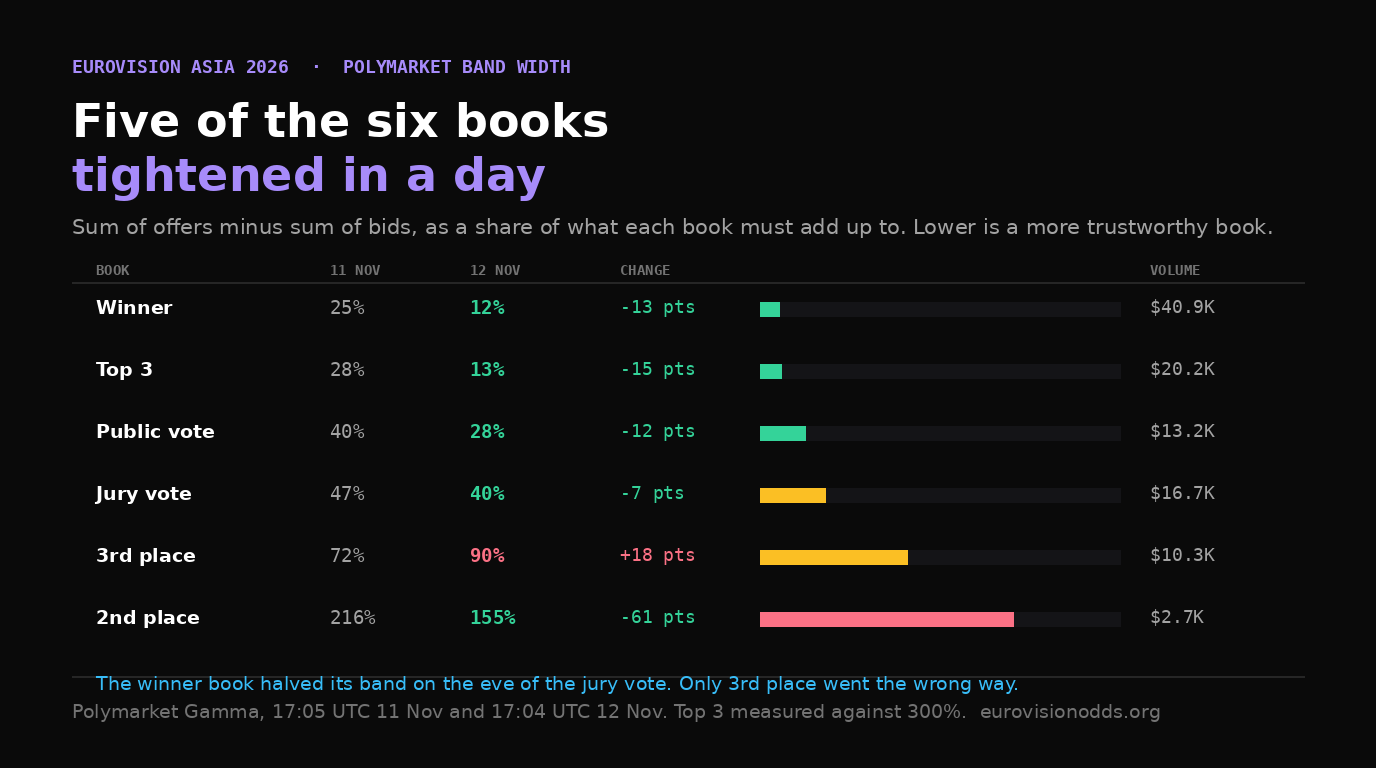
- Five of the six Polymarket books narrowed in a day, and the winner book halved its bid-offer band. The 2nd-place book remains unusable.
- Malaysia’s outright hit its high of the week at 61.5% while its public-vote price fell four points to 40.0%. The market is pricing a jury win.
- The official Voting Terms say the count is verified by the organiser’s own internal audit; the same page’s footer says voting is “independently verified by” an outside firm. Both claims are on the official site.
Who the five are
Per TV3, reported by Eurovoix on 12 November:
| Juror | Role |
|---|---|
| AG Coco | Head of the Jury; music producer and composer |
| Justin Seow | Music producer and composer |
| Iman Tang | Event manager and concert promoter |
| Bobby Husaini | Commercial and film director |
| Shamshul Azree Samshir | Senior Entertainment News Editor and Projects Editor, Berita Harian |
Two of the five are working music producers. The other three come from live events, film direction and entertainment journalism. That is a broader definition of a music-industry panel than the European contest uses, where the EBU requires every juror to be a music professional and publishes the list for all participating countries. Eurovision Asia has published no equivalent standard, and ten of the eleven countries have published nothing at all. Malaysia going first is a transparency point in its favour, not against it.
What these five actually control — and what they do not
This is the part worth getting right, because it is the part most easily misread. Nobody votes for their own country. Under the Voting Terms, residents of a participating territory cannot vote for that territory’s entry, and the same principle governs the juries.
So AG Coco and his four colleagues have no influence whatsoever over Malaysia’s score. What they control is the distribution of Malaysia’s twelve, ten, eight, seven, six, five, four, three, two and one among the other ten countries. If you hold a position on the Philippines, Vietnam or Thailand, a Malaysian jury of producers and promoters is a live input into your bet. If you hold Malaysia, it is irrelevant.
The arithmetic underneath is already published and already on our hub. Juries and public both award 12, 10, 8, 7, 6, 5, 4, 3, 2 and 1. There are twenty-one sets of points in all — ten juries and eleven public votes, the eleventh being the Rest of World vote — so the maximum any song can score is 252, of which at most 120 comes from juries and 132 from the public. Across the whole scoreboard the juries control 638 of 1,334 points and the public 696. The 50/50 of §8.2 holds exactly inside each competing country; the Rest of World vote is the extra public set that tilts the totals.
One consequence that matters for the jury-winner market: with only ten juries in play for any given song, a single panel is worth up to twelve of a possible 120 jury points. One juror set is a tenth of that half of the contest. That is a large enough share that the composition of each published panel is genuinely tradeable information — and small enough that no single country’s jury decides the jury book on its own.
The books tightened, and the winner book halved its band
This site has been tracking a trust metric across the six Asia books: add up every bid, add up every offer, and measure the band against what the book must sum to. A one-winner book must sum to 100; the Top 3 book, which asks eleven independent questions, must sum to 300. A wide band means the midpoints are decoration.
| Book | Band, 11 Nov | Band, 12 Nov | Volume |
|---|---|---|---|
| Winner | 25% | 12% | $40.9K |
| Top 3 | 28% | 13% | $20.2K |
| Public vote | 40% | 28% | $13.2K |
| Jury vote | 47% | 40% | $16.7K |
| 3rd place | 72% | 90% | $10.3K |
| 2nd place | 216% | 155% | $2.7K |
Read at 17:05 UTC on 11 November and 17:04 UTC on 12 November. Five of six narrowed, and the two biggest books narrowed most: the winner book halved. That is what a market looks like when real money arrives rather than drifting quotes, and it is the first clean signal this week that the Asia books are maturing into something worth reading.
The exception is the 3rd-place book, which widened from 72% to 90% — the wrong direction on the eve of the vote. And the 2nd-place book, at 155%, is still so wide that a midpoint in it carries no information at all. Our analysis of the place books on 11 November showed why: buying every 2nd-place contract at the offer cost about 279 to collect 100, and selling every one at the bid collected about 63 against a 100 liability. The apparent arbitrage was entirely spread. At 155% that is still true, just less spectacularly.
Carry this into Saturday: quote the winner and Top 3 books, caveat the two split books, and do not quote the 2nd-place book at all. Nothing that happened on 12 November changes that ordering, it only sharpens it.
Malaysia’s outright hit a high as its public vote fell
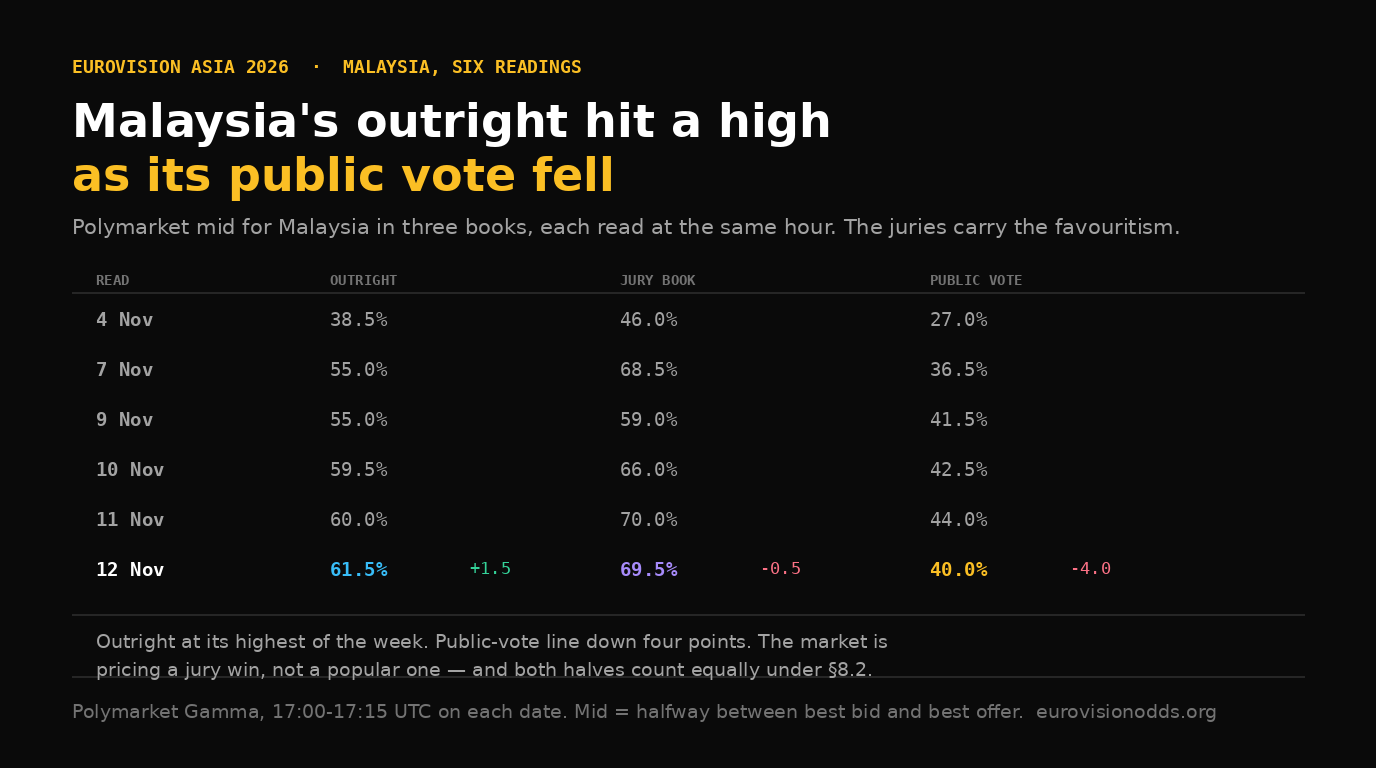
Six readings, each taken at the same hour:
| Read | Outright | Jury book | Public vote |
|---|---|---|---|
| 4 November | 38.5% | 46.0% | 27.0% |
| 7 November | 55.0% | 68.5% | 36.5% |
| 9 November | 55.0% | 59.0% | 41.5% |
| 10 November | 59.5% | 66.0% | 42.5% |
| 11 November | 60.0% | 70.0% | 44.0% |
| 12 November | 61.5% | 69.5% | 40.0% |
The outright reached its highest of the week while the public-vote line gave back four points. Those two things pulling apart on the same day is the clearest statement the market has made about how it thinks Malaysia wins: on juries, not on popularity. Aina Abdul is 69.5% to top the jury vote and 40.0% to top the public vote, and under §8.2 those two halves count equally inside every competing country.
The Philippines is the mirror image and the reason this is a contest rather than a procession. CARMELLE is 8.0% with the juries and 34.5% with the public — a six-point gap behind Malaysia on the half of the vote that is marginally the larger one. A public-vote act with a jury problem, against a jury act with a public-vote problem. If the juries land where this book expects and the public lands where it expects, Malaysia wins comfortably. The scenario that breaks it is a public vote that goes four or five points further toward Manila than 34.5% implies.
Two anomalies this site flagged have now cleared
Worth recording, because flagging a bad price is cheap and following it up is not.
Nepal has corrected. On 10 November Nepal was 5.7% to win and 6.5% for a top-three finish, implying a country that places wins about 88% of the time — an impossible-looking ratio flagged here on consecutive days. On 11 November it read 72%. On 12 November Nepal is 1.8% to win and 2.7% for a podium, a ratio of about 67%, which is now below the favourite’s 69%. The anomaly is gone.
Bhutan has halved. Nyendra was quoted 7.5% to top the jury vote on 11 November against 0.2% to win the contest, on about $133 of lifetime turnover — the cleanest dead quote on the board. On 12 November that jury price reads 3.7%. Still high against an 0.2% outright, but no longer fourth in the book.
And on Kalshi, the last of the two long-standing distortions cleared. Vietnam’s last trade had been stuck at 79c — above its own 40c offer, on a contract Polymarket priced near 6% — for weeks. Between 11 and 12 November it traded down through 18c and settled at a 39c last against a 29c offer. Both of Kalshi’s headline distortions have now resolved; Malaysia’s cleared on 9 November.
The Kalshi board still carries its structural problem: nine of eleven contracts have no bid at all, and only Malaysia and the Philippines are quoted two-sided. Both of those tightened on 12 November — Malaysia from 53c/66c to 57c/64c, the Philippines from 25c/34c to 27c/32c — and both agree closely with Polymarket. The rule holds for a third day: read the bid, ignore the last trade. A new wrinkle appeared as the old ones cleared, though: the Philippines’ own last trade of 38c now sits above its own 32c offer. One distortion clears, another forms, on a board where Laos alone holds about 55% of all lifetime volume on a 2c mark with no bid under it.
Who verifies the number all six books settle on
Every one of the six Polymarket Asia books resolves on the official Grand Final ranking, with ties broken on total points, then jury points, then public points. That makes the integrity and publication of the scoreboard the single point of failure for every position on the contest — more so than any individual price.
So it is worth noting what the official Voting Terms actually say, and what sits beside them. Section 7.4 of the Voting Terms, last updated 28 August 2026, reads: “The vote count is verified by Voxovation, using our internal audit process.” Voxovation is the production company behind the contest. That is the organiser auditing itself.
The footer of the same page carries a different claim: a logo beside the line “Voting independently verified by”. The firm is Forvis Mazars, the international audit and advisory network. Its logo file was uploaded to the organisers’ public media library at 14:10 UTC on 12 November 2026 — the newest file in a library of 215, and the only addition since 10 November.
Two things follow, and neither is an accusation. First, an independent verifier appears to be engaged, which is the right answer and better than nothing for a first-year contest; in the European contest that role has long sat with a major audit firm. Second, the document text and the page footer currently make different claims about who does the verifying, and the external one went up on the site two days before the final. The organisers have published no statement describing the scope of the engagement — whether Forvis Mazars observes the count, audits the systems, or signs off the published scoreboard.
For anyone holding a position, the practical point is narrow: the bets settle on the official ranking as published, whoever verified it, and the organisers have so far published no full scoreboard for any national selection this season except South Korea’s. If Saturday’s scoreboard arrives without a jury/public split, the jury and public-vote books have nothing clean to settle against. That is the risk to watch, and it is a disclosure risk rather than an integrity one.
The position going into Friday
Turnover across the six books reached about $104.0K by 17:04 UTC on 12 November, up roughly $11.0K in a day, against about $4.8K the day before and about $6.8K the day before that. Money is accelerating into the final, which is the ordinary shape of a contest market and the opposite of what this site reported yesterday on two days of data.
The winner book is now the most trustworthy it has been: a 12% band, $40.9K of turnover, Malaysia 61.5% quoted 61c against 62c. The Top 3 book is close behind at 13%, with Malaysia 89.5%, the Philippines 77.0%, Vietnam 43.5% and Thailand 35.0%. One cross-book gap survives from yesterday and is worth watching rather than trading: Laos is the only country whose win, second and third prices sum to less than its top-three price, by about seven points, down from about nine on 11 November.
Tomorrow is the irreplaceable reading — the closing prices on all six books before the juries vote. Every country’s live price sits on the Eurovision Asia hub, our full market view is on the winner odds page, and the rest of this week’s Bangkok coverage is collected there too.
The honest note
No fixed-odds bookmaker prices Eurovision Asia 2026. The two venues are prediction markets: Kalshi, regulated by the US CFTC, which opened the first Asia market on 14 September 2026, and Polymarket, which listed the contest on 3 November 2026. Polymarket is not available to users in Great Britain. Every figure above is a midpoint between a live bid and a live offer at a stated time, on books where nine of Kalshi’s eleven contracts have no bid and one Polymarket book carries a band wider than the thing it is pricing. Prices quoted here were read at 17:04 UTC on 12 November 2026 and will have moved. See our bookmaker page for the full picture, and Eurovision 2027 for the European contest.