
Two of Eurovision’s biggest national selections now say, on the record, that songs written by machines are sitting in their 2027 submission piles. Norway’s NRK bans them outright and its Head of Delegation thinks 30 to 50 got in anyway. Sweden’s SVT has not banned them, cannot detect them, and does not want to be the broadcaster that writes the rule. Both said so on 12 October 2026, within hours of each other, as the selection season for Eurovision 2027 moved from submissions to shortlists.

18+ | New customers only | T&Cs apply | Please gamble responsibly
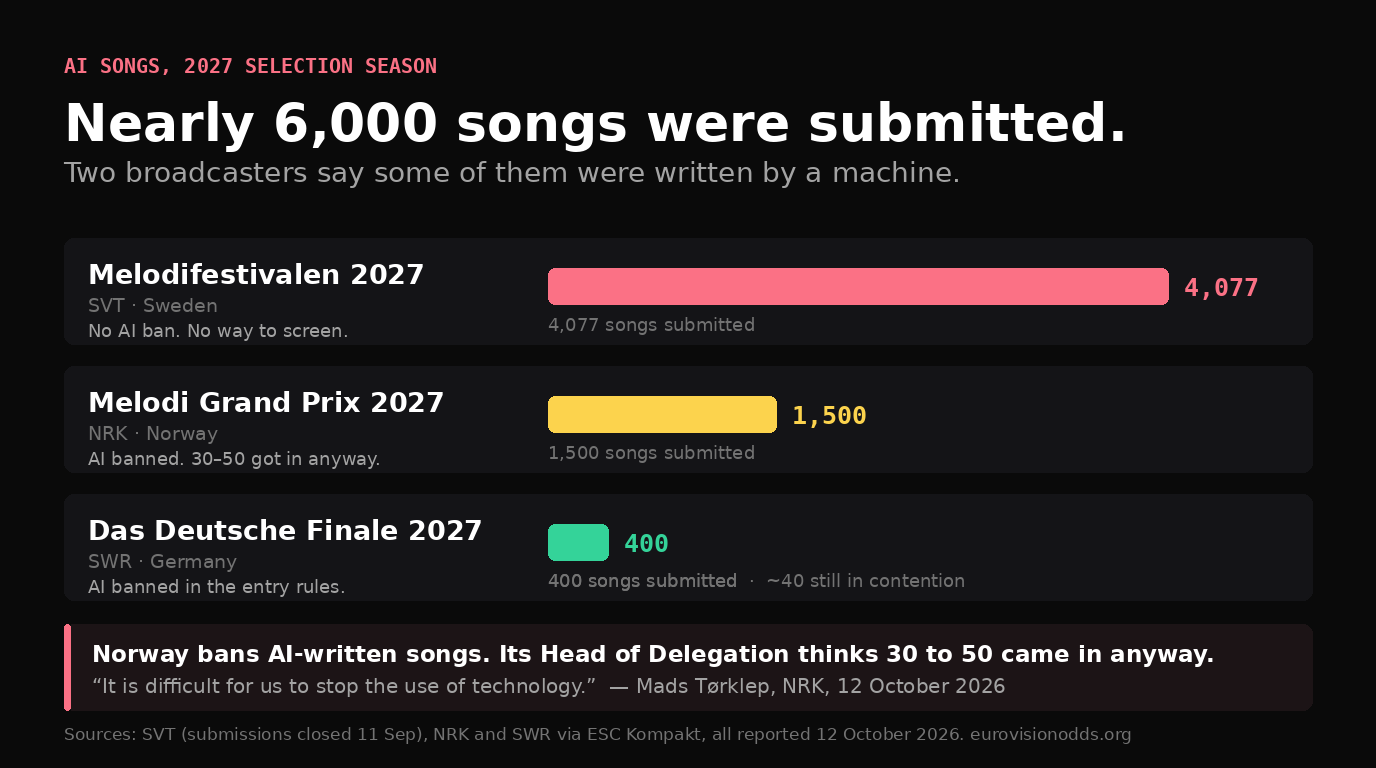
Between them, Sweden, Norway and Germany have taken in close to 6,000 songs for Burgas. Nobody involved can tell you how many of those a person wrote.
What NRK said
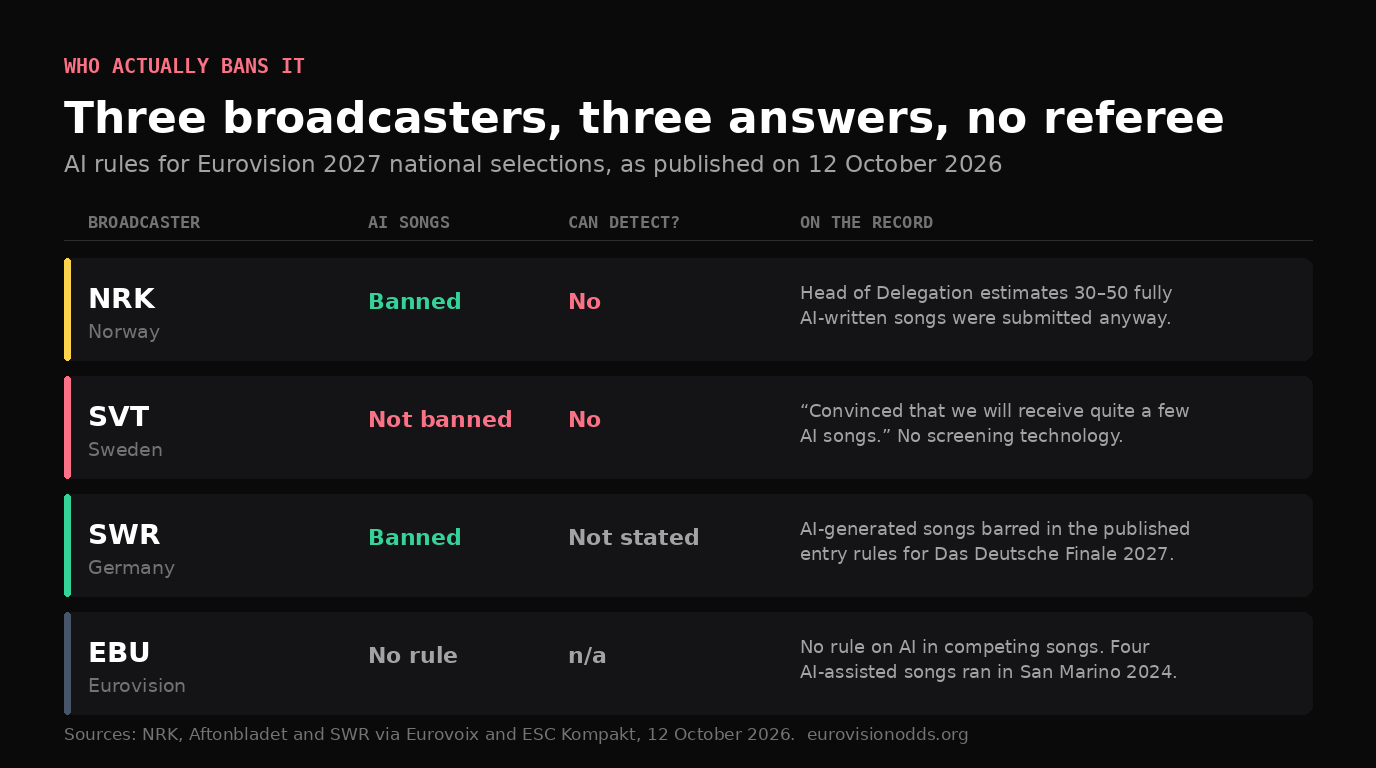
NRK’s published rules for Melodi Grand Prix 2027 are unambiguous: songs must be original, and anything generated by AI is disqualified. The same rules cap entries at three minutes, require at least one Norwegian songwriter, and require the song to be unreleased before 1 September 2026. That ban has been in the rulebook since submissions opened in June.
Mads Tørklep, Norway’s Head of Delegation for the Eurovision Song Contest, told NRK he believes 30 to 50 fully AI-created songs were submitted this year regardless. His explanation was not that the rule is weak but that enforcement is: “It is difficult for us to stop the use of technology.”
Put that against the pile. NRK confirmed on the same day that around 1,500 songs were submitted for MGP 2027, in line with recent editions, which have drawn between 1,000 and 1,500. So Tørklep’s estimate is roughly two to three per cent of everything Norway received — a small share, and still dozens of entries that broke a published rule with no mechanism to catch them. NRK has not revealed the MGP 2027 format.
What SVT said
Anders Wistbacka, the Melodifestivalen project manager, told Aftonbladet he is “convinced that we will receive quite a few AI songs”. He then said the part that matters more: he cannot confirm it, because SVT has no technology to screen songs for AI use.
SVT has also not banned AI from the writing process. What Wistbacka offered instead was a heuristic — an unknown name submitting many songs across many genres at once. “That in itself suggests that it could be AI,” he said. That is pattern-matching on submission behaviour, not detection of the song, and it would miss any AI entry that arrived one at a time under a plausible name.
On whether SVT should simply write a rule, he was explicit that it should not go first: “this is an issue that the music industry will solve.” Coming from the broadcaster that runs the largest national selection in the contest, that is a decision not to lead rather than an absence of a position.
The scale makes it pointed. Melodifestivalen 2027 closed submissions on 11 September 2026 with a record 4,077 songs, from which thirty are picked to compete across five heats — 6, 13, 20 and 27 February and 6 March 2027 — before a final at the Strawberry Arena in Stockholm on 13 March 2027. Nobody is listening to 4,077 songs twice.
Germany bans it too, and is already down to forty
Germany sits between the two. SWR bars AI-generated songs in the published entry rules for Das Deutsche Finale 2027, alongside requirements that acts be 18 or over by 1 January 2027 with a strong German connection and that songs be unreleased before 1 September 2026. Submissions closed at 12:00 CEST on 21 September 2026.
SWR told ESC Kompakt that around 400 songs came in, about 25 of them out of the broadcaster’s own songwriting camps, and that the count is “in line with 2026” with quality “stronger than last year”. The first assessment round is complete — the first rejection emails have gone out — and roughly 40 songs remain in contention going into a round judged by an international jury of music and Eurovision figures. SWR and its five-person music team then pick the finalists for a final in February 2027, the date still unpublished.
Germany has said nothing about whether it can detect an AI submission. But a field narrowed from 400 to 40 by a five-person team is the one process here where a human being has plausibly heard everything.
The EBU has no rule at all
This is the gap underneath the whole story. The Eurovision Song Contest has no set rule on the use of AI in competing songs. National selections are therefore free to ban it, permit it or say nothing, and all three positions are currently live inside the same contest. A song disqualified in Oslo could be eligible in Stockholm.
It has already happened on stage. In 2024, four songs written with AI assistance competed in San Marino’s Una Voce per San Marino — the clearest precedent anyone has, and it passed without a governing-body response. Both Wistbacka and Tørklep said the music industry rather than the broadcasters should settle how AI is used in production and what the rules should be, which is a coherent position and also means nobody with authority over the contest is currently writing one.
Worth separating two different things that “AI song” is doing in these statements. NRK’s ban is on songs generated entirely by AI. Nobody is proposing to ban AI-assisted mixing, stem separation, pitch correction or the dozen other machine-learning tools that are already standard in every studio that will produce a 2027 entry. The line being drawn is about authorship, and it is a hard line to police precisely because the tooling on either side of it is the same tooling. We looked at how the generative-music platforms are approaching provenance in our piece on Suno’s watermarking and what producers need to know — inaudible watermarking is the only mechanism on the table that would let a broadcaster answer this question at the point of submission, and none of these three is using it.
What this is worth to a bettor
Directly, nothing: there is no market on it. No bookmaker and no prediction market prices whether an AI-written song reaches a national final, let alone Burgas, and we are not going to imply otherwise — our bookmaker comparison covers the winner and outright markets that actually exist. The one Eurovision event open on Polymarket is the 2027 participants board, which prices broadcasters, not songs.
Indirectly it matters for how you read the next four months. Submission counts are the first number out of every selection season and they get quoted as a proxy for strength of field — a record 4,077 for Sweden, a steady 1,500 for Norway, a holding 400 for Germany. On one broadcaster’s own estimate, dozens of those Norwegian entries are not human efforts at all. The number is a measure of how cheap it has become to submit, not of how deep the field is, and it was already drifting in that direction before anyone mentioned AI.
The genuinely tradeable consequence, if it arrives, is a disqualification. A song pulled from a national final in January or February over its authorship would move that country’s selection market and could move its Eurovision 2027 winner odds if it happened to a favourite. NRK is the one to watch for it, because NRK is the only one of the three that has both a ban and a public estimate of how many entries have broken it. SVT has no rule to enforce and therefore nothing to disqualify anyone for.
Where the selections stand
- Sweden — Melodifestivalen 2027: 4,077 submissions, a record. Thirty acts, five heats from 6 February, final 13 March 2027 at the Strawberry Arena, Stockholm. Hosts Oscar Zia and Björn Kjellman. AI not banned.
- Norway — Melodi Grand Prix 2027: around 1,500 submissions, closed end of August. Format unrevealed. AI banned; 30–50 believed submitted anyway.
- Germany — Das Deutsche Finale 2027: around 400 submissions, closed 21 September. About 40 still in contention. Final in February 2027, date unpublished. AI banned.
- The EBU: no rule on AI in competing songs. Four AI-assisted songs competed in San Marino’s 2024 selection without consequence.
The full confirmed field, every selection date published so far and the broadcasters still deciding are on our Eurovision 2027 page, which carries the submission figures and the AI statements above against each country.
Sources: Eurovoix, 12 October 2026, reporting Aftonbladet and NRK, for the Wistbacka and Tørklep statements and the San Marino precedent; Eurovoix, 12 October 2026 for Norway’s submission count; and Eurovoix, 12 October 2026 for SWR’s figures via ESC Kompakt. Checked 13 October 2026.