
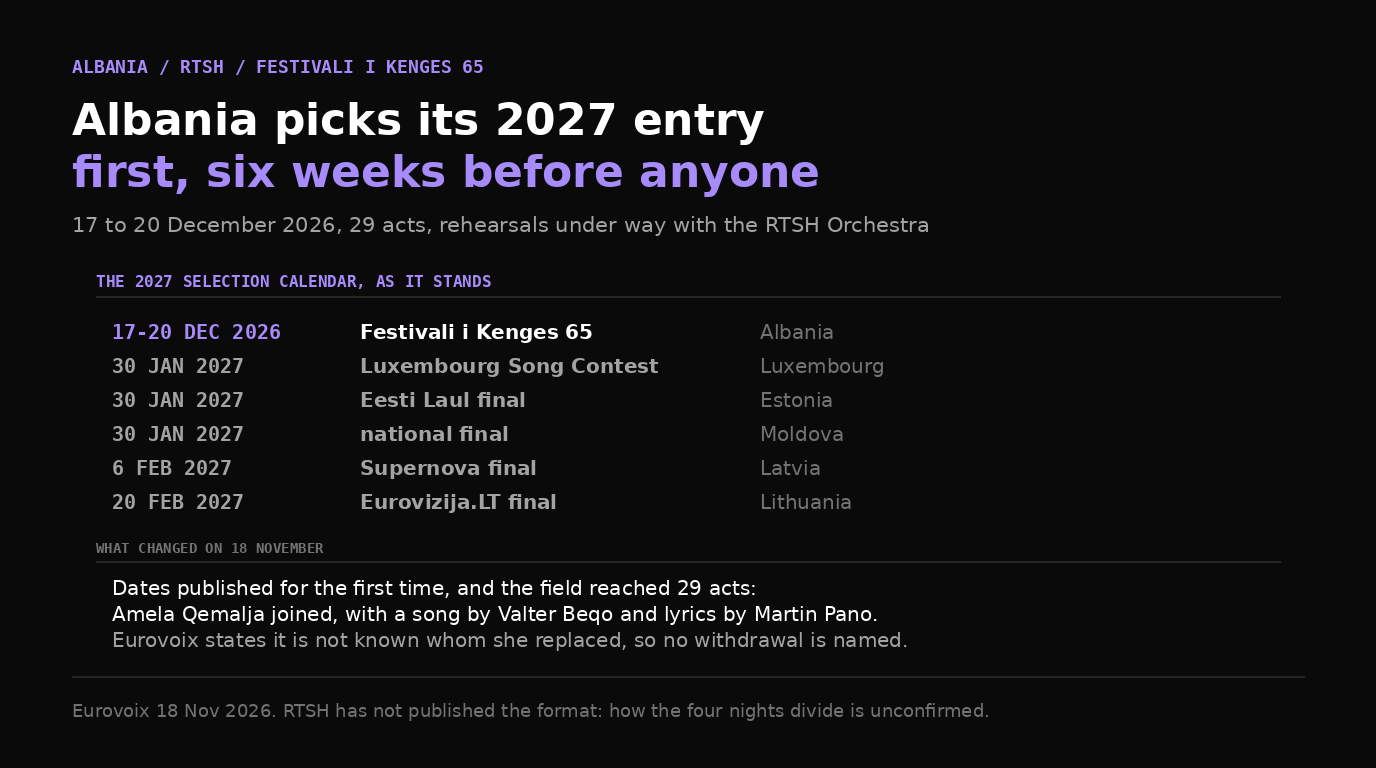
Albania will choose its Eurovision 2027 entry before anyone else. Festivali i Këngës 65 runs from 17 to 20 December 2026 with 29 acts, RTSH confirmed as rehearsals began at the RTSH Orchestra Hall on 18 November — six weeks before the next national final anywhere in Europe.

18+ | New customers only | T&Cs apply | Please gamble responsibly
That makes Albania the first of the 36 broadcasters confirmed for Burgas to put an entry on the record. The gap is not small: the next selections are on 30 January 2027, when Luxembourg, Eesti Laul and Moldova all stage finals on the same night.
The 2027 selection calendar as it now stands
| Date | Selection | Country |
|---|---|---|
| 17–20 December 2026 | Festivali i Këngës 65 | Albania |
| 30 January 2027 | Luxembourg Song Contest | Luxembourg |
| 30 January 2027 | Eesti Laul final | Estonia |
| 30 January 2027 | National final | Moldova |
| 6 February 2027 | Supernova final | Latvia |
| 20 February 2027 | Eurovizija.LT final | Lithuania |
Albania has used Festivali i Këngës to pick its Eurovision entry since its 2004 debut, and the festival itself dates to 1962, which makes it older than most of the contest it now feeds. It is also the only selection in Europe performed with a live orchestra throughout: each of the 29 acts rehearses with the RTSH Orchestra, which is why the rehearsal period is long and starts a month out.
What changed on 18 November
Two things, one of them firmly and one of them not. The dates were published for the first time — until this week our own 2027 page recorded only “a final in December 2026” with format and dates unpublished.
And the line-up changed. Amela Qemalja joined the field with a song composed by Valter Beqo to lyrics by Martin Pano. Eurovoix states plainly that it is not known whom she replaced, and no withdrawal has been announced, so this article is not going to name one. The field stands at 29 acts including several duos — Auron Deva & DJ Sardi, Josif Gjipali & Ardita Meni, Petro Fejza & Antonio Papa.
The format is still not published. RTSH has not said how the four nights divide into semi-finals and a final, nor how the winner is decided, nor what weight any jury carries. Recent editions have run two semi-finals and a grand final, and recent editions have also changed the voting rules more than once. We are recording the four-night window and leaving the rest blank rather than filling it from last year.
Who is in the field
The best-known name is Kejsi Tola, who won Festivali i Këngës 47 and represented Albania at Eurovision 2009 in Moscow with “Carry Me in Your Dreams”. One clarification worth making, because the name invites it: Gigliola Haveriku is also in the field and has never represented Albania at Eurovision. She competed at Festivali i Këngës 59 in 2021 with “E lirë” and did not win that edition, which went to Anxhela Peristeri. She is not Gigliola Cinquetti, who won Eurovision for Italy in 1964.
The full field of 29
As listed by RTSH at the start of rehearsals, in alphabetical order: Adhurim Demiri, Alegra Jaho, Algert Sala, Amela Qemalja, Ana Bushgjokaj, Ardit Çuni, Arsi Bako, Auron Deva & DJ Sardi, Chip Deva, Djemtë e Detit, Eldis Arrnjeti, Erinda Agolli, Gigliola Haveriku, Gjergj Jorgaqi, Herva Novaku, Josif Gjipali & Ardita Meni, Kejsi Jazxhi, Kejsi Tola, Khuba-Shkelzen Rexhaj, Leandra Godaj, Martina Serreqi, Michela Paluca, Orgesa Zaimi, Petro Fejza & Antonio Papa, Rei Bezhani, Sara Bajraktari, Sigi Bastri, Vanesa Sono and Xhoni Jesku.
Djemtë e Detit are the field’s institution: a group formed in Durrës in the 1960s whose name recurs through the festival’s history. Beyond them and Kejsi Tola, this is a field of recent Festivali competitors and newcomers rather than returning Eurovision names, which is the normal shape for this selection.
Albania’s Eurovision record, and the thing that happens after Festivali
Albania debuted at Eurovision in 2004, and Festivali i Këngës has chosen its entry every year since. Its best result is fifth, in Baku in 2012, with Rona Nishliu’s “Suus” — a Festivali i Këngës 50 winner performed in Albanian. Its other standout was Eugent Bushpepa’s “Mall” in 2018, eleventh in the final and also sung in Albanian. Both of its strongest results came from songs it did not translate.
There is a pattern anyone betting a Festivali result needs to know about: winning Festivali i Këngës does not guarantee the song reaches Eurovision in the form it won in. Albania has repeatedly revised the winning entry between December and May — shortening it to the three-minute limit, re-recording it, and in several years releasing an English-language or partly English version. In some editions the winning artist has gone with a different song entirely. A market closing on 21 December resolves on who wins the festival, which is a different question from whose song is heard in Burgas.
That is also why an early selection is a mixed blessing competitively. Albania gets five months of promotion time that Luxembourg and Estonia will not have, and five months in which a song chosen before any rival exists can start to sound dated by May.
And for the first time, a market on it
Albania’s selection is now priced. Polymarket opened a Festivali i Këngës 65 winner book at about 21:35 UTC on 18 November, one of the first two national-final markets of the 2027 season, alongside Eesti Laul. It lists all 29 acts and closes on 21 December. Read at 17:10 UTC on 19 November 2026:
| # | Act | Mid | Best bid | Best offer | Last trade |
|---|---|---|---|---|---|
| 1 | Kejsi Jazxhi | 29.5c | 11.0c | 48.0c | 7.0c |
| 2 | Sara Bajraktari | 26.0c | 10.0c | 42.0c | 7.0c |
| 3 | Arsi Bako | 23.5c | 1.0c | 46.0c | 9.0c |
| 4 | Gjergj Jorgaqi | 23.4c | 1.0c | 45.7c | never traded |
| 5= | Djemtë e Detit | 18.5c | 1.0c | 36.0c | never traded |
| 5= | Gigliola Haveriku | 18.5c | 1.0c | 36.0c | never traded |
Now the caveats, which matter more than the prices. Only 6 of the 29 contracts have traded at all, total lifetime volume is about $261, and the 29 midpoints add up to 260.4% of a question exactly one act can answer. Twenty of the twenty-nine sit on an identical 4.5c midpoint, which is not an assessment of twenty acts but the absence of one.
The deeper problem is that nobody has heard the songs. Festivali i Këngës is judged on live orchestral performances that have not happened yet, and the entries are not released in advance the way Eesti Laul’s are on 27 November. A price on Kejsi Jazxhi at 29.5c is a price on a name and a composer credit. Our full treatment of the six new 2027 books is in Polymarket’s first Eurovision 2027 winner market.
Albania is quoted at 3.7c on that new Eurovision 2027 winner board, near the foot of the 36. Its best result remains fifth in 2012, with Rona Nishliu’s “Suus”.
What picking first is worth, and what it costs
Being first has a measurable upside in a Eurovision season and a measurable downside, and the balance has shifted over the years.
The upside is attention with no competition for it. Between 20 December and 30 January there is exactly one 2027 entry in existence. Fan media, reaction channels and the Eurovision preview circuit have one song to discuss, and an Albanian entry that lands well can accumulate a following for six weeks before a single rival exists. That is also the window in which any early betting market has only one real input.
The downside is five months of exposure. Songs chosen in December have to survive a selection season in which 35 other countries pick, the strongest of them in late February and early March. A December entry peaks early in the fan polls and is frequently overtaken; the market has months to find its flaws, and the delegation has months in which the temptation to revise grows. That is the mechanism behind the revision pattern described above — it is not indecision so much as the natural consequence of choosing before anyone else has.
For bettors there is a narrower point. An early national final is the first genuine information any 2027 market will receive. The new Polymarket winner board currently prices 36 countries on reputation alone, because not one of them has a finished entry. On 20 December, one will. Whether the board moves on it — and by how much, given that Albania is quoted near the foot of the field — is the first practical test of whether these markets are processing information or simply sitting where they opened.
What to watch next
- RTSH on the format: how the four nights divide, and how the winner is chosen.
- Whether the winner goes to Burgas unchanged. Albania has in past years revised or replaced the winning song before Eurovision, so a Festivali result is not always the final entry.
- 17 to 20 December: the first 2027 entry chosen anywhere, and the first real test of whether these new markets reprice on a result.
- Latvia’s Supernova field on 20 November and Eesti Laul’s twelve songs on 27 November.
Where this fits in the 2027 season
Albania’s December date lands in a selection season that is unusually crowded at the front and unusually empty behind it. Three countries have put national finals on 30 January — Luxembourg, Estonia and Moldova — which makes that the season’s first real night and a scheduling collision none of the three has commented on.
Behind them the picture is thinner than the confirmed count suggests. Thirty-six broadcasters are confirmed for Burgas, but only one has named an artist: Cyprus, which revealed George Perris on 4 November and is taking open song submissions until 13 December for a live national final. Austria, Belgium and Australia have all confirmed internal selections with no date attached. Croatia’s Dora submissions close on 29 November, Lithuania’s closed on 18 November after a week’s extension, and San Marino has taken more than 500 applications from 42 countries.
So Albania is not merely first by a margin. It is the only broadcaster of the 36 that will have a finished, performed, chosen entry in 2026 at all. Everything else is a submission window, a shortlist or a date in the new year. Our Eurovision 2027 page tracks all 36 confirmations, the two broadcasters still deciding and the full selection calendar as it fills in.
Sources
- Eurovoix, 18 November 2026, reporting RTSH on the rehearsals, the dates and the line-up change.
- Polymarket Gamma API, read at 17:10 UTC on 19 November 2026.
- Artist histories checked against Eurovisionworld’s Festivali i Këngës archives.