
TALK, the one contract in the Canada’s Choice 2027 book that had never traded, traded for the first time on 23 November 2026 and became the favourite. It sat at 18.0c for thirty-two hours, moved 20.5 cents in the single minute to 10:16 UTC, peaked at 62.5c at 10:51, and settled at 51.5c quoted one cent wide. Rêve, favourite since the book opened, fell from 53.0c to 40c. No Canadian Eurovision news was published on either day.

18+ | New customers only | T&Cs apply | Please gamble responsibly
Key takeaways
- TALK went from 18.0c to 51.5c — Polymarket’s own one-day change field reads +33.5 points, the largest single-day move of the 2027 season so far.
- It happened inside one hour. Flat at 18.0c from 22 November 03:00 UTC, then +20.5c in a minute, a partial retrace, a second leg to 62.5c, and a settle at 51.5c that has held.
- The favourite changed. Rêve 53.0c → 40c, quoted 35c against 45c.
- The book took about $5,423 in a day, up 161%, and is now the largest national-final market of the season at about $8,793.
- The result already exists. Public voting closed at 11:59 p.m. Pacific on 5 November; the winner is revealed on 5 December. Nothing about the future changed on 23 November.
- We could not find a cause. Eurovoix has published nothing about Canada since 12 November, and CBC/Radio-Canada has announced nothing since the 9 November reveal date.
What’s on this page
The hour, minute by minute · The whole book, both reads · Why a sealed result changes the read · How Canada’s Choice is actually decided · Is this informed money? · Where the 2027 money went · Israel bought back · What we would actually do
The hour, minute by minute
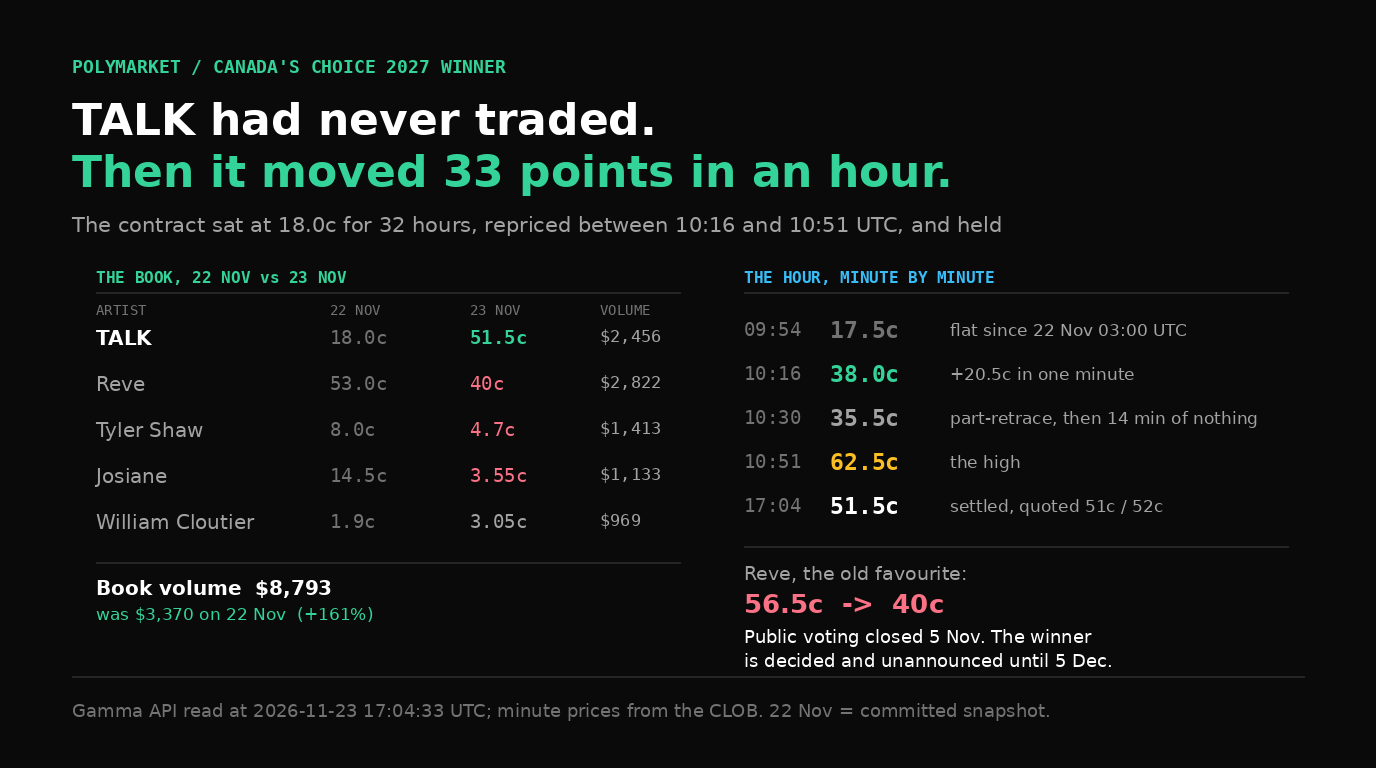
Polymarket’s order book publishes a minute-by-minute price history, and on this contract it is unusually easy to read because almost nothing happened before it did. TALK was marked at 18.0c for thirty-two consecutive hours, from 03:00 UTC on 22 November through 10:00 UTC on 23 November, drifting no further than half a cent in either direction across that entire window. At 09:54 on 23 November it was 17.5c.
| Time (UTC, 23 Nov) | TALK | Rêve | What happened |
|---|---|---|---|
| 09:54 | 17.5c | 56.0c | Unchanged since 22 November 03:00 |
| 10:16 | 38.0c | 45.0c | +20.5c and −8.5c in the same minute |
| 10:20–10:43 | 35.5c | 48.5c | Part-retrace, then twenty-four quiet minutes |
| 10:45 | 52.0c | 42.0c | Second leg begins |
| 10:51 | 62.5c | 36.0c | The high |
| 11:05 | 54.5c | 29.5c | Rêve’s low |
| 17:04 | 51.5c | 40.0c | Settled; TALK quoted 51c against 52c |
Two features of that sequence are worth separating, because they say different things.
The first is that it was abrupt and two-sided. TALK and Rêve moved in the same minute, in opposite directions, by comparable amounts. That is the signature of someone reallocating between the two leaders rather than of new money wandering in and lifting one offer. A single buyer sweeping a thin order book would have moved TALK and left Rêve alone until the arbitrage was noticed; instead both legs went at once, twice.
The second is that it held. A fat-fingered order or a single impatient market order spikes and then decays as makers refill the book. This did not decay. Six hours after the second leg, at 2026-11-23 17:04:33 UTC, TALK was quoted 51c bid against 52c — a one-cent spread, the tightest quote anywhere in the 2027 complex — with the price sitting a cent above the middle of the range it reached at 10:51. Market makers requoted around the new level instead of fading it. That is evidence about conviction. It is not evidence about correctness, and the distinction matters more here than in almost any other market on the board.
The whole book, both reads
Read at 2026-11-23 17:04:33 UTC, against this site’s committed snapshot of 2026-11-22 17:15:25 UTC. Every price is the midpoint between best bid and best offer, and the volume column is lifetime turnover on the contract.
| Artist | 22 Nov mid | 23 Nov mid | Bid / offer now | Last trade | Volume |
|---|---|---|---|---|---|
| TALK | 18.0c | 51.5c | 51c / 52c | 64c | $2,456 |
| Rêve | 53.0c | 40c | 35c / 45c | 40c | $2,822 |
| Tyler Shaw | 8.0c | 4.7c | 1.4c / 8c | 3c | $1,413 |
| Josiane | 14.5c | 3.55c | 1.1c / 6c | 3.3c | $1,133 |
| William Cloutier | 1.9c | 3.05c | 0.9c / 5.2c | 0.8c | $969 |
The book’s midpoints now sum to 102.8%, against 95.4% a day earlier. Both figures are remarkable by the standards of this complex — the six main Eurovision 2027 books sum to between 147.6% and 242% — and the reason is the one this site gave on 22 November: a closed, published field of five with a near resolution date is something a market maker can quote both sides of. The move did not break that. It tightened it.
Note also where the losses came from. Rêve gave up thirteen points, but Josiane fell from 14.5c to 3.55c and William Cloutier rose from 1.9c to 3.05c, and Polymarket’s one-day change field puts Josiane at −5.0 and Cloutier at −8.55 on the traded price. The outsiders were repriced too, which is what happens when a book is re-based rather than when one contract is bid up in isolation.
Why a sealed result changes the read
This site made the point on 22 November and the day after proved it worth making. Canada’s Choice is not a forecast. Public voting closed at 11:59 p.m. Pacific Time on 5 November 2026, with up to ten votes per person, and CBC/Radio-Canada will announce the result on 5 December. Between those two dates the answer exists and is simply not public.
That is a different instrument from every other Eurovision contract open today. A market on a future event rewards judgement: you are paid for forecasting better than the crowd. A market on a settled-but-undisclosed outcome rewards access. Nobody can forecast their way to a better estimate of a number already written down, so the only edge available is knowing it. That does not mean anyone broke a confidence. It means the usual inference — price moved, therefore the crowd learned something — is unavailable here, because there is nothing to learn except the answer itself.
We wrote on 22 November that if Rêve shortened sharply on no public news, that would not be confirmation she had won. The same discipline applies in reverse now that it is TALK, and it applies more strongly, because the move is bigger. A 33-point move in a book of this size is about $2,100 of new turnover on one contract. That is a sum one determined individual can deploy. It is not a crowd.
How Canada’s Choice is actually decided — sources disagree
Correction, 23 November 2026. Our 22 November piece stated flatly that the winner is decided 50% by public vote and 50% by a jury. That figure comes from Eurovoix, which reported on 27 October that “public voting will count for 50% of the results” with “the rest of the results… decided by a professional jury”. CBC/Radio-Canada’s own announcement does not publish a split, and says the opposite in substance: its release is headed “It’s up to the public to choose Canada’s representative” and states that after the jury shortlisted the five, “the final decision is now entirely in the hands of the public”.
We should have attributed that rather than asserting it, so here is the position. The broadcaster describes the jury’s role as selecting the five finalists at a meeting in Toronto on 8 October, and the public vote as deciding the winner. Eurovoix describes a 50/50 weighting at the final stage. This site does not pick between them, and the honest summary is that CBC has published who voted and when, but not the arithmetic.
It changes very little about the trade and nothing about the timing. Under either reading the public phase closed on 5 November and no further input is being collected, so the outcome is settled either way. It matters only for how many people have seen it: a pure public tally is a number in a CBC spreadsheet, while a jury-weighted result has a panel attached to it.
One smaller thing the same source settles. Secondary reports variously give the voting deadline as 5 or 6 November, which looks like a contradiction and is not: 11:59 p.m. Pacific on 5 November is 07:59 UTC on 6 November, so both are the same instant described from different clocks.
Is this informed money? What we can and cannot say
We looked for a cause and did not find one. Eurovoix has not published an article about Canada since 12 November, and that one was about a possible Junior Eurovision debut. CBC/Radio-Canada has announced nothing since 9 November, when the 5 December reveal date was confirmed. There was no artist announcement, no leak reported anywhere we could find, no scheduling change and no press story about any of the five finalists on 22 or 23 November.
So the available readings are these, and we cannot distinguish between them from the tape:
- Somebody knows. A result that exists inside a broadcaster has been seen by production staff, and a market that pays out on it is the obvious place for that to surface. The two-sided, held reprice is consistent with this.
- Somebody decided. One trader formed a strong view — on TALK’s streaming profile, on the bilingual requirement, on anything — and had enough capital to move a $3,000 book on their own. Equally consistent with the tape.
- The 18c was simply wrong. TALK had never traded. Its 17c/19c quote was two makers’ opinion and nobody had tested it. The first real buyer discovering that the offer was thin would produce exactly this shape.
Reading three deserves more weight than it usually gets, because of a specific thing this site observed in the same complex two days earlier. On 21 November the Festivali i Këngës book showed two acts at 21% midpoints that had never traded; within a day both collapsed to single figures once a real bid appeared. An untested quote is not a probability, and TALK’s 18c was an untested quote. The difference is that Rei Bezhani’s 21% fell when tested and TALK’s 18c rose, which tells you the direction of the error but not its cause.
What we will not do is treat this as a tip. If reading one is right, the price is now roughly correct and there is no value left in it. If reading two or three is right, a 51.5c favourite in a five-horse field is an opinion with a one-cent spread around it, and buying it means paying a maker to take the other side of a guess. Neither case produces an edge for an outsider reading about it afterwards.
Where the 2027 money went: national finals, not the contest
The Canada move is the loudest part of a quieter shift. In the twenty-four hours to 2026-11-23 17:04:33 UTC, the four national-final books took about $9,991 of new turnover and the six main Eurovision 2027 books took about $1,377. That is 88% of all new money on the 2027 complex going to national selections, which between them opened only five days ago.
| National-final book | 22 Nov volume | 23 Nov volume | Change | Midpoints sum |
|---|---|---|---|---|
| Canada's Choice 2027 (Canada) | $3,370 | $8,793 | +161% | 95.4% → 102.8% |
| Festivali i Kenges 65 (Albania) | $2,391 | $4,153 | +74% | 207.7% → 188.5% |
| Eesti Laul 2027 (Estonia) | $1,393 | $3,260 | +134% | 253.4% → 115.5% |
| Benidorm Fest 2027 (Spain) | $1,173 | $2,112 | +80% | 115.8% → 151.1% |
The Eesti Laul column is the one to look at twice. Its midpoints fell from 253.4% to 115.5% while its volume more than doubled, and the mechanism is the one this site has been describing all week: an overround on a thin book measures quote width, not opinion. On 22 November eight of its twelve contracts were quoted with offers above 40c against sub-10c bids. On 23 November those offers had come in to single and low double figures. Nobody changed their mind about Estonian pop; makers simply started quoting both sides.
Across all ten 2027 books the pattern is consistent. The money is going where the resolution date is near and the field is published, and it is leaving the May 2027 markets alone — the winner book took about $348 in the same day, on a contest six months away whose songs do not exist.
Israel was bought back, and one midpoint is lying again
On 22 November this site reported that Israel had been sold down eighteen cents on the public-vote book on no news. The follow-up is that money came back into Israel on 23 November, but into different questions.
| Israel | Bid 22 Nov | Bid 23 Nov | New volume | Read |
|---|---|---|---|---|
| Top 5 | 56.0c | 63c | +$229 | Real buying; last trade 52c → 69c |
| Winner | 6.0c | 7c | +$249 | Real buying |
| 3rd place | 11.0c | 9c | +$162 | Bid fell despite the turnover |
| Public vote | 28.0c | 26c | +$0 | Quote drift; nothing traded |
| 2nd place | 14.0c | 20c | +$0 | Nothing traded. See below. |
The second-place line is the trap, for the second day running. Israel’s best bid in that book rose from 14.0c to 20c, which looks like conviction arriving. The contract’s volume is unchanged at $354. Not one share traded. Somebody posted a higher bid and nobody hit it, which is a willingness to buy, not a purchase. Yesterday the same book produced the mirror image — a midpoint that rose because the offer was pulled — and the lesson is the same in both directions: in a thin market, read the bid and read the volume, and treat either one alone as half a sentence.
The top-5 line, by contrast, is real: the bid rose seven cents, the last trade moved from 52c to 69c and about $229 went through. Israel is being bought to finish high and, on the same day, is not being bought to top the televote. Those are consistent positions, not contradictory ones.
What we would actually do
Canada: nothing, and watch the date. We said on 22 November that the interesting part was the 5 December announcement as a test of whether this book knew anything. That test just became far sharper. The book has now committed to an answer, publicly, thirteen days early. If TALK is announced on 5 December, this hour is the strongest evidence yet that a Polymarket national-final book can front-run a broadcaster. If Rêve is announced, it is the strongest evidence that these books are one opinionated trader wide. Either outcome is worth more than any position in it.
On the new favourite specifically: a one-cent spread is not an invitation. It is the tightest quote in the 2027 complex, and tight quotes on thin books are where the least informed money gets filled fastest. There is no price at which an outsider can beat someone who may have seen the result.
Albania and Estonia: still nothing, for the reason the overround column gives. Both books halved their quote width in a day without anyone changing their mind, which tells you the prices you saw last week were never offers in any meaningful sense.
As ever: none of these are bookmaker markets. No UK or Irish bookmaker prices any 2027 national final, Polymarket is not accessible from Great Britain, and the volumes discussed here are in the low thousands of dollars. Our bookmaker comparison and winner odds page cover the markets reachable from the UK, and the full 2027 calendar is on the Eurovision 2027 hub.
What to watch next
- 27 November: the twelve Eesti Laul songs are released on ETV at 19:00 CET, into a book that has just doubled in size.
- 1 December: Melodifestivalen’s thirty artists, still unpriced anywhere.
- 5 December: Canada’s Choice. The single most informative date of the 2027 season so far, for reasons that have nothing to do with who wins.
- 7 December: Hungary’s extended EBU deadline, the one date that could still add a 37th country.
- 11 December: “Sarà Sanremo” names the 24th Campione — see our report on the six finalists.
- 17–20 December: Festivali i Këngës 65, the first 2027 national final to resolve.
Background on these books is in our report on the Canada and Benidorm books opening and on the first Eurovision 2027 winner market.
Prices read from the Polymarket Gamma API at 2026-11-23 17:04:33 UTC and stored in this site’s market feed; the 22 November column is the committed snapshot of the same file, so it cannot drift. Minute prices from the Polymarket CLOB prices-history endpoint, read 23 November 2026. Voting dates and the jury’s role from the CBC/Radio-Canada media release; the 50/50 split and the 5 December reveal from Eurovoix. Kalshi’s European Eurovision series returned no open markets on 23 November 2026. Nothing here is a tip, and prediction-market prices move.