
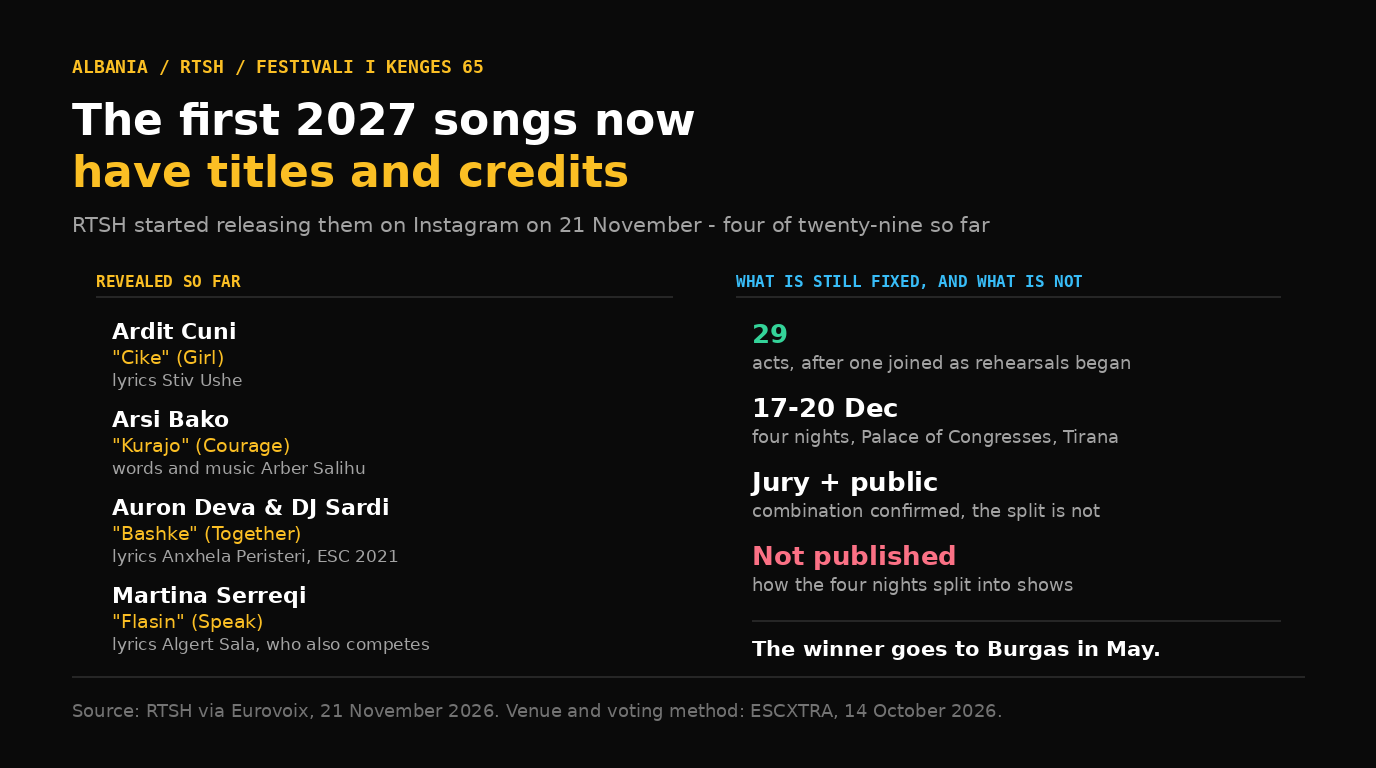
The first Eurovision 2027 songs now have names. RTSH began publishing the details of the Festivali i Këngës 65 entries on Instagram on 21 November 2026, giving each song a title and a full set of music, lyrics and orchestration credits. Four of the twenty-nine are out, and because Albania picks its 2027 entry before anybody else does, these are the first identified songs of the entire Eurovision 2027 season.

18+ | New customers only | T&Cs apply | Please gamble responsibly
That is the whole significance of a small announcement. Festivali i Këngës 65 runs from 17 to 20 December 2026 at the Palace of Congresses in Tirana, six weeks ahead of the 30 January triple-header of Luxembourg, Eesti Laul and Moldova. Albania will therefore be the first of the 36 confirmed broadcasters to hand the EBU a finished song for Burgas, and the first four titles landed on a Saturday in November with no ceremony at all.
The four Festivali i Këngës 65 songs revealed so far
RTSH is releasing them in batches on its own Instagram account rather than through a single reveal programme, which is why these arrived without warning. Each post carries the title, a composer, a lyricist and an orchestrator — the orchestration credit matters at this festival in a way it does not at most national finals, because every act performs with the RTSH Orchestra live.
| Artist | Song | Music | Lyrics | Orchestration |
|---|---|---|---|---|
| Ardit Çuni | “Çike” (Girl) | Marsel Gunga & Ardit Çuni | Stiv Ushe | Marcel Gunga |
| Arsi Bako | “Kurajo” (Courage) | Arbër Salihu | Arbër Salihu | Gjergj Kaçinari |
| Auron Deva & DJ Sardi | “Bashkë” (Together) | DJ Sardi | Anxhela Peristeri | Geraldo Beshku |
| Martina Serreqi | “Flasin” (Speak) | Kejdi Musta | Algert Sala | Algert Sala |
The English glosses above are the ones Eurovoix gave. Where a title has not been translated by the source, this site does not supply a translation of its own — on a page whose claim is that every detail traces to something read on the day, an invented gloss is the same class of error as an invented price.
Two credits worth stopping on
Anxhela Peristeri wrote the lyrics for Auron Deva & DJ Sardi. Peristeri represented Albania at Eurovision 2021 with “Karma”, and she is now on the credit sheet rather than the stage. A former representative turning songwriter is a familiar pattern at Festivali i Këngës, and it is one of the few pieces of information available this early that says anything at all about how seriously a given entry is being built.
Algert Sala wrote both the lyrics and the orchestration for Martina Serreqi — and he is also competing himself. Sala is one of the twenty-nine acts in the field, so he is simultaneously a rival of the singer he is writing for and the person arranging her for the same orchestra he will perform with. That is not a scandal; small national finals in small music industries work this way, and the Albanian scene is unusually interconnected. It is, though, the kind of detail that makes a 29-act field smaller than it looks on paper.
What RTSH still has not published
The format is the big gap. RTSH has confirmed four nights, 17 to 20 December, and ESCXTRA reported in October that the winner is decided by a combination of jury and public voting, with the broadcaster saying more detail would follow. What has not been published is how those four nights divide into semi-finals and a grand final, how many acts advance from each, or what the jury-to-public split actually is. Recent editions have used at least two semi-finals and a final, but a pattern is not a confirmation and this site does not report it as one.
The running order is not out either, and neither are the remaining twenty-five song titles. On the current release pattern — four titles in one batch on a Saturday — the rest should arrive over the coming days rather than in a single drop.
One further piece of housekeeping from earlier in the week: Amela Qemalja joined the line-up on 18 November as rehearsals began at the RTSH Orchestra Hall, with a song composed by Valter Beqo to lyrics by Martin Pano. Eurovoix stated plainly that it is not known whom she replaced, so no withdrawal is named here. That is what took the field from twenty-eight to twenty-nine.
The twenty-nine acts, and the Eurovision history among them
The full Festivali i Këngës 65 field is: Adhurim Demiri, Alegra Jaho, Algert Sala, Amela Qemalja, Ana Bushgjokaj, Ardit Çuni, Arsi Bako, Auron Deva & DJ Sardi, Chip Deva, Djemtë e Detit, Eldis Arrnjeti, Erinda Agolli, Gigliola Haveriku, Gjergj Jorgaqi, Herva Novaku, Josif Gjipali & Ardita Meni, Kejsi Jazxhi, Kejsi Tola, Khuba-Shkelzen Rexhaj, Leandra Godaj, Martina Serreqi, Michela Paluca, Orgesa Zaimi, Petro Fejza & Antonio Papa, Rei Bezhani, Sara Bajraktari, Sigi Bastri, Vanesa Sono and Xhoni Jesku.
Kejsi Tola is the only act in the field who has actually been to Eurovision. She won Festivali i Këngës 47 on 21 December 2008 with “Më merr në ëndërr”, and took the revamped English version, “Carry Me in Your Dreams”, to Moscow in May 2009, where she performed nineteenth in the final and finished seventeenth of twenty-five on 48 points. The song was composed by Edmond Zhulali to lyrics by Agim Doçi. Seventeen years is a long gap, and a returning winner is a genuinely different proposition from a debutant in a jury-influenced final.
Sara Bajraktari has the strongest recent Festivali record in the field: third at Festivali i Këngës 58 in 2019 with “Ajër”, the edition that sent Arilena Ara and “Shaj” to the cancelled 2020 contest. Kejsi Jazxhi is also a repeat entrant, most recently at Festivali i Këngës 63 in 2024 with “Kur bota hesht”, from which she qualified out of her semi-final.
None of the four songs published today belongs to any of those three. The titles so far cover Ardit Çuni, Arsi Bako, Auron Deva & DJ Sardi and Martina Serreqi, which is to say the reveal has started with the less-fancied end of the field.
Why the orchestration credit is on the poster
Most national finals publish a title and a songwriter. Festivali i Këngës publishes an orchestrator too, and that is not decoration. The festival has kept a live orchestra at the centre of the show throughout its history, and the twenty-nine acts have spent this week rehearsing with the RTSH Orchestra at the broadcaster’s Orchestra Hall rather than to backing tracks. An arrangement that works for a Tirana orchestra in December is a different object from the one that will eventually be staged in an arena in May.
That is why the Algert Sala credit on Martina Serreqi’s entry is substantive rather than trivia: writing the lyric and the orchestration for a rival act means shaping how that act sounds on the night you are also performing. And it is why the Marsel Gunga credit on Ardit Çuni’s “Çike” — co-composer and orchestrator, with the artist as the other writer — tells you the entry was built as a single piece rather than assembled from a demo.
A December winner gets the longest revamp window in Europe
There is a structural consequence to picking this early that is easy to miss. The Festivali i Këngës winner is chosen on 20 December and does not go to Burgas until 15 May, which is close to five months. No other broadcaster in the contest has that much time between selecting a song and performing it, and Albania has historically used the gap.
The clearest precedent is sitting in this year’s field. Kejsi Tola won Festivali i Këngës 47 with the Albanian-language “Më merr në ëndërr” in December 2008, and what reached Moscow in May 2009 was a revamped English version under a different title. A song that wins in Tirana in December is therefore a strong indication of what Albania will send, and a weak indication of what it will sound like. Anyone reading the four titles published today as finished Eurovision entries is reading them a stage too early.
Albania’s most recent outing was Vienna 2026, where Alis performed “Nân” and finished thirteenth in the grand final won by Bulgaria’s DARA with “Bangaranga” — which is why the 2027 contest is in Burgas in the first place. Thirteenth is Albania’s territory: a country that qualifies more often than not and converts rarely, which makes the revamp decision between December and May a larger part of its result than the festival itself.
Why Albania matters more than usual this season
Festivali i Këngës has chosen Albania’s Eurovision entry in every year the country has competed, and it has always been a December festival rather than a February one. In most seasons that makes Albania an early curiosity. This season it makes Albania the entire supply of information.
Until 17 December there is no completed national final anywhere, no finished song for Burgas, and nothing for anyone to judge a 2027 entry against. The next dates on the calendar after Albania are the three finals of 30 January, and then February. Everything published between now and Christmas about what Eurovision 2027 will sound like comes from Tirana, which is why four song titles on an Instagram account are worth writing down.
The winner goes to Burgas, Bulgaria, for the 71st Eurovision Song Contest: semi-finals on 11 and 13 May 2027 and the final on 15 May. The full picture of who has confirmed, who is still deciding and which national finals happen when is on our Eurovision 2027 page, and we covered the festival dates and the twenty-nine-act field when they were published in Albania picks its 2027 entry first.
Is there anything to bet on yet?
There is a market, and it is worth being precise about how little it currently knows. Polymarket opened a Festivali i Këngës 65 winner book on 18 November with one contract for each of the twenty-nine acts, closing on 21 December, the day after the festival ends. No bookmaker has priced the festival at all.
Here is the part that matters for anyone reading today’s song news as a betting signal: read at 17:04 UTC on 21 November 2026, the four acts whose songs were published are quoted at about 3.95%, 6.65%, 4.5% and 4.5%, and three of the four sit on the book’s seeded floor of ten dollars of lifetime volume. The information arrived on contracts nobody is trading. We have gone through what both 2027 national-final books did with their first real money, and what the prices are actually worth, in our read of the first national-final odds.
For the European contest as a whole, the first Eurovision 2027 winner market and its thirty-six contracts are covered in our piece on the opening prices, and our standing guidance on where these contests can actually be bet is on the bookmakers page.
Sources: Eurovoix, 21 November 2026, reporting RTSH’s own Instagram account; ESCXTRA, 14 October 2026, for the venue, the four-night structure and the jury-and-public voting method; and Eurovoix, 18 November 2026, for the rehearsals and the line-up change.