
Malaysia has broken out of the range it held all week. Read through Polymarket’s public API at 17:05 UTC on 10 November, Aina Abdul is 59.5% to win Eurovision Asia 2026 — the first move in the outright book across three consecutive readings, after it sat at 55.0% on 7 November, 54.5% on the morning of 9 November and 55.0% again that evening. The jury book, which had slipped nine and a half points in a day, has taken almost all of it back.

18+ | New customers only | T&Cs apply | Please gamble responsibly
Key takeaways
- Malaysia 59.5% to win (59c bid against 60c offered), up from 55.0% the previous evening — the first outright move in three readings.
- The jury book recovered to 66.0% from 59.0%, undoing most of 9 November’s slip. The public vote also firmed, 41.5% to 42.5%.
- The Philippines came back too, 24.0% to 28.0%, so the gap between the top two is unchanged at about 31 points.
- Nepal is priced incoherently: 5.7% to win against 6.5% for a top-three finish. That implies a country which places finishes first almost nine times in ten.
- The second-place book is barely a book — its eleven mids sum to 195.7% of a one-slot market, on about $2.6K of lifetime turnover.
- On Kalshi, read the bid and ignore the last trade. The three contracts carrying a live bid now agree with Polymarket almost exactly; the eight without one do not.
- About $88.2K has traded across the six books, up from about $81.4K a day earlier — the slowest day of the week so far.
What’s on this page
All six books on 10 November · The breakout, and what it followed · The jury book takes it back · The Nepal problem · Which books are real · Kalshi: read the bid · How we would read it · FAQ · Sources
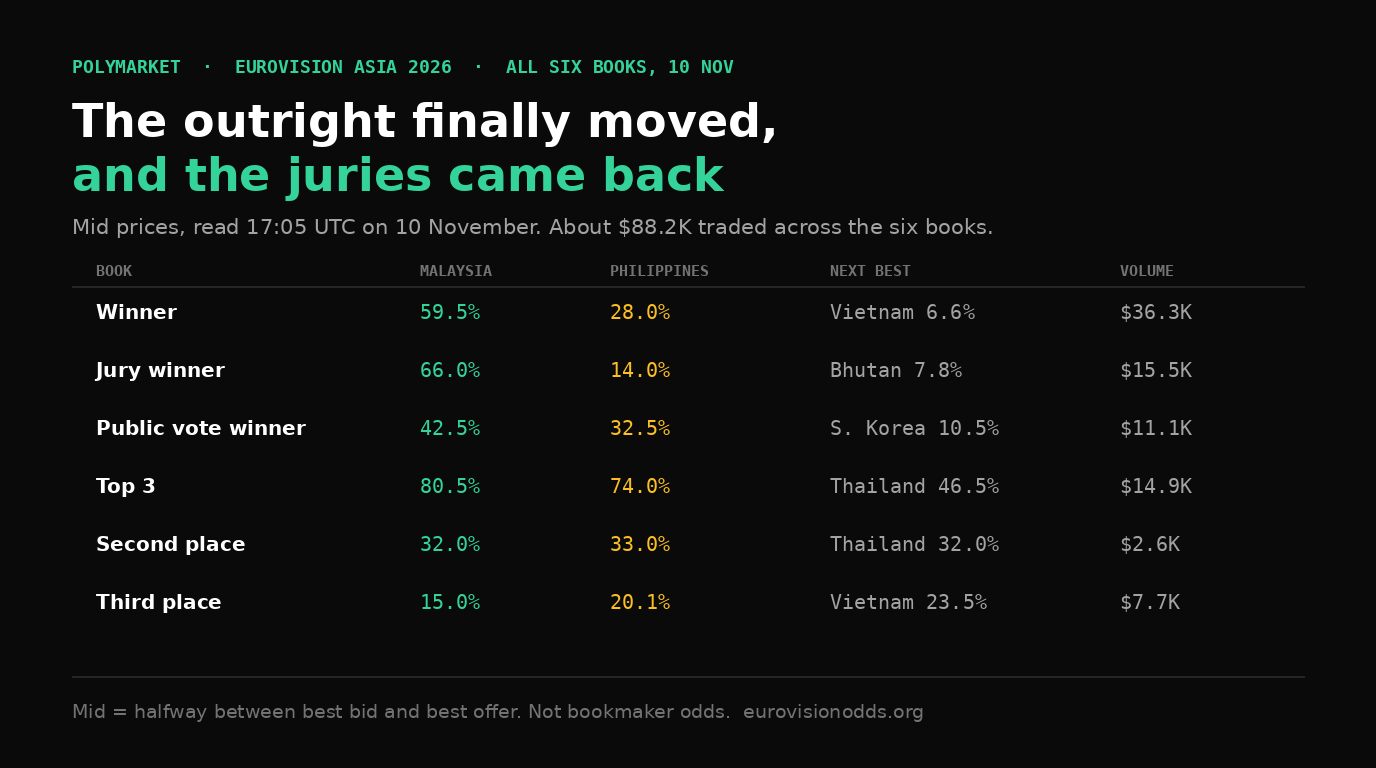
Eurovision Asia odds: all six books on 10 November
Every figure below is a midpoint between best bid and best offer on Polymarket’s Eurovision Asia markets, read at 17:05 UTC on 10 November 2026 and filtered to the eleven competing countries. The same API payload carries twenty-two unused template contracts named “Other” and “Country A” through “Country T”, quoted 0c against 100c; including them would put the winner book over eleven hundred per cent. They are excluded throughout.
| Book | Malaysia | Philippines | Next best | Mids sum to | Turnover |
|---|---|---|---|---|---|
| Winner | 59.5% | 28.0% | Vietnam 6.6% | 107.6% | $36.3K |
| Jury winner | 66.0% | 14.0% | Bhutan 7.8% | 118.7% | $15.5K |
| Public vote winner | 42.5% | 32.5% | South Korea 10.5% | 103.2% | $11.1K |
| Top 3 | 80.5% | 74.0% | Thailand 46.5% | 329.0% | $14.9K |
| Second place | 32.0% | 33.0% | Thailand 32.0% | 195.7% | $2.6K |
| Third place | 15.0% | 20.1% | Vietnam 23.5% | 107.4% | $7.7K |
The full winner book, in order: Malaysia 59.5%, the Philippines 28.0%, Vietnam 6.6%, Nepal 5.7%, Thailand 4.0%, Laos 2.1%, South Korea 1.1%, Mongolia 0.2%, and Bhutan, Bangladesh and Cambodia at 0.1% each.
The breakout, and what it followed
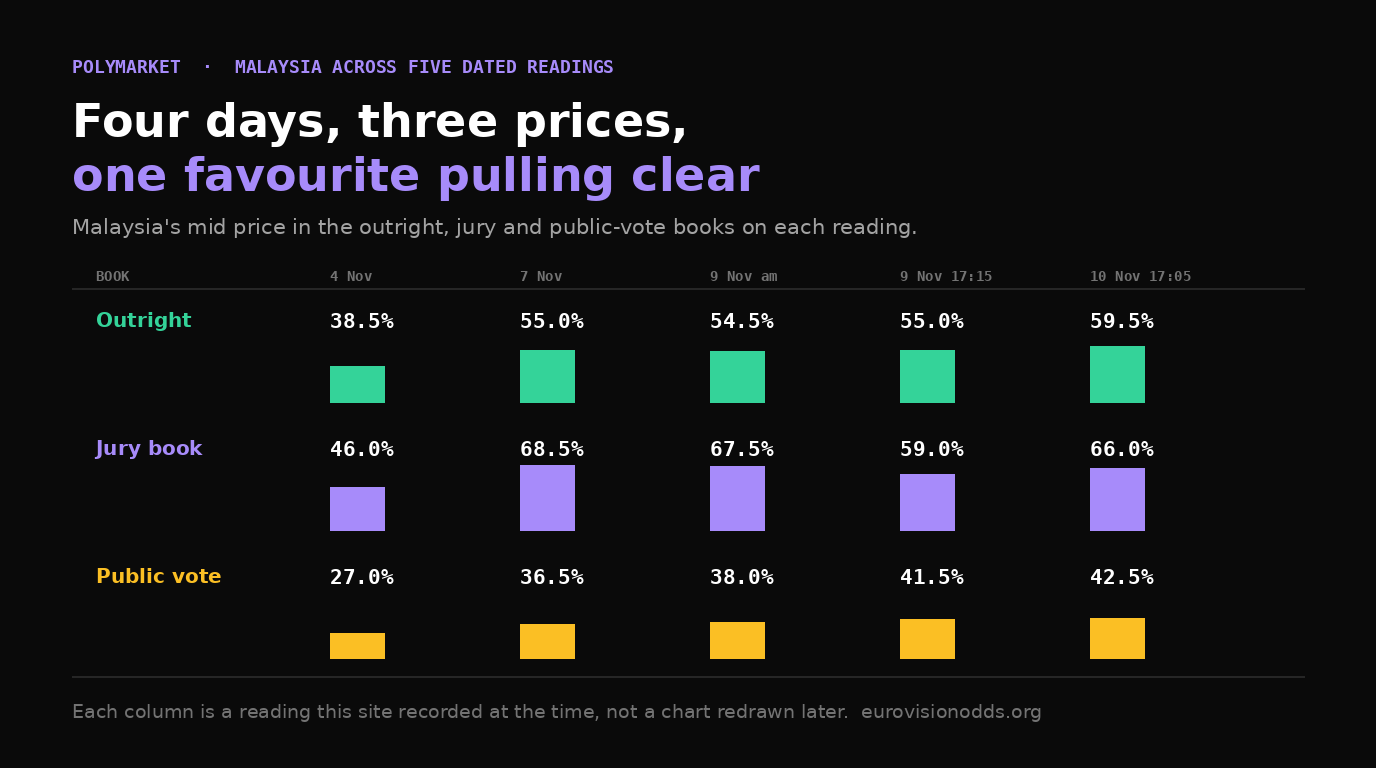
Five dated readings, one country:
| Reading | Outright | Jury book | Public vote |
|---|---|---|---|
| 4 November | 38.5% | 46.0% | 27.0% |
| 7 November | 55.0% | 68.5% | 36.5% |
| 9 November, morning | 54.5% | 67.5% | 38.0% |
| 9 November, 17:15 UTC | 55.0% | 59.0% | 41.5% |
| 10 November, 17:05 UTC | 59.5% | 66.0% | 42.5% |
The outright had been pinned at 55% for three readings while the two halves moved underneath it in opposite directions. On 10 November all three moved the same way at once, and the outright finally went with them.
What happened on 10 November? Malaysia rehearsed. Aina Abdul used the One Bangkok Forum stage for the first time that day, and the organisers’ press partners published a description: a white Melinda Looi ensemble, a transparent prop carrying a rippling water effect, her own Anugerah Juara Lagu staging and lighting crew in the building. We cover the staging and the three-day rehearsal timeline separately.
Be careful about reading that as cause. Nobody outside the hall has watched a Eurovision Asia rehearsal. There is no press-centre feed and no broadcast; the public has a still photograph and a short clip chosen by the people staging the show. A market moving 4.5 points on the day a favourite is photographed in a white blazer is consistent with traders pricing the staging, and equally consistent with money simply arriving as a Saturday final approaches. The honest statement is that the move coincided with the rehearsal, and that about $6.8K of new turnover arrived across the six books in the same window — the slowest day of the week, not a flood.
The jury book takes back almost all of it
The most striking line on the board is the jury market. Malaysia was 68.5% there on 7 November, 67.5% on the morning of 9 November, then 59.0% by that evening — a nine-and-a-half point slide inside a day that we wrote up at the time. On 10 November it is 66.0%, quoted 64c against 68c on about $10.5K, which is most of the way back.
Two readings of that are available and we cannot separate them. Either 9 November’s slip was a genuine reassessment that has now been reversed, or it was never a reassessment at all — a thin evening book drifting on a few hundred dollars. The second is more likely than it sounds: the jury book is the loosest of the three liquid markets, with its mids summing to 118.7%, and four of its eleven contracts have never traded at all.
The public-vote book is the one to watch for the opposite reason. At 103.2% it is the tightest book in the event and the closest contest on it: Malaysia 42.5% against the Philippines 32.5%, a ten-point gap where the jury book shows fifty-two. Under the contest’s published scoring the two halves are nearly equal in weight — juries control 638 of 1,334 points and the public 696, which we worked through when the EBU published the 252-point scale. A favourite who is a near-certainty with juries and a coin-flip with the public is not a 59.5% favourite in any obvious way; it is the jury half carrying the price.
The Nepal problem: a win price that cannot sit beside its own place price
Nepal’s Pratik Himal Rai is 5.7% to win and 6.5% to finish in the top three. Those two numbers cannot both be sensible. A country cannot win without placing, so the ratio of the two is the market’s implied answer to: given that this act makes the podium, how often does it take the whole thing?
| Country | Win | Top 3 | Implied: wins, given it places |
|---|---|---|---|
| Nepal | 5.7% | 6.5% | 88% |
| Malaysia | 59.5% | 80.5% | 74% |
| Philippines | 28.0% | 74.0% | 38% |
| Vietnam | 6.6% | 37.5% | 18% |
| Thailand | 4.0% | 46.5% | 9% |
| Laos | 2.1% | 28.5% | 7% |
| South Korea | 1.1% | 31.5% | 3% |
Nepal is the outlier and it is not close. The market says the fourth favourite, if it reaches the podium at all, wins more often than the favourite does. No reading of this contest supports that.
Now the honest part, because this is the bit a betting site usually leaves out. You cannot harvest it at the mids. Nepal’s outright is quoted 3.5c bid against 7.9c offered and its top-three line 4.0c against 9.0c. To express the view you would buy top three at the 9.0c offer and sell the outright into the 3.5c bid, paying 9.0 and collecting 3.5 — a net 5.5c for the outcome where Nepal places without winning. That is a position, not an arbitrage, and the spreads eat most of what the mids appear to offer.
What it does tell you is how much weight to put on a mid on a thin line. Nepal has about $2.1K of lifetime turnover in the outright and about $721 in the top-three book. On numbers like that a midpoint is the average of two people’s opinions about where they might trade, not a price.
Which of these books are real, and which are decoration
The sum of the mids is the quickest test. A one-winner market should sum near 100%, a three-place market near 300%:
- Public vote, 103.2% — the tightest in the event, and a genuine contest between two countries.
- Winner, 107.6% — tight at the top, where Malaysia is quoted inside a single cent and the Philippines inside two.
- Third place, 107.4% — respectable, but on $7.7K and with Vietnam leading it at 23.5%.
- Jury winner, 118.7% — loose, with four contracts that have never traded.
- Top 3, 329.0% — twenty-nine points of overround on a three-slot market, which is relatively the tightest of the lot.
- Second place, 195.7% — not a book. Thailand is quoted 12c against 52c, Malaysia the same, Laos 0.6c against 43.3c. Eleven mids summing to nearly double a one-slot market is what happens when almost nothing has traded.
Use the winner and public-vote books. Treat the second-place market as a curiosity until it has turnover. There are still no fixed-odds bookmakers on this contest at all — our bookmaker page has been saying so since August, and that has not changed four days before the final.
Kalshi: read the bid, never the last trade
Kalshi has run a CFTC-regulated Eurovision Asia winner market since 14 September, two months before Polymarket listed one. Its board was read at 17:05 UTC on 10 November: eleven contracts, about 6,695 contracts of lifetime volume, with Laos accounting for about 55% of it.
The useful finding is a split. Three contracts carry a live bid, and all three now agree with Polymarket closely:
| Contract | Kalshi quote, 10 Nov | Kalshi last trade | Polymarket mid |
|---|---|---|---|
| Malaysia | 53c / 62c | 60c | 59.5% |
| Philippines | 27c / 31c | 31c | 28.0% |
| Laos | 1c / 4c | 2c | 2.1% |
The eight contracts with no bid at all do not agree with anything. On the same read, Vietnam’s last trade is 79c against its own 40c offer with nothing bid underneath, while Polymarket prices Vietnam at 6.6%. South Korea’s last trade is 22c against 1.1% on Polymarket; Bhutan’s is 15c against 0.1%; Thailand’s is 13c against 4.0%.
That is a clean rule to carry into the weekend: on a thin exchange, the bid is information and the last trade is an artefact. Laos is the illustration — it traded again between the 15:02 and 17:05 reads on 10 November, and its last price fell from 6c to 2c, moving straight onto the Polymarket number as soon as real interest showed up.
How we would read it four days out
Three things we would hold to, and one we would not.
Hold: the price is a jury price. Malaysia’s 59.5% is built on 66.0% with the juries and 42.5% with the public, and the public half is marginally the larger of the two on the published scale. If you think a first-edition contest with a brand-new online voting system and a diaspora-heavy audience will produce a public vote that behaves unlike a jury, the favourite is short.
Hold: the Philippines at 28.0% is the only other contract with real two-sided liquidity, and it leads nothing on stage that anybody has been shown. CARMELLE has had no first-look release from the organisers at all.
Hold: every number below about 8% on this board is a quote rather than a price. Nepal, Vietnam, Thailand and Laos all have wide spreads and small lifetime turnover, and three of them have at some point this week shown a mid that contradicts another book.
Would not: we would not read the 4.5-point outright move as the market grading Aina Abdul’s rehearsal. The information released was a photograph and a wardrobe description. Our full set of dated readings since the books opened is on the Eurovision Asia hub, and the winner odds page carries the European contest for comparison.
Frequently asked questions
What are the Eurovision Asia 2026 odds right now?
On Polymarket at 17:05 UTC on 10 November 2026: Malaysia 59.5%, the Philippines 28.0%, Vietnam 6.6%, Nepal 5.7%, Thailand 4.0%, Laos 2.1%, South Korea 1.1%, and Mongolia, Bhutan, Bangladesh and Cambodia at 0.2% or below. These are exchange prices, not bookmaker odds.
Who is favourite to win Eurovision Asia 2026?
Malaysia’s Aina Abdul with “Bluest Sky”, at 59.5% to win, 66.0% to top the jury vote and 42.5% to top the public vote. She closes the show from slot 11.
Do any bookmakers price Eurovision Asia?
No. As at 10 November 2026 no fixed-odds bookmaker prices the contest. The only two venues are prediction markets: Polymarket, which listed it on 3 November 2026, and Kalshi, which opened the first market on 14 September 2026.
Why do Polymarket and Kalshi disagree?
Mostly because Kalshi’s displayed price is a last trade and eight of its eleven contracts have no bid. Where a Kalshi contract does carry a live bid — Malaysia, the Philippines and Laos — the two venues agree closely.
When do these markets settle?
The six Polymarket books resolve on the official Grand Final ranking of 14 November 2026, with ties broken on total points, then jury points, then public points, and close on 15 November. The Kalshi contract runs to 2 January 2027.
Sources
Polymarket Gamma API, read 17:05 UTC on 10 November 2026, eleven competing countries only. Kalshi public markets API, series KXEUROVISIONASIA, read the same minute. Scoring and settlement rules from the official Eurovision Asia Voting Terms (§8.2) and the voting-rules announcement of 9 November 2026 reported by Eurovoix. Earlier readings cited here were taken and published by this site on 4, 7 and 9 November 2026.
Prices move, and every figure on this page carries the minute it was read. Prediction markets are exchanges, not bookmakers, and nothing here is advice. 18+.