
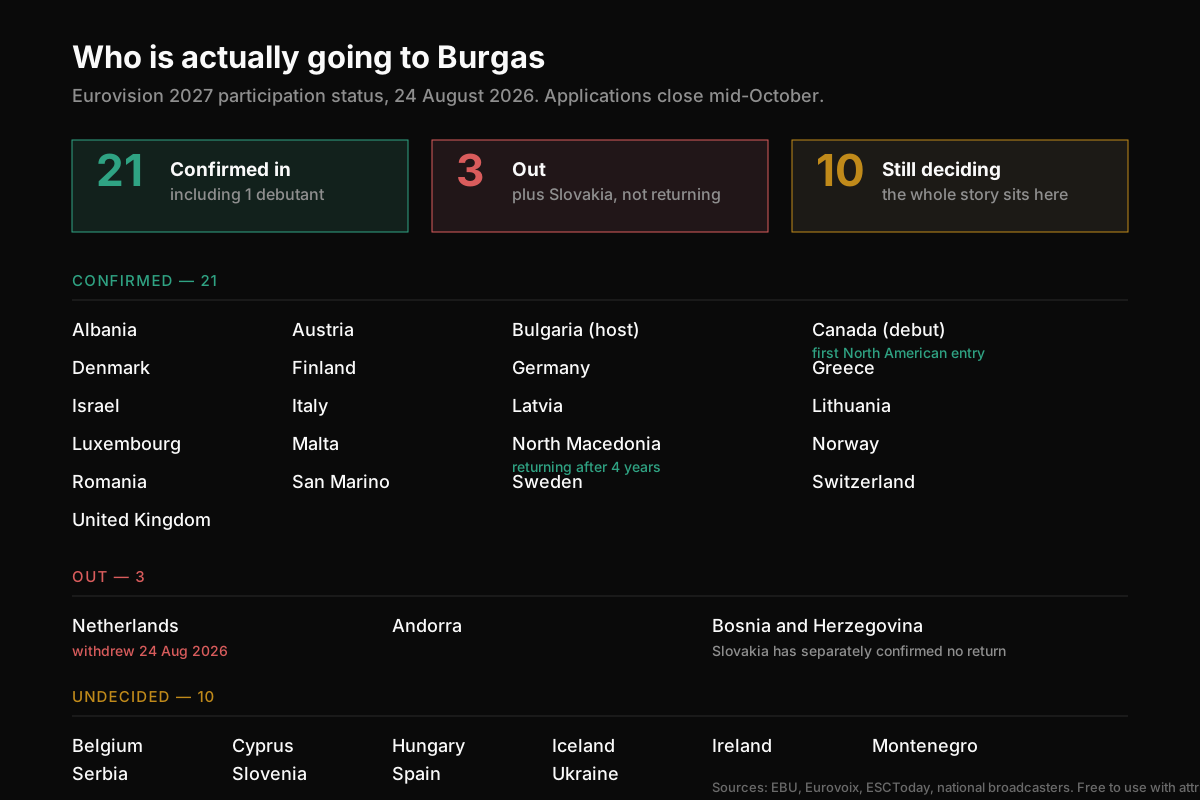
Twenty-one broadcasters are confirmed for Eurovision 2027, three are out and ten have not decided. That last number is the story. With applications closing in mid-October, roughly a third of the potential field is still undeclared, and it contains Ireland, Spain, Slovenia, Iceland and Belgium — the countries whose decisions will determine whether Burgas hosts a normal contest or a visibly diminished one.

18+ | New customers only | T&Cs apply | Please gamble responsibly
Here is the complete board as at 24 August 2026, the day AVROTROS confirmed the Netherlands is out.
The board
The confirmed twenty-one
Nothing in this group is surprising, which is itself the point: the Big Five are intact, the Nordics are intact, and the reform-driven wobble has not spread to the contest's structural core. Germany, Italy and the United Kingdom are in. Sweden, Norway, Denmark and Finland are in. Bulgaria hosts.
Two entries in that list are worth pulling out.
Canada debuts, confirmed on 1 July. CBC/Radio-Canada became a full EBU member, and Canada becomes the first North American country ever to compete. That is the single biggest structural change to the contest in 2027 and it is happening in a year dominated by withdrawal coverage.
North Macedonia returns after four years away, confirmed back on 21 May — the earliest of the confirmations and a useful reminder that the traffic is not all one way.
Israel confirmed on 12 July. That confirmation is the fixed point around which every undecided broadcaster is making its own decision, and the EBU has closed off further votes on exclusion. Any model of the 2027 field that assumes Israel might yet be removed is modelling a scenario the governing body has explicitly ruled out.
The three that are out
The Netherlands is the only one of the three that represents a live political withdrawal. AVROTROS confirmed on 24 August, handing the Dutch mandate back to NPO. Update, 25 August: KRO-NCRV and BNNVARA have since ruled themselves out, so while a substitute broadcaster remains possible in principle, the realistic path now runs through Omroep MAX or nobody.
Andorra and Bosnia and Herzegovina are long-term absentees rather than new departures. Neither has competed in years, and both sit on the list for the ordinary reasons of cost and broadcaster capacity.
Slovakia deserves a separate line because it keeps generating false hope. STVR confirmed in August that it will not return for 2027, days after remarks from a Rádio Slovensko executive revealed Slovakia had actually attempted a 2026 return before abandoning it on cost. The broadcaster reviews participation annually. Slovakia has not competed since 2012 and this is a cost decision, not a political one — worth separating from the boycott cluster when you are counting.
The ten that matter
Belgium, Cyprus, Hungary, Iceland, Ireland, Montenegro, Serbia, Slovenia, Spain and Ukraine.
Belgium is the one to watch. VRT has said plainly that under current conditions “the likelihood of VRT sending an artist next year is low.” Spokesperson Yasmine Van der Borght framed the demand as a firm EBU stance against war and violence and a clear framework grounded in respect for human rights, alongside a transparent mechanism giving member broadcasters a direct vote on participation questions.
The structural detail that makes this dangerous: Belgium alternates its Eurovision mandate between RTBF and VRT. RTBF held it in 2026 and sent an entry to Vienna. The rotation puts VRT in the chair for 2027. So the Belgian question is not whether the country's appetite has changed in aggregate — it is that the specific broadcaster whose turn it is has been the more reluctant of the two, and unions at both have already called for a boycott. Belgium withdrawing would make six.
Ireland is leaning out, and we make it about 85% to stay out. Spain is keeping options open while running Benidorm Fest preparations. Slovenia is the most likely of the boycotters to return, with participation under active consideration. Iceland is quiet and evaluating — its board next meets at the end of September, and we make it about 65% to stay out.
Cyprus, Hungary, Montenegro, Serbia and Ukraine are undecided for ordinary reasons rather than political ones — budget cycles, internal policy, and in Hungary's case a possible return after years away. Hungary coming back would be a genuine surprise and a significant one.
What the shape of the field means
Three things follow from this board that are easy to miss in the headline counting.
The withdrawal wave has not spread. Every 2027 departure so far is either a 2026 boycotter repeating itself or a long-term absentee. No broadcaster that competed in Vienna has yet announced a withdrawal. Belgium would be the first, and it has not done it.
Twenty-one confirmed is already a workable contest. With ten undecided, the realistic 2027 field lands somewhere between about 26 and 31. That is smaller than 2025 but comfortably enough for two semi-finals, and the semi-final structure is where a shrinking field actually bites — fewer entries per semi means a higher qualification rate and materially different pricing on qualifier markets.
The undecided cluster is correlated, not independent. This is the trap for anyone modelling the field country by country. Ireland, Spain, Slovenia, Iceland and Belgium are all weighing the same question about the same broadcaster-level dispute. They will not resolve as five separate coin flips. A credible EBU concession — particularly the direct member vote VRT is asking for — could move several at once, and its absence keeps several out at once.
Which makes the voting reform consultation more consequential than it looks. The EBU is asking these same broadcasters to weigh in on how the public vote should work while several of them are deciding whether to turn up at all.
Dates
Applications close mid-October 2026. The EBU is expected to publish the confirmed list by late 2026. The contest runs 11, 13 and 15 May 2027 at Arena Burgas.
Live prices on several of these countries are tracked in our participation market piece — with the caveat, learned the hard way today, that those markets are thin and that a media report of a decision is not the decision.
Quick answers
How many countries are in Eurovision 2027? Twenty-one confirmed as at 24 August 2026, with ten undecided and three out. The final field will likely land between 26 and 31.
Who is debuting? Canada, the first North American country to compete, confirmed 1 July 2026.
Who is returning? North Macedonia, after four years away.
Is Israel competing? Yes, confirmed 12 July 2026. The EBU has ruled out further votes on excluding it.
Which country is most likely to withdraw next? Belgium. VRT holds the 2027 mandate under the RTBF/VRT rotation and has said an entry is unlikely without EBU reform.
Is Slovakia returning? No. STVR confirmed in August 2026 that it will not compete in 2027. Its reasons are cost, not politics.