
The EBU wants to stop you giving all your votes to one country. A letter sent to member broadcasters in August 2026 — signed by EBU Chief Executive Jean Philip De Tender and Eurovision Reference Group chair Ana Maria Bordas, and first reported by Swedish outlet Aftonbladet on 14 August — sets out two changes the union is working towards for Eurovision 2027: moving the public vote entirely online, and requiring each voter to spread their vote across more than one entry.

18+ | New customers only | T&Cs apply | Please gamble responsibly
Neither is ratified. Both would change how every Eurovision betting market has to be modelled.

What the letter says
The operative sentence is short: “Our research points towards two changes: moving the public vote entirely online and requiring people to vote for more than one entry.”
The stated goal is threefold — raise turnout, improve fairness, and dilute organised voting. The letter is blunt about the third. Politically-motivated voting is described as “persistent” and “deeply worrying” to many people, and the union's expectation is that the changes “will increase engagement and the willingness to vote and help dilute the effect of mobilized bloc voting.”
“Three favourites” is the EBU's own worked example of what “more than one” might mean. It is an illustration, not a fixed number. Treat any confident claim about a specific count as speculation until the Reference Group publishes a rule.
This is the second step, not the first
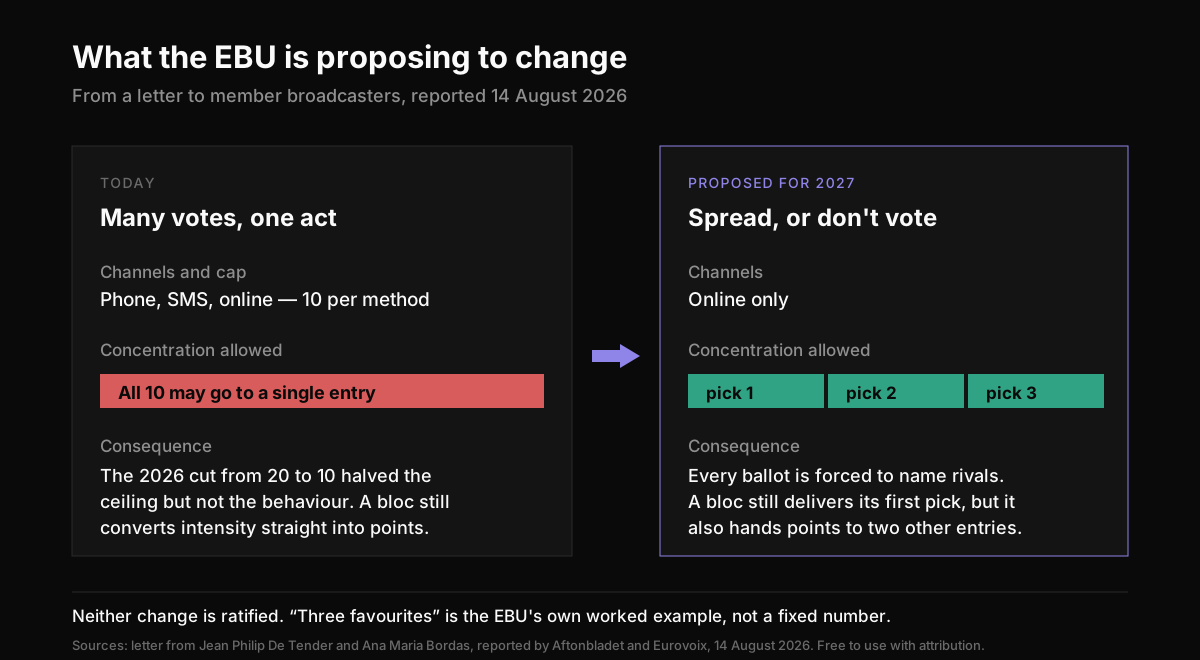
For the 2026 contest the EBU had already cut the cap from 20 votes to 10 per payment method and added guidance discouraging disproportionate promotional campaigns by third parties, governments included. That reform was announced in November 2025, in the wake of the 2025 contest.
The reference point everyone is circling is Israel's 2025 result. Yuval Raphael's entry placed 15th with the juries and second overall after the public vote, in a year when the Israeli government actively encouraged multiple voting. That gap between the two halves of the result is the specific phenomenon the reform programme exists to address.
The 2026 cut halved the ceiling. It did not change the behaviour, because a viewer could still put all ten votes on one act. Requiring the vote to be spread is the first change that touches the mechanism itself rather than the volume.
Why the spread requirement is the significant half
Halving a vote cap scales everyone down together. If a mobilised bloc casts ten votes each and a casual viewer casts one, cutting the cap to five leaves the ratio between them unchanged. It is a smaller number multiplied by the same imbalance.
A spread requirement does something structurally different: it makes every ballot cast for your entry also cast points for two other entries. A bloc can still deliver its first pick in full. What it can no longer do is deliver that pick without simultaneously funding the field. The mobilised voter's second and third picks are close to random with respect to the bloc's intent, so they distribute roughly like the broad public's preferences — which is precisely the signal the concentrated vote was drowning out.
The online-only half matters for a duller reason: it is what makes the spread requirement enforceable and auditable. You cannot easily make someone rank three entries over SMS.
Update, later on 24 August: this mechanism is not hypothetical. The EBU's own Eurovision Asia contest is already running it — eight free votes per user, spread across at least three songs, online only — and has been since Bhutan's national final on 11 August.
What this does to the betting markets
Four consequences, in descending order of confidence.
First, the televote tail compresses. Under concentration, a country with a small but intense following can post a large televote score. Under a spread requirement, the same following delivers a smaller peak and scatters the remainder. Expect fewer extreme televote outliers in both directions, and a televote ranking that looks more like the jury ranking than it has since 2023. That narrows the jury-televote divergence that several profitable strategies have depended on.
Second, breadth beats intensity. The entry that finishes second or third on a lot of ballots gains relative to the entry that finishes first on fewer. That is a real re-rating of song types: broadly likeable mid-tempo entries and strong vocal performances gain, and polarising novelty acts — which live or die on concentrated enthusiasm — lose. If you price outrights off Spotify streams and fan-poll wins, both of those inputs measure intensity, not breadth.
Third, semi-final qualification markets get harder, not easier. Qualification is a cut-off, and compressing the distribution puts more entries near the line. More entries near the line means more genuine coin-flips and fewer of the standout 1.05-shot qualifiers that fund a season.
Fourth — and this is the one to be careful about — historical data stops transferring cleanly. Any model trained on 2016–2026 televote behaviour is trained on a concentration-permitting system. If the mechanism changes, the training set describes a contest that no longer exists. The first year under new rules is the year to size down, not up.
The rest of the 2027 rulebook
Separately from the voting proposal, the EBU has already confirmed a set of rule changes for 2027. These are decided, not under consideration.
Minimum age rises from 16 to 18, measured on the day of the first rehearsal. That removes a slice of the talent pool that has produced winners before, and it lands hardest on countries whose selections lean on teenage pop acts.
Live vocals are tightened. Lead singers must perform the main melody live. Backing tracks are still permitted but cannot replace or unduly assist the lead vocal, and pre-recorded elements cannot carry the main melody.
A host-security clause. A winning broadcaster is automatically ineligible to host if armed conflict, geopolitical tension or security concerns affect its region, with the EBU empowered to commission an independent security assessment and to appoint an alternative host broadcaster carrying full rights and obligations. This is now written into the rules rather than handled case by case.
Promotion rules are codified. Broadcasters, artists and commentators may encourage voting. Disproportionate promotional activity is prohibited, with large-scale and state-backed campaigns named explicitly.
Contest director Martin Green on the package: “These changes are about giving everyone involved greater clarity, protecting artists and ensuring the Contest continues to provide a safe and welcoming environment.”
What to watch, and when
The voting proposal needs to clear the Reference Group and the member broadcasters. Several of the broadcasters being consulted are the same ones deciding whether to enter 2027 at all, which makes this consultation unusually loaded. Participation applications close in mid-October 2026; a voting rule for a May 2027 contest realistically needs to be settled by the turn of the year to give broadcasters and the telecoms partner time to build it.
Until then, the honest position is that the mechanism for Eurovision 2027 in Burgas is not yet known. That is itself worth pricing: outright markets this far out are already wide, and a pending change to how points are generated is a reason to keep stakes small rather than to hunt for an edge.
Quick answers
Is Eurovision going online-only for voting? Not yet. It is a proposal in an EBU letter to member broadcasters, reported on 14 August 2026, targeted at the 2027 contest. No rule has been ratified.
Will I have to vote for three acts? The EBU says voters would have to pick more than one entry, and uses “three favourites” as its example. The exact number is not fixed.
How many votes can I cast now? For 2026 the cap is 10 per payment method, cut from
- All ten may currently go to a single entry — which is the thing the proposal would end.
Why is the EBU doing this? To raise turnout and to dilute organised bloc voting, which the letter calls “persistent” and “deeply worrying”.
What else changes in 2027? Confirmed already: minimum age 18, tighter live-vocal rules, a host-security ineligibility clause, and codified limits on promotional campaigns.