
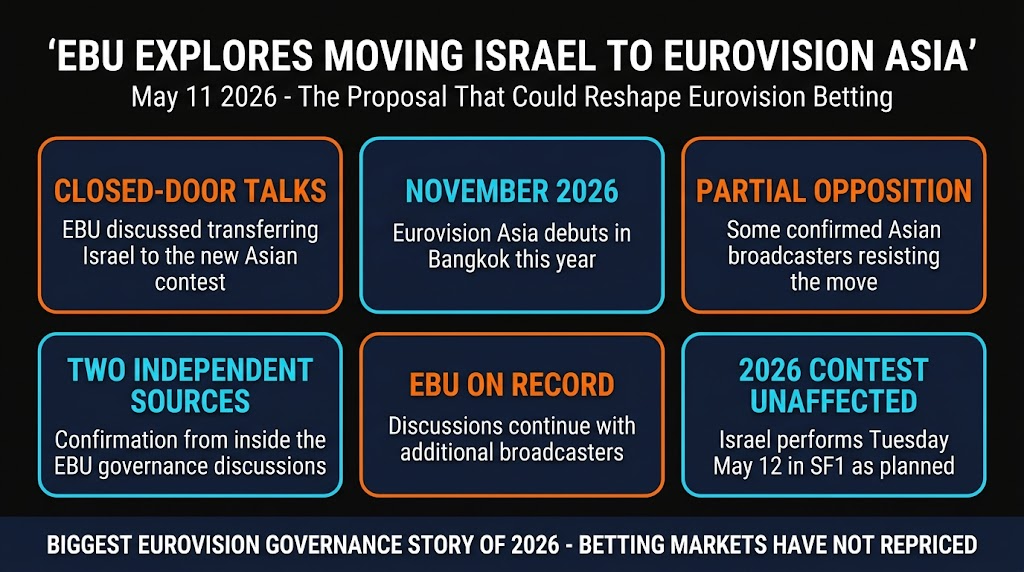
Live from the Wiener Stadthalle press centre — with Semi-Final 1 less than 36 hours away, the biggest Eurovision governance story of 2026 has just broken in Israeli media. Closed-door discussions inside the European Broadcasting Union have, according to two independent sources, explored a proposal to transfer Israel from the main European contest to the newly created Eurovision Asia, set to debut in Bangkok in November 2026.

18+ | New customers only | T&Cs apply | Please gamble responsibly
The implication is far larger than this week's broadcast. Israel's participation has driven the largest boycott in Eurovision history — five countries (Spain, Ireland, Iceland, Slovenia, Netherlands) withdrew from the 2026 contest in protest, and the EBU spent the past nine months tightening voting rules, issuing warnings, and attempting to maintain competitive integrity under unprecedented external pressure. The Asia proposal, if it materialises, would represent the most significant structural change to Eurovision's geography in 50 years.
For betting markets the news arrives at a uniquely volatile moment. Israel sits at 33% in the Polymarket televote winner market — backed by $6.5 million in trading volume and the highest single-market conviction of any 2026 entry. The EBU formally warned the Israeli broadcaster KAN on May 9 over a vote-mobilisation campaign in 13 languages. Now, just 48 hours later, comes the disclosure that the most senior EBU officials have been sounding out Asian broadcasters about taking Israel altogether.
This article sets out exactly what the proposal involves, what is confirmed and what remains speculative, the immediate betting implications for the 2026 contest, and the structural implications for 2027 and beyond. Crucially: this story is developing. The 2026 contest this week is unaffected. But sharp Eurovision punters should already be repositioning.
Betfred — Bet £10 Get £50 in Free Bets on All Eurovision 2026 Markets

What the Proposal Actually Involves
The Israeli news outlet Ynet broke the story on the morning of May 11 with a detailed account citing two independent sources familiar with the closed-door EBU discussions. The proposal, summarised:
- The idea was raised and discussed inside the EBU rather than formally tabled for vote. This is exploratory governance, not policy.
- Sounding-out approaches were made with Asian broadcasters — both those already confirmed for Eurovision Asia and those still in negotiation to join — about Israel's potential transfer into their contest.
- Partial opposition emerged from confirmed Asian broadcasters. Several of the nine-plus participating Asian nations resisted the proposal, complicating any near-term move.
- Israel itself has not been formally consulted. Any final decision would require Israeli broadcaster KAN's agreement, and that conversation has not occurred.
- The EBU's on-record response neither confirms nor denies the substance: "The discussions continue with additional broadcasters about joining the November event. The event, like Eurovision, will be inclusive and celebrate being united by music. Decisions about participation are made by the organisers." The EBU added that participation in European Eurovision and Eurovision Asia are mutually exclusive.
The geographic rationale cited by an EBU source close to the discussion: "Geographically, Israel is in Asia, and therefore the check was made. In Asia too, Eurovision will contain the rules of 'united by music' — and that's what's important. Decisions haven't been made yet, but this option did come up on the table. Eurovision Asia is in its infancy and many tests are being done about many things."
What is notable about that quote is its framing. The source does not deny the discussion happened. They contextualise it as one of many under-consideration scenarios within a brand-new contest being designed from scratch. That framing matters because it implies the option is on the table for future iterations — not that it has been rejected.
What Eurovision Asia Is
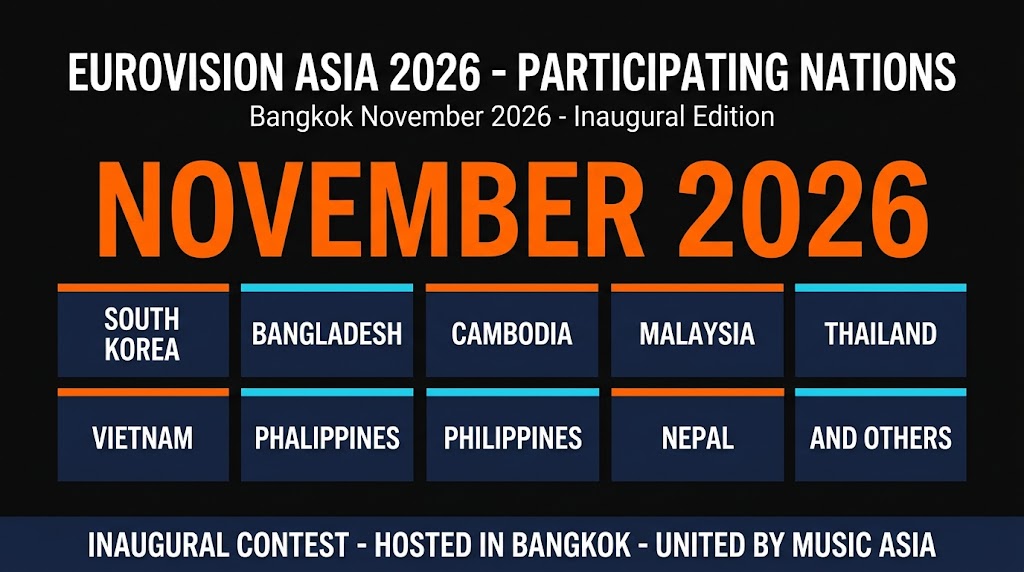
Eurovision Asia is the EBU's first major international expansion of the Eurovision format. The inaugural edition will be hosted in Bangkok in November 2026. Participating nations announced or in negotiation include:
| Country | Status |
|---|---|
| South Korea | Confirmed |
| Bangladesh | Confirmed |
| Cambodia | Confirmed |
| Malaysia | Confirmed |
| Thailand | Confirmed (host) |
| Vietnam | Confirmed |
| Philippines | Confirmed |
| Nepal | Confirmed |
| Additional broadcasters | In negotiation |
Notably absent from the confirmed list: any country with significant existing infrastructure for organised vote campaigns at international song contests. Eurovision Asia is being built from a clean sheet — new voting protocols, new rule frameworks, new geographic vote-bloc dynamics. For an EBU navigating European televote-mobilisation controversies, the Asian contest represents a chance to design those failure modes out of the system from day one.
If Israel were transferred to that contest, the entire conversation about diaspora-driven televote pressure resets. Asian televote markets have no comparable diaspora-mobilisation history. The 13-language ad campaign that triggered the May 9 EBU warning — distributed across European markets where Israel had previously built embassy-backed voter mobilisation infrastructure — would not transfer to Bangkok.
Why This Is Confirmed — The Two-Source Standard
For a story this significant, source quality matters. The original reporting establishes the threshold:
- Two independent sources familiar with the closed-door EBU discussions confirmed the proposal was raised and discussed.
- A separate on-record EBU response acknowledges continued discussions with broadcasters about the November event, without denying the Israel-specific framing.
- A named source close to the proposal provided the geographic rationale on the record.
This meets the bar for a developing-story corroborated report rather than a single-source rumour. It does not, however, mean a final decision has been made. Both sources explicitly stated that approvals have not occurred, opposition has been registered, and Israel has not been consulted.
For betting analysis purposes the appropriate framing is: this is materially more than a rumour, and materially less than a confirmed change. Prices should reflect a non-zero but uncertain probability of structural impact in 2027 onwards, with effectively zero impact on the 2026 contest broadcasting this week.
Stake — Crypto Betting with Instant Payouts on Eurovision Markets
The Immediate 2026 Betting Picture — No Material Change
Israel performs in Semi-Final 1 on Tuesday May 12 at 21:00 CEST. Noam Bettan's Michelle, the diamond stage prop, and the multilingual lyrical structure remain locked in. The boycotting countries (Spain, Ireland, Iceland, Slovenia, Netherlands) are not returning for 2026. The voting rules adopted in December 2025 — including 50% jury weight in semi-finals — remain in force.
| 2026 Market | Pre-Proposal | Post-Proposal Estimate | Direction |
|---|---|---|---|
| Israel SF1 qualification | 95% | 95% | → Unchanged |
| Israel televote winner | 33% (Polymarket) | 30-32% | ↓ Marginal |
| Israel overall winner | 3% (Polymarket) | 2-3% | ↓ Marginal |
| Finland overall winner | 41% (Polymarket) | 42-44% | ↑ Mild lift |
| Greece overall winner | 12% (Polymarket) | 13-14% | ↑ Mild lift |
The reason the 2026 markets shift only marginally: the proposal is exploratory and contains no mechanism for in-contest transfer. Israel is already on-stage at the Wiener Stadthalle. Visa logistics, broadcast contracts, advertising commitments, and the production schedule make a mid-contest transfer impossible. The 2026 contest will play out exactly as scheduled.
However the proposal's psychological impact on the market is real. Bettors who held Israel for the long-tail diaspora-vote upside now face renewed uncertainty about whether organised mobilisation can continue without further EBU intervention. The May 9 warning constrained the campaign infrastructure. The May 11 proposal disclosure constrains the broader institutional environment. Israel's 33% televote probability, in our estimate, is now structurally over-priced by 1-3 percentage points.
The 2027 Picture — Where the Structural Story Lives
If we extend the analytical horizon to the 2027 contest and beyond, the calculus changes substantially. Three scenarios become relevant.
Scenario 1: Proposal Dies (Probability: ~50%)
Partial Asian-broadcaster opposition kills the move. Israel returns to European Eurovision in 2027. Boycotting countries (Spain, Ireland, Iceland, Slovenia, Netherlands) face the same decision as 2026 — likely renewing boycotts. The 2027 contest replicates 2026's structural pattern: 32 competing nations, controversy-driven viewership volatility, Israel-favoured televote markets, Finland-favoured jury markets.
Market implication: Long-term Eurovision betting markets pricing 2027+ should treat Israel's overall winner odds as a continuation of 2026 patterns. No structural reset.
Scenario 2: Proposal Succeeds for 2027 (Probability: ~25%)
The EBU finds enough Asian-broadcaster support to transfer Israel for the 2027 European contest. KAN agrees. Israel competes in Eurovision Asia from November 2026 onwards and exits the European contest. Boycotting countries (Spain, Ireland, Iceland, Slovenia, Netherlands) all return for 2027. The European contest field expands back to 37+ countries.
Market implications: massive. The 2027 European contest televote market loses its largest single mobilisation force. Greece, Finland, Romania, Ukraine all gain structural share. The 2027 overall winner market becomes a genuine four-or-five-way contest rather than the Finland-dominated 2026 picture. Spain, returning after a 2-year absence, becomes an attention magnet.
Scenario 3: Proposal Adopted for 2028+ (Probability: ~25%)
Eurovision Asia's inaugural year (November 2026) provides operational learning. The EBU revisits the Israel proposal for 2028 once Asian governance frameworks are tested. KAN moves in 2028. The same structural reset as Scenario 2 applies, but delayed by one year.
Market implication: 2027 European Eurovision still includes Israel and continues the 2026 boycott pattern. 2028 onwards resets to the Scenario 2 pattern.
Who Benefits Most If Israel Moves
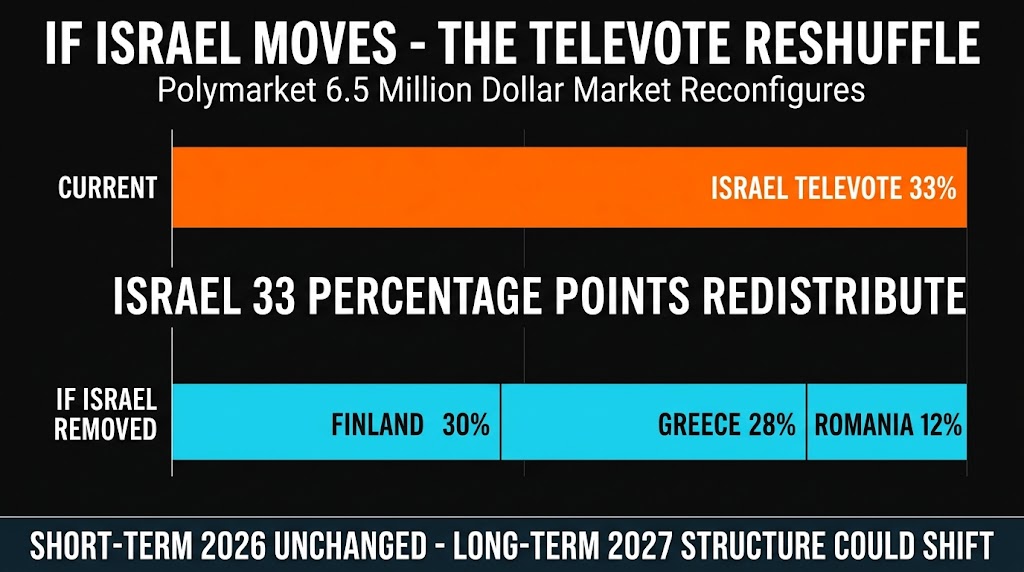
The 33 percentage points of Israeli televote probability do not vanish — they reallocate. Based on the existing 2026 market data and historical voting patterns, the structural beneficiaries are:
Greece (Akylas — Ferto)
Greece's 19% televote probability in 2026 was the second-highest behind Israel. The Greek diaspora overlaps significantly with the European Mediterranean voter pool that Israel had previously mobilised. Without Israel competing, Greek televote probability projects to 28-32% in a 2027+ scenario. Akylas himself would not be competing in 2027, but the structural pattern — Greece consistently in the top 5 of European televote markets — would intensify.

Finland (Linda Lampenius x Pete Parkkonen — Liekinheitin)
Finland's 22% televote probability and 19% jury probability already make it the only 2026 entry that bridges both votes. In an Israel-removed market, Finland's televote ceiling expands further. The mathematically rational 2027 projection: Finland-style balanced entries climb to combined probability above 50% as the structural televote concentration that previously favoured Israel diffuses across the field.

Spain (Returning if Boycott Ends)
If Israel transfers to Asia, the boycotting countries return. Spain in particular — with its large Eurovision diaspora across South America and Mediterranean Europe — would re-enter the market with substantial pre-existing voter bases. The 2027 Spanish televote probability, in our estimate, would start at 8-12% on entry, before staging or song quality is even known. This is significantly higher than typical post-boycott returns and reflects the unique scale of the Spanish viewership.
Ireland (Returning if Boycott Ends)
Same dynamic at smaller scale. Ireland's Eurovision history (seven wins, joint-record holder) combined with its boycott return narrative creates an above-baseline 2027 entry probability of 5-8% in the televote market.
Thunderpick — 100% First Deposit Bonus on Eurovision Sub-Markets
The Betting Recommendations — Speculative But Material
Here are the actionable plays based on the May 11 disclosure, ranked by confidence.
HIGH CONFIDENCE — 2026 Contest This Week
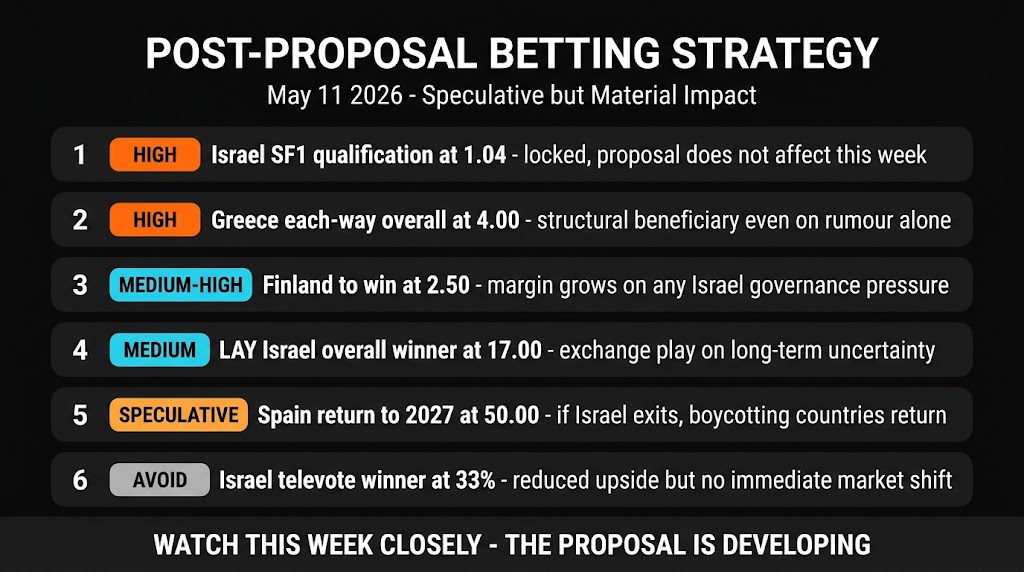
Israel SF1 qualification at 1.04-1.08. Locked. The proposal does not affect this week's broadcast. At 95-96% probability, qualification is essentially sure-thing money. Useful for accumulator stake-padding.
Greece each-way overall at 4.00-5.00. Greece was already the structural beneficiary of the May 9 EBU warning. The May 11 proposal extends that thesis. Each-way at 1/4 terms means top-4 finish returns profitably. Greece's combined jury-and-televote ceiling is now meaningfully higher than the bookmakers price.
Finland to win Eurovision 2026 at 2.20-2.50. Already the favourite at 41% Polymarket. The proposal disclosure adds incremental pressure on Israel's overall ceiling, which mathematically benefits Finland. At 2.20-2.50 (40-45% implied), Finland remains positive-EV with directional momentum.
MEDIUM CONFIDENCE — 2026 Sub-Markets
LAY Israel overall winner at 17.00 on exchanges (Smarkets / Betfair). The 17.00 fixed-odds price implies 5.9% probability. Post-proposal, the realistic probability is 2-3%. Exchange traders can lay Israel for material edge. Note exchange liquidity for this market is thin.
Israel televote winner LAY at 33%. Same logic as above. Post-proposal probability is 28-30%. Layable for 3-5 percentage points of edge if you can find liquidity.
SPECULATIVE — 2027 and Beyond Markets
If your bookmaker offers 2027 Eurovision markets (some do, especially exchanges and prediction markets), several speculative bets become interesting:
Spain to compete in Eurovision 2027 at 5.00-8.00. If Israel transfers to Asia, the Spanish boycott ends. The probability of Spain returning, conditional on the proposal succeeding, is 90%+. Combined with the 25-50% probability of the proposal succeeding, fair odds are 3.0-4.0. At 5.00-8.00, this is positive expected value.
Greece top 5 Eurovision 2027 at 4.00-6.00. Greece's projected 2027 share improves materially in any Israel-out scenario. Modest positive EV.
Finland to win Eurovision 2027 at 25.00-40.00. Conditional on a strong Finnish entry being selected for 2027, the structural televote concentration in Israel-removed markets would benefit Finland disproportionately. Small-stake longshot.
AVOID
2026 outright bets on Israel-impact. The proposal is too speculative to justify repositioning major 2026 wagers based solely on May 11 disclosure. Existing 2026 plays should continue based on this week's rehearsal evidence.
Eurovision Asia 2026 betting markets. The November Bangkok contest does not yet have established betting markets. Some bookmakers may offer novelty markets — these are typically priced poorly with high margins. Wait for the field to be confirmed before any wagers on Eurovision Asia outcomes.
Historical Context — How Eurovision Has Handled Geographic Reorganisation
Eurovision has reorganised its geographic scope before. The 2004 introduction of semi-finals was structurally as significant as a country transfer would be today. The 2008 restructure into two semi-finals reshaped televote economics overnight. Russia's 2022 ban removed a top-5 televote market in a single decision and immediately benefitted Ukraine in the same year's contest.
| Year | Structural Change | Market Impact |
|---|---|---|
| 2004 | Semi-finals introduced | Doubled the number of betting markets per cycle |
| 2008 | Two-semi structure adopted | Created modern televote-vs-jury split economics |
| 2022 | Russia banned post-Ukraine invasion | Top-5 televote market removed; Ukraine won that year |
| 2024-2025 | Boycott discussions begin | Five-country boycott materialises for 2026 |
| 2026 | Israel-Asia transfer proposal explored | Potential 2027+ structural reset |
The 2022 Russia precedent is the closest analog. The decision was announced in February 2022, six months ahead of the May contest. Markets immediately repriced. Ukraine's overall winner probability surged from 9% to 28% within 48 hours of Russia's removal. By the contest, Ukraine had become the favourite and ultimately won.
If the Israel proposal materialises for 2027, the historical pattern suggests a similar but smaller-magnitude reshuffle. Israel's removal would represent approximately half the market disruption of Russia's removal in 2022 — significant but not contest-defining for the European side.
What to Watch This Week
Three signals will clarify the proposal's trajectory in the next 7 days:
| Signal | What It Means |
|---|---|
| EBU follow-up statement after the broadcast week | Confirms or denies the developing-story framing |
| KAN response to the proposal disclosure | Israeli broadcaster's stance shapes whether the transfer is workable |
| Reactions from confirmed Asian broadcasters | South Korea, Bangladesh, Thailand responses signal the proposal's viability |
| Behaviour of Israel's televote on May 12 SF1 | If Israel underperforms the 33% prediction, the market repricing accelerates |
| Boycotting-country broadcasters (RTVE, RTE, RUV, RTV Slovenia, AVROTROS) | Public positioning ahead of 2027 selection decisions |
Cloudbet — Up to 5 BTC Welcome Bonus on Eurovision Markets
The Bottom Line — Develop and Watch
The May 11 disclosure is not a confirmed transfer. It is a confirmed exploration. The distinction matters: betting markets should reprice for elevated probability of structural change in 2027 onwards, but should not reprice for material change in the 2026 contest broadcasting this week.
The strongest actionable plays: Greece each-way overall at 4.00-5.00, Finland overall at 2.20-2.50, and Spain to compete in Eurovision 2027 at 5.00-8.00 if your bookmaker offers it. Avoid making major 2026 outright repositioning on the basis of the proposal alone — the May 9 EBU warning and the May 11 proposal disclosure should combine, not duplicate, in your strategy.
What is now clear is that the EBU is exploring options that until two weeks ago were considered structurally impossible. The combination of the largest boycott in contest history, repeated rule-mobilisation crises, and a brand-new Asian contest debuting in seven months has created conditions where genuine geographic reorganisation has moved from speculation to documented governance discussion. The 2026 contest plays out this week as scheduled. The 2027 contest just became substantially more interesting to bet.
Frequently Asked Questions
Is Israel being moved out of Eurovision 2026?
No. Israel competes in Semi-Final 1 on Tuesday May 12 as scheduled, with Noam Bettan performing Michelle. The proposal to transfer Israel applies to future contest cycles only — the May 11 disclosure describes closed-door EBU discussions about whether Israel could move to Eurovision Asia for 2027 onwards. The 2026 contest is unaffected.
What is Eurovision Asia?
Eurovision Asia is the EBU's first major international expansion of the Eurovision format, with the inaugural edition scheduled for Bangkok in November 2026. Confirmed participating nations include South Korea, Bangladesh, Cambodia, Malaysia, Thailand, Vietnam, Philippines, and Nepal, with additional broadcasters in negotiation. Participation in European Eurovision and Eurovision Asia are mutually exclusive — countries cannot compete in both.
How does this affect Eurovision 2026 betting odds?
Minimally. Israel's 33% Polymarket televote probability may drift to 28-30% as bettors absorb the elevated institutional uncertainty. Israel's overall winner probability stays at 2-3%. Finland's 41% favourite status strengthens slightly to 42-44%. Greece's 12% climbs to 13-14%. The 2026 contest plays out as scheduled — the proposal's impact is on 2027 and beyond.
Will Spain return to Eurovision if Israel moves to Asia?
Almost certainly. Spain withdrew from Eurovision 2026 specifically over Israel's continued participation. If Israel transfers to Eurovision Asia for 2027, the boycott rationale dissolves and Spain returns. The same logic applies to the other boycotting nations: Ireland, Iceland, Slovenia, and the Netherlands. All four would face renewed selection pressure to re-enter the 2027 contest.
What's the strongest bet based on this story?
Greece each-way overall at 4.00-5.00 is the best 2026 play, combining the May 9 EBU warning impact with the May 11 proposal disclosure. Both push Israel's televote ceiling downward and reallocate share to Greece. For 2027 markets, Spain to compete in Eurovision 2027 at 5.00-8.00 represents speculative but positive expected value. Avoid major 2026 repositioning solely on the May 11 disclosure — wait for the EBU's follow-up after the broadcast week.
Related Articles
- Eurovision 2026 EBU Warns Israel: Vote-10-Times Crackdown Reshapes Televote Markets
- Eurovision 2026 Boycott Effect: How Missing Countries Change Winner Odds
- Why Finland Will Win Eurovision 2026: Full Betting Analysis
- Can Greece Win Eurovision 2026? Akylas 'Ferto' Odds Analysis
- Eurovision 2026 Jury vs Televote Predictions: Country-by-Country Breakdown
- Eurovision 2026 Semi-Final 1: Who Qualifies? Post-Rehearsal Predictions
All odds referenced from Eurovisionworld.com and Polymarket, verified May 11 2026. 18+. Please gamble responsibly. BeGambleAware.org. When the fun stops, stop.