
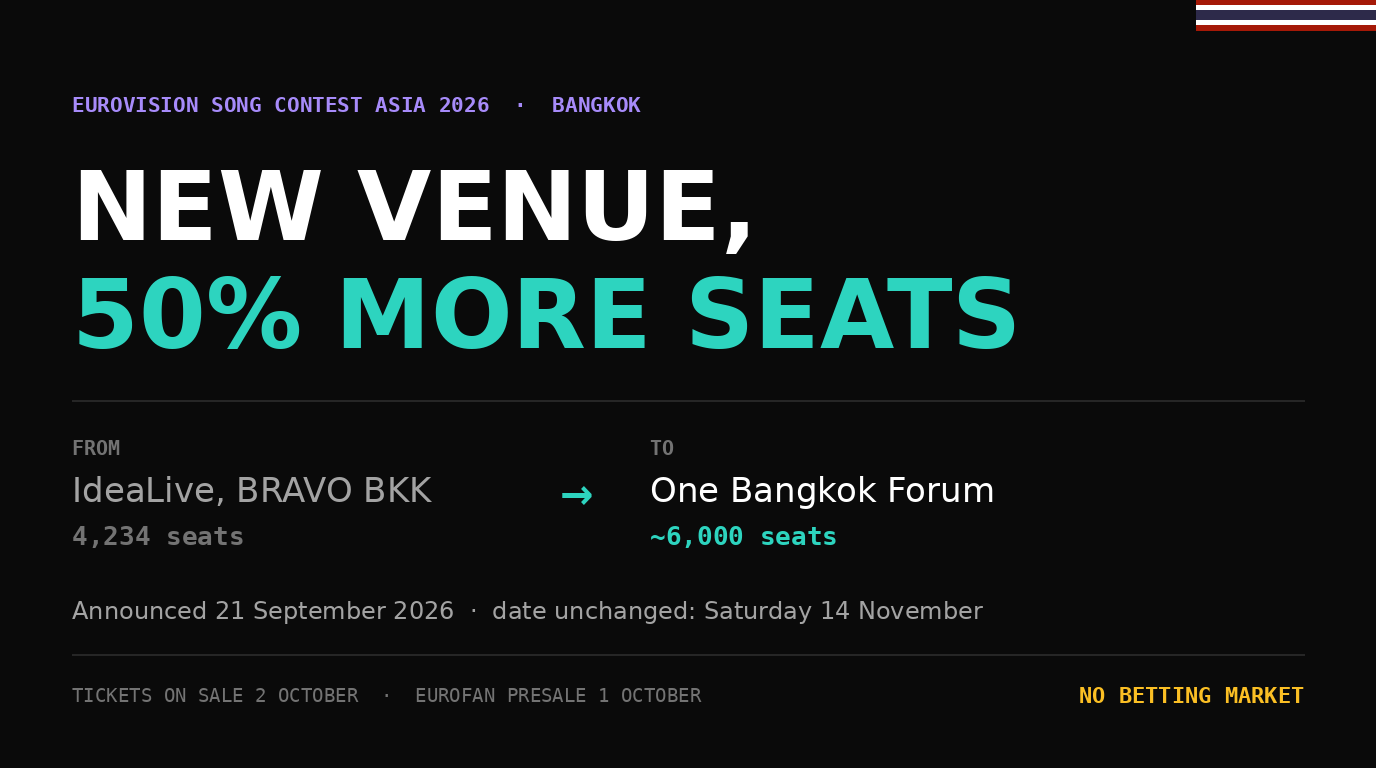
The inaugural Eurovision Song Contest Asia has changed venue eight weeks before it airs. The Grand Final on Saturday 14 November 2026 will now come from the One Bangkok Forum, reported at around 6,000 seats, rather than IdeaLive at BRAVO BKK, the 4,234-seat hall that had been the announced venue since March. The move was announced on 21 September 2026 and the official Eurovision Asia site now carries the new venue.

18+ | New customers only | T&Cs apply | Please gamble responsibly
The date has not moved. Nor has the city, the format or the field: eleven broadcasters, one live final, no semi-finals.
What changed, precisely
- Old venue: IdeaLive, on the fifth floor of the BRAVO BKK entertainment complex in Bangkok’s Rama 9 district. 4,234 seats.
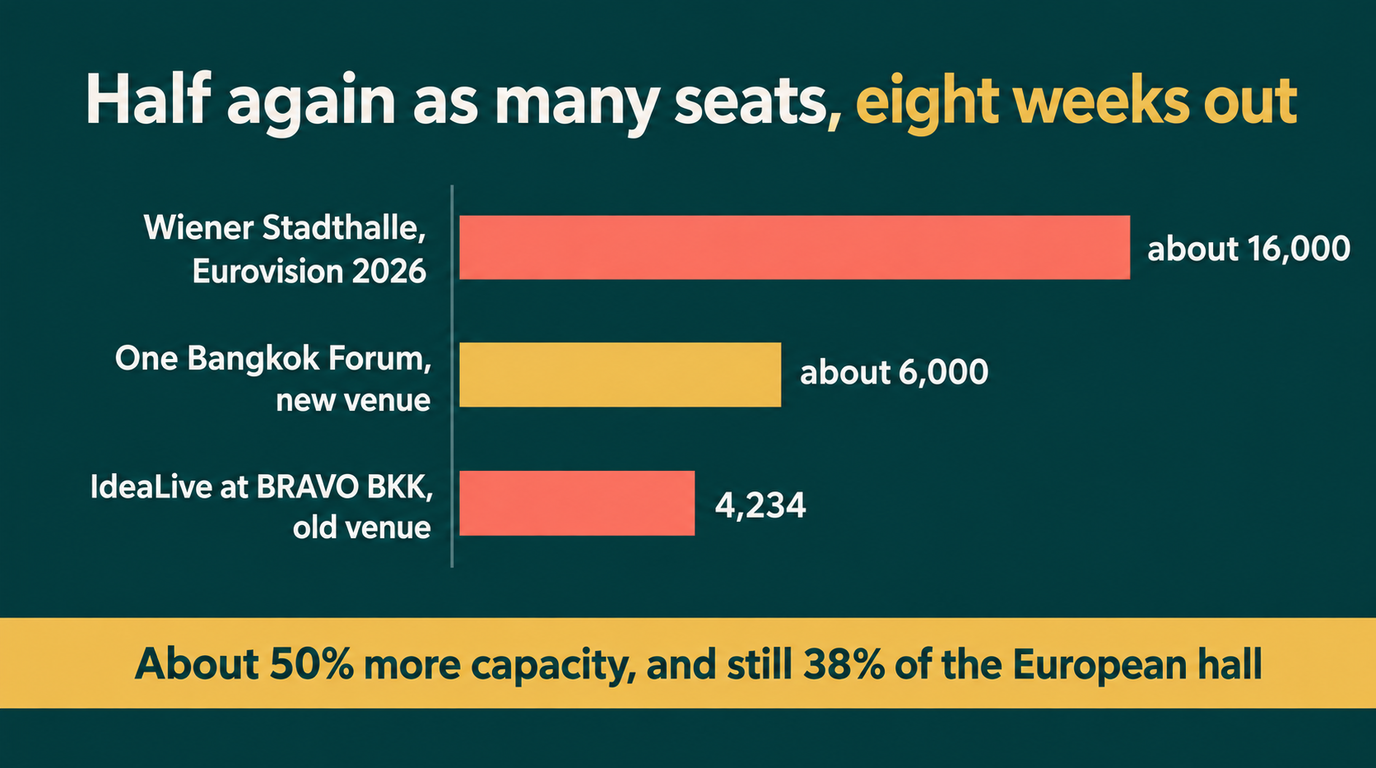
- New venue: One Bangkok Forum, reported at roughly 6,000 seats — about 50% more capacity.
- Unchanged: Saturday 14 November 2026, Bangkok, produced in partnership with Thailand’s Channel 3 and Voxovation.
The organisers have not published a reason for the move. We are stating that plainly rather than filling the gap: a capacity increase of this size, this late, is consistent with stronger-than-expected demand, but “consistent with” is inference and nobody official has said it. Treat the seat count as the fact and the explanation as an open question.
| Hall | Where | Seats |
|---|---|---|
| IdeaLive at BRAVO BKK | Fifth floor, Rama 9 district, Bangkok | 4,234 |
| One Bangkok Forum | Bangkok, new venue from 21 September | about 6,000 |
| Wiener Stadthalle | Vienna, staged Eurovision 2026 in May | about 16,000 |
Read down that column and the scale of the contest is the story, not the change. The move adds roughly 1,766 seats, which is more than a third again on a hall that was already small by European standards, and it still leaves the inaugural Asian final in a room around 38% the size of the one that staged the European contest four months earlier. A production that wanted to look big would not have started at 4,234 in the first place.
Tickets: 1 and 2 October
The venue change landed alongside the ticketing announcement, which is itself the first hard demand test the contest has faced.
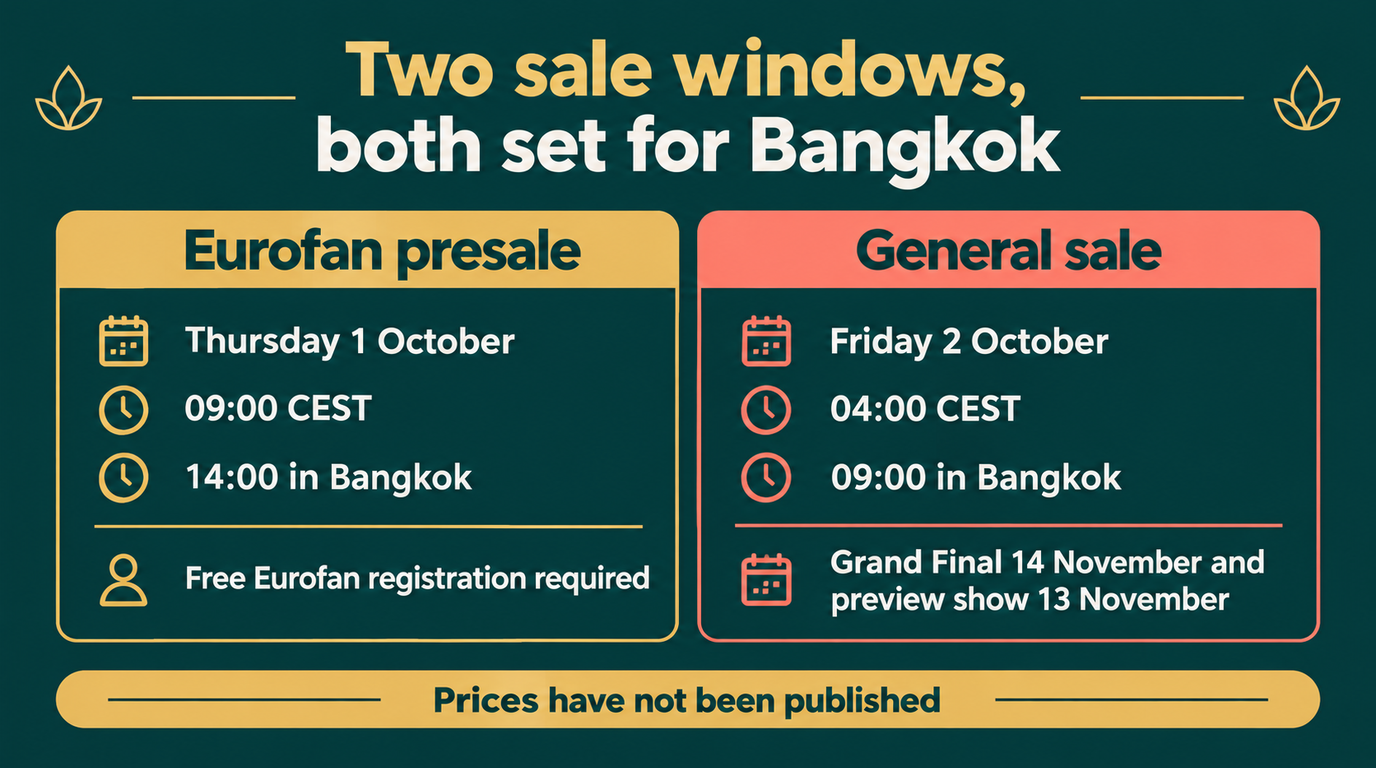
- Eurofan presale: Thursday 1 October, 09:00 CEST (14:00 in Bangkok). Free registration as a Eurofan on the official Eurovision site is required.
- General sale: Friday 2 October, 04:00 CEST (09:00 in Bangkok).
- What is covered: the Grand Final on 14 November and a preview show on Friday 13 November — a full run-through of the broadcast as it will appear the following night, the Asian equivalent of the European contest’s jury final.
Prices have not been published. Note the general-sale time: 04:00 CEST is set for Bangkok business hours, not European ones, which is a small but real signal about who the organisers think the room is for.
| Window | Date | Bangkok time | Central European time |
|---|---|---|---|
| Eurofan presale | Thursday 1 October | 14:00 | 09:00 CEST |
| General sale | Friday 2 October | 09:00 | 04:00 CEST |

Why a late venue change is worth noticing
Moving halls eight weeks out is not trivial. Staging, lighting plots, camera positions, delegation logistics and accreditation all key off the room. That the production has absorbed it without touching the date suggests the move was decided early enough internally to be manageable — and that the upside was judged worth it.
There is a supply number under all of this that nobody has stated, so it is worth stating. Two shows are being sold, the Grand Final on 14 November and the preview on 13 November, and at roughly 6,000 seats each that is around 12,000 tickets rather than the 8,468 the original hall would have carried across the same two nights. An organiser who expected to struggle does not add 3,500 sellable seats to its own problem eight weeks out. That is still inference, and it is the strongest version of the inference available.
Scale matters here in a way it does not for the European contest. Even at 6,000, this is roughly 38% of the Wiener Stadthalle (~16,000) that staged Eurovision 2026 in May. Eurovision Asia was designed deliberately small and television-first: EBU Director Martin Green said the launch contest was “starting small” and would expand in later editions. The move does not change that design. It does mean the first edition now has half again as many seats to sell, which is a more confident posture than the one the contest launched with.
What the move says about the contest’s first year
Eurovision Asia has spent 2026 being quietly re-scoped in public. The field was announced as ten countries and became eleven when Mongolia joined. The calendar slipped repeatedly — Bangladesh’s national final moved from 23 August to 30 September, Nepal’s from 19 September to 7 October after the August floods, and Cambodia’s date was not fixed until 3 September. Against that run of dates sliding backwards, a venue moving upwards in capacity is the first change this season that points the other way.
It is worth being precise about what that does and does not tell you. A bigger room is a supply decision made by organisers who can see their own pre-registration numbers; it is not audited evidence of demand, and no sales figures have been published. What can be said is that an organisation eight weeks from its first live show chose to take on the cost and disruption of a hall change rather than sell out a smaller one. Organisations under-confident about ticket sales do not usually do that.
The counter-reading deserves an airing too: venue changes this late are sometimes about the building, not the audience — availability, technical fit, a production requirement that the original hall could not meet. IdeaLive is a fifth-floor space inside a mixed-use complex, which imposes real constraints on rigging, load-in and crowd flow for a live international broadcast. Nobody official has said which of these drove the decision, so both remain on the table.
Where the eleven countries stand
Six of the eleven have named an artist; five have not, and every one of them has a date:
- Laos — Thinla is confirmed, but her song is not. She performs “Bae”, “Star” and “Water” on Sieng Lao: The One on 23 September, a 24-hour public vote follows, and the result comes on 24 September.
- Thailand — Thailand’s Chosen One, 27 September. Ten acts, with rock veteran Sek Loso as guest performer. The host nation picks last-but-five.
- Bangladesh — Voice of Bangladesh, 30 September. Ten acts, and all ten songs were released in full on 21 September.
- Vietnam — The Sound of Vietnam, 3 October. Tóc Tiên is confirmed and picks between five songs, all released on 20 September as the EP Thanh Âm Việt Nam.
- Nepal — Nepal Decides, 7 October, moved from 19 September after the August floods. Eleven acts.
- Mongolia — 10 October. Cambodia — Cambodia’s Finest Voice, 17 October, closing the calendar.
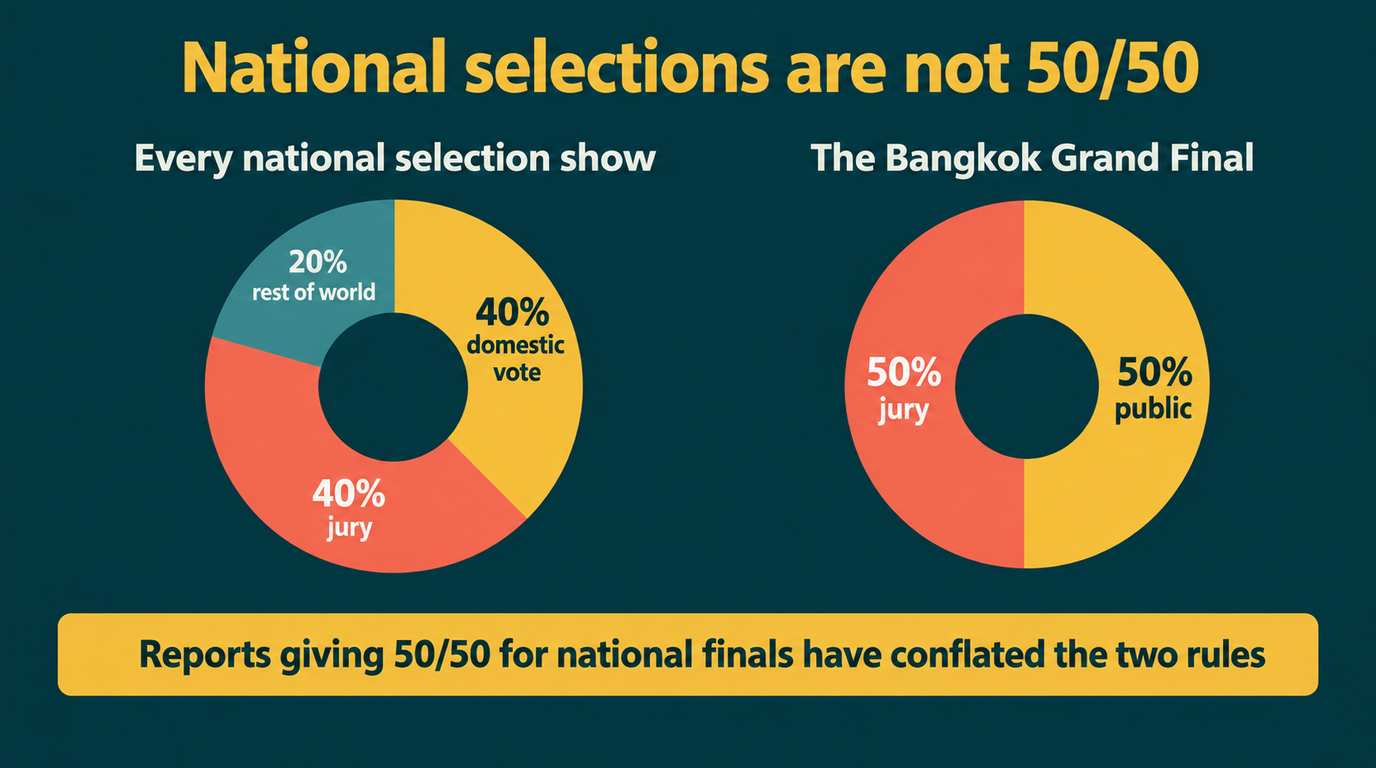
One correction worth repeating, because the fan press keeps getting it wrong: national selections are not 50/50. The official Eurovision Asia Voting Terms set every national selection show at 40% domestic vote, 40% jury and 20% rest of world, and reserve the 50/50 public-jury split for the Bangkok Grand Final. Reports giving 50/50 for the Philippines, Bangladesh, Laos and Nepal national finals have all conflated the two rules.
| Country | Show | Date | Where it stands |
|---|---|---|---|
| Laos | Sieng Lao: The One | 23 September | Thinla confirmed, song chosen by public vote on 24 September |
| Thailand | Thailand’s Chosen One | 27 September | Ten acts, Sek Loso guesting |
| Bangladesh | Voice of Bangladesh | 30 September | Ten acts, all ten songs released 21 September |
| Vietnam | The Sound of Vietnam | 3 October | Tóc Tiên confirmed, five candidate songs |
| Nepal | Nepal Decides | 7 October | Eleven acts, moved from 19 September |
| Mongolia | Not named | 10 October | Act not named |
| Cambodia | Cambodia’s Finest Voice | 17 October | Closes the calendar |
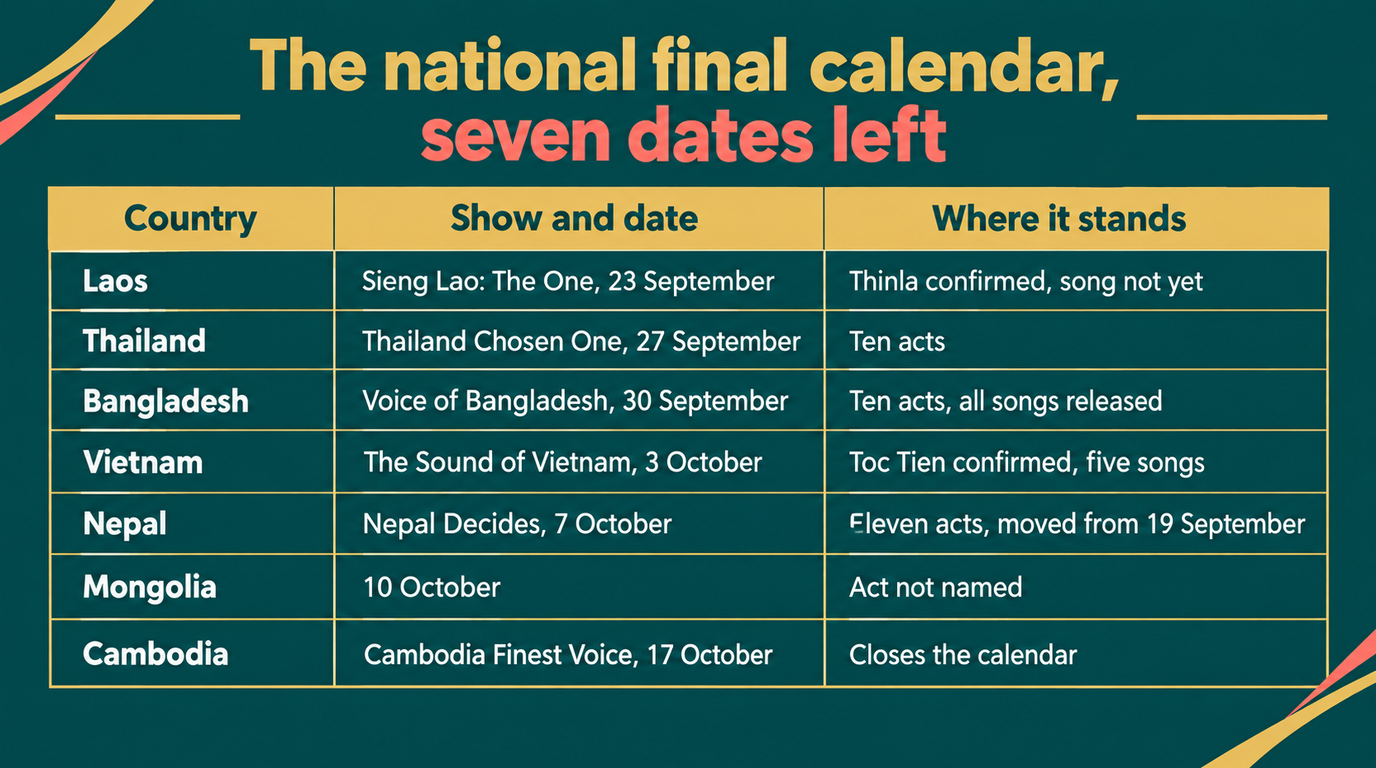
Two things follow from that calendar. The first is that every one of the seven dates falls before the general sale has been open a fortnight, so the organisers are asking people to buy tickets to a show whose line-up is five acts short. The second is that the calendar is now firm: after a season in which Bangladesh, Nepal and Cambodia all moved, nothing has slipped since 3 September. A production changing halls upward while its selection calendar finally stops moving is a coherent picture, even if nobody official has drawn it.
Two things would settle the question the organisers have left open. A published sell-out, or a published sales figure of any kind, would turn the capacity increase from a supply decision into evidence of demand. A statement naming a production or building constraint at IdeaLive would close it the other way. Neither exists as of 23 September 2026, and we will not be reporting one until it does.
The betting position: still nothing to bet on
There is no Eurovision Asia market. Not on Polymarket, not with any bookmaker we track. Our check on 22 September 2026 was the eighth consecutive check that found nothing listed under Polymarket’s Eurovision tag beyond the Eurovision 2027 Participants event.
That is now genuinely odd. The contest is under eight weeks away, six of eleven acts are named, most of the candidate songs are public and tickets go on general sale on 2 October. The raw material for a winner market exists. It simply has not been listed, and we would rather say so than imply that odds exist somewhere for readers to go and find.
If you want a sense of how the field is shaping up in the absence of prices, our Eurovision Asia hub tracks every national final and result as it lands, the stats pages cover the historical patterns the European contest has established, and the bookmaker comparison is where any Asia market would show up first. We poll Polymarket’s Gamma API on every run and will publish the moment an Asia market opens.
Sources: the official Eurovision Song Contest Asia site and its ticketing announcement, plus The Manila Times on the capacity change. Market status read from Polymarket’s Gamma API, 22 September 2026.
Correction, 28 September 2026: this article said no prediction market had opened a Eurovision Asia market. That was wrong when it was published. Kalshi, the CFTC-regulated US exchange, opened an eleven-country Eurovision Asia winner market on 14 September 2026. It is thin: on 28 September the last trades summed to 143% of the field, nine of the eleven contracts had no bid at all, and Laos accounted for about three-quarters of every contract ever traded. Our full coverage of the first Eurovision Asia market →