
Bangladesh just gave itself five more weeks — and its eventual winner five fewer. The national final that picks Bangladesh's first Eurovision Song Contest Asia entry, now officially titled Voice of Bangladesh, has moved from 23 August to 30 September 2026. Eurovoix confirmed the new date on 24 July, following a press conference in Dhaka, and ESCXTRA corroborated it on the 28th.

18+ | New customers only | T&Cs apply | Please gamble responsibly
We track every date change in this contest because dates are data. This one comes with a number attached that explains the whole decision — and a runway consequence nobody in Dhaka will enjoy talking about in November. Here is the delay, the reason behind it, and what it does to Bangladesh's position in the field.
What changed, and the number behind it
The original plan, announced in May, was clean: submissions through 10 June, a 12-finalist reveal on 21 June, intensive training through July, live final on 23 August at NTV's Dhaka studios. That plan is gone. At the Dhaka press conference, organisers revealed that around 50 to 70 applications had been received — and that the submission window was being extended by four to six weeks in response.

Read that application number against the country's size. Bangladesh has roughly 170 million people and one of South Asia's most active pop and folk scenes; 50–70 submissions for a televised national platform is a soft number, and the organisers treated it as one. The extension is a bet that more of the Bangla music establishment can be persuaded in — and the reshaped show now carries stakes worth entering for: the winner receives a cash prize and a recording contract on top of the Bangkok ticket.

The show: Tahsan Khan hosts, a heavyweight jury judges
The delay announcement doubled as the show's formal unveiling. Voice of Bangladesh airs on NTV with streaming partner Bongo, hosted by Tahsan Khan — the singer-actor who sits about as close to the centre of mainstream Bangladeshi entertainment as it gets. Twelve artists will compete in the televised final, with the result decided by a 50/50 split of jury and public voting, mirroring the Bangkok format.
The five-member jury is a deliberate spread across the Bangla music establishment: Fahmida Nabi, Hamin Ahmed, Bappa Mazumder, Shawkat Ali Emon and Akhi Alamgir — names spanning the modern-song tradition, band-scene rock, and film music direction. That panel composition is its own recruitment pitch: it tells hesitant established artists that the show is being judged by peers, not by a reality-TV celebrity desk.

The runway problem — six and a half weeks to Bangkok
Here is the trade the organisers made, in plain numbers. The Grand Final is fixed: 14 November, IdeaLive Arena, Bangkok. Every week added to the selection window comes straight out of the winner's preparation time. The confirmed calendar now looks like this:
- Bhutan — selects 11 August → 13.5 weeks of runway
- Malaysia — reveals 15 August → 13 weeks
- Philippines — selects 30 August → 11 weeks
- South Korea — selects 4 September → 10 weeks
- Nepal — selects 19 September → 8 weeks
- Bangladesh — selects 30 September → 6.5 weeks, the shortest confirmed runway in the contest

Does runway matter? For seasoned touring acts, less than fans think. But this field will be dominated by artists making their first appearance on any international broadcast stage, performing an unreleased song under Eurovision staging rules — three minutes, six performers, live lead vocals. Staging refinement, vocal arrangement and promo all compress into whatever window the calendar leaves. Bangladesh's window is now the tightest of the six confirmed dates, and only Thailand, Vietnam and Laos — still dateless — could end up tighter.
What it means for the markets
There is a second-order effect worth pricing when markets finally exist: information timing. Polymarket still lists no Eurovision Asia 2026 markets as of 4 August, but boards become viable as named entries stack up between 11 August and early September. Bangladesh will be the last confirmed country to show its hand — which means any board trading through September prices Bangladesh on pure fundamentals while eight or nine rivals trade on actual songs and staging.
That gap is where mispricing lives. A late reveal that over-delivers (an established name walking out of the extended submission window, say) would move a stale Bangladesh price sharply — the same national-final-night dynamic we documented in our Polymarket Eurovision guide as the most profitable recurring trade of the European cycle. Our Bangladesh country page carries the full talent-pool analysis, and the sentiment tracker will read Bangla social reaction from the moment the finalists are named.
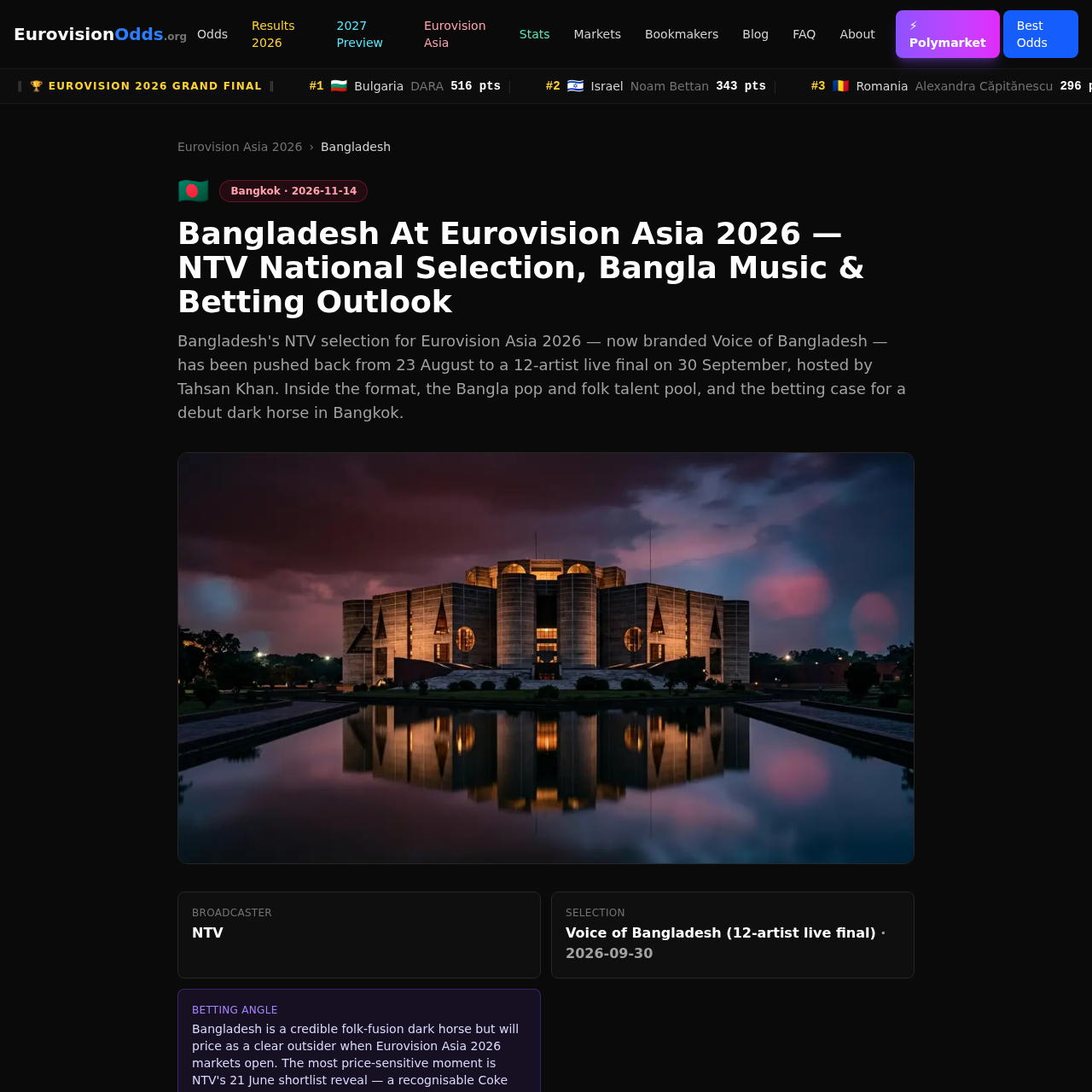
The scene the show is recruiting from
The jury names are the map of the territory. Hamin Ahmed fronts Miles, one of the defining bands of Bangladesh's rock era; Bappa Mazumder co-founded Dalchhut and has four decades of songwriting credits across the modern-song tradition; Fahmida Nabi and Akhi Alamgir are established vocal institutions; Shawkat Ali Emon works the film-music direction side. Between them they touch every commercially meaningful lane in Bangla music: band rock, adhunik (modern song), playback, and the folk-fusion current that travels best internationally.
That last lane is the interesting one for Bangkok. Bangla folk traditions — baul song most famously — are the kind of instantly distinctive sound that cuts through a ten-country television lineup, and the fusion scene around them is commercially alive in a way that pure heritage acts are not. A folk-fusion entry would give Bangladesh the same structural advantage we flagged for Bhutan: cultural specificity in a field where several rivals will default to English-language pop. Whether the extended submission window produces one is the question the 12-finalist reveal will answer.
The reshaped calendar
With Bangladesh moved, the confirmed selection order is now: Bhutan on 11 August, Malaysia's reveal on 15 August, the Philippines on 30 August, South Korea on 4 September, Cambodia in early September, Nepal on 19 September, and Bangladesh closing on 30 September. Thailand, Vietnam and Laos remain unannounced — and the host broadcaster sitting on its date this deep into August is a story we are watching closely.
Related reading: the full national-selection calendar, the Cambodia's Finest Voice breakdown, and the Eurovision Asia hub with all ten country trackers.
Who walks through the extended window?
The extension only makes sense if NTV believes better applicants exist and can be persuaded. The wish-list conversation in Bangladeshi fan spaces has centred for months on the crossover generation — artists who already bridge television, film music and the streaming charts. Pritom Hasan has been the most-mentioned name on that wish list since June, though no established act has publicly confirmed entering. The heavyweight jury panel and the new cash-prize-plus-recording-contract package read as direct pitches to exactly that tier of artist.
The counter-scenario matters for pricing too: if the extended window still produces a field of unknowns, the jury names become the story — five establishment figures lending credibility to a debut platform. Either way, the 12 finalists NTV eventually names will be the most information-rich reveal of Bangladesh's entire campaign, because they will tell us whether the establishment showed up. That reveal now lands in late August or early September, with training compressed into the weeks before the 30 September final.
Quick answers
When is the Voice of Bangladesh final? 30 September 2026, on NTV and streaming partner Bongo — moved from the original 23 August date. Twelve artists will compete.
Why was it delayed? Organisers received roughly 50–70 applications and extended the submission window by four to six weeks to widen the field. The delay was announced at a press conference in Dhaka in late July.
Who hosts and who judges? Singer-actor Tahsan Khan hosts. The jury: Fahmida Nabi, Hamin Ahmed, Bappa Mazumder, Shawkat Ali Emon and Akhi Alamgir.
What does the winner get? A cash prize, a recording contract, and Bangladesh's ticket to the Eurovision Song Contest Asia Grand Final in Bangkok on 14 November — with six and a half weeks to prepare, the shortest confirmed runway in the contest.