
Correction — 22 September 2026: the venue in this article is no longer the venue. On 21 September 2026 the organisers moved the Grand Final from IdeaLive at BRAVO BKK to the One Bangkok Forum, reported at around 6,000 seats rather than 4,234. The date is unchanged — Saturday 14 November 2026 — and no reason for the move has been published. The analysis below was written in June 2026 and its central argument, that Eurovision Asia is engineered for television rather than arena scale, still holds at the new capacity: ~6,000 seats is still only about 38% of the Wiener Stadthalle. But every seat count and venue detail in the body text refers to the original hall. The venue move, in full →

18+ | New customers only | T&Cs apply | Please gamble responsibly
The EBU and AMPAS have confirmed that the inaugural Eurovision Asia Song Contest will take place in Bangkok on Saturday 14 November 2026. The venue is IdeaLive arena, a 4,234-seat purpose-built music hall on the fifth floor of the BRAVO BKK entertainment complex in Bangkok's Rama 9 district. The host broadcaster is Channel 3 (BEC World) — a commercial free-to-air terrestrial network — working in partnership with the Tourism Authority of Thailand (TAT). It is the smallest production footprint by capacity of any Eurovision-branded televised contest since the European event's modern arena era began, and that is by design.
Betfred — Bet £10 Get £50 in Free Bets on Eurovision markets
1. IdeaLive and the Rama 9 district — a venue built for TV cameras, not stadium energy
IdeaLive opened in 2024 as the headline venue inside BRAVO BKK, a vertically stacked entertainment and lifestyle complex on Rama 9 Road in Huai Khwang, Bangkok's emerging cultural and media district. The hall sits on the building's fifth floor, with a flat-floor configuration that can be reseated for theatre, standing-floor concert, or televised event modes. In its televised-event configuration, the room holds 4,234 spectators across raked seating plus a small standing pit.
For context, that puts IdeaLive in the same capacity bracket as the smallest indoor halls ever used for the European Eurovision Song Contest — closer to the 4,000-seat theatre format used in the 1960s and 1970s than to the 10,000-to-20,000-seat arenas the contest has used since the late 1990s. The European Broadcasting Union's modern host-city criteria require a minimum 10,000-seat indoor venue. Eurovision Asia is being run to a different rulebook entirely.
| Metric | Eurovision Asia 2026 — IdeaLive | Eurovision 2026 — Wiener Stadthalle |
|---|---|---|
| Host city | 🇹🇭 Bangkok | 🇦🇹 Vienna |
| Date | 14 November 2026 | 16 May 2026 (Grand Final) |
| Venue | IdeaLive at BRAVO BKK, Rama 9 | Wiener Stadthalle, Halle D |
| Capacity (televised event mode) | 4,234 | ~16,000 |
| Relative size | ~26% of Stadthalle | baseline |
| Host broadcaster | Channel 3 (BEC World) — commercial | ORF — public broadcaster |
| Format intent | TV-first, intimate, fan-engineered | Stadium-scale, arena-led |
Rama 9 itself matters to the production logic. The district sits at the intersection of Bangkok's MRT Blue Line and the Airport Rail Link, putting Suvarnabhumi Airport within a 35-minute door-to-venue transfer for international delegations. The surrounding hotel cluster around Asok and Phetchaburi can absorb the EBU/AMPAS press accreditation footprint without the centre-of-Bangkok traffic overhead that would have hit a Ratchadamri or Siam-based bid. BRAVO BKK's mixed-use floors above and below the hall provide built-in green-room, hospitality, sponsor activation and broadcast-truck staging space inside a single building envelope — a meaningful TV production simplification.
2. Channel 3, not Thai PBS — why the early reporting got this wrong
One of the most widely repeated factual errors in the first wave of Eurovision Asia coverage is the host broadcaster. A substantial slice of regional and English-language press reported that Thai PBS would host. That is incorrect. The confirmed host broadcaster is Channel 3, operated by BEC World Public Company Limited, one of Thailand's largest commercial free-to-air terrestrial networks.
The confusion is understandable but not trivial. Thai PBS is Thailand's public service broadcaster — the closest structural analogue to the BBC, ORF or RAI, and therefore the network most journalists outside Thailand would default to when scanning for an EBU-style public partner. Eurovision Asia, however, is not being run by the EBU on European public-broadcaster principles. The format is a commercial joint venture, and Channel 3's commercial reach across Thai households plus its existing T-Pop and reality-format slate made it the production partner the organisers actually wanted.
This matters for bettors and analysts because commercial broadcaster incentives shape voting-window design, sponsor segments, ad load and the broadcast schedule. Public broadcasters traditionally lean conservative on production sponsor integration; commercial networks lean the other way. Expect Eurovision Asia's televised product to look closer to a high-budget Channel 3 prime-time entertainment special than to the public-broadcaster aesthetic of European Eurovision.
The Tourism Authority of Thailand has been explicit about the strategic logic of the partnership. In the EBU release confirming the host arrangements, TAT Deputy Governor Chuwit Sirivajjakul described Thailand's role in the contest as a vehicle for soft-power tourism reach — positioning Bangkok not just as a host city but as the visual centrepiece of the Asia-Pacific broadcast.
3. The T-Pop landscape ready to step up — and where the host-country song is likely to come from
Thailand's hosting of Eurovision Asia coincides with a domestic T-Pop industry that has matured rapidly across 2024 to 2026. The genre is no longer dependent on Korean co-production templates — there is a stable pipeline of Thai-language idol groups, vocal solo acts and electronic-pop hybrids with both domestic chart traction and meaningful streaming presence across Indonesia, the Philippines, Vietnam, Malaysia and Singapore.
Acts that are realistically in the conversation for a Thai host entry or for showcase performance slots include BUS (the 12-member Sonray Music group out of the 789 Survival reality format), 4EVE and ATLAS from XOXO Entertainment, PROXIE, PiXXiE, LYKN, 4MIX, BNK48, SERIOUS BACON, JMNK, Felizz and DICE. Each of those acts is verifiably active in the 2026 release cycle — meaning Channel 3's casting room has a deep, current talent pool to draw from rather than relying on legacy luk thung or Thai pop standards that would not translate cleanly to a regional broadcast.
The format intent — a smaller hall, a TV-first edit, a commercial broadcaster's pacing — also favours acts that look engineered for the camera rather than for an arena bowl. T-Pop's strong vocal-and-dance idol formats fit that production language directly. European Eurovision's recent winners (DARA in 2026, JJ in 2025, Nemo in 2024) all leaned into camera-first staging over arena-floor energy, and the visual grammar of the Asian contest is being built around the same principle from the ground up.
4. Thailand's host advantage on betting markets — the historical baseline
One of the cleanest sub-markets to watch when prediction-market liquidity opens on Eurovision Asia is the host-country finish. In the European contest, host-country performance is statistically stronger than the field average — though not as dominant as casual fans assume. Here is the host-country finish for every European Eurovision Grand Final across the most recent ten contests (2015 to 2026, excluding 2020 which was cancelled):
| Year | Host country | Host entry finish |
|---|---|---|
| 2026 | 🇦🇹 Austria | 15th |
| 2025 | 🇨🇭 Switzerland | 10th |
| 2024 | 🇸🇪 Sweden | 9th |
| 2023 | 🇬🇧 United Kingdom (for Ukraine) | 25th |
| 2022 | 🇮🇹 Italy | 6th |
| 2021 | 🇳🇱 Netherlands | 23rd |
| 2019 | 🇮🇱 Israel | 23rd |
| 2018 | 🇵🇹 Portugal | 26th |
| 2017 | 🇺🇦 Ukraine | 24th |
| 2016 | 🇸🇪 Sweden | 5th |
The host-country median finish across those ten contests is roughly mid-table (Sweden 9th to 15th brackets) — better than the field average of around 16th in a 26-country Grand Final, but a long way from automatic. Hosts that finish in the top five are the exception, not the rule. Hosts that finish bottom half are common, particularly when a previous winning country uses the home contest to soft-launch a debut act rather than push a marquee one.
For Eurovision Asia 2026, the implication is direct: a Thai host entry should price up at single-figure odds for a top-half finish but should not be presumed an outright favourite. The historical European base rate suggests something like a 35–45% top-half probability and a 10–20% top-five probability for a typical host-country entry. A market that prices Thailand as a 30%+ outright favourite would be over-extending the host-advantage signal; a market that prices Thailand below 10% for top-half would be underweighting it.
One important wrinkle: the Asian contest's voting model has not yet been published in full. If the contest follows European Eurovision's 50/50 jury-and-televote split, host advantage will manifest mostly on the televote half (home audience bias), partially offset by international juries who tend to under-mark host entries. If the Asian contest weights televote more heavily — which a commercial-broadcaster format might favour — host advantage compresses higher.
5. When Polymarket opens — what to watch in the next four months
As of June 2026 there is no live Polymarket event surface specifically for Eurovision Asia 2026. Polymarket has shown willingness to list Eurovision-family contests with material trading interest — the European event traded over $175 million in volume across the 2026 cycle, including host-city, outright winner, second-place and margin-of-victory markets. The Asian contest's debut cycle is unlikely to match that liquidity but should be substantial enough to support outright and host-country markets at minimum.
Here is the realistic timeline to watch for market openings, based on how Polymarket handled the European 2026 and 2027 cycles:
- July to August 2026: First national pre-selections from participating Asian broadcasters confirmed. Polymarket typically opens outright winner markets once three or four entries are publicly named. Expect early thin liquidity and wide spreads.
- September 2026: Field locks. Bookmakers and prediction markets converge on a price set. Host-country, top-three and qualifier-from-each-semi markets typically follow.
- October to mid-November 2026: Rehearsal coverage, Spotify pickup, regional press hype. Prices compress to their pre-event resting state. The largest single move in any Eurovision cycle is the price shift from rehearsal week through the semi-finals.
- 14 November 2026: Live contest. Real-time televote-driven market moves on Polymarket — the European 2026 event ran active liquidity on second-place and margin specials right through the broadcast window.
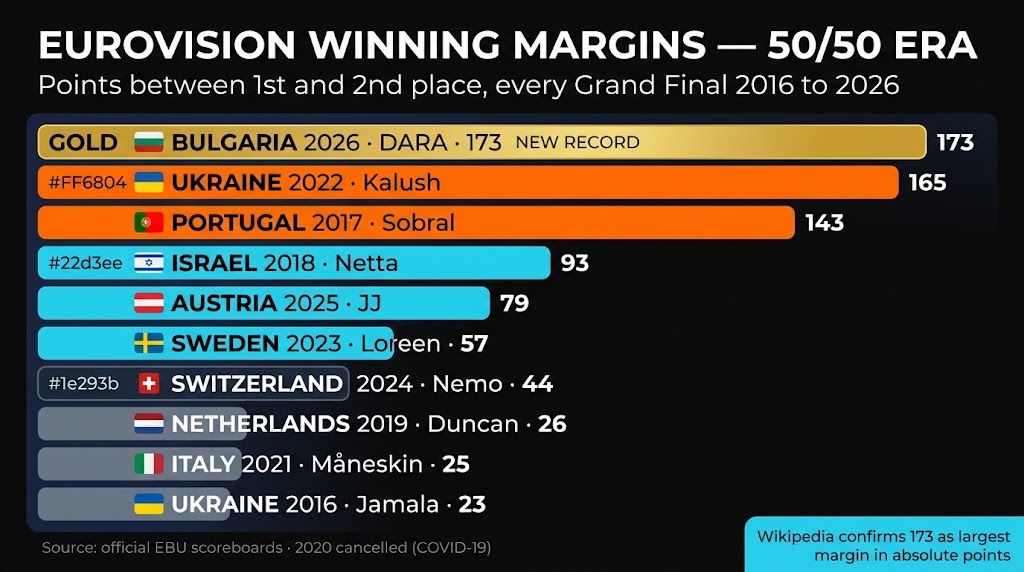
For UK bettors and prediction-market traders, the most realistic value windows are likely to sit in two places. First, the early outright market in July to August, where thin liquidity tends to misprice fancied non-host entries — the same pattern that left Bulgaria's DARA at 25/1 going into Vienna 2026's rehearsal week before compressing to a 173-point record win. Second, the host-country sub-market — Thailand's true probability for a top-half finish is almost certainly higher than a debut-contest market would initially price it, given how reliably home-country televote bias shows up in the European data.
The big picture — why a small venue is a feature, not a problem
Bangkok's IdeaLive at 4,234 seats is not a compromise. It is the visible artefact of a contest being deliberately built for a different distribution model than European Eurovision. European Eurovision is a stadium broadcast — the live audience matters to the production both as energy source and as ticket-revenue contributor. Eurovision Asia, as Channel 3 and the EBU/AMPAS partnership are framing it, is a television and streaming event with a curated live audience inside the studio frame. The hall is small precisely because the cameras are doing the work, and the production budget is going into screen-side spectacle rather than arena floor coverage.
That production logic should colour every betting analysis of the inaugural contest. Acts that translate to TV — high-resolution camera-first staging, polished idol-format choreography, vocally clean studio-grade live performance — will outperform acts that depend on arena-bowl crowd lift. Thailand's host advantage exists, but it is the camera-friendly T-Pop acts on the Channel 3 talent roster that will convert it into a real probability edge, not a generic home-field assumption.
Related coverage
- Eurovision Asia 2026 — full country index, format and broadcast schedule
- Thailand at Eurovision Asia — host country profile and entry tracker
- South Korea at Eurovision Asia — broadcaster, betting angle and entry tracker
- Philippines at Eurovision Asia — broadcaster, betting angle and entry tracker
- Eurovision 2027 host city — Sofia leads Burgas and Plovdiv at 84.5% on Polymarket
- Eurovision host countries — full venue and finish history
18+. Please gamble responsibly. BeGambleAware.org. GAMSTOP. When the fun stops, stop.