
The inaugural Eurovision Song Contest Asia takes place on Saturday 14 November 2026 at the IdeaLive arena in Bangkok, Thailand. Ten broadcasters from across South, Southeast and East Asia have been confirmed by the European Broadcasting Union (EBU) and the contest's production partner Voxovation. National selections begin in August 2026 and run through October 2026. The Grand Final will use the same 50% jury, 50% public televote scoring system that has defined every European Eurovision since 2016.

18+ | New customers only | T&Cs apply | Please gamble responsibly
For context on the scale of what is being built: the European Eurovision 2026 in Vienna, won by Bulgaria's DARA with Bangaranga on 16 May, generated a combined $175 million+ in trading volume across the major outright and head-to-head prediction markets, making it the most-traded single music event in Polymarket and Kalshi history. Eurovision Asia 2026 will be the first Asian-continental music event of comparable production scale — and the markets that will price it are already being scoped.
Betfred — Bet £10 Get £50 in Free Bets on Eurovision 2027
What we know about Bangkok 14 November
The EBU and host broadcaster Channel 3 (BEC World) have confirmed the contest will take place on Saturday 14 November 2026 at the IdeaLive arena, a 4,234-seat purpose-built live entertainment venue inside the BRAVO BKK complex in the Rama 9 commercial district of Bangkok. The venue was scoped during a joint Aussievision–EBU site visit in early 2026 and selected for its modular staging, established broadcast infrastructure, and proximity to Suvarnabhumi airport for incoming delegations.
At 4,234 seats, IdeaLive is smaller than any European Eurovision Grand Final arena since the Stockholm 2016 contest, but the EBU has briefed that the inaugural edition is intentionally being run at a contained scale to lock in production quality and broadcast logistics before any future expansion. The arena's footprint is comparable to Junior Eurovision 2024 in Madrid, which the EBU treated as a successful proof-of-concept for a single-show, single-stage continental contest format.
The contest itself will be a single Grand Final — no semi-finals — given that ten broadcasters can comfortably fit a single live show. The voting will be 50% jury and 50% public televote, with each participating country submitting a jury of five music industry professionals and a public televote tallied within that country only. The same dual-pool, top-12-points-per-country scoring system used in European Eurovision since 2016 will apply. A 'Rest-of-the-World' online vote, as introduced for European Eurovision in 2023, has not yet been confirmed for the Asian edition.
The 10 broadcasters and their selection methods
The ten confirmed participating broadcasters span South, Southeast and East Asia. Voxovation, the EBU's global national-selection production partner, is producing or supervising the production of every national final to ensure a consistent broadcast standard. Each broadcaster retains editorial control over its selection format — some are running televised national finals, some are conducting internal selections, some are using a hybrid open-call-plus-jury process.
| Country | Broadcaster | Selection method | Selection window |
|---|---|---|---|
| 🇹🇭 Thailand (host) | Channel 3 (BEC World) | TBC — national showcase format expected | September–October 2026 |
| 🇰🇷 South Korea | ENA | Open call + televised national final | National final 4 September 2026 |
| 🇵🇭 Philippines | ABS-CBN | Internal selection | Announcement August 2026 |
| 🇻🇳 Vietnam | VTV3 | Internal selection (format TBC) | September–October 2026 |
| 🇲🇾 Malaysia | Media Prima (TV3) | Hybrid — open submissions + jury shortlist | September–October 2026 |
| 🇧🇩 Bangladesh | NTV | Televised national final | National final 23 August 2026 |
| 🇳🇵 Nepal | Himalaya TV | Televised national final | National final 19 September 2026 |
| 🇰🇭 Cambodia | TV5 Cambodia | Internal selection | August–September 2026 |
| 🇱🇦 Laos | VCTV (Vientiane Capital Television) | Internal selection | August–September 2026 |
| 🇧🇹 Bhutan | BBS | Druk Dra televised national final | National final August 2026 |
The ten-country mix is striking. It is not a lineup dominated by music-industry heavyweights — South Korea is the obvious K-pop power, the Philippines and Thailand have strong domestic pop industries with international footprints, and the rest are smaller markets that are using the inaugural edition as a music-industry launchpad. That mix mirrors the original 1956 Eurovision Song Contest precisely: seven founding European countries with widely varying domestic music economies, all using the contest as a continental music-export platform.
What is notably absent so far is participation from Japan, China, Taiwan, Indonesia and India. The EBU briefed in early 2026 that several of those broadcasters were approached during the contest's scoping phase but declined or deferred to a possible second edition. Japan in particular was reported by Aussievision to have engaged in detailed discussions before pulling back over scheduling conflicts with the year-end Kohaku Uta Gassen NHK production cycle. Indonesia's RCTI and India's Doordarshan were both confirmed by Eurovoix in March 2026 as having received formal participation invitations. The ten-broadcaster inaugural lineup is the floor, not the ceiling, of what the EBU expects long-term Eurovision Asia participation to look like.
The national-final calendar
Four broadcasters have so far committed to specific national-final dates. Bangladesh's NTV was the first to publicly announce its date — 23 August 2026 — making it the inaugural Eurovision Asia national final in chronological order. Bhutan was the first broadcaster to publicly commit to running a televised national final at all, per Eurovoix's 15 May 2026 confirmation, with its Druk Dra format running in August.
| Date | Country | National final | Broadcaster |
|---|---|---|---|
| 23 August 2026 | 🇧🇩 Bangladesh | NTV national final | NTV |
| August 2026 (date TBC) | 🇧🇹 Bhutan | Druk Dra | BBS |
| 4 September 2026 | 🇰🇷 South Korea | ENA national final | ENA |
| 19 September 2026 | 🇳🇵 Nepal | Himalaya TV national final | Himalaya TV |
The remaining six broadcasters — Thailand, the Philippines, Vietnam, Malaysia, Cambodia and Laos — are expected to publish their selection windows through July and August 2026 as Voxovation finalises the per-country production schedules. The EBU has indicated that all ten national selections will conclude by mid-October 2026 to leave a four-week pre-contest window for rehearsals, press week and the Bangkok delegation arrival cycle.
Why South Korea, Thailand and the Philippines are the pre-market favourites
No prediction-market liquidity has opened on Eurovision Asia 2026 as of writing. But the structural case for a top-three of South Korea, Thailand and the Philippines is the cleanest pre-market consensus among Asian music-industry analysts. Three reasons.
1. K-pop's televote ceiling is the highest in the field. South Korea's domestic televote is the most engaged music-fan audience of any participating country by absolute volume, and ENA's open-call selection format on 4 September 2026 is structured to surface a major-label-attached artist with a real release schedule behind the entry. The closest European parallel is Sweden's Melodifestivalen — a televised selection that surfaces commercial-quality entries — and Sweden has won three of the last ten Eurovisions. K-pop entering a continental song contest with full label backing is the closest thing to a Sweden-style production pipeline that any Asian market has.
2. Host-country bounce is a real Eurovision phenomenon. In the European contest, the host country has finished in the top ten in 7 of the last 10 editions and won twice (Sweden 2023 had hosted in 2016; Switzerland 2024 won the year after Sweden hosted). Thailand as host nation gets the closing-segment narrative arc, the home-arena televote energy, and the production attention that comes with being the inaugural host. Channel 3 is also a major Thai entertainment broadcaster with the production resources to back a credible entry.
3. The Philippines has the deepest pop-vocal bench. ABS-CBN's internal selection means whichever artist is chosen will have major-label coordination and an established international fanbase. The Filipino diaspora across Asia and the Pacific is also a televote multiplier — Filipino communities in Hong Kong, Singapore, Dubai and Riyadh have been a documented driver of regional pop-act streaming volume for over a decade.
The remaining seven broadcasters are not without upside scenarios. Bangladesh's televised national final landing earliest (23 August) gives NTV a six-week buzz window before the next selection. Bhutan's Druk Dra format is the most distinctive cultural-production package in the field and could be the surprise jury-pleaser. Vietnam, Malaysia, Cambodia and Laos all have strong domestic-pop scenes whose Eurovision-Asia entries will be their first major continental music-event slot — the cross-pool televote dynamics are genuinely unknown.
Two further structural factors are worth flagging before the markets price anything. The first is jury composition: the EBU has indicated each country's five-person jury will be drawn from the local music industry — producers, label executives, vocal coaches, recording artists and music journalists — under the same eligibility rules used in European Eurovision. Cross-cultural jury voting is the variable nobody can model from prior data, because there is no prior data. The first national-final juror panels published in August will be the earliest signal of how the cross-country jury vote will distribute. The second factor is the running order, which under European-Eurovision convention is producer-determined rather than drawn, and which the EBU has confirmed will be set in Bangkok during the rehearsal week of 9–13 November 2026.
Betting outlook and Polymarket aspirational
No UK-licensed bookmaker has yet opened an outright market on Eurovision Asia 2026. That is expected to change in late August once the first national finals deliver their selected entries. The European Eurovision 2026 outright market opened on Polymarket in November 2025 — roughly six months before the contest — and reached $175M+ combined volume across all linked markets by Grand Final week.
For Asia 2026, the realistic prediction-market timeline is:
- August 2026: First outright-winner contracts open on Polymarket once Bangladesh and Bhutan complete their national finals and the first two artists are public.
- September 2026: Major liquidity arrives as South Korea, Philippines and Nepal selections complete. The top-three short-price contraction happens here.
- October 2026: Pre-contest stretch — qualifying head-to-heads, jury-vs-televote splits, top-five and top-ten markets typically follow the main outright.
- 14 November 2026: Grand Final liquidity spikes during the show itself — historically the highest in-show volume of any music-event prediction market.
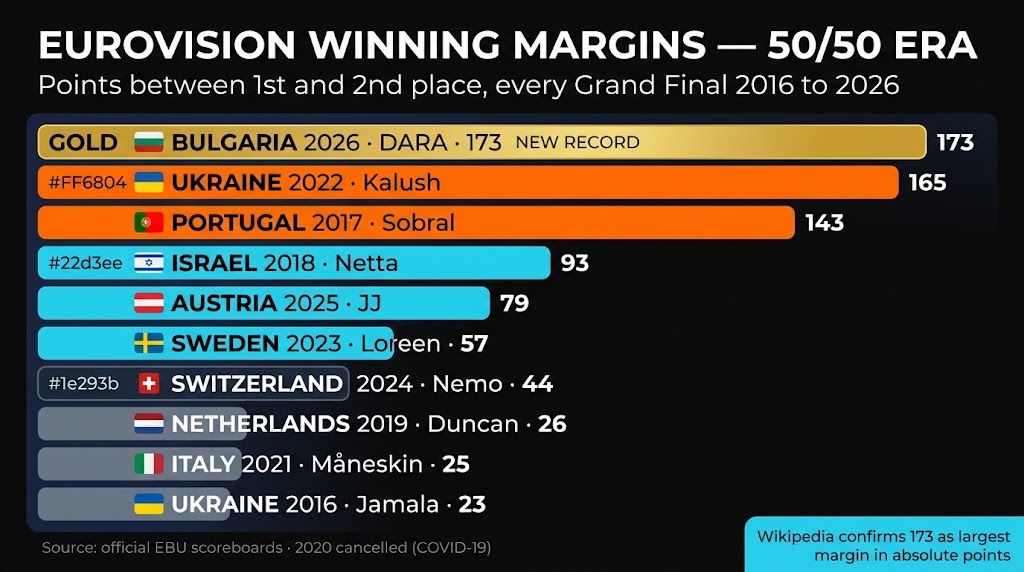
UK bettors should treat the first outright market opening as the highest-information moment of the entire cycle. The European 2026 outright lesson — Bulgaria opened at 25/1, drifted to 15/1 on Grand Final morning, and won by a 173-point margin (the largest in the modern 50/50 era) — is the cleanest case study of a structural televote signal being priced too slowly. Whichever Asian broadcaster lands a televised national final with a strong public-vote response in August or September 2026 is the prediction-market price to chase before liquidity arrives.
The Eurovision Asia hub on EurovisionOdds tracks every confirmation, national-final date, betting market open, and rumoured rule change between now and Bangkok 14 November. Bookmark it.
Related Eurovision Asia coverage
- Eurovision Asia announcement: the first continental launch since 1956
- EBU explores moving Israel to Eurovision Asia — betting impact
- Eurovision Asia 2026 hub — all 10 countries, national finals, betting markets
18+. Please gamble responsibly. BeGambleAware.org. GAMSTOP. When the fun stops, stop.