
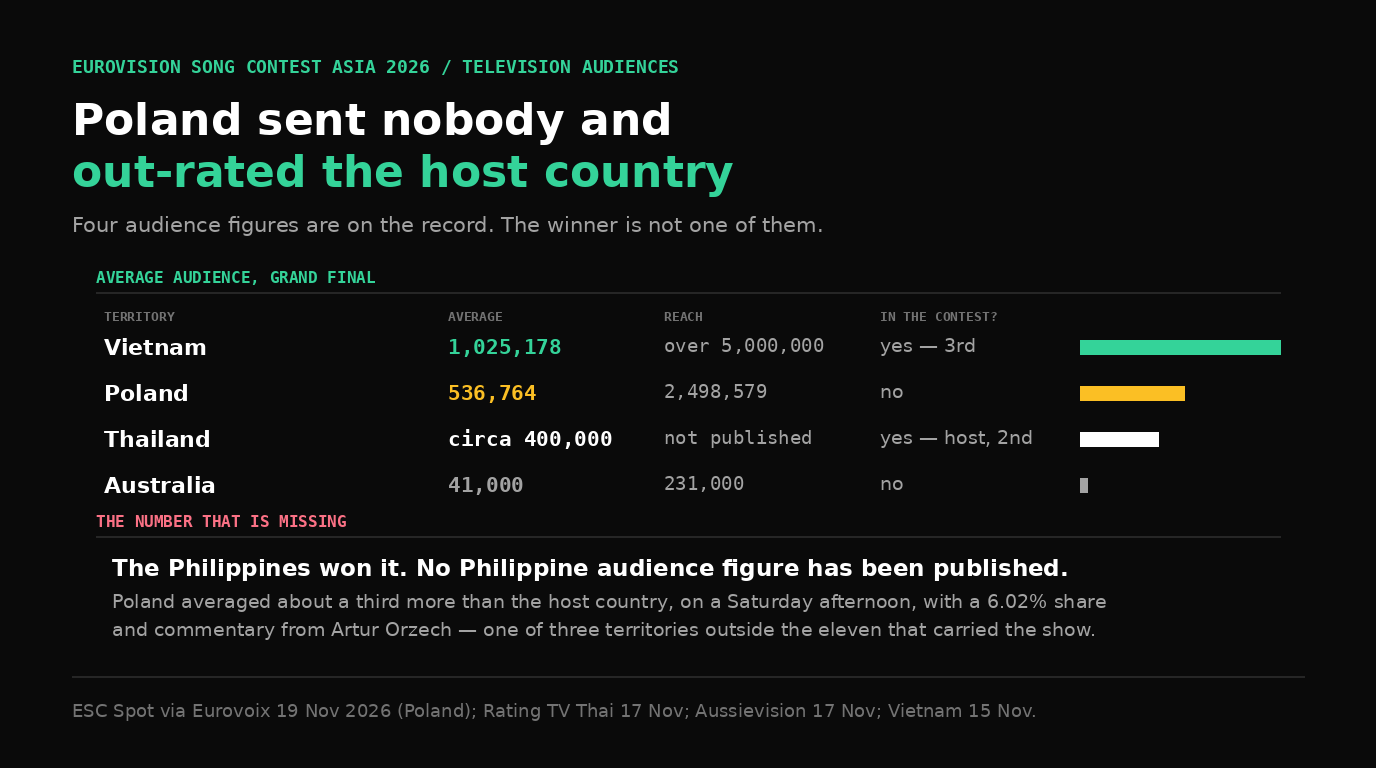
Poland did not compete at the Eurovision Song Contest Asia 2026, could not vote for itself, and still watched more of it on average than the country that hosted it. TVP 2 averaged 536,764 viewers for the Bangkok Grand Final and reached 2,498,579 people across the 2.5-hour broadcast, for a 6.02% share on a Saturday afternoon.

18+ | New customers only | T&Cs apply | Please gamble responsibly
Thailand, the host nation, recorded about 400,000 viewers. That comparison is the most useful single fact to come out of the first edition’s ratings, and it says something uncomfortable about where the appetite for this contest actually sits.
Every Eurovision Asia 2026 audience figure on the record
| Territory | Broadcaster | Average audience | Reach | Competed? |
|---|---|---|---|---|
| Vietnam | VTV | 1,025,178 | over 5,000,000 | Yes — 3rd |
| Poland | TVP 2 | 536,764 | 2,498,579 | No |
| Thailand | Channel 3 | circa 400,000 | not published | Yes — host, 2nd |
| Australia | SBS | 41,000 | 231,000 | No |
Four figures, from four territories, published across five days between 15 and 19 November 2026. Two of the four come from countries that were not in the contest at all. No figure has been published for the Philippines, which won it, and that remains the most conspicuous gap in the record.
The Polish numbers in detail
The Polish figures were published domestically and reported by ESC Spot on 19 November. The Grand Final went out on TVP 2 with commentary from Artur Orzech, the veteran Polish Eurovision commentator, and drew an average audience of 536,764 with a 6.02% share. Across the full 2.5-hour broadcast the show reached 2,498,579 people.
Reach and average audience are different measurements and should not be used interchangeably. Average audience is roughly how many people were watching at any given moment; reach counts everyone who watched for at least a qualifying period, usually a few minutes. A reach-to-average ratio of about 4.7 to 1, as here, describes a show people dipped into rather than sat through — which is exactly what an afternoon broadcast of a contest with no home entry would be expected to produce.
The timing is worth holding on to. The final started at 20:30 ICT in Bangkok, which is 14:30 CET in Poland: a Saturday afternoon slot, against the weekend schedule rather than in prime time. A 6.02% share in that slot is a respectable commercial result for an acquired programme with no national stake in the outcome.
Why Poland was watching at all
Poland was one of only three territories outside the eleven competing countries known to have carried the first edition, alongside Australia on SBS and Israel on Kan 11, with Sveriges Radio P4 taking it on radio in Sweden. There was no British broadcast at all.
Poland’s Eurovision audience is one of the largest and most durable in Europe, and TVP has a long history of treating the contest as mainstream entertainment rather than a niche acquisition. Handing a new spin-off to TVP 2 with an established commentator attached is a low-risk way to test whether that audience travels, and the answer appears to be that a meaningful part of it does.
The contrast with Australia is instructive, because the Australian number is not a verdict on Australian interest so much as on scheduling. SBS averaged 41,000 and reached 231,000, but the live final went out at 12.30am AEDT on the Sunday. Poland got an afternoon; Australia got the middle of the night. Our full write-up of that figure is in the SBS audience piece.
The host country figure is the awkward one
Thailand’s Channel 3 recorded a 0.675 rating for the live Grand Final, which converts to just over 400,000 viewers. It was the first figure published from inside the contest and it ranked the Grand Final fourteenth among Thai programmes that day.
A host country that builds an arena show, supplies both presenters and finishes second in its own contest would ordinarily expect to dominate its own schedule on the night. Thailand did not. Poland, with no entry, no vote that could change the result and no domestic stake whatsoever, averaged roughly a third more viewers than the host. The detail is covered at length in our piece on the Thai numbers.
The obvious caveat is that these figures come from four different measurement systems in four countries, and cross-country television ratings are not strictly comparable. Panel sizes, qualifying durations and the treatment of streaming all differ. The gap between 536,764 and 400,000 is not large enough to be decisive on methodology alone. What survives the caveat is the shape of the thing: the host did not produce a standout domestic number, and a non-participating European market produced a solidly commercial one.
Vietnam is the real high-water mark
The largest audience published so far belongs to Vietnam, which averaged 1,025,178 viewers and reached over 5 million. Vietnam finished third with Tóc Tiên, was one of the pre-contest favourites, and is a large market with a genuine stake in the result — which is what a strong home audience is supposed to look like.
Vietnam’s figure is roughly two and a half times Thailand’s and roughly twice Poland’s. If the first edition proved anything commercially, it is that the contest performs where a competitive entry meets a big domestic market, and that it can also pick up substantial incidental audiences in Europe where Eurovision habits already exist.
Reading ratings across four countries, carefully
Four territories reported, and no two of them reported the same thing. Poland gave an average, a reach and a share. Vietnam gave an average and a reach. Australia gave an average and a reach. Thailand gave a rating point and a derived viewer estimate, and no reach at all. Anyone building a single league table out of that is already making assumptions.
The three measurements in play mean genuinely different things. Average audience is the mean number of people watching across the duration, and it is the figure broadcasters are usually judged on. Reach counts every individual who watched at least a qualifying minimum, so it scales with how long a programme runs and how loosely the threshold is set. Share is the percentage of people watching television at that moment who were watching this programme, which rewards a show for doing well in a weak slot and penalises it for doing adequately in a strong one.
Poland’s 6.02% share and its 536,764 average are therefore two different claims. The share says the broadcast did well against what else was on a Saturday afternoon. The average says just over half a million Poles were watching at a typical moment. Both are real; neither is the same as saying Poland cared more about the contest than Thailand did.
The honest framing of the headline comparison is this: on the only measure the two countries both published, the average audience, Poland is ahead of Thailand by roughly a third. That is a real and verifiable gap. Whether it survives a like-for-like methodology is unknowable from outside, because the panels and the qualifying rules are not the same.
Who else carried it, and who did not
Outside the eleven competing countries, the known pick-ups were Poland on TVP 2, Australia on SBS, Israel on Kan 11 and Sweden on Sveriges Radio P4, the last of those on radio rather than television. Of those, only Poland and Australia have published figures.
There was no United Kingdom broadcast of any kind. That absence is worth recording because the UK is one of the largest Eurovision audiences in the world and a natural market for a spin-off, and because it shaped how British viewers could engage at all — no domestic broadcast, a Rest of World vote open to them, and no UK bookmaker pricing the contest. We covered that gap in our guide to watching from the UK.
The pattern across the two published non-participant figures is straightforward and probably predictive. Where the show landed in a watchable slot and a Eurovision habit already existed, it performed commercially: Poland, afternoon, 6.02% share. Where it landed at 12.30am, it did not: Australia, 41,000 average. Nothing about either number suggests the format is the variable.
A first edition has nothing to be measured against
The hardest part of reading these numbers is that there is no prior year. Every rating published for Eurovision Asia 2026 is a first observation, which means none of the usual judgements — up or down, held or collapsed, over-delivered or under-delivered against slot average — can be made at all.
That cuts both ways, and both ways get used. A figure like Thailand’s 400,000 can be presented as a disappointment for a host nation, or as a solid start for a brand nobody in the market had heard of eighteen months ago. Neither claim is testable until there is a second edition. The same applies to Poland: 536,764 is a good afternoon number for an acquisition, and it is also the first number TVP has, so it establishes the benchmark rather than clearing one.
What can be said without a prior year is relative. Within a single night, measured by four separate systems, the ordering was Vietnam, then Poland, then Thailand, then Australia — and the two countries with a real competitive stake in the outcome, Vietnam and Thailand, finished first and third rather than first and second. A non-participant placed between them. For a contest whose commercial pitch is that it belongs to its eleven participating markets, that ordering is the single most interesting thing in the dataset, and it will be the first thing anyone checks against next year.
What this means for the 2027 edition
Eurovision Asia 2027 currently has exactly one confirmed participant: Bangladesh, whose broadcaster NTV committed on 18 November, four days after finishing eleventh of eleven on 35 points. There is no host city, no date and no venue, and organiser discussions were trailed to begin in late November 2026. Sixteen countries have been linked with hosting bids.
Audience data is the currency those discussions run on, and the four figures published so far will be read in two directions. A prospective Asian broadcaster will note Vietnam’s million and the host’s 400,000 and ask which of the two its own market resembles. A European rights buyer will note that Poland delivered a 6% share in an afternoon slot for a show with no local angle at all, which is the kind of number that makes an acquisition easy to justify.
The missing Philippine figure matters most of all, and its continued absence a week after the win is itself a data point. The winner’s own market has published nothing. Until it does, the ratings record for the first Eurovision Asia will have a hole exactly where its best story should be.
Our full coverage of the contest, the eleven countries and what happens next is on the Eurovision Asia hub; the scoreboard and the result are at who won Eurovision Asia 2026, and the 2027 outlook, including the host bids, is in our 2027 preview. For the European contest, the Eurovision 2027 page tracks the 36 confirmed countries.
Sources: Eurovoix, 19 November 2026, reporting ESC Spot, for the Polish figures; Rating TV Thai via Eurovoix, 17 November, for Thailand; Aussievision, 17 November, for the SBS figures; and VTV figures reported 15 November for Vietnam.