
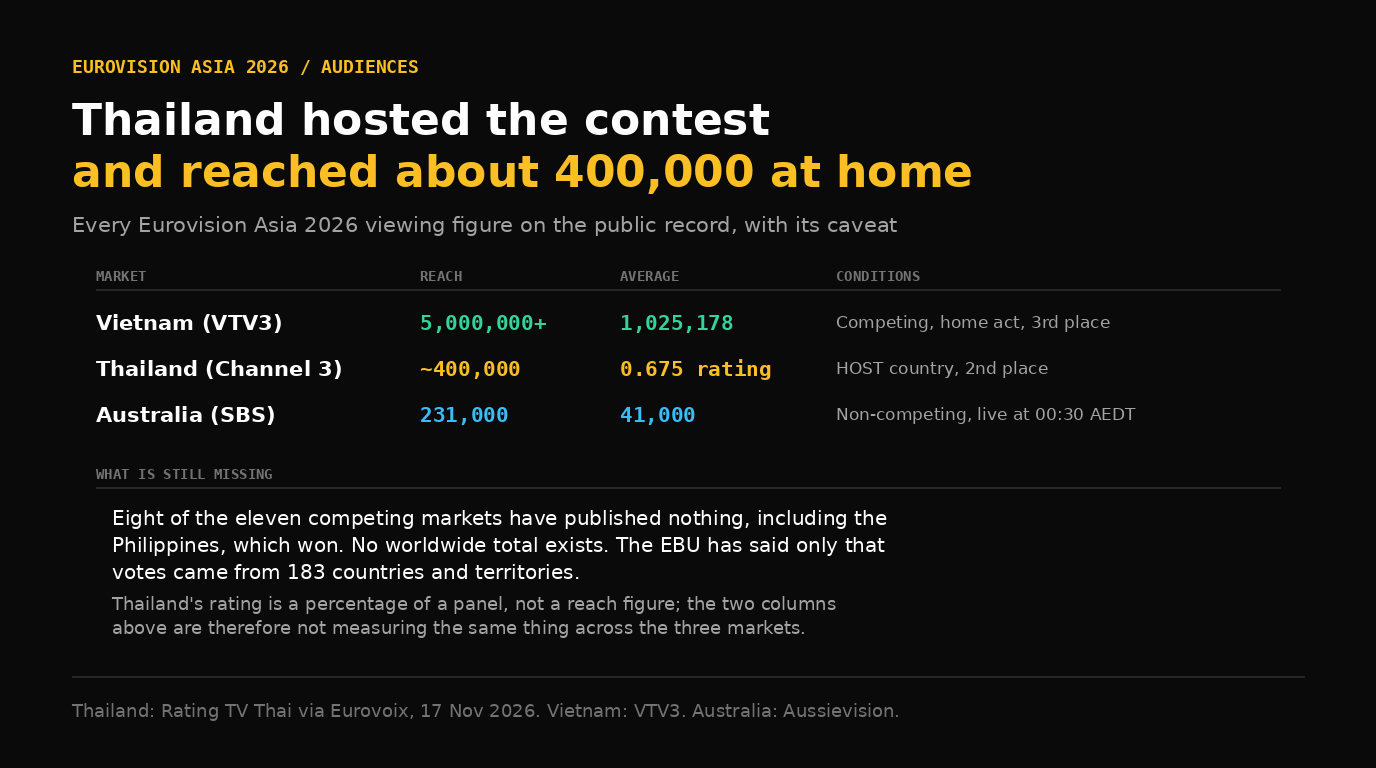
Just over 400,000 people in Thailand watched the Eurovision Song Contest Asia 2026 Grand Final live on Channel 3, on a rating of 0.675. The figure was published by Rating TV Thai and reported on 17 November 2026. It makes Thailand the third of the eleven competing countries to put an audience number on the record, and the first from the country that hosted the contest.

18+ | New customers only | T&Cs apply | Please gamble responsibly
It is also, by some distance, the most awkward of the three. Thailand staged the show, finished second with it, and broadcast it at home in Saturday prime time — and the Grand Final was the fourteenth most-watched entertainment programme on its own channel that weekend.
Key takeaways
- Thailand recorded a 0.675 rating on Channel 3, equal to just over 400,000 viewers, for the live Grand Final from Bangkok on 14 November.
- The show placed 14th among Channel 3’s entertainment programmes across that weekend, on its own broadcaster, in the host city.
- Vietnam is still the largest figure by far: VTV3 reached over 5 million with an average of 1,025,178, for a country that finished third.
- The three published figures are not measuring the same thing. A rating is a share of a measured panel; reach and average audience are different quantities again.
- Eight of the eleven competing markets have published nothing, including the Philippines, which won, and Malaysia, whose broadcast became an international story.
- This matters for 2027 because the organisers said it would. Executive producer Assaf Blecher tied a second edition to how Bangkok performed, and talks with broadcasters begin around 21 November.
- There is nothing to bet on. Neither venue lists a Eurovision Asia 2027 market; all six Polymarket books and Kalshi’s eleven contracts settled on 15 November.
What’s on this page
The number, and what a 0.675 rating is · All three published figures · The one fair comparison · The host-market problem · A discrepancy in the Australian line · Eight markets have published nothing · What it means for a second edition · Nothing to bet on · What to watch next · Sources
The number, and what a 0.675 rating actually is
Channel 3 carried the Grand Final live from the One Bangkok Forum on the evening of Saturday 14 November, starting at 20:30 ICT. Rating TV Thai recorded a 0.675 rating for the broadcast, which the measurement converts to a reach of just over 400,000 viewers.
A rating point is a percentage of a measured universe, not a headcount, and the universe is a panel rather than the population. So 0.675 does not mean 0.675% of Thailand watched, and the 400,000 is the measurement service’s own conversion rather than an independent count. We quote both because quoting either alone would mislead.
The comparative detail is the more useful one: the contest was the fourteenth most-viewed entertainment show on Channel 3 over that weekend. That is a ranking within one commercial free-to-air schedule, which strips out most of the measurement questions. Thirteen other entertainment programmes on the same channel did better over the same two days.
All three published figures, side by side
| Market | Broadcaster | Reach | Average / rating | Conditions |
|---|---|---|---|---|
| Vietnam | VTV3 | 5,000,000+ | 1,025,178 average | Competing, home act, finished third |
| Thailand | Channel 3 | ~400,000 | 0.675 rating | HOST, home act, finished second |
| Australia | SBS | 231,000 | 41,000 average | Non-competing, live at 00:30 AEDT |
Read down the right-hand column before reading the numbers. Vietnam had a home act and prime time. Thailand had a home act, prime time and the stage itself. Australia had none of those and a start time in the middle of the night. On conditions alone, Thailand should be sitting second in that table and close to Vietnam. It is sitting second and nowhere near it.
Thailand’s own result makes the gap stranger. MANG x DAOU finished second with 170 points for the host country with “Aroma” — fourth with the juries on 62 points, but second with the public on 108. The full eleven-country scoreboard is in our result report, and the contest hub is at Eurovision Asia.
The one comparison the three figures do support
Stacking a rating against a reach against an average is not a comparison, it is a category error. But two of the three markets published both a reach and an average, and that pair does support one honest reading: the ratio between them describes how much of the audience stayed.
| Market | Reach | Average | Reach-to-average ratio |
|---|---|---|---|
| Vietnam (VTV3) | 5,000,000+ | 1,025,178 | about 4.9 to 1 |
| Australia (SBS) | 231,000 | 41,000 | about 5.6 to 1 |
| Thailand (Channel 3) | ~400,000 | not published | cannot be calculated |
Those two ratios are close, and that is the mildly reassuring finding buried in a set of otherwise unflattering numbers. In both markets that published a pair, roughly five people looked in for every one who stayed through — a dip-in, dip-out pattern that is normal for a long live entertainment broadcast and does not suggest an audience walking out. A contest that was actively losing viewers would show a much wider ratio than that.
Thailand published no average, so it cannot join that comparison, and we are not going to estimate one. If Channel 3 or Rating TV Thai releases an average audience figure, the Thai ratio is the single number that would tell us whether the host market watched the show or merely switched past it.
The host-market problem, stated carefully
There is an obvious story here and it is worth resisting until the evidence supports it. The obvious story is that Thailand did not watch its own contest. The careful version is narrower: on the one channel that carried it live, on the one measurement service that has reported, the Grand Final reached about 400,000 people and ranked fourteenth in its own channel’s weekend entertainment list.
What that version leaves out, deliberately, is everything we have not been shown. No streaming figure has been published for Thailand. No catch-up or repeat figure has been published. No total across all Thai platforms has been published. In Australia, where a breakdown does exist in outline, most of the audience came through streaming rather than broadcast television — and if the same is even partly true in Bangkok, the Channel 3 linear number is a floor rather than a total.
The other thing it leaves out is any expectation to measure against. Neither Voxovation nor Channel 3 has said what it was hoping for. Without that, 400,000 is a number without a verdict attached, and anyone supplying the verdict is supplying it themselves.
A discrepancy in the Australian line, and which version we use
The 17 November summary table that carried Thailand’s figure describes Australia’s as “Average 41,000 viewers / Reached 231,000 viewers for SBS Two repeat”. That conflicts with the same outlet’s own report a day earlier, which said the 231,000 was reach across television and streaming, with the SBS2 broadcast only one part of it and most viewing coming through SBS On Demand.
We use the fuller version, because it is the one that states its method and cites Aussievision as the source of the figures. The summary line attaches both numbers to the repeat alone, which the earlier report explicitly contradicts. It is a small thing, but it is exactly the kind of small thing that gets copied forward until it is treated as established, and this site has done that before and had to correct it. Our 17 November piece on the Australian figures is here.
Eight of eleven markets have still published nothing
| Status | Countries |
|---|---|
| Figure published | Vietnam, Thailand |
| Nothing published | Philippines, Malaysia, Laos, Bhutan, South Korea, Mongolia, Nepal, Cambodia, Bangladesh |
| Published, non-competing | Australia |
Two of eleven competing markets is about 18% of the field, which is better than the 9% we had yesterday and still not enough to support a confident conclusion. The absence that matters most is the Philippines. CARMELLE won the contest with 211 points, topping both the jury and public halves, and no Philippine audience figure has appeared. Malaysia’s is the second most interesting, because TV3’s altered broadcast became an international story and a ratings number would say something about how many people saw the version that was altered.
There is also a timing point worth noting. Vietnam’s figure appeared on 15 November, the day after the final; Australia’s on 17 November; Thailand’s on the same day. Ratings bodies in most of these markets publish on a weekly cycle, so the next genuine opportunity for several of the silent nine falls in the days immediately around the organiser talks — which is either useful timing for the broadcasters or awkward timing, depending on what the numbers say.
No worldwide total has been published by anyone. The only global figure of any kind the organisers have given is that votes came from 183 countries and territories, which is a measure of voting reach, not of viewing.
What it means for a second edition
The organisers made this relevant themselves. Executive producer Assaf Blecher tied a second edition to how Bangkok performed, and talks with broadcasters about Eurovision Asia 2027 are due to begin around 21 November — within days of these figures appearing. Unlike the European contest, the winner does not host: Eurovision Asia uses a Junior-style bidding process, no city has been named and no bid has been publicly lodged.
Set against that, two data points from a field of eleven, one of them from the host and smaller than expected, is a thin evidence base for a decision worth tens of millions. It is also, as of today, the entire public evidence base. Christer Björkman has said he expects 16 countries at a second edition and Blecher told AFP that 16 or 17 countries and territories are interested, naming China, Hong Kong and Taiwan — but no broadcaster already in the European contest can enter. The full outlook is in our 2027 piece.
There is nothing to bet on, and that is worth stating plainly
No Eurovision Asia 2027 market exists on any venue, and no fixed-odds bookmaker has ever priced this contest. The 2026 books are all finished: Polymarket closed its six at 04:59 UTC on 15 November on about $271,796 of lifetime turnover, and Kalshi settled its eleven contracts at 19:46 UTC the same day. A settled market is not a live one, and we will not present one as though it were.
One correction is owed on that subject. On 17 November this site wrote that Kalshi returns no open Eurovision market at all on either contest. That is wrong for the European side: Kalshi has 38 open contracts on Eurovision 2027 participation, checked again at 17:07 UTC on 18 November. It is correct for Asia, where Kalshi has nothing open. The affected sentences have been corrected in place with a dated note. Venue comparisons live on our bookmakers page.
What to watch next
- Organiser talks with broadcasters, around 21 November. A confirmed second edition, a named bidding city or a broadcaster committing would each be a genuine story.
- A Philippine audience figure. The winning country has published nothing, and it would be the single most informative number still missing.
- A Malaysian figure, for what it would say about the reach of the altered broadcast.
- Any worldwide total. None exists, from the EBU, Voxovation or anyone else.
- Any 2027 market opening anywhere. None has.
Sources
- Eurovoix, 17 November 2026 — the Thai rating and viewer figure, citing Rating TV Thai.
- Eurovoix, 17 November 2026 — the Australian reach and average, obtained by Aussievision.
- Eurovision Song Contest Asia — the official contest site.
- Kalshi and Polymarket Gamma APIs, both queried directly at 17:07 UTC on 18 November 2026.
- Scoreboard and settlement figures from this site’s own dated reporting, linked above.