
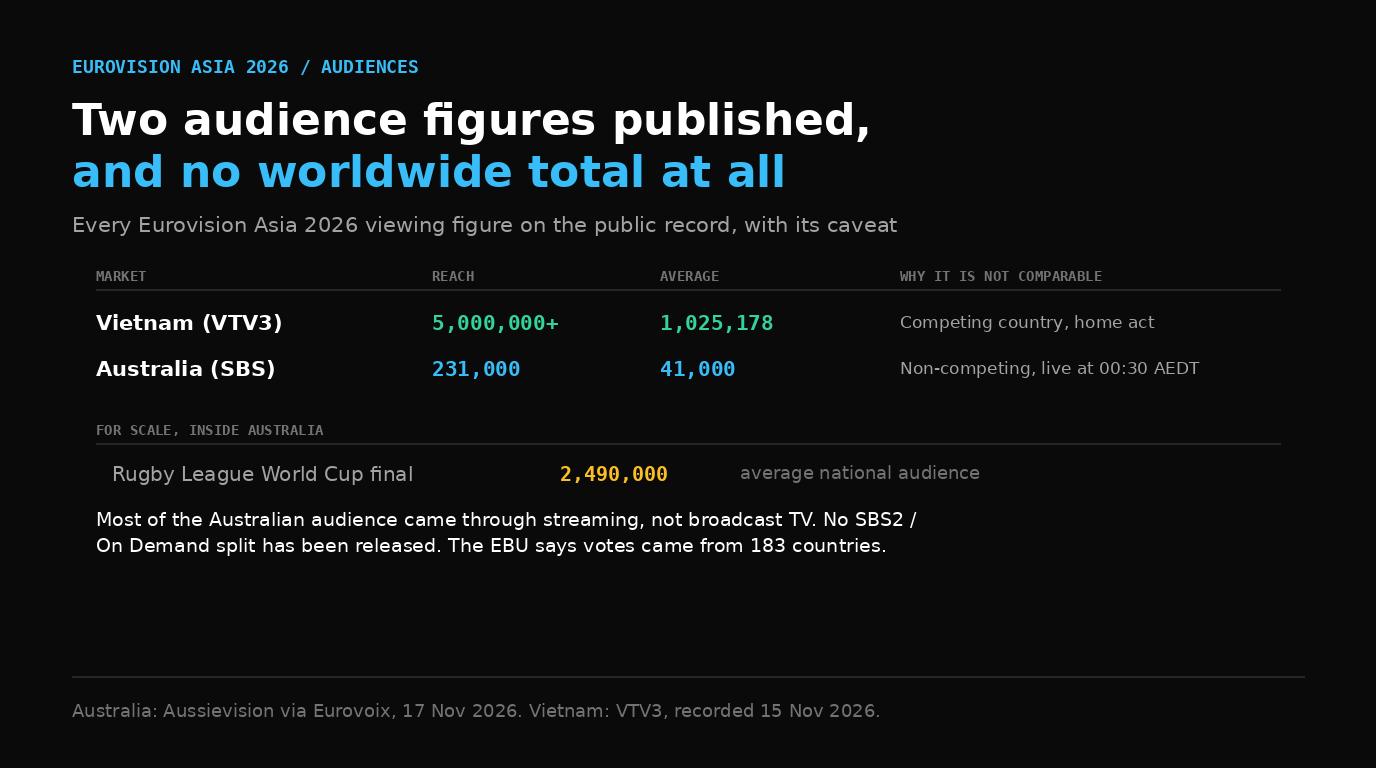
Eurovision Song Contest Asia 2026 reached 231,000 people in Australia across television and streaming, at an average audience of 41,000. The figures were obtained by Aussievision and reported on 17 November 2026. They are only the second set of viewing numbers published for the contest anywhere, and they arrive at the moment the figures matter most: organiser talks with broadcasters about a second edition are due to begin around 21 November.

18+ | New customers only | T&Cs apply | Please gamble responsibly
Australia was one of a handful of territories outside the eleven competing countries to pick the show up. SBS carried the Grand Final live on SBS On Demand in the early hours of 15 November AEDT, with a replay on SBS2 at 19:30 that evening. Most of the audience came through broadcast video on demand rather than traditional television, and no split between the two has been released.
Why 41,000 is not the number to be alarmed by
It is a small figure and it should be read as a small figure from a market that had almost nothing going for it. Australia had no act in the contest, because SBS competes in the European Eurovision Song Contest and no broadcaster already in that contest can enter the Asian one. It had no vote that mattered to a home entry. And it had a start time of 12:30am, because the Grand Final began at 13:30 UTC from Bangkok.
Against that, the comparison Eurovoix itself reaches for is instructive about scale rather than about the contest: the Rugby League World Cup final between Australia and New Zealand drew an average national audience of about 2.49 million. That is roughly sixty times the Eurovision Asia average. It is also a sport Australia plays, in a final Australia was in, at a civilised hour.
The honest framing is that this is a cold-open number. A first edition of a new contest, broadcast overnight in a country with no stake in the result, reached 231,000 people. Whether that is encouraging or disappointing depends entirely on what SBS expected, and SBS has not said.
The only other published figure, and why they do not compare
The sole other audience figure on the public record comes from Vietnam, and it is a different kind of number altogether. VTV3 reached over 5 million viewers with an average audience of 1,025,178 — the largest reach of any programme on the channel that Saturday.
| Market | Reach | Average | Context |
|---|---|---|---|
| Vietnam (VTV3) | 5,000,000+ | 1,025,178 | Competing country, home act, prime time |
| Australia (SBS) | 231,000 | 41,000 | Non-competing, live at 00:30 AEDT |
Putting those two side by side is useful only as a demonstration of how far apart the conditions were. Vietnam had Tóc Tiên on stage, finished third, and watched in the evening. The ratio between the two averages is about twenty-five to one, and essentially all of it is explained by the circumstances rather than by anything about the show.
What nobody has published is a worldwide total. Not the EBU, not Voxovation, not the host broadcaster. The only global figure of any kind on the record is the EBU’s statement that votes came from 183 countries and territories, which measures the reach of the voting window rather than the size of the audience. Two national figures and a count of voting territories is a thin evidentiary base, and it is all anyone outside the organisation currently has.
Reach and average are two different questions
The two Australian numbers are not a range and they are not alternatives. They answer different things, and the gap between them carries information.
Reach counts how many distinct people watched at all, typically above a minimum duration. Average audience is the mean number watching at any given moment across the broadcast. A show with 231,000 reach and a 41,000 average has a ratio of roughly 5.6 to one, which describes an audience that largely dipped in and out rather than sitting through the whole thing.
For a three-hour overnight broadcast of a contest with no home entry, that is close to what you would expect, and it is arguably the more encouraging of the two numbers: a quarter of a million Australians chose to look at a brand-new contest in the middle of the night. The 41,000 tells you how many stayed. Neither figure alone is the story, and quoting only one of them — in either direction — misrepresents it.
The streaming skew compounds this. SBS carried the live broadcast on SBS On Demand only, with linear television getting the replay at 19:30, and most viewing came through BVOD. Streaming measurement and panel-based television measurement do not produce like-for-like numbers, and no split between SBS2 and SBS On Demand has been released, so even the internal composition of the 231,000 is not public.
The comparison SBS itself has already drawn
There is a sharper benchmark available than the rugby, and it comes from SBS’s own public reasoning. When the broadcaster confirmed on 1 September 2026 that Australia would compete at the Eurovision Song Contest 2027 in Burgas, it framed the decision around audience reach rather than results, citing 3.27 million Australian viewers for the 2026 European contest.
So in the same market, through the same broadcaster, in the same year: the European Eurovision reached about 3.27 million Australians, and Eurovision Asia reached 231,000. That is a ratio of roughly fourteen to one.
Read it carefully, because it cuts both ways. The European contest has been on Australian television since the 1980s, has a national act, a national vote, a decades-old audience habit and a broadcaster that promotes it heavily. Eurovision Asia had none of that and was four days old. A fourteen-to-one gap against an entrenched incumbent is not obviously a failure for a debut. But it does establish the scale of the gap that a second edition would have to start closing, in the one non-participating market where we can actually measure it.
What this does and does not tell you about a 2027 edition
Executive producer Assaf Blecher has tied the prospect of a second edition to how the Bangkok debut performed. That makes audience data the governing evidence, and it is why two national figures published four days apart are worth more attention than they would normally get.
But be careful about the direction of the inference. Neither figure is the one the decision will be made on. A contest produced for Asian broadcasters will be judged on Asian audiences, on the eleven participating markets and on whatever the organisers can show prospective entrants. Vietnam’s million-plus average is a data point in that argument. Australia’s 41,000 is a data point in a much smaller argument about whether non-participating markets are worth servicing at all.
What we know about the 2027 process otherwise has not moved. Unlike the European contest, winning does not confer hosting: Eurovision Asia uses a Junior-style bidding process, no city has been named, and no bid has been publicly lodged. Christer Björkman has said he expects 16 countries to compete. Blecher told AFP that 16 or 17 countries and territories are interested, naming China, Hong Kong and Taiwan — though no broadcaster already in the European contest can enter, which rules out Georgia, Armenia, Azerbaijan, Israel and Australia’s own SBS. Our full 2027 outlook sets out what is confirmed and what is not.
Ten of the eleven competing markets have published nothing
The measurement gap is the part that should temper any confident reading in either direction. Eleven countries competed in Bangkok. Exactly one of them — Vietnam — has published an audience figure. The Philippines, which won; Thailand, which hosted and finished second; Malaysia, whose broadcast became an international story; and the other seven have all released nothing.
That is not unusual this soon after a debut, and national ratings bodies across the region report on different timetables and different methodologies, which is part of why a clean worldwide total is hard to assemble even internally. But it means the evidence base for judging the contest’s reach currently consists of one competing market, one non-competing market, and a count of voting territories. Anyone drawing a confident conclusion about how Eurovision Asia performed is working from roughly 9% of the competing field.
It also means the next few weeks are likely to produce more numbers, not fewer, and the ones from the Philippines, Thailand and Malaysia will matter considerably more than Australia’s.
There is nothing to bet on, and that is worth stating plainly
No prediction market and no fixed-odds bookmaker currently lists any Eurovision Asia 2027 market of any kind. No host city market, no participants market, no winner market. Both venues were checked directly on 17 November 2026: Kalshi returns no open Eurovision market at all on either contest, and Polymarket has exactly one, on the European side.
The 2026 books are all settled. Polymarket closed its six Eurovision Asia markets at 04:59 UTC on 15 November, on about $271,796 of lifetime turnover across the six. Kalshi finalised its eleven contracts at 19:46 UTC the same day, six weeks ahead of its own scheduled close. A settled market is not a live one, and anyone presenting those closing prices as current odds is misreading them. For the full settlement record see how Kalshi settled, and for the venue comparison, our bookmakers page.
The Malaysian broadcast: a second day of silence
The other story still running from the Grand Final has not advanced, and the absence is itself becoming the point. TV3 has still not commented on the altered Malaysian broadcast, and neither has its parent company Media Prima, a second day after the EBU and Voxovation both spoke.
To restate the position without embellishing it: Martin Green, Director of the Eurovision Song Contest, said the organisers were “surprised and disappointed to learn that the broadcast of Eurovision Song Contest Asia was altered in Malaysia,” and that the change “appears to be isolated to the Malaysian broadcast of the show.” Voxovation said it is working with the broadcaster to establish the circumstances. Philippine spokesperson Vice Ganda was reportedly replaced during parts of the jury points reveal with the contest logo, audio intact, and drag performers were reportedly cut from the opening act.
Coverage has since spread into Malaysian domestic press and the international LGBTQ+ press. No party has given a reason, so the widely published link to Malaysia’s broadcast content rules remains inference rather than established fact, and this site has not seen the broadcast. Neither organiser has said whether unaltered transmission is contractually required, or whether any sanction exists — and that governance gap is the part that bears on 2027, because the territories Blecher named as interested have content rules of their own.
What to watch next
Three things. Organiser talks with broadcasters, due around 21 November, which is the first point at which a second edition stops being a question about ratings and becomes a question about commitments. Any further national audience figures — the eleven competing markets are the ones that matter, and only Vietnam has published. And any statement from TV3 or Media Prima, which would be the first word from the only party that knows why the Malaysian feed was altered.
The full contest record, the eleven country pages and the final scoreboard are on our Eurovision Asia hub, and the European contest’s own 2027 picture is tracked on our Eurovision 2027 page.
Sources
- Eurovoix, 17 November 2026 — 231,000 viewers watched Eurovision Asia 2026 in Australia (figures obtained by Aussievision)
- SBS — broadcaster of the Grand Final in Australia, live on SBS On Demand and replayed on SBS2
- Polymarket Gamma and Kalshi APIs, both checked directly on 17 November 2026: no open Eurovision Asia market on either venue.