
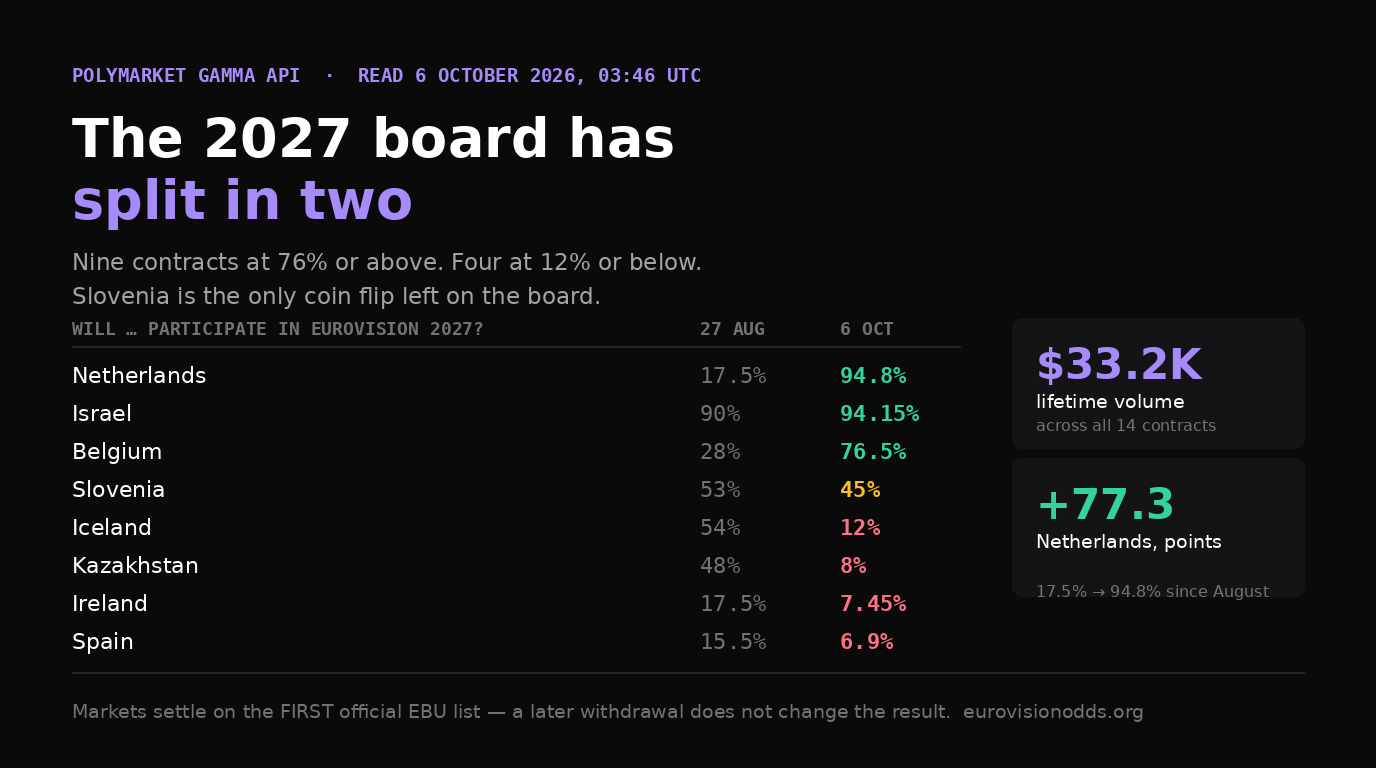
Belgium’s public broadcaster confirmed three weeks ago that it is going to Burgas, and Polymarket still prices the country at 70%. Every other broadcaster in the confirmed field that carries a contract on the same board trades between 95.25% and 97.35%. Read from Polymarket’s Gamma API at 16:30 UTC on 13 October 2026, Belgium sits at 70.5% — a 26-point discount to Canada, Italy, the Netherlands, Germany, Israel, Austria and North Macedonia, all of which have done exactly what VRT has done and said yes.

18+ | New customers only | T&Cs apply | Please gamble responsibly
There is a reason for the gap, and it is not the one the price looks like. It is in the contract’s fine print, and it has a deadline that falls this week. There is also a second reason the number is not worth as much as it looks: the Eurovision 2027 participation board is quoting Belgium between a 58c bid and an 83c ask, so the 70.5% is the midpoint of a 25-point spread rather than a price anyone has paid.
What VRT actually decided
VRT confirmed on 23 September 2026 that Belgium will compete in Burgas, after asking the EBU for an extension past the 15 September confirmation deadline. CEO Frederik Delaplace framed it as leverage rather than enthusiasm: “We did well to put a lot of pressure on the EBU to make changes possible,” he said, adding that VRT had “received a clear commitment from the EBU leadership that changes will be felt.” He also said the call was taken jointly by the full Executive Board and the Board of Directors, which matters when you are pricing the odds of a reversal: this is not one executive’s decision to unmake.
Belgium alternates its entry between VRT and RTBF and 2027 is VRT’s turn. Because the decision came so late there is no national final — VRT says there is no longer time to stage one, so the entry will be chosen internally. Eurosong, the national final VRT used in 2023 and 2025, does not return this cycle.
What makes Belgium genuinely different from the other late confirmations is that the decision is contested inside the building. Trade unions ACV VRT and ACOD-VRT filed strike notices covering 11, 13 and 15 May 2027 — the two semi-finals and the grand final — to, in their joint statement, “protect all employees who have moral objections to contribute from far or near to the programs and broadcasts of and about the Eurovision Song Contest”. No Eurovision broadcast has previously been struck by its own host-country staff. ESCXTRA also lists political opposition from the PVDA, Vooruit and Groen. Delaplace’s answer to that is that taking part is not an endorsement of events in Gaza and that VRT wants to support efforts to restore what the contest stands for.
So: a confirmed participant, with a CEO statement, a board decision, an internal selection under way, and a workforce that has served notice on the broadcast. That is the news. Now the contract.
The contract does not resolve on whether Belgium competes
This is the part that explains the board’s whole shape, and it is worth quoting. Every market in Polymarket’s Eurovision 2027 Participants event carries the same resolution text:
This market will resolve to “Yes” if the listed country is included in the earliest official list of participants for the Eurovision Song Contest 2027, as announced by the European Broadcasting Union (EBU) or Eurovision by May 31, 2027, 11:59 PM ET. … This market will solely resolve based on the countries mentioned in the first official announcement; subsequent withdrawals or adjustments will not affect the resolution of this market.
Read that twice, because it inverts the obvious bet. The contract is not will Belgium sing in Burgas. It is will Belgium’s name be on the EBU’s first published participant list, which the event description expects “at the end of 2026”. If VRT entered that list and withdrew in February, the contract would still pay YES. If a Belgian strike took the broadcast off air in May, the contract would still pay YES. Nothing after the first announcement counts.
Which leaves exactly one path to NO: VRT reversing before the EBU publishes that list. A 70.5% quote is therefore not a 30% chance that Belgium misses Burgas. It is a 30% chance that a broadcaster which announced on 23 September un-announces inside the next few weeks.
The same clause is why Czechia is the most instructive absence on the board. Česká televize withdrew from 2027 on 6 October, on cost rather than politics — the only actual withdrawal of the month, and comfortably before any EBU list. Polymarket never listed a Czech contract, so the one market on the subject could not price the one thing that happened. A board that resolves on a list cannot price a country the list has not reached.
One more piece of plumbing worth knowing before you treat these as short-dated: the Gamma API gives these markets an endDate of 31 December 2026, while the resolution language runs to 31 May 2027. If the EBU’s list slips past the new year, the second date is the one that governs.
The one documented reason a confirmed country might still be cheap
There is a mechanism that would justify discounting a confirmed participant, and it is dated this week. Reporting VRT’s confirmation on 7 October, ESCXTRA wrote that “the broadcasters have until mid-October to withdraw their participation without facing a financial penalty”. If that is right, then every broadcaster that said yes in late September has had a free option to change its mind, and that option expires at roughly the moment you are reading this.
We are flagging it rather than leaning on it, because it is single-sourced. Neither the EBU nor VRT has published such a window, and Eurovoix’s confirmation report does not mention one. We could not find a second source for the date and we are not going to treat a penalty schedule nobody has published as a fact. But it is the only documented reason on the record why a country with a board decision behind it might trade below the rest of the confirmed field, and if it is right it also means the discount should disappear within days rather than persist to the EBU list.
The alternative explanation is less interesting and more likely: thin books drift. Which brings us to the number that actually matters.
Read the book before you read the percentage
Belgium’s 70.5% is a midpoint. Here is what stands behind it, read on 13 October 2026:
- Best bid 58c, best ask 83c. A 25-point spread — wider than the 26-point gap to the confirmed field that this whole article is about.
- Last traded price 77c. Someone did pay, and they paid well above the midpoint.
- $6,919 of lifetime volume, the second-heaviest book in the event behind the Netherlands at $8,275.
- Down about 14 points on the week, up about half a point on the day.
And the recent path, as dated history rather than a trend: Belgium was quoted around 79.5% on 7 October, 57.5% on 10 October and 70.5% on 13 October. A 22-point fall and a 13-point recovery inside six days, with no broadcaster statement in that window to explain either leg. On a book 25 points wide, that is the midpoint wandering between a bid and an ask, not opinion changing twice.
This is the discipline the Eurovision 2027 participation board demands and almost never gets in write-ups of it, including one of ours. The quoted percentage is outcomePrices, a bid/ask midpoint. On a tight book it is close to a probability. On a 25-point book it is an arithmetic artefact that will move when a single resting order moves. Our full read of the participants board goes through the rest of them the same way.
The whole board, read the same way
Every figure below was read from Polymarket’s Gamma API at 16:30 UTC on 13 October 2026. Event volume stood at about $36.8K lifetime with roughly $10.3K of standing liquidity across fourteen contracts.
| Contract | Mid | Bid / ask | Last trade | Volume | Read it as a probability? |
|---|---|---|---|---|---|
| Canada | 97.35% | 95.3c / 99.4c | 95.3c | $2,961 | Yes — tight and traded |
| Italy | 96.8% | 95.6c / 98.0c | 97.8c | $736 | Yes |
| North Macedonia | 96.75% | 93.8c / 99.7c | 92.9c | $1,510 | Roughly |
| Netherlands | 96.4% | 95.3c / 97.5c | 94.8c | $8,275 | Yes — heaviest book |
| Germany | 96.25% | 93.8c / 98.7c | 93.0c | $414 | Roughly |
| Israel | 95.75% | 94.0c / 97.5c | 92.0c | $2,232 | Yes |
| Austria | 95.25% | 93.1c / 97.4c | 82.7c | $278 | Mind the last trade |
| Moldova | 90.5% | 90.0c / 91.0c | never traded | $41 | No — a placeholder |
| Belgium | 70.5% | 58.0c / 83.0c | 77.0c | $6,919 | No — 25c wide |
| Kazakhstan | 26.15% | 16.6c / 35.7c | 16.4c | $1,533 | No — 19c wide |
| Slovenia | 24.5% | 24.0c / 25.0c | 27.0c | $3,062 | Yes — tightest on the board |
| Iceland | 22.5% | 17.0c / 28.0c | 21.0c | $677 | Roughly |
| Spain | 4.0% | 1.8c / 6.2c | 5.3c | $6,843 | Yes |
| Ireland | 3.75% | 2.6c / 4.9c | 2.0c | $1,361 | Yes |
Two rows deserve a sentence each. Moldova at 90.5% has never traded — $41 of lifetime volume and no last price at all — while TVM has not published a decision; head of delegation Veronica Cojocaru said on 1 October that the call would come “in a few days” and twelve days later nothing has. That 90.5% is a market maker’s opening quote, not an opinion. And Slovenia at 24.5% is the one contract on this board that has earned its number: a 24c/25c book, $3,062 traded, and the only undecided boycotting broadcaster left. It has fallen about 20 points on the week, having spiked to 36.0% on 10 October after the 23.5% it reached on 8 October — we led on that collapse, then watched half of it come back, and it has now gone lower again. RTVSLO has published nothing throughout.
A correction we owe you
Until today this site’s live markets table said of Belgium that “VRT has published no 2027 decision either way”. That was wrong. VRT confirmed on 23 September 2026, our own Eurovision 2027 field page has carried the confirmation and the CEO’s statement since then, and the strike notices we did cite are a consequence of the decision rather than a substitute for one. The error went live on 10 October and is fixed today. It is worth saying plainly because it changed the reading: we treated Belgium’s fall as a market artefact around a silent broadcaster, when in fact it was a market discounting a broadcaster that had already spoken — which is a far more interesting thing for a price to be doing.
Where this leaves a bet
Honestly, mostly nowhere, and the reason is the spread rather than the view. No fixed-odds bookmaker prices Eurovision participation markets at all — our bookmaker comparison covers winner and outright markets, and participation is a prediction-market product only. On Polymarket you would be crossing a 25-point spread on a contract whose remaining uncertainty is confined to a few weeks. Paying the 83c ask to collect $1 on a country whose board has already voted is a thin edge after the spread; selling the 58c bid is betting that a jointly-taken board decision reverses before the EBU publishes a list, which is a real possibility and nowhere near a 42% one.
The genuinely useful takeaway is structural, and it applies to every contract in the event. On this board a confirmation is only worth what the EBU’s publication schedule says it is worth. Everything hinges on one unpublished date — when the first official participant list appears — and nothing that happens after it can move a single contract. If you want to trade the 2027 field, the EBU’s announcement calendar is the variable to follow, not the broadcasters’ press releases. For the contest itself, our winner odds page tracks the market that will actually decide money in May.
And watch the mid-October penalty window. If ESCXTRA has it right and no broadcaster withdraws this week, the free option expires, and every confirmed country on this board should converge on the 95–97% the rest of the field already trades at. If Belgium is still at 70% in a fortnight with the window shut, that is not a discount for risk any more. That is just a wide book nobody has bothered to tighten.
Sources: Eurovoix, 23 September 2026 for VRT’s confirmation and Frederik Delaplace’s statement; ESCXTRA, 7 October 2026 for the penalty-free withdrawal window and the political opposition; and Polymarket’s Gamma API for every price, bid, ask, last trade and volume figure, read at 16:30 UTC on 13 October 2026. Prices move; these did not come from a screenshot taken last week.