
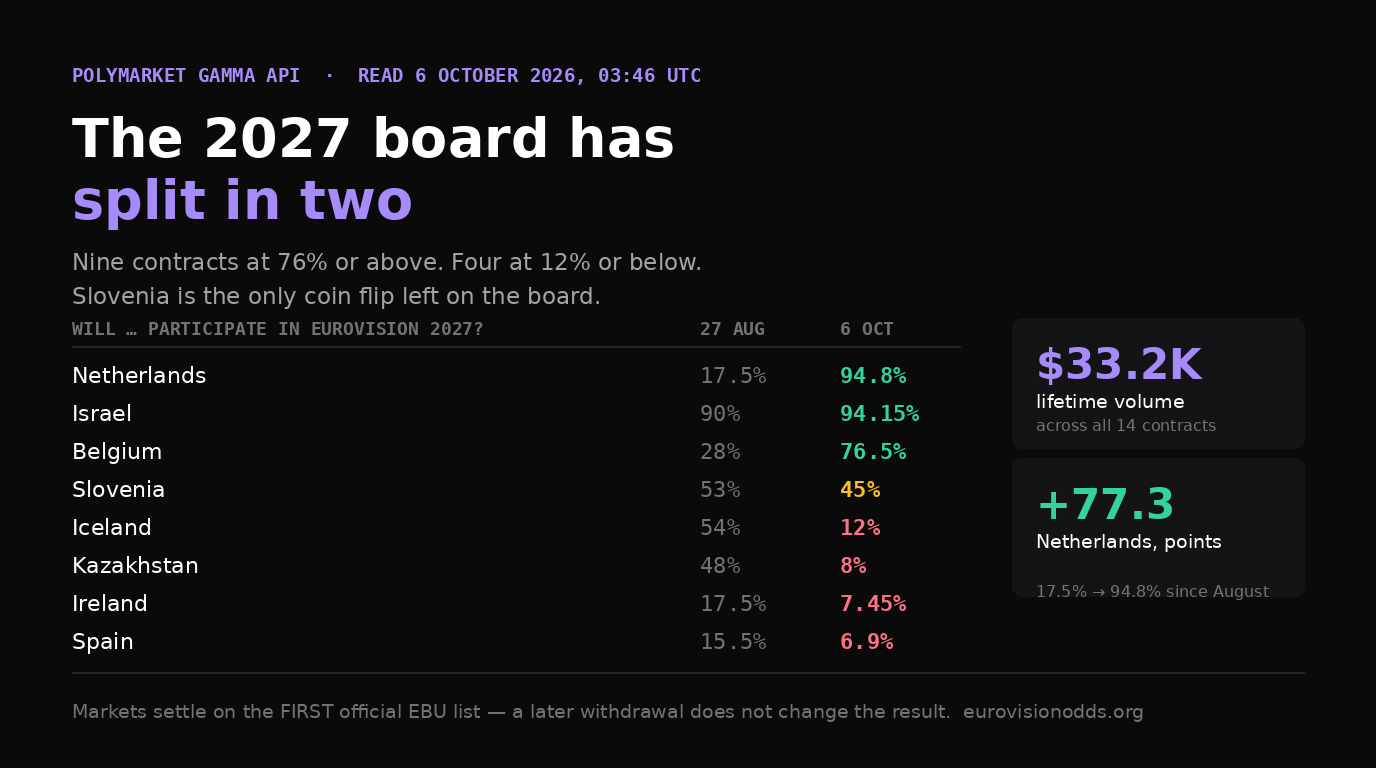
Polymarket’s Eurovision 2027 participants board has stopped being a question and started being an answer. Read on 6 October 2026, four of its fourteen contracts price a country as all but certain to be absent from Burgas — Spain at 6.9%, Ireland 7.5%, Kazakhstan 8% and Iceland 12% — while the three broadcasters that looked gone in August have been repriced back in. Six weeks ago this board was a row of coin flips. Today only Slovenia is genuinely undecided.

18+ | New customers only | T&Cs apply | Please gamble responsibly
Key takeaways
- The board has split into two blocks. Nine contracts sit at 76% or above, four sit at 12% or below, and Slovenia alone is in between at 45%.
- The Netherlands is the biggest move of the season: 17.5% on 27 August to 94.8% now, after NPO confirmed a route back without AVROTROS.
- Belgium went 28% to 76.5% and North Macedonia 52% to 79.75%. The August thesis that the 2026 boycott would widen has been traded out.
- Israel sits at 94.15%. The market is pricing no EBU reversal, which is the assumption every boycott contract on the board is implicitly built on.
- Italy is the anomaly — 97% down to 81.25% with no 2027-specific news we can find, on $710 of lifetime volume.
- The resolution language is the trap. These settle on the first official EBU list. A broadcaster that is named and then withdraws still resolves Yes.
- Still no Eurovision Asia market on Polymarket, eight weeks after we started checking. Bangkok is priced on Kalshi or nowhere.
What’s on this page
The board today · What moved since August · The four that are priced out · Slovenia, the last real question · The Italy anomaly · The resolution rule that catches people · How much money is actually here · What is happening offstage
The board today
Fourteen contracts, each asking whether that country appears on the first official Eurovision 2027 participant list. Prices read from Polymarket’s public Gamma API at 03:46 UTC on 6 October 2026, against our own stored read of 27 August.
| Country | 27 Aug | 6 Oct | Move | Volume |
|---|---|---|---|---|
| Canada | 98% | 96.4% | –1.6 | $2,957 |
| Germany | 97% | 95.5% | –1.5 | $414 |
| Netherlands | 17.5% | 94.8% | +77.3 | $8,175 |
| Israel | 90% | 94.15% | +4.2 | $2,232 |
| Austria | 84% | 92.95% | +9.0 | $278 |
| Moldova | 91% | 90.5% | –0.5 | $41 |
| Italy | 97% | 81.25% | –15.8 | $710 |
| North Macedonia | 52% | 79.75% | +27.8 | $1,031 |
| Belgium | 28% | 76.5% | +48.5 | $5,518 |
| Slovenia | 53% | 45% | –8.0 | $2,194 |
| Iceland | 54% | 12% | –42.0 | $673 |
| Kazakhstan | 48% | 8% | –40.0 | $1,492 |
| Ireland | 17.5% | 7.45% | –10.1 | $1,321 |
| Spain | 15.5% | 6.9% | –8.6 | $6,164 |
On Polymarket a price reads directly as a probability: 45¢ means the market implies 45%. There is no bookmaker overround to strip out, which is exactly why this board is worth reading even when its volumes are small.
What moved since August
In late August we described this board as a row of genuinely uncertain contracts — Iceland 54%, Slovenia 53%, North Macedonia 52%, Kazakhstan 48%. Four countries clustered within six points of a coin flip. That is now gone. Three of those four have resolved in the market’s mind, in opposite directions, and the spread of the board has roughly doubled.
The single biggest repricing is the Netherlands, from 17.5% to 94.8%. That contract was the clearest value on the board in August and we said so at the time: Dutch television had already reported that a return was being worked out, and the market was still pricing AVROTROS’s November 2025 withdrawal as if it were the last word. NPO confirmed the route back in September and the contract moved 77 points. It is also the second-most-traded book on the board, at $8,175.
Belgium’s +48.5 is the same story with a longer fuse, and North Macedonia’s +27.8 the same again. The August thesis — that the 2026 boycott would spread through 2027 — has been comprehensively traded out of this board.
The four that are priced out
Spain, Ireland, Kazakhstan and Iceland are now priced between 6.9% and 12%. At that level the market is not expressing doubt; it is expressing a view that these broadcasters have decided and that nothing between now and the EBU’s list changes it.
Iceland is the sharpest fall — 54% to 12%, a 42-point collapse. Six of nine RÚV board members backed staying out unless Israel is barred, and the market moved immediately. Worth noting against that price: on 3 October Eurovoix reported RÚV as still formally undecided, the director general having qualified the board’s vote as advisory. A 12% contract is pricing a board recommendation as if it were a decision. That is probably right. It is not certainly right, and it is the cheapest disagreement available on this board.
Spain is the most-traded of the four at $6,164 and the lowest priced at 6.9%. Kazakhstan’s fall from 48% to 8% is the quietest big move of the season; its path to 2027 was never about the boycott at all, but about associate-member eligibility, and the market appears to have concluded that door is shut.
Slovenia, the last real question
At 45%, Slovenia is the only contract on the board that is still a genuine coin flip, and it has $2,194 of volume behind it — more than Iceland, Italy and Austria combined. If you want the one contract on this board where the market is admitting it does not know, this is it.
It is also the one where the resolution rule below matters most, because RTVSLO is exactly the profile of broadcaster that could be named on a list in December and reconsider in February.
The Italy anomaly
Italy has gone from 97% to 81.25% and we cannot find the news that did it. RAI publicly backed Israel’s participation and confirmed its own entry for 2026; the pressure on it has come from a USB union petition and three board members, none of which is new and none of which is about 2027.
Look at the book rather than the price. Italy has $710 of lifetime volume against $1,111 of standing liquidity — more money sitting in the order book than has ever traded through it. A contract like that moves 16 points when one participant decides to take a position, and it is the clearest example on this board of why you read volume before you read a price. We would treat Italy’s 81% as noise until something confirms it.
The resolution rule that catches people
This is the part most people trading a boycott story get wrong. The market’s own rules say it resolves on the countries named in the first official announcement of the 2027 participant list, and that “subsequent withdrawals or adjustments will not affect the resolution”.
So these are not contracts on whether a country competes in Burgas. They are contracts on whether a country is on one specific document, expected from the EBU at the end of 2026. A broadcaster that is listed in December and withdraws in March still resolves Yes. A broadcaster that misses the list and joins late still resolves No.
That asymmetry argues for the Yes side of any contract where a broadcaster is merely wavering rather than formally out — which is precisely Slovenia’s position, and arguably Iceland’s.
How much money is actually here
The whole event carries $33,200 of lifetime volume against $10,941 of liquidity. Individual books run from Moldova’s $41 to the Netherlands’ $8,175. Four contracts — Netherlands, Spain, Belgium and Canada — account for roughly two-thirds of everything traded.
This is a real market with real settlement and no overround, and it is still small enough that a few hundred dollars moves a price. Both things are true at once. Treat the four big books as informative and Moldova’s $41 as decorative.
For comparison, the Eurovision 2026 winner market traded close to $194M on the same venue. That is the difference between a market that is pricing an event and a market that is waiting for one, and it is the main reason the fixed-odds books we track remain the better read on anything with a live contest attached.
What is happening offstage
Three things moved this week that the board has not obviously absorbed.
The Netherlands lost its Reference Group seat. On 5 October Eurovoix reported that Dutch head of delegation Claudia van der Pas is no longer a member; the wildcard that kept her there through the 2026 season expired in the summer, because the seats are for heads of delegation actively serving. Spain’s Ana María Bordas continues as chair until 2027 despite Spain’s absence. There is an obvious tension with a 94.8% Netherlands contract — the country the market is most confident about is the one that just lost its seat at the table — though the seat follows the delegation, so a confirmed return would restore it.
Hungary filed Eurovision under 2030. The summary of Hungary’s public media reform, published this week, places “return to the Eurovision Song Contest” among supplementary services to be addressed by 2030, and does not mention the EBU talks at all. The EBU has offered a reduced participation fee and extended Hungary’s application deadline to 7 December 2026. Hungary has no contract on this board, which is a gap: it is one of the few genuinely open questions left about the 2027 field.
And still nothing on Asia. Polymarket lists no Eurovision Song Contest Asia market of any kind — not a winner, not a country, not a top three. The only venue pricing the 14 November Grand Final in Bangkok is Kalshi, whose eleven-contract board currently has prices summing to 227% and no bid on ten of them.
Sources
- Prices, volumes and liquidity read from Polymarket’s Eurovision 2027 Participants event via its public Gamma API, 6 October 2026, 03:46 UTC. August figures are this site’s own stored read of 27 August 2026.
- Resolution wording quoted from the market’s published rules.
- Eurovoix, 5 October 2026 — Reference Group membership.
- Eurovoix, 5 October 2026 — Hungary’s public media reform summary.
Prediction-market prices move continuously. Every figure here is stamped with the time it was read — check the live board before acting on any of it, and see our bookmaker guide for the regulated alternatives. 18+. Markets carry risk.