
Polymarket booked over $175M of Eurovision 2026 betting volume across its outright market and its derivative books — the largest non-sports event ever priced on a prediction market, as confirmed by the New York Times in the days after the Grand Final. At the close of business on Friday 15 May, the day before Vienna, the platform was pricing 🇫🇮 Finland's Ofelia Wellbore at a 44.5% implied win probability, with $4.79M of Finnish bet volume sitting on the YES side of the outright market. Finland finished sixth with 279 points. The actual winner — Bulgaria's DARA, performing Bangaranga — was trading below 5% on Polymarket throughout most of contest week. That is the largest top-line miss any major prediction market has produced on Eurovision since the format went open in 2022.

18+ | New customers only | T&Cs apply | Please gamble responsibly
The miss in numbers
Polymarket's pre-final outright distribution on Friday 15 May 2026 had Finland as a dominant favourite, with Greece, Denmark and France clustered as runner-up plays (per the public order book screenshots circulated by @TheePopData on Instagram and Facebook). Bulgaria sat outside the top five despite its 9-televote-12s SF2 sweep the previous day. The table below contrasts the Friday closing prediction-market line against the Saturday-night result.
| Country | Polymarket pre-final probability | Final position | Final points | Delta (rank) |
|---|---|---|---|---|
| 🇫🇮 Finland — Ofelia Wellbore | 44.5% | 6th | 279 | −5 places |
| 🇬🇷 Greece | ~11% | 9th | 231 | −7 places |
| 🇩🇰 Denmark | ~9% | 8th | 241 | −5 places |
| 🇫🇷 France | ~8% | 11th | 198 | −8 places |
| 🇧🇬 Bulgaria — DARA | <5% | 1st | 516 | + winner |
| 🇮🇱 Israel — Noam Bettan | ~6% | 2nd | 343 | + podium |
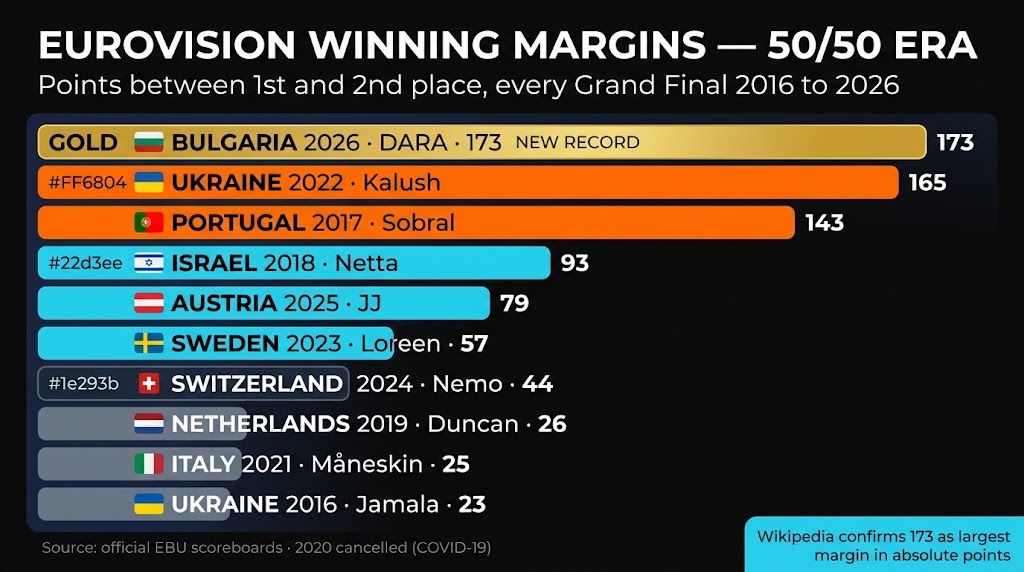
The headline figure for anyone modelling future prediction-market lines is simple: a market sitting on $4.79M of Finland exposure at 44.5% was implying nine-times-better odds than the actual sixth-place outcome warranted, and was simultaneously implying that an entry which finished first with the largest margin of the 50/50 era was less likely than each of three top-ten finishers it ultimately beat by more than 200 points combined.
How Polymarket compared to UK fixed-odds books
The miss was not unique to crypto-liquidity prediction markets. UK fixed-odds bookmakers ran the same trap in parallel — see the Finland 1/1-favourite anatomy for the full breakdown. Betfred priced Finland at 2.00 on Grand Final morning — a 50% implied probability, fractionally tighter than Polymarket's 44.5%. Bet365 and Unibet ran within a tick of each other in the 1.95-to-2.10 range.
| Country | Betfred (decimal) | Bet365 (decimal) | Unibet (decimal) | Polymarket implied % | Bookmaker avg. implied % |
|---|---|---|---|---|---|
| 🇫🇮 Finland | 2.00 | 2.10 | 1.95 | 44.5% | ≈49% |
| 🇬🇷 Greece | 9.00 | 9.50 | 8.50 | ~11% | ≈11% |
| 🇩🇰 Denmark | 11.00 | 10.00 | 11.00 | ~9% | ≈9% |
| 🇫🇷 France | 14.00 | 13.00 | 15.00 | ~8% | ≈7% |
| 🇧🇬 Bulgaria | 17.00 | 15.00 | 16.00 | <5% | ≈6% |
The two ecosystems disagreed by less than five percentage points on every top-five country. Polymarket users were not getting an information edge over high-street UK books — they were paying the same bias premium with extra liquidity stacked behind it.
Volume routed per country on Polymarket
| Country | Polymarket pre-final volume | Implied probability | Actual finish |
|---|---|---|---|
| 🇫🇮 Finland | $4.79M | 44.5% | 6th |
| 🇬🇷 Greece | ≈$1.2M | ~11% | 9th |
| 🇩🇰 Denmark | ≈$960K | ~9% | 8th |
| 🇫🇷 France | ≈$860K | ~8% | 11th |
| 🇮🇱 Israel | ≈$640K | ~6% | 2nd |
| 🇧🇬 Bulgaria | ≈$520K | <5% | 1st (516 pts) |
Total Eurovision 2026 turnover on Polymarket exceeded $175M across the outright market plus its derivative books on top-2, top-5 and margin-of-victory. Roughly $4.79M of that — almost 3% of all outright volume — was routed to a single country that placed sixth. Reddit's r/eurovision summarised the post-mortem cleanly: "The odds completely flipped to Bulgaria during the finals, (many) people saw it would win before the voting started, but there was no way to know that before." The YouTube post-mortem that crystallised the story for the wider gambling community was titled Prediction Markets Failed Spectacularly At Eurovision 2026, and circulated alongside the NYT's reporting on Polymarket's volume record.
Why prediction markets and fixed-odds books both got it wrong — the same way
The instinctive defence of a prediction market is that aggregated stake-weighted opinion converges to truth. That defence fails when the pool itself is biased — and the Eurovision pool on Polymarket is biased in three identical ways to the UK high-street book.
- Streaming-platform survivorship. Finland's Ofelia Wellbore entered Grand Final week as the most-streamed entry on Spotify, with a viral TikTok hook clip. Both Polymarket bettors and Betfred traders weighted streaming heavily because it is the easiest pre-contest signal to scrape. It has never been a reliable predictor of jury votes, and the 50/50 jury-plus-televote split means a jury collapse mathematically caps any winner.
- Geographic concentration of the bettor base. Polymarket's most active Eurovision week-of users skew Western European and North American — overlapping almost exactly with the bookmaker book. Bulgaria's televote dominance came from Greece, Romania, Cyprus, North Macedonia, Albania, Serbia, Slovenia, Switzerland and the Rest-of-the-World aggregate. Those nine pools were not where the prediction-market stakes were sitting.
- Recency bias on contest week. Finland's pre-final Polymarket price spiked from 28% to 44.5% in the final 48 hours, driven by the dress-rehearsal jury vote leak and a single viral X clip. Both signals were noise — neither survives Bulgaria's 9-televote-12s SF2 evidence when properly weighted.
The reason this matters for next year's pricing is that none of those three biases are corrected by adding more liquidity. $4.79M on Finland at 44.5% was the wrong price not because too few people were betting, but because the people betting were reading the wrong scoreboard.
What Bulgaria's SF2 signal showed that both markets ignored
On Thursday 14 May, two days before the Grand Final, Bulgaria received twelve points from eight separate competing countries plus the Rest-of-the-World online aggregate in SF2's televote — nine 12-point sets from a single show. No 50/50-era semi-final pool had ever produced that figure. The previous high was 5 competing countries plus RoW, recorded by Israel in SF1 2018 and matched by Israel in SF1 2026. That signal alone — independent of streaming, jury rehearsals, running order or social-media virality — should have repriced Bulgaria's Polymarket line into the 15–20% band by Friday 15 May. It didn't move it above 5%.
The same pools that delivered 9-televote-12s in SF2 voted again on Saturday and produced an identical ranking pattern. Bulgaria's final televote of 312 was the third-largest of the 50/50 era. The cross-pool jury vote of 204 was Bulgaria's all-time best ever at any Eurovision. Both numbers were forecastable on Friday morning. Polymarket did not forecast them. UK fixed-odds books did not forecast them. The full margin breakdown sits in the 173-point-margin record analysis.
What this repricing means for the Eurovision 2027 outright on Polymarket
Polymarket's 2027 outright market launched within days of the Vienna Grand Final, alongside two specific derivative books that traded heavily in 2026 and are likely to do so again: the 35-outcome second-place book and the seven-outcome margin-of-victory book (where Bulgaria's 173-point Vienna margin would have settled the 100+ outcome heavily in the money).
The lesson the 2027 line will need to internalise is identical to the lesson UK bookmakers will be carrying into Sofia: semi-final televote-pool dominance is the strongest single predictor of a large-margin Grand Final win in the 50/50 era. Three of the four largest winning margins in the era — Ukraine 2022, Portugal 2017, Bulgaria 2026 — were preceded by 4+RoW or better in a single semi-final televote pool. The 2027 outright should reprice any entry above 5+RoW in semi-final pool dominance into single-figure odds within hours of the SF result. Whether Polymarket's liquidity converges to that signal faster than UK books is the open question for next May. On 2026 evidence, it did not.
For UK bettors specifically — Polymarket is geo-restricted by the FCA, so UK-resident traders will not be touching its 2027 outright directly. The cleanest UK route to translate the same edge is to take the post-SF semi-final televote-pool data, apply it to Betfred's 2027 outright price within minutes of the SF2 scoreboard, and bet ahead of the second wave of price compression. Betfred priced Bulgaria from 17.00 on Grand Final morning to settle on a winning ticket worth 17× stake — a £10 bet returning £170. The same trade after SF2 at the 25.00 pre-SF price returned £250.
Betfred — Bet £10 Get £50 in Free Bets on Eurovision 2027
How to trade Polymarket if you're new to prediction markets
Polymarket is a USDC-settled decentralised order-book exchange. Each outcome trades as a YES/NO contract priced between $0.00 and $1.00 — the price is the implied probability. A YES contract bought at $0.05 (5% implied) pays $1.00 if the outcome resolves true, returning 20× stake. A YES contract bought at $0.445 (44.5% implied, the Finland line) pays $1.00 if true, returning 2.25× stake. There is no bookmaker margin or overround — the YES + NO prices sum to $1.00 by construction, which is why Polymarket lines often look fractionally sharper than fixed-odds books on liquid markets, and why the 2026 Eurovision miss is structurally interesting rather than dismissible as bookmaker greed.
- Wallet: fund via USDC on Polygon. Eurovision markets typically clear in seven days from Grand Final settlement.
- Order book vs market order: Eurovision outright has thin depth below 5% — limit orders fill better than market orders on long-shot YES contracts.
- Derivative books: the second-place and margin-of-victory books often have wider spreads than the outright. A trader confident in Bulgaria's televote signal but unsure of the jury could have hedged a Bulgaria YES on the outright against a 100+ YES on the margin-of-victory book.
- Settlement risk: Polymarket resolves Eurovision markets against the official EBU scoreboard. The 2026 outright settled within 6 hours of the Vienna scoreboard going public.
For the longer-term outright play, the Polymarket Eurovision 2027 winner book is live now, and the same structural edges that produced the Bulgaria mispricing in 2026 are visible in its early pricing. The cleanest tradeable signal in the 50/50 era remains semi-final televote-pool dominance — and that signal does not become visible until the SF2 result on the Thursday of contest week.
Related
- Grand Final recap — Bulgaria 516, Israel 343
- The 173-point margin record — every winning spread since 2016 ranked
- Finland 1/1-favourite-to-sixth — the UK bookmaker side of the same miss
- DARA's 9-televote-12s SF2 sweep — the pool signal Polymarket missed
- Eurovision 2027 — Sofia outright market and odds tracker
18+. Please gamble responsibly. BeGambleAware.org. GAMSTOP. When the fun stops, stop.